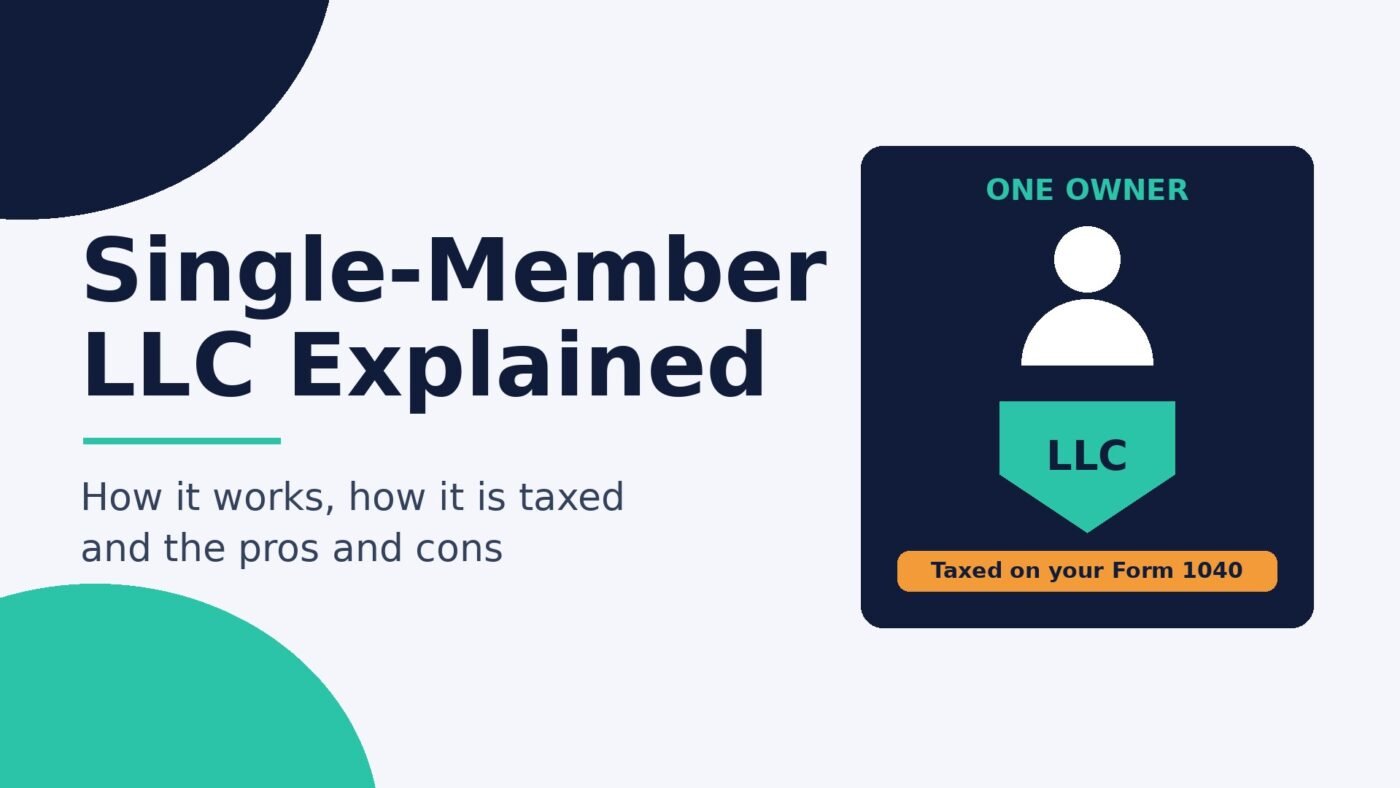
A single-member LLC is a limited liability company with one owner. Under state law it’s a separate legal entity, so it generally keeps your personal assets apart from business debts and lawsuits. For federal income tax, the IRS ignores it by default: it’s a “disregarded entity,” so you report the profit on your own Form 1040 (usually Schedule C) and pay self-employment tax just like a sole proprietor. You can change that by electing to be taxed as an S corporation or C corporation.
Most side hustlers and solo founders who form an LLC end up with this setup. It’s popular because it adds legal separation without adding a separate federal income tax return. But “disregarded” doesn’t mean the IRS ignores it for everything, and a few rules (EINs, W-9s, payroll, married owners) catch people out. This guide covers how a single-member LLC works, how it’s taxed, how it compares with a sole proprietorship and a multi-member LLC, and how to set one up. Every tax rule links to the IRS or state page it comes from.
Single-member LLC at a glance
| Single-member LLC (default tax treatment) | |
|---|---|
| Owners | One member (a person, or another company) |
| Created by | Filing formation documents with a state |
| Legal status | Separate entity from the owner |
| Federal income tax status | Disregarded entity (no separate income tax return) |
| Where profit is reported | Owner’s Form 1040: Schedule C, E or F |
| Self-employment tax | Yes, same as a sole proprietor |
| Payroll and certain excise taxes | Treated as a separate entity, using the LLC’s own name and EIN |
| Can change tax treatment? | Yes: elect C corp (Form 8832) or S corp (Form 2553) |
Source for the tax rows: the IRS page on single member limited liability companies.
How a single-member LLC works
An LLC is created under state law, not federal law. The IRS notes that most states also permit “single-member” LLCs, those having only one owner, and that a few types of businesses, such as banks and insurance companies, generally can’t be LLCs. The owner is called a member. Since a member can be a person or another business, a single-member LLC can be owned by you personally or by another company you own.
The single-member LLC has two identities, and keeping them apart makes everything else easier to follow:
- Legally, it’s separate from you. The LLC can sign contracts, open a bank account and own property in its own name. The SBA says an LLC protects you from personal liability in most instances, so your vehicle, house and savings generally aren’t at risk if the LLC faces bankruptcy or lawsuits.
- For federal income tax, it usually isn’t separate. The IRS says a one-member LLC is treated as an entity disregarded as separate from its owner unless it elects to be treated as a corporation. The business’s income and expenses flow straight onto your personal return.
That split explains why people say a single-member LLC gets the legal protection of a company with the tax simplicity of a sole proprietorship.
How a single-member LLC is taxed
Default: taxed like a sole proprietorship
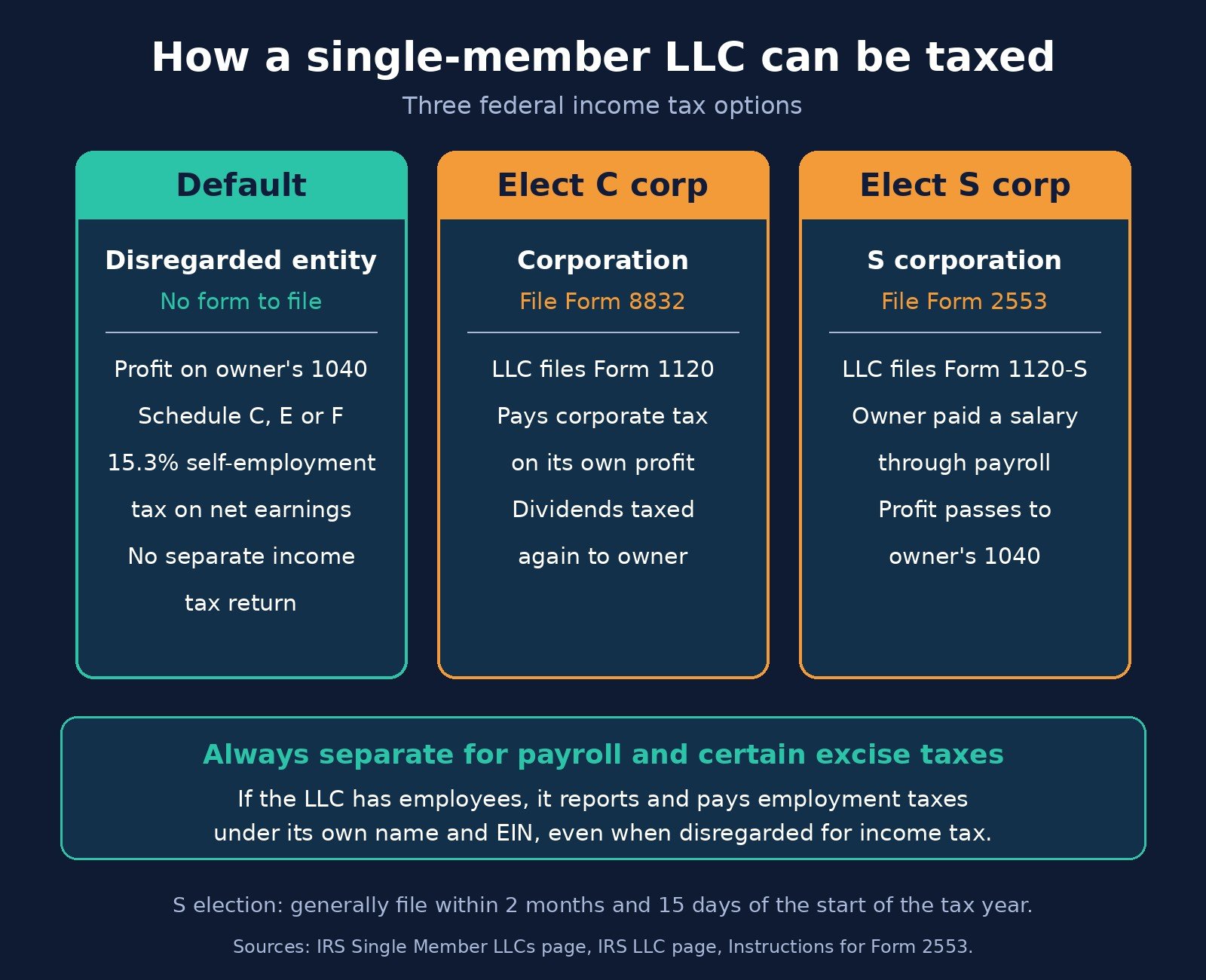
If you do nothing, the IRS says the LLC’s activities should be reflected on its owner’s federal tax return. For an individual owner that usually means:
- Schedule C (Profit or Loss from Business) for most service and product businesses
- Schedule E (Supplemental Income or Loss), for example for rental property held in an LLC
- Schedule F (Profit or Loss from Farming) for farms
The LLC itself files no federal income tax return. If a corporation or partnership owns the LLC, the IRS says it is reported as a division of that owner instead.
Self-employment tax still applies. The IRS says the individual owner of a single-member LLC that runs a trade or business is subject to self-employment tax in the same manner as a sole proprietorship. The self-employment tax rate is 15.3%: 12.4% for Social Security and 2.9% for Medicare. For 2026, the Social Security part applies to the first $184,500 of combined wages, tips and net earnings, and you must file Schedule SE once your net earnings from self-employment reach $400. You can deduct the employer-equivalent half of the tax when figuring adjusted gross income.
Because the profit is reported as business income on your return, you may also qualify for the qualified business income deduction. The IRS describes it as up to 20 percent of QBI for eligible owners of sole proprietorships and other pass-through businesses, subject to income-based limits. No tax is withheld from business profit, so most owners pay quarterly estimated taxes.
The exception: payroll and certain excise taxes
This is the part most guides skip. Since federal regulations took effect for employment taxes in 2009, a single-member LLC is treated as a separate entity for purposes of employment tax and certain excise taxes. In practice:
- If the LLC hires employees, it reports and pays payroll taxes under the LLC’s own name and EIN, not yours.
- If the business owes certain federal excise taxes, the LLC uses its own name and EIN on the related forms (the IRS lists Forms 637, 720, 730, 2290, 11-C and 8849).
Everything else about your income tax stays on your personal return.
Optional: elect S corp or C corp taxation
A single-member LLC doesn’t have to stay disregarded. It has two other options:
- C corporation. File Form 8832, Entity Classification Election. The IRS says an election generally can’t take effect more than 75 days before the date it’s filed or more than 12 months after. The LLC then pays corporate income tax on its own profit, and dividends you take out are taxed again. Our LLC vs corporation guide covers that double-tax trade-off.
- S corporation. File Form 2553. The IRS instructions say an entity eligible to elect corporate treatment that makes a valid S election doesn’t need to file Form 8832. To take effect for a tax year, the election generally has to be filed no more than 2 months and 15 days after the beginning of the tax year (or at any time in the year before). You then become an employee of your LLC, pay yourself a reasonable salary through payroll, and the LLC files Form 1120-S.
The S corp route is usually discussed as a way to reduce self-employment tax once profits are steady, but it adds payroll, a separate return and more bookkeeping. We compare the numbers and the paperwork in LLC vs S corp. Talk to a tax professional before electing, because switching back has its own rules.
EINs and W-9s for a single-member LLC
The tax ID rules follow the “disregarded except for payroll and excise” logic:
- On a W-9, use the owner’s number. The IRS says that if a disregarded single-member LLC owned by an individual is asked for a Form W-9, it should provide the owner’s SSN or EIN, not the LLC’s EIN.
- You need an LLC EIN if you have employees or excise tax filings. A disregarded single-member LLC with no employees and no excise tax liability does not need an EIN for federal tax.
- You can still get one for banking or state needs. The same IRS page says the LLC can apply for an EIN if it needs one to open a bank account or if state tax law requires it. In reality, many banks ask for one, so most owners get it. It’s free and takes minutes. See how to apply for an EIN online.
- Converting from a sole proprietorship? The IRS says you don’t need a new EIN if you use your sole proprietor EIN for your single-member LLC and don’t elect corporate or S corp taxation, have no employees and don’t owe excise tax.
Single-member LLC vs sole proprietorship
For federal income tax, a default single-member LLC and a sole proprietorship look nearly identical: same Schedule C, same self-employment tax. The differences are legal and administrative:
- Liability: a sole proprietorship does not produce a separate business entity, so you’re personally liable for business debts. An LLC is a separate entity that generally shields personal assets.
- Setup and upkeep: a sole proprietorship exists automatically once you start doing business. An LLC requires a state filing, a registered agent, and usually annual reports and fees. Some states charge a lot: California requires every LLC doing business or organized there to pay an annual tax of $800, even if it isn’t conducting business.
- Tax flexibility: a sole proprietorship can’t elect S corp status. An LLC can.
For a full side-by-side and help deciding, read sole proprietorship vs LLC.
Single-member vs multi-member LLC
Add a second owner and the default tax treatment changes. The IRS says a domestic LLC with at least two members is classified as a partnership for federal income tax unless it elects corporate treatment.
| Single-member LLC | Multi-member LLC | |
|---|---|---|
| Owners | One | Two or more (no maximum) |
| Default federal tax status | Disregarded entity | Partnership |
| Business tax return | None by default (owner’s Schedule C, E or F) | Form 1065 information return |
| How owners report profit | Directly on their 1040 | From a Schedule K-1 issued to each member |
| Can elect S corp or C corp? | Yes | Yes |
| Operating agreement | Strongly recommended | Essential (ownership splits, votes, buyouts) |
Sources: IRS pages on LLCs and partnerships. A partnership must file an annual information return but doesn’t pay income tax itself; it passes profit and loss through to the partners.
If you later bring in a partner, your LLC’s tax classification changes from disregarded entity to partnership, which brings a separate return and usually a new EIN. Plan the change with an accountant, and update your operating agreement before money changes hands.
Can a married couple own a single-member LLC?
Usually not in a tax sense: two spouses are two members. The IRS rules depend on where you live:
- Community property states: if the LLC is wholly owned by spouses as community property, the IRS will accept the position that it’s a disregarded entity, or that it’s a partnership, depending on how the couple treats it (Rev. Proc. 2002-69). Switching between the two later counts as a conversion.
- Other states: the IRS says an LLC owned by spouses in a non-community property state should file as a partnership.
- The qualified joint venture option doesn’t apply to LLCs. Married co-owners of an unincorporated business can elect to be a qualified joint venture and skip partnership returns, but the IRS says a business owned and operated by the spouses through a limited liability company does not qualify.
If only one spouse owns the LLC, it’s a single-member LLC like any other.
Pros and cons of a single-member LLC
Pros
- Liability protection for personal assets in most situations, as long as you run the LLC as a separate business
- Simple default taxes: no separate federal income tax return
- Tax flexibility: you can elect S corp or C corp treatment later without forming a new company
- Credibility: contracts, invoices and bank accounts in a business name; some platforms, like the Apple and Google developer programs, require a legal entity for organization accounts (see what is a DUNS number)
- Few formalities: no board or shareholder meetings like a corporation
Cons
- State fees and filings: formation fees, annual reports and, in some states, annual taxes (California’s $800 is the best-known example)
- No self-employment tax savings by default: you pay the same 15.3% as a sole proprietor unless you elect S corp status
- Protection isn’t automatic: mixing personal and business money or ignoring the LLC’s separate identity can put the shield at risk
- Extra steps if you hire: payroll runs under the LLC’s own EIN
How to set up a single-member LLC
- Choose a state and a name. Most people form in the state where they live and work. Check that the name is available with your state’s business filing office. If you’ll trade under a different name, see DBA vs LLC.
- Appoint a registered agent. This is the person or company that receives legal papers for the LLC at a physical address in the state.
- File articles of organization (some states use a different name, such as a certificate of formation) and pay the state fee. Our how to start an LLC guide lists state costs.
- Sign an operating agreement. Even with one owner, a written agreement documents that the LLC is a separate business, sets out what happens if you die or become incapacitated, and is often requested by banks. See LLC operating agreement.
- Get an EIN if you’ll have employees, owe excise taxes, or your bank or state asks for one.
- Open a business bank account and run all business income and expenses through it.
- Handle state and local registrations: sales tax permits, business licenses and any state tax accounts.
One filing you can likely skip: FinCEN’s beneficial ownership report. Under a final rule effective August 14, 2026, U.S. companies are exempt from the Beneficial Ownership Information (BOI) reporting requirements. Be wary of letters or emails demanding payment for “BOI filing.”
How to keep your liability protection
An LLC’s shield works best when the LLC clearly acts like a separate business. With one owner, the line between you and the company is easy to blur, so be disciplined about it:
- Keep business money in a business account. Don’t pay personal bills from it or deposit client payments into a personal account.
- Sign contracts and invoices in the LLC’s name, with your title (for example “Member”), not just your personal name.
- Keep the LLC in good standing: file annual reports, pay state fees and keep your registered agent current.
- Keep records: the operating agreement, major decisions and clean books. Our cash vs accrual accounting guide covers the bookkeeping basics.
- Get business insurance. The LLC protects your personal assets from business claims, but it doesn’t protect the business itself, and you can still be personally liable for your own negligence or for loans you personally guarantee.
State laws on LLC liability differ, so if you have significant assets or a higher-risk business, a short consultation with a business attorney in your state is worth it.
Single-member LLC: frequently asked questions
What is a single-member LLC?
A single-member LLC is a limited liability company with one owner, called a member. It’s a separate legal entity under state law, which generally protects the owner’s personal assets from business debts. For federal income tax, the IRS treats it as a disregarded entity by default, so profit goes on the owner’s personal return.
How is a single-member LLC taxed?
By default, like a sole proprietorship. The owner reports business income and expenses on Schedule C (or Schedule E or F) of Form 1040 and pays 15.3% self-employment tax on net earnings. The LLC can instead elect to be taxed as a C corporation with Form 8832 or as an S corporation with Form 2553.
What does “disregarded entity” mean?
A disregarded entity is a business the IRS doesn’t treat as separate from its owner for federal income tax. A single-member LLC is disregarded by default, so it files no income tax return of its own. It is still treated as separate for payroll taxes and certain excise taxes, and it remains a separate legal entity under state law.
Does a single-member LLC need an EIN?
Only if it has employees or must file certain excise tax returns. Otherwise the IRS says it can use the owner’s SSN or EIN for federal tax. Many owners get an LLC EIN anyway because banks or state tax agencies ask for one, and it’s free from the IRS.
Do I put my SSN or the LLC’s EIN on a W-9?
For a disregarded single-member LLC owned by an individual, the IRS says the W-9 should show the owner’s SSN or EIN, not the LLC’s EIN. That’s because the LLC’s income is reported on the owner’s return. If the LLC has elected to be taxed as a corporation, it uses its own EIN.
Is a single-member LLC better than a sole proprietorship?
It’s better if you want liability protection, plan to sign contracts or hire, or may elect S corp status later. A sole proprietorship is cheaper and simpler for low-risk side hustles. Federal income taxes are the same by default, so the decision mostly comes down to risk and state fees.
Can a single-member LLC have employees?
Yes. A single-member LLC can hire employees, but it then needs its own EIN and must report and pay employment taxes under the LLC’s name and EIN. The owner of a default single-member LLC isn’t an employee and doesn’t receive a W-2 from it.
The bottom line
A single-member LLC gives one owner a separate legal entity for liability purposes while, by default, keeping federal taxes on the owner’s personal return. You still pay self-employment tax, payroll and certain excise taxes use the LLC’s own EIN, and spouses or a second owner usually turn it into a partnership. Form it in your state, sign an operating agreement, keep business money separate, and revisit the S corp election once your profit is steady.

The Teck Hustlers Editorial Team covers technology, business, finance and gaming news for readers who want the story behind the headline. Every article is researched, written and edited by our in-house team, checked against company announcements, filings and reputable reporting, and updated when new facts emerge. We focus on what each development means for founders, professionals, investors and everyday users. Have a tip or a correction? Reach us through our contact page.