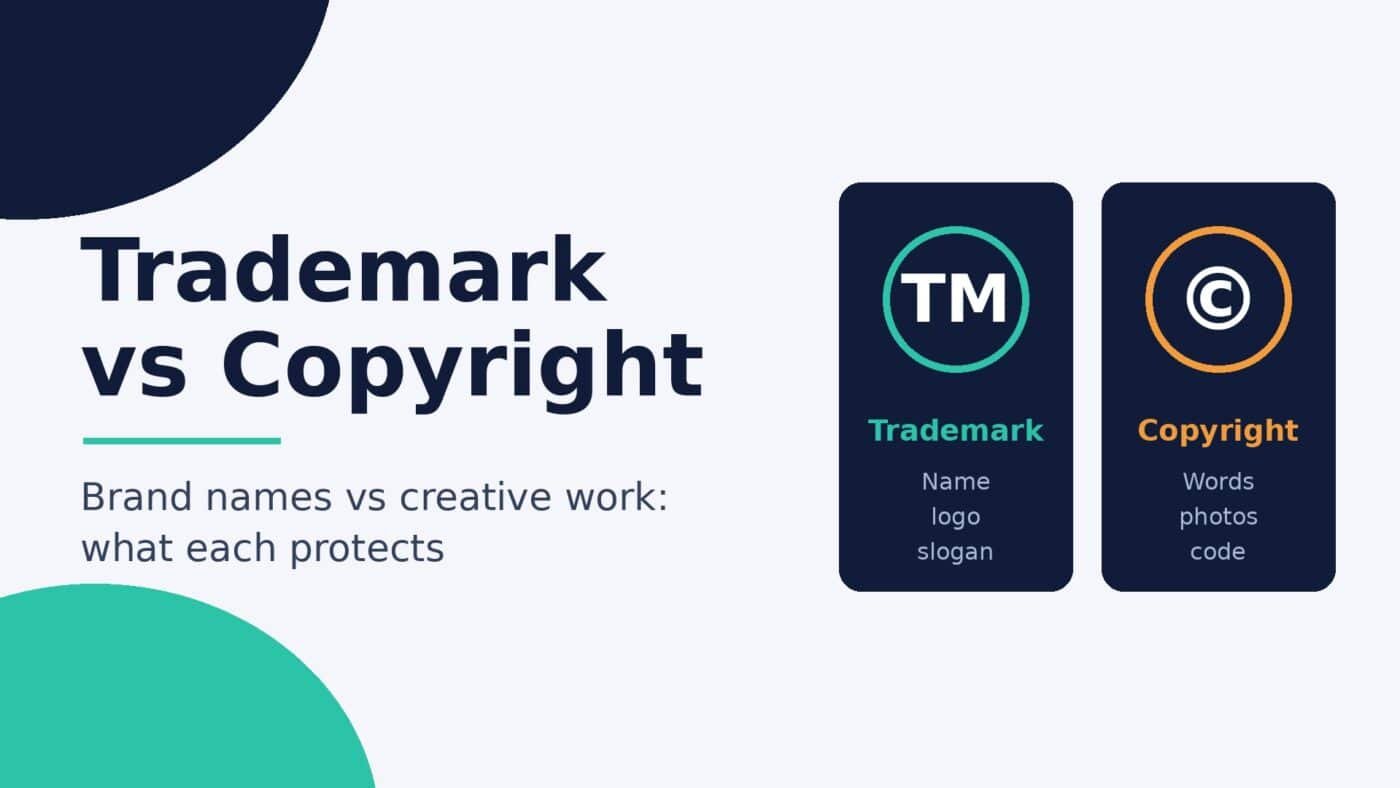
A trademark protects the things that identify your business to customers, such as your brand name, logo and slogan. A copyright protects original creative work, such as your website copy, photos, videos, designs and code. Trademarks are registered with the U.S. Patent and Trademark Office (USPTO) and can last as long as you keep using the mark and filing maintenance paperwork. Copyright exists automatically once a work is created and fixed, is registered (optionally) with the U.S. Copyright Office, and usually lasts for the author’s life plus 70 years.
Most small businesses need both kinds of protection at some point, but for different assets. A trademark won’t stop someone from copying your blog posts, and a copyright won’t stop a competitor from opening a shop under your name. This guide explains what each one covers, which of your business assets falls under which, what registration costs today, and the mistakes that trip up new owners. Every fee and time limit links to the official USPTO or Copyright Office page it comes from.
Trademark vs copyright at a glance
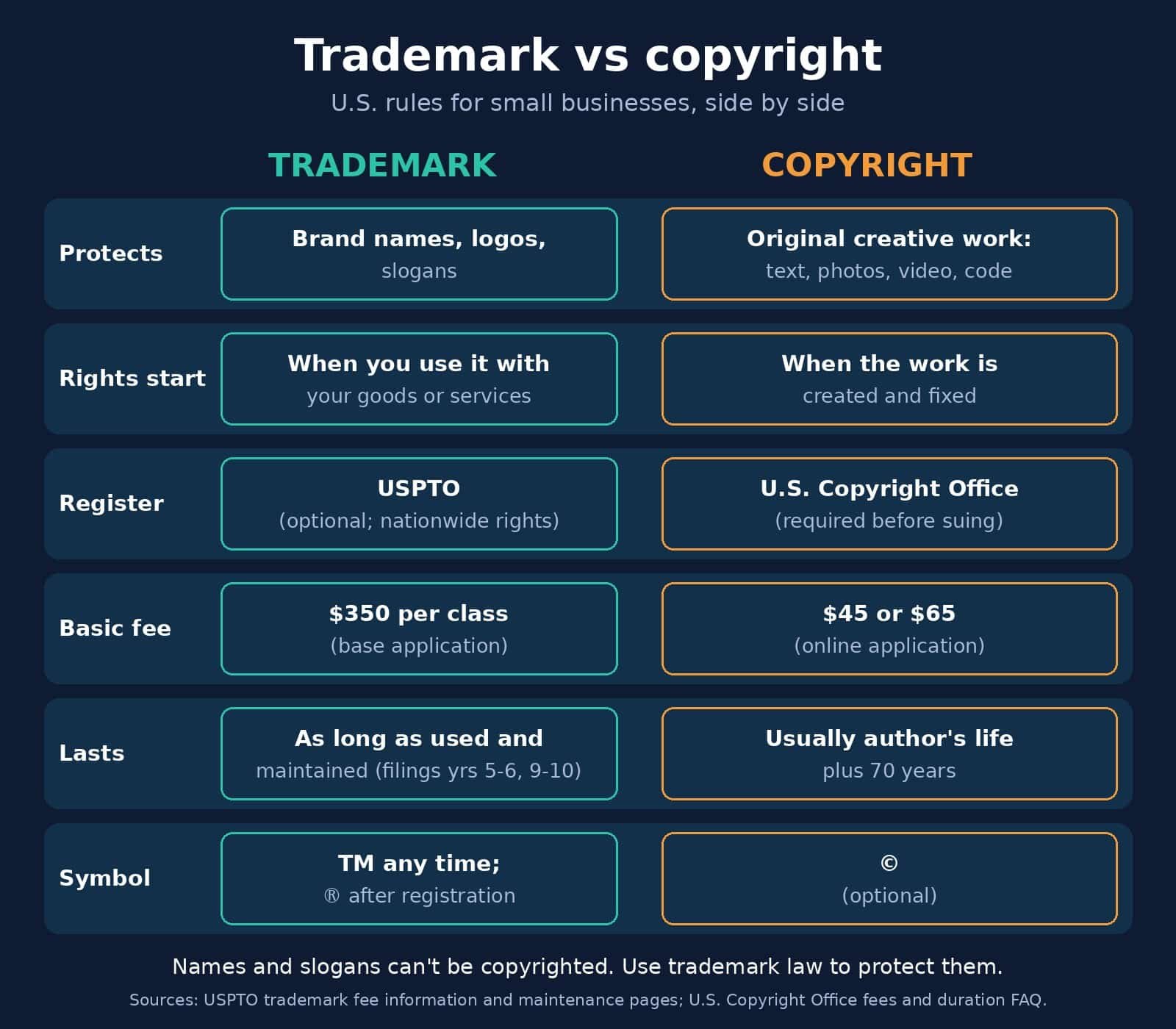
| Trademark | Copyright | |
|---|---|---|
| Protects | Words, phrases, symbols or designs that identify the source of goods or services | Original creative works fixed in a tangible form |
| Business examples | Business or product name, logo, slogan | Website text, blog posts, photos, videos, graphics, software code |
| Rights start when | You start using the mark with your goods or services | The work is created and fixed (written down, saved, recorded) |
| Federal registration with | USPTO | U.S. Copyright Office (Library of Congress) |
| Registration required? | No, but it gives nationwide rights | No, but U.S. works must be registered before you can sue |
| Basic federal filing fee | $350 per class of goods or services | $45 or $65 per online application |
| How long it lasts | As long as you use it and file maintenance documents | Usually the author’s life plus 70 years |
| Symbol | ™ or ℠ any time; ® only after federal registration | © (optional) |
Sources for the table: USPTO Trademark, patent, or copyright, USPTO What is a trademark?, USPTO Trademark fee information, U.S. Copyright Office What is Copyright? and Fees.
What a trademark protects
The USPTO defines a trademark as any word, phrase, symbol, design, or a combination of these things that identifies your goods or services. Its job is to tell customers who is behind a product. When someone sees a name or logo on a box or a website, the trademark is what lets them trust it came from you and not a copycat.
Technically, a mark used for products is a trademark and a mark used for services is a service mark, but “trademark” is commonly used for both.
The key limit: a trademark doesn’t give you ownership of a word. The USPTO puts it plainly: you don’t have rights to the word or phrase in general, only to how that word or phrase is used with your specific goods or services. A woodworking business with a logo can’t stop someone from using a similar logo in an unrelated field. That’s why trademark applications are filed for specific classes of goods and services.
Rights from use vs federal registration
You don’t have to register anything to have a trademark. The USPTO says you become a trademark owner as soon as you start using your trademark with your goods or services. Those use-based rights are limited to the geographic area where you actually do business. Federal registration creates nationwide rights in your mark for the goods or services listed.
That difference matters as you grow. A bakery known locally under a name may have rights in its own town, but if it starts shipping nationwide, an unregistered mark gives it far less to work with if someone else is already using a similar name elsewhere.
TM vs ®: which symbol can you use?
- ™ or ℠: You can use “TM” for goods or “SM” for services even if you haven’t filed an application. It simply tells people you claim the mark.
- ®: Only after the USPTO registers your mark, and only for the goods or services listed in the registration.
What a copyright protects
The U.S. Copyright Office says copyright protects original works of authorship as soon as an author fixes the work in a tangible form of expression. Two conditions do the work here:
- Original: independently created by a human author with at least a minimal degree of creativity.
- Fixed: captured in a lasting form, such as written down, saved to a file or recorded.
For a business, that covers a lot: website copy, blog posts, product descriptions, photos, videos, illustrations, course materials, podcasts, music and software code. The moment you save that blog post draft, it’s protected. You don’t need to register it or put a © on it for the copyright to exist.
Copyright gives the owner exclusive rights to reproduce the work, prepare derivative works, distribute copies, and perform or display the work publicly, plus the right to license those rights to others. Those rights have limits, including fair use.
What copyright doesn’t cover
This is where most confusion comes from. The Copyright Office lists things that aren’t protected, including titles, names, short phrases, and slogans; familiar symbols or designs, and it says copyright protects expression, never ideas, procedures, methods, systems or concepts. Its FAQ adds that names, titles, slogans and short phrases may be protected as trademarks in some cases.
So you can’t “copyright your business name.” If you want to protect a name or slogan, trademark law is the tool. And you can’t copyright a business idea; you can only protect the specific way you’ve written, drawn or coded it.
Which one covers your business assets?
Here’s how the two apply to things a typical small business or side hustle owns:
| Asset | Trademark? | Copyright? |
|---|---|---|
| Business name | Yes, if used to identify your goods or services | No (names aren’t copyrightable) |
| Product or app name | Yes | No |
| Slogan or tagline | Yes, if it identifies your brand | No (short phrases aren’t copyrightable) |
| Logo | Yes | Possibly, if the design has enough original artwork |
| Website copy and blog posts | No | Yes |
| Product photos and videos | No | Yes |
| Software or app code | No | Yes |
| E-book, course or template you sell | The product name, yes | The content, yes |
| Business idea or method | No | No (ideas and methods aren’t covered) |
| Domain name | Not by registering it alone | No |
Can something be protected by both?
Yes, and a logo is the classic example. The logo as a brand identifier is a trademark question: can customers tell your products apart from a competitor’s? The artwork itself can be a copyright question: is the design original enough to be a creative work? A simple wordmark in a standard font, or a familiar shape, usually won’t qualify for copyright, because the Copyright Office excludes mere variations of typographic ornamentation, lettering, or coloring. A detailed illustrated mascot is more likely to.
A product can carry both, too. A book has a copyrighted text and may be sold under a trademarked series name. An app has copyrighted code and a trademarked name and icon.
How much does it cost to register a trademark vs a copyright?
Trademark fees (USPTO)
The USPTO changed its trademark fees on January 18, 2025, replacing the old TEAS Plus and TEAS Standard options with one base application fee plus extra fees for incomplete or custom applications. Under the current structure:
- Base application: $350 per class of goods or services if the application meets the requirements. The USPTO’s own example: a clothing line in one class costs $350, but adding custom T-shirt printing services (a second class) makes it $700.
- Extra fees per class: $100 for insufficient information, $200 for typing your own description in the free-form text box instead of picking from the USPTO’s ID Manual, and $200 for each additional 1,000 characters of free-form text.
- If you file before you start selling (intent to use): later you’ll pay $150 per class to file a statement of use or amendment to allege use, and $125 per class for each extension request.
The cheapest path is to choose your goods and services descriptions from the USPTO’s ID Manual and fill in every required field. Filing yourself is allowed: the USPTO says applicants domiciled in the U.S. aren’t required to hire an attorney, though it strongly encourages using a trademark attorney. Applicants domiciled outside the U.S. must be represented by a U.S.-licensed attorney. Fees are set by the USPTO and change periodically, so check the current USPTO fee schedule before filing.
Copyright fees (U.S. Copyright Office)
Copyright registration is much cheaper. For online filing, the Copyright Office charges $45 for a single author, same claimant, one work, not for hire and $65 for a standard application. A paper application costs $125. There are also group options for things like photos and short online works, listed on the same fee page.
Registration isn’t required for copyright to exist, but it’s what unlocks enforcement. For U.S. works, the Copyright Office says registration is necessary to enforce the exclusive rights of copyright through litigation. Timing matters too: under Circular 1, if you register before infringement or within three months after publication, you can be eligible for statutory damages and attorneys’ fees. Registering within five years of publication also makes the certificate prima facie evidence that your copyright is valid.
How long does a trademark vs a copyright last?
Trademarks: as long as you keep using them
A federal trademark registration doesn’t have a fixed end date, but it isn’t automatic either. The USPTO requires these maintenance filings:
- Between the 5th and 6th years after registration: a Section 8 declaration of use
- Between the 9th and 10th years: a combined declaration of use and renewal under Sections 8 and 9
- Every 10 years after that: another combined Sections 8 and 9 filing
There’s a six-month grace period after each deadline for an extra fee; miss that and the registration is canceled or expires. Current fees are $325 per class for the five-year declaration and $650 per class for the combined 10-year renewal and declaration. The Section 8 filing is a declaration that you’re still using the mark (or have an excusable reason for not using it), so a brand you’ve abandoned can’t be kept registered just by paying fees.
Copyright: usually life plus 70 years
For works created on or after January 1, 1978, copyright generally lasts for the life of the author plus an additional 70 years. For works made for hire and anonymous or pseudonymous works, it lasts 95 years from first publication or 120 years from creation, whichever expires first. No renewal is needed for works created since 1978. After the term ends, the work enters the public domain and anyone can use it.
Common trademark and copyright mistakes small businesses make
Assuming your LLC, DBA or domain gives you trademark rights
Forming an LLC, filing a DBA or buying a domain doesn’t give you a trademark. The USPTO says registering a domain name with a domain name registrar doesn’t give you any trademark rights, and that using a business name doesn’t necessarily count as trademark use either. A state accepting your LLC name generally just means the name is available on that state’s business register; it says nothing about trademarks in other states or at the federal level. If you’re choosing a name, run the checks in our guide on how to find out if a business name is taken, including a search of the USPTO’s trademark search system. For the entity side, see DBA vs LLC and how to start an LLC.
Not owning the logo or content you paid for
If a freelancer designs your logo or writes your website, the default author is the freelancer, not you. The Copyright Office explains that works created by an employee within the scope of employment are owned by the employer, but the work-made-for-hire rule only applies to certain independent contractor relationships and types of commissioned works. Ownership can also move through a written assignment. The practical fix: put a clause in your contract that transfers the copyright to your business. That’s especially important if you plan to trademark the logo. Our 1099 vs W-2 guide covers the contractor vs employee distinction for tax purposes.
Picking a descriptive name
The USPTO warns that creative and unique trademarks are more effective and easier to protect than names that just describe what you sell. It also says it will refuse to register a mark that is generic or functional for your goods or services, or one that’s similar to a mark someone else already claims for related goods or services. A name like “Best Plumbing Services” is hard to protect; an invented or unexpected word is easier.
Falling for official-looking notices
Once your application or registration is public, expect mail from private companies offering “registration” or “monitoring” for a fee. The USPTO says many of these unsolicited mailings are fraudulent and that official USPTO email comes only from the “@uspto.gov” domain. Pay fees only through the USPTO or Copyright Office websites.
Where do patents fit?
Patents are the third main type of intellectual property, and they cover inventions, not brands or creative works. The USPTO describes patents as protecting technical inventions such as new mechanical processes, machine designs or chemical compositions. The USPTO grants patents and registers trademarks, while the U.S. Copyright Office registers copyrights. Most service businesses, creators and side hustlers deal with trademarks and copyrights far more often than patents.
Trademark vs copyright: frequently asked questions
What is the main difference between a trademark and a copyright?
A trademark protects brand identifiers, such as a business name, logo or slogan, that tell customers who a product or service comes from. A copyright protects original creative works, such as writing, photos, music, videos and code. Trademarks are registered with the USPTO; copyrights are registered with the U.S. Copyright Office.
Should I trademark or copyright my business name?
Trademark it, if you register anything. Copyright doesn’t protect names, titles, slogans or short phrases. You get some trademark rights just by using a name for your goods or services, and a federal registration with the USPTO gives you nationwide rights for the goods or services you list.
Can a logo be copyrighted and trademarked?
Yes. A logo used to identify your brand can be registered as a trademark, and if the design has enough original artwork, it can also be protected by copyright. Simple lettering, standard fonts or familiar shapes usually don’t qualify for copyright, but they can still work as trademarks.
How much does it cost to trademark a name?
The USPTO’s base application fee is $350 per class of goods or services, effective since January 18, 2025. Extra per-class fees apply for incomplete applications ($100) or custom descriptions of goods and services ($200 and up). Intent-to-use filers pay another $150 per class later to show use.
How much does it cost to register a copyright?
Online, the U.S. Copyright Office charges $45 for a single author registering one work that isn’t made for hire, and $65 for a standard application. Paper applications cost $125. Copyright exists without registration, but U.S. owners must register before suing for infringement.
How long does a trademark last?
A trademark can last indefinitely as long as you keep using it. A federal registration stays alive only if you file a declaration of use between years 5 and 6, a renewal between years 9 and 10, and another renewal every 10 years after that.
How long does a copyright last?
For works created since 1978, copyright usually lasts for the author’s life plus 70 years. Works made for hire and anonymous or pseudonymous works last 95 years from publication or 120 years from creation, whichever ends first. No renewal is required.
The bottom line
Use trademarks to protect how customers recognize you: your business name, product names, logo and slogan. Use copyright to protect what you create: your website, content, photos, designs and code. Copyright is automatic and cheap to register; a federal trademark costs more, starting at $350 per class, but it’s the only way to get nationwide rights in your brand. Before you spend money on either, search the USPTO database for conflicts, make sure you actually own the work your contractors created, and file only through the official USPTO and Copyright Office sites. Once your name is settled, the next setup steps are usually your entity and IDs, such as an EIN and, if a supplier or app store asks, a DUNS number.
This article is general information, not legal advice. Trademark and copyright questions often depend on specific facts, so consider talking to a licensed intellectual property attorney before filing or taking action against someone.

The Teck Hustlers Editorial Team covers technology, business, finance and gaming news for readers who want the story behind the headline. Every article is researched, written and edited by our in-house team, checked against company announcements, filings and reputable reporting, and updated when new facts emerge. We focus on what each development means for founders, professionals, investors and everyday users. Have a tip or a correction? Reach us through our contact page.