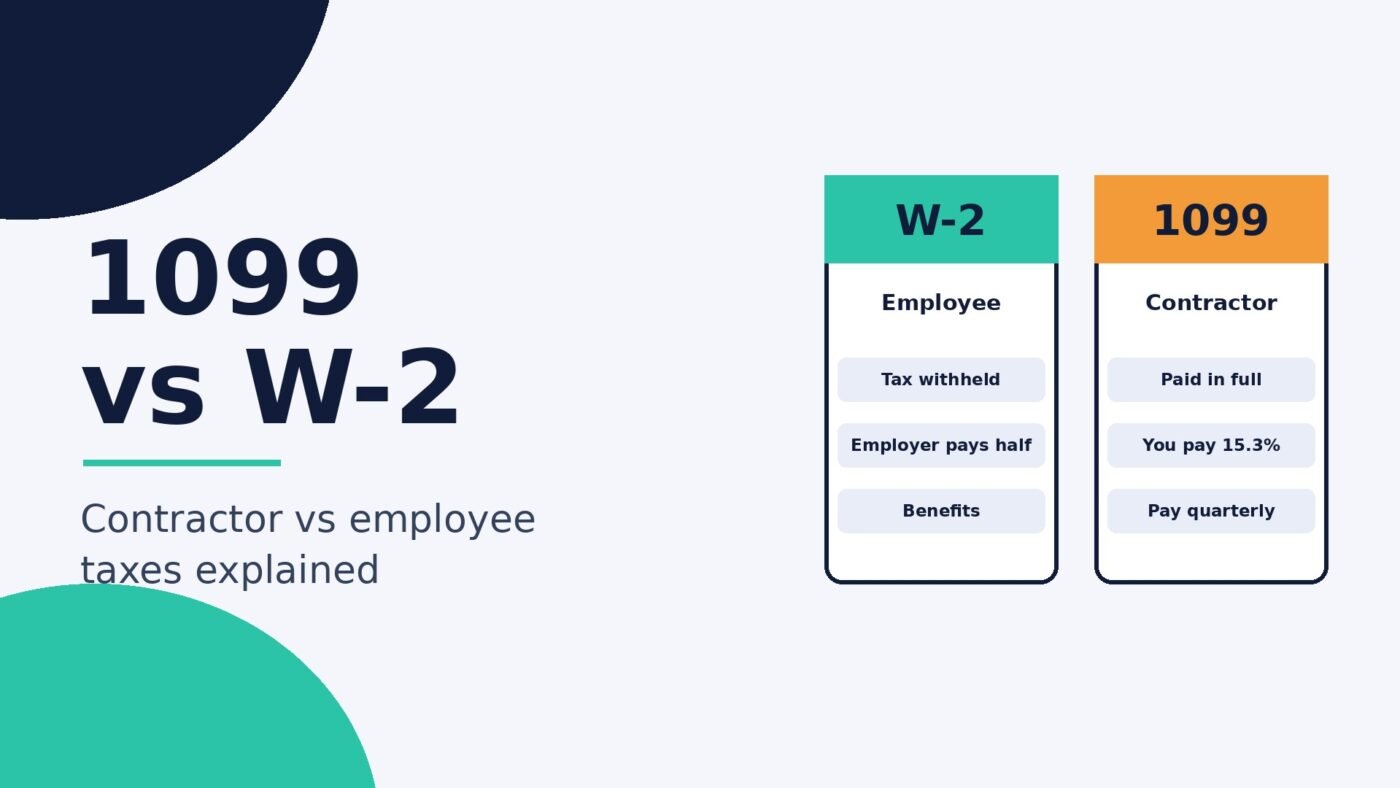
A W-2 employee has federal income tax, Social Security and Medicare taxes taken out of every paycheck, and the employer pays a matching share of Social Security and Medicare on top. A 1099 contractor gets paid in full with nothing withheld, then pays their own income tax plus the full 15.3% self-employment tax, usually through quarterly estimated payments. Which one you are isn’t a choice the company gets to make freely: it depends on how much control the business has over how you do the work.
If you’ve been offered a contract job, you’re weighing a freelance rate against a salary, or you’re hiring your first helper, this is the difference that decides how much you actually take home and what paperwork you’ll deal with. Below: how each is taxed, a worked example with real IRS rates, how worker status is decided, and how to compare a 1099 rate with a W-2 salary. Every rule and number links to the IRS page it comes from.
Not tax or legal advice: this covers general US federal rules. State taxes and labor laws differ, so check your situation with a tax professional.
1099 vs W-2 at a glance
| W-2 employee | 1099 contractor | |
|---|---|---|
| Form you receive | Form W-2, Wage and Tax Statement | Form 1099-NEC from each client that paid you $2,000 or more (payments after 2025) |
| Income tax | Withheld from each paycheck based on your Form W-4 | Not withheld; you pay it yourself, often in quarterly estimated payments |
| Social Security and Medicare | You pay 7.65% (6.2% + 1.45%); employer pays another 7.65% | You pay the full 15.3% self-employment tax, and deduct the employer-equivalent half |
| Unemployment tax | Employer pays FUTA and state unemployment tax | None paid on your behalf |
| Work expenses | Often reimbursed by the employer | Deductible as business expenses on Schedule C |
| Benefits | Health insurance, paid leave, retirement match if the employer offers them | You arrange and pay for your own |
| Who controls the work | The employer can direct what you do and how you do it | You control how the work gets done; the client controls the result |
| Tax forms you file | Form 1040 | Form 1040 plus Schedule C and Schedule SE |
What the two forms actually are
People say “a 1099 job” or “a W-2 job,” but the forms are just paperwork that reports the relationship. The relationship comes first.
Form W-2
Employers use Form W-2 to report wages paid to an employee and the income, Social Security and Medicare taxes withheld. It goes to the employee and to the Social Security Administration. For wages paid in 2026, the IRS instructions say employers must furnish W-2s to employees and file them with the SSA by February 1, 2027 (January 31 falls on a Sunday that year).
Form 1099-NEC
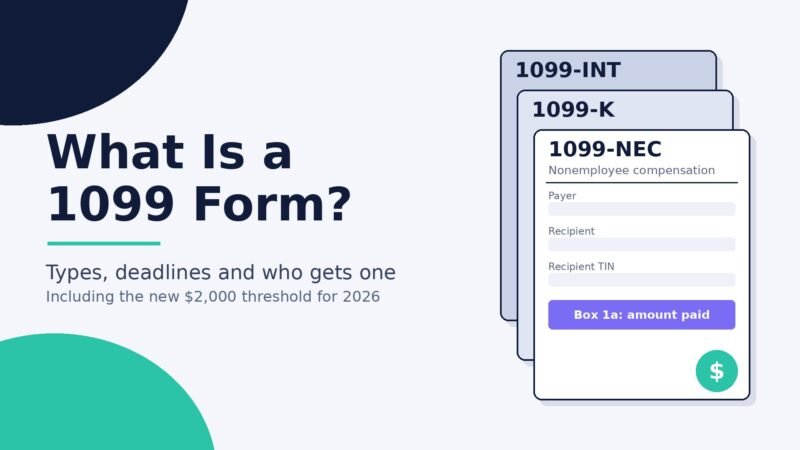
Businesses use Form 1099-NEC to report payments for services to someone who isn’t an employee. The reporting threshold is $600 for payments made before 2026 and $2,000 for payments made after December 31, 2025. A 1099 shows what you were paid, with no tax taken out. Our guide to what a 1099 form is covers the other 1099 types and deadlines, and before a client pays you they’ll usually ask you to fill out a Form W-9.
One thing to know: income is taxable whether or not you get a 1099. If a client paid you $1,500 and sent nothing, you still report it.
How taxes work for each
W-2: taxes come out before you see the money
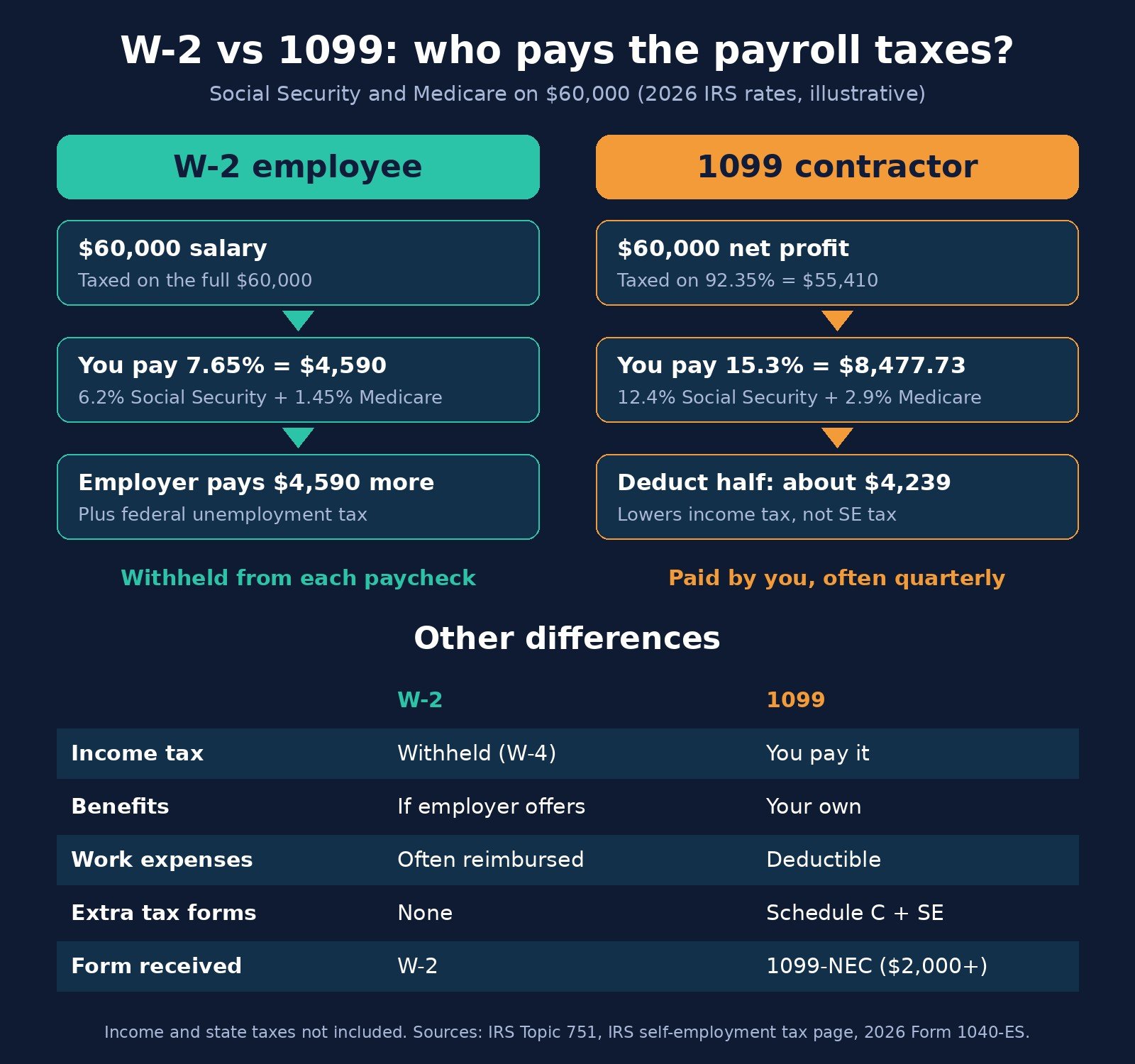
As an employee, your employer handles the math. It withholds federal income tax based on the W-4 you filled out, plus your share of FICA: 6.2% for Social Security and 1.45% for Medicare. The employer pays the same 6.2% and 1.45% again from its own pocket. It also pays federal unemployment tax, which is 6.0% on the first $7,000 of each employee’s wages, usually cut to 0.6% after the credit for state unemployment taxes. You never see those employer costs on your pay stub, but they’re real money the business spends to employ you.
The result is that your paycheck is your net pay, and at tax time you’re usually settling a small difference rather than paying the whole bill.
1099: you’re the employee and the employer
The IRS says a business generally doesn’t have to withhold or pay any taxes on payments to independent contractors. So the whole bill lands on you. On top of income tax, you owe self-employment tax, which the IRS describes as 15.3%: 12.4% for Social Security and 2.9% for Medicare. That’s both halves of FICA. You owe it once your net earnings from self-employment reach $400 or more.
Two things soften this. First, the tax applies to 92.35% of your net profit, not 100%; you can see that factor in the self-employment tax worksheet in the 2026 Form 1040-ES. Second, you can deduct the employer-equivalent half of your self-employment tax when figuring adjusted gross income, which lowers your income tax (but not the SE tax itself).
The Social Security part has a ceiling. For 2026, it applies to the first $184,500 of combined wages and self-employment earnings. The 2.9% Medicare part has no ceiling, and an extra 0.9% Medicare tax kicks in above $200,000 for single filers and $250,000 for married couples filing jointly.
A worked example: $60,000 either way
Here’s the payroll-tax piece only, using the IRS rates above. This leaves out income tax, state tax, deductions and benefits, so treat it as an illustration of the gap, not your tax bill.
| W-2: $60,000 salary | 1099: $60,000 net profit | |
|---|---|---|
| Amount taxed | $60,000 of wages | $60,000 × 92.35% = $55,410 |
| Social Security | 6.2% = $3,720 | 12.4% = $6,870.84 |
| Medicare | 1.45% = $870 | 2.9% = $1,606.89 |
| You pay | $4,590 | $8,477.73 |
| Employer pays on top | Another $4,590, plus unemployment tax | Nothing |
| Deduction that lowers income tax | None for FICA | Half of SE tax, about $4,238.87 |
So on the same $60,000, the contractor pays roughly $3,900 more in Social Security and Medicare, and gets a deduction of about $4,239 that trims their income tax a little. That’s why a 1099 rate needs to be higher than the matching salary just to break even.
Deductions contractors can take
Contractors report income and expenses on Schedule C and pay tax on profit, not gross receipts. Ordinary business costs like software, a work laptop, a share of your phone bill, or business mileage reduce that profit, which lowers both income tax and self-employment tax. Many contractors can also take the qualified business income deduction, which lets eligible taxpayers deduct up to 20% of their qualified business income, subject to income limits. W-2 employees don’t get either of these for their job.
Paying as you go
Because nothing is withheld, the IRS expects contractors to pay through the year. If you expect to owe $1,000 or more when you file, you generally need to make estimated tax payments, or you can face an underpayment penalty. Our guide to estimated taxes for the self-employed walks through the 2026 due dates and how to figure each payment. A simple habit that works: move a fixed percentage of every client payment into a separate savings account the day it lands.
Who decides whether you’re an employee or a contractor?
Not the job ad, and not the form the company sends. The IRS looks at the whole relationship under common-law rules, grouping the evidence into three categories:
- Behavioral control: does the company control, or have the right to control, what you do and how you do it? Set hours, required methods and detailed training point toward employee.
- Financial control: who controls the business side? Think how you’re paid, whether expenses are reimbursed, who provides the tools, and whether you can make or lose money on the job.
- Type of relationship: are there written contracts or employee-type benefits like a pension, insurance or vacation pay? Is the work ongoing and a key part of the business?
The IRS is clear that there’s no magic number of factors and no single factor decides it. Working from home doesn’t make you a contractor either: a remote worker is an employee under the common-law rules if the business can control what will be done and how it will be done.
If you think you’re misclassified
If you’re treated as a contractor but the job looks like employment, you have two IRS tools. Either the business or the worker can file Form SS-8 to ask the IRS for an official determination; the IRS warns it can take at least six months. And workers who believe they were improperly classified can attach Form 8919 to their return to report only the employee share of Social Security and Medicare tax, rather than the full self-employment tax.
For businesses, the stakes are higher: a company that treats an employee as a contractor with no reasonable basis can be held liable for the employment taxes for that worker. State labor departments run their own tests for things like minimum wage and unemployment insurance, and they can be stricter than the IRS.
Pros and cons for workers
Being a W-2 employee
- Pros: taxes handled for you, employer pays half of FICA, access to employer benefits, and usually eligibility for unemployment insurance and workers’ compensation.
- Cons: less say over when, where and how you work; can’t deduct job expenses; one employer means one income source.
Being a 1099 contractor
- Pros: you choose clients, hours and methods; you can deduct business expenses; you may qualify for the QBI deduction; you can work for several clients at once.
- Cons: the full 15.3% self-employment tax, quarterly payments to manage, no employer benefits or paid leave, and you chase your own invoices. A clean invoicing routine helps more than you’d think.
How to compare a 1099 rate with a W-2 salary
A $60 an hour contract and a $60 an hour job are not the same offer. Before you compare them, add up what the contractor has to cover that the employer would have paid:
- The employer half of FICA: 7.65% of pay, up to the Social Security wage base.
- Benefits you’d lose: price out your own health insurance, and value any retirement match and paid time off the job would give you. These vary a lot, so use the actual figures from the offer.
- Unpaid time: hours spent finding clients, invoicing and doing admin that nobody pays you for, plus gaps between contracts.
- Business costs: software, equipment, insurance and accounting help.
- What you get back: expense deductions, the deduction for half of SE tax, and possibly the QBI deduction.
Then compare take-home pay, not headline numbers. If you’re thinking about going full-time freelance, our guides to sole proprietorship vs LLC and LLC vs S corp explain when a different business setup can change the self-employment tax picture.
Getting a W-2 and a 1099 in the same year
This is the normal setup for a side hustle: a day job on a W-2 and freelance work on a 1099. You file one Form 1040 with both. Your wages go on the main return; your freelance income and expenses go on Schedule C, and self-employment tax on Schedule SE.
Two practical tips. If your combined wages and self-employment earnings pass $184,500 in 2026, you stop owing the 12.4% Social Security part on earnings above that, because wages count first. And instead of making estimated payments, you can raise the withholding at your day job by updating your W-4 so the extra tax on your side income is covered from your paycheck. If you’re just starting out, see how to start a side hustle while working full-time.
Frequently asked questions
Is 1099 or W-2 better?
Neither is better for everyone. W-2 work is simpler and the employer pays half of Social Security and Medicare plus any benefits. 1099 work gives you more control and business deductions, but you pay the full 15.3% self-employment tax and handle your own tax payments, so it only pays off if your rate is high enough to cover those costs.
Do you pay more taxes on a 1099 than a W-2?
Usually yes on the same pay, because a contractor pays both halves of Social Security and Medicare (15.3%) instead of the employee’s 7.65%. Business expense deductions, the deduction for half of self-employment tax and the QBI deduction can narrow the gap.
How much should I set aside for taxes on 1099 income?
There’s no single percentage, because it depends on your income tax bracket and state. Start with the self-employment tax, which is about 14.1% of net profit (15.3% of 92.35%), then add your expected federal and state income tax rate. Pay it in quarterly estimated payments if you’ll owe $1,000 or more.
Can an employer choose to pay me on a 1099?
Not freely. Worker status depends on the actual relationship, mainly how much control the business has over how you work. A company that controls your hours and methods like an employer generally has to treat you as an employee, whatever the contract says.
Can I be both W-2 and 1099 for the same company?
It’s possible if you do genuinely different work under different terms, but it draws scrutiny. If the contract work looks like your regular job, the IRS is likely to treat it as wages.
Do 1099 contractors get a W-2?
No. Contractors get a 1099-NEC from each client that paid them $2,000 or more during the year (for payments after 2025). Employees get a W-2.
Bottom line
A W-2 means someone else withholds your taxes, pays half your Social Security and Medicare, and may cover benefits. A 1099 means you get the full payment and the full responsibility: 15.3% self-employment tax, quarterly payments and your own benefits, in exchange for control and business deductions. Your status depends on how the work is actually controlled, not on which form you’re handed. If you’re going the 1099 route, set aside tax money from every payment, keep records of your expenses, and get a W-9 ready for new clients.

The Teck Hustlers Editorial Team covers technology, business, finance and gaming news for readers who want the story behind the headline. Every article is researched, written and edited by our in-house team, checked against company announcements, filings and reputable reporting, and updated when new facts emerge. We focus on what each development means for founders, professionals, investors and everyday users. Have a tip or a correction? Reach us through our contact page.