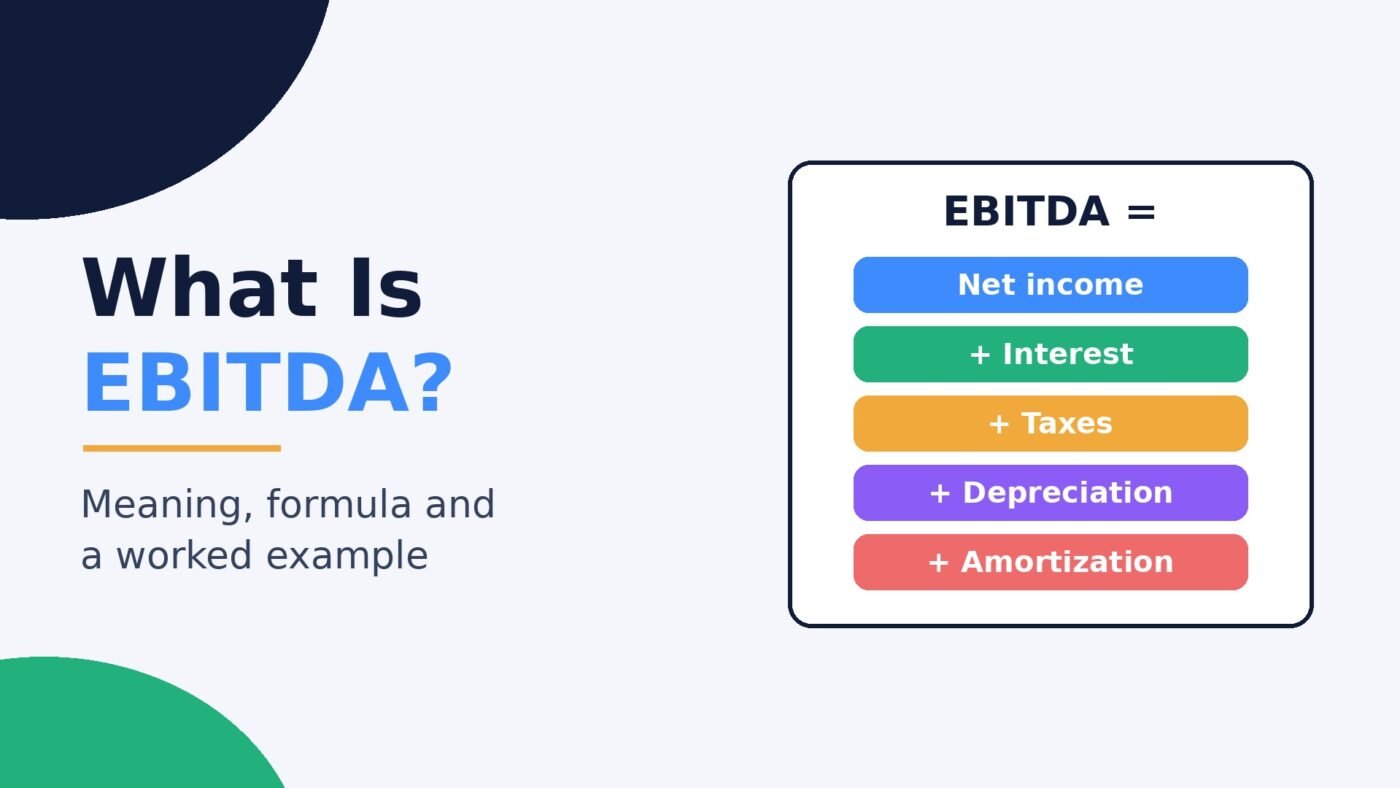
EBITDA stands for earnings before interest, taxes, depreciation and amortization. You calculate it by taking net income and adding back those four items: EBITDA = net income + interest + taxes + depreciation + amortization. What’s left shows how much profit a business makes from its day-to-day operations, before loan costs, income taxes and non-cash write-offs. That makes it easier to compare companies that borrow differently or own different amounts of equipment. EBITDA is not a GAAP measure, though. When a U.S. public company reports it, the SEC expects it to be reconciled to net income.
This guide explains what each part of EBITDA means, shows both ways to calculate it with a worked example, compares it with gross profit, operating income and net income, and covers EBITDA margin, adjusted EBITDA and the ways lenders, buyers and the IRS use the number. It also covers the big weakness that makes some investors distrust it. It is general business education, not accounting or tax advice.
What does EBITDA stand for?
Each letter is one cost that EBITDA leaves out of profit:
- E: Earnings. The starting point is net income, the bottom line of the income statement. The SEC’s staff says “earnings” in EBITDA means net income as presented under GAAP (Question 103.01).
- B: Before. The next four costs are added back as if they had not been subtracted.
- I: Interest. What the business pays on loans, credit lines and bonds. It depends on how the company is financed, not on how well it runs.
- T: Taxes. Income taxes, which vary with location, entity type and tax planning.
- D: Depreciation. The yearly expense that spreads the cost of physical assets, such as vehicles, machines and buildings, over their useful life.
- A: Amortization. The same idea for intangible assets, such as patents, software licenses or customer lists bought in an acquisition.
Depreciation and amortization are non-cash expenses. The cash went out when the asset was bought. The yearly charge is an accounting entry. That is why EBITDA is often described as a rough proxy for operating cash flow. As you’ll see below, it’s a rough one.
The EBITDA formula: two ways to calculate it
There are two standard formulas. Both give the same answer when the inputs are consistent (Investopedia).
1. Starting from net income (bottom-up)
EBITDA = Net income + Interest expense + Income taxes + Depreciation + Amortization
This is the version the SEC describes, and it’s the easiest if you have a full income statement.
2. Starting from operating income (top-down)
EBITDA = Operating income (EBIT) + Depreciation + Amortization
Operating income is revenue minus cost of goods sold and operating expenses. It is already before interest and taxes, so you only add back depreciation and amortization. One catch: if the company has non-operating gains or losses (for example, a one-time gain from selling a building), the two methods can give slightly different numbers. The SEC says public companies should reconcile EBITDA to net income, not operating income, for exactly that reason (Question 103.02).
Where to find the numbers
- Net income, interest and taxes: the income statement (profit and loss statement).
- Depreciation and amortization: sometimes a line on the income statement, but often buried in operating expenses. The cash flow statement lists it near the top of the operating section, where non-cash charges are added back.
If you keep your own books, your accounting software’s profit and loss report and fixed-asset schedule have what you need. Our guide to cash vs accrual accounting explains why the method you use changes when revenue and expenses show up.
How to calculate EBITDA: a worked example
Here is a made-up small company, a bakery that sells wholesale and through its own shop. These numbers are hypothetical, chosen only to show the math.
| Income statement line | Amount |
|---|---|
| Revenue | $1,200,000 |
| Cost of goods sold (ingredients, packaging, baker wages) | −$480,000 |
| Gross profit | $720,000 |
| Operating expenses (rent, staff, marketing, utilities) | −$510,000 |
| Depreciation (ovens, van, fit-out) | −$50,000 |
| Amortization (purchased recipe rights and software) | −$10,000 |
| Operating income (EBIT) | $150,000 |
| Interest on equipment loan | −$30,000 |
| Pre-tax income | $120,000 |
| Income taxes | −$24,000 |
| Net income | $96,000 |
Bottom-up: $96,000 net income + $30,000 interest + $24,000 taxes + $50,000 depreciation + $10,000 amortization = $210,000 EBITDA.
Top-down: $150,000 operating income + $50,000 depreciation + $10,000 amortization = $210,000 EBITDA.
Same result. The bakery’s core operations produced $210,000 before financing, taxes and write-offs, even though only $96,000 reached the bottom line.
EBITDA vs gross profit, EBIT and net income
EBITDA sits in the middle of a ladder of profit measures. Each step down subtracts another layer of cost.
| Measure | How it’s calculated | What it tells you | Bakery example |
|---|---|---|---|
| Gross profit | Revenue − cost of goods sold | How profitable the product itself is | $720,000 |
| EBITDA | Gross profit − operating expenses (excluding D&A) | Operating profit before financing, taxes and non-cash charges | $210,000 |
| EBIT / operating income | EBITDA − depreciation − amortization | Operating profit after the cost of using up assets | $150,000 |
| Pre-tax income (EBT) | EBIT − interest (± other non-operating items) | Profit after financing costs | $120,000 |
| Net income | Pre-tax income − income taxes | What’s left for owners: the GAAP bottom line | $96,000 |
For a plain-English refresher on the top and bottom of this ladder, see gross vs net income.
EBITDA vs EBIT
The only difference is depreciation and amortization. EBIT treats the wear and tear on assets as a real cost. EBITDA ignores it. For a software company with few physical assets, the two are close. For a trucking company or a factory, EBITDA can be much larger than EBIT, and EBIT is usually the more honest measure.
EBITDA vs net income
Net income is the official, audited bottom line. EBITDA is a management or analyst measure built from it. Net income can be negative while EBITDA is positive, which is common for heavily indebted or asset-heavy businesses. That gap is worth investigating, not ignoring.
EBITDA margin
EBITDA margin = EBITDA ÷ revenue × 100
The bakery’s EBITDA margin is $210,000 ÷ $1,200,000 = 17.5%. Its operating margin is 12.5% and its net margin is 8%. A margin turns EBITDA into a percentage, so you can compare a $1 million business with a $100 million one, or track whether your own operations are getting more efficient year over year. Margins vary widely between industries, so compare a business with its peers, not with companies in unrelated sectors.
What is adjusted EBITDA?
Adjusted EBITDA starts with EBITDA and removes more items that management argues don’t reflect normal operations. Common adjustments include stock-based compensation, restructuring costs, legal settlements, acquisition fees and one-time gains or losses. In small-business sales, owners often add back personal expenses run through the business or above-market owner pay.
This is where EBITDA gets slippery, because there is no standard list of adjustments. The SEC’s staff has drawn some lines for public companies:
- A measure calculated differently from plain EBITDA should not be called “EBITDA.” It needs a distinct name, such as “Adjusted EBITDA” (Question 103.01).
- Excluding normal, recurring cash operating expenses needed to run the business can make the measure misleading. The staff treats an expense that happens repeatedly, or occasionally at irregular intervals, as recurring (Question 100.01).
- EBIT and EBITDA must not be shown per share (Question 103.02).
When you see adjusted EBITDA, look for the reconciliation table and read every adjustment. If “one-time” costs show up every year, they aren’t one-time.
How EBITDA is used
Comparing companies
Because it strips out financing and tax differences, EBITDA lets you compare two businesses in the same industry even if one is funded with debt and the other with owner cash, or one operates in a high-tax state. That’s its main legitimate purpose.
Valuing a business (EV/EBITDA)
Buyers and analysts often value companies as a multiple of EBITDA. The common ratio is enterprise value (equity value plus debt, minus cash) divided by EBITDA. If someone offered the bakery 4 times EBITDA, purely for illustration, that would imply an enterprise value of $840,000. The seller would then pay off any debt from that amount. Real multiples depend on industry, size, growth and risk, so don’t apply a multiple you saw for a different kind of business.
This is why owners preparing to sell care so much about EBITDA. Every legitimate dollar added back can raise the price by several dollars, and it’s also why buyers check every adjustment so carefully.
Loans and debt covenants (debt/EBITDA)
Lenders use total debt ÷ EBITDA to judge how heavily a company is borrowing. With $420,000 of debt, the hypothetical bakery would be at 2.0x. Many loan agreements set covenants with a maximum debt/EBITDA ratio. For years, U.S. bank regulators’ 2013 leveraged lending guidance said leverage above 6x total debt/EBITDA “raises concerns for most industries,” and gave total debt above 4x EBITDA as an example of what many institutions defined as leveraged lending. The OCC and FDIC rescinded that guidance on December 5, 2025, so today each lender sets its own limits. The ratio itself is still one of the most common in commercial lending.
Taxes: the business interest limit
EBITDA isn’t a tax term, but a similar idea appears in the U.S. tax code. Under Section 163(j), deductible business interest is generally capped at business interest income plus 30% of adjusted taxable income (ATI), plus floor plan financing interest (IRS FAQ). For tax years beginning after December 31, 2024, the One Big Beautiful Bill Act brought back the add-back for depreciation, amortization and depletion when calculating ATI (Form 8990 instructions), so the cap is once again based on an EBITDA-like number rather than an EBIT-like one.
Most small businesses don’t need to worry about this. The limit doesn’t apply to businesses that aren’t tax shelters and have average annual gross receipts of $32 million or less for the prior three years in 2026 (IRS).
The limits of EBITDA (and why critics distrust it)
EBITDA is useful, but it leaves out real costs. Here’s what it misses:
- Capital spending. Depreciation is non-cash, but the equipment it represents had to be paid for and will need replacing. If the bakery spends $90,000 this year on new ovens, its $210,000 of EBITDA turns into $120,000 before interest and taxes are even paid.
- Interest and debt repayment. A company can have healthy EBITDA and still be unable to make its loan payments.
- Taxes. Taxes are a real cash cost for profitable businesses.
- Working capital. Growing businesses often tie up cash in inventory and unpaid customer invoices. EBITDA doesn’t show that, which is why it isn’t the same as cash flow.
- Accounting choices. Since EBITDA isn’t defined by GAAP for private companies, and “adjusted” versions vary, two companies’ numbers may not be calculated the same way.
Warren Buffett put the capital-spending problem bluntly in Berkshire Hathaway’s 2000 shareholder letter: “References to EBITDA make us shudder – does management think the tooth fairy pays for capital expenditures?”
The fix isn’t to ignore EBITDA. Read it next to net income and the cash flow statement, especially operating cash flow minus capital expenditures (free cash flow).

EBITDA for small businesses and side hustles
If you run a small company, EBITDA is worth tracking even if you never plan to sell:
- Pass-through businesses often have no “T” to add back. Sole proprietorships, most LLCs and S corporations usually don’t pay federal income tax at the business level. Profit flows to the owners’ personal returns. For these businesses, EBITDA is effectively net income plus interest, depreciation and amortization. See sole proprietorship vs LLC and S corp vs C corp for how each entity is taxed.
- Owner pay changes the picture. In an S corp the owner takes a salary that counts as an expense. In a sole proprietorship the owner’s draw doesn’t. When buyers value very small businesses, they often use seller’s discretionary earnings (SDE), which also adds back the owner’s own pay and perks, instead of EBITDA.
- Lenders will ask. Business loan applications often ask for profit before interest and non-cash charges, so knowing your EBITDA and debt/EBITDA ahead of time speeds things up.
- It’s a clean way to track operations. If you buy a big piece of equipment or refinance a loan, net income jumps around. EBITDA margin shows whether the core business is actually improving.
Just don’t confuse EBITDA with money you can spend. You still owe the IRS (see our guide to estimated taxes for the self-employed), and you still have to replace what wears out.
Frequently asked questions
What is EBITDA in simple terms?
EBITDA is a company’s profit before interest, taxes, depreciation and amortization are subtracted. It shows how much the core business earns from operations, without the effects of how it’s financed, where it pays tax or how its assets are written down.
What is the formula for EBITDA?
EBITDA = net income + interest + taxes + depreciation + amortization. You can also start from operating income: EBITDA = operating income + depreciation + amortization. Both usually give the same result.
Is EBITDA the same as cash flow?
No. EBITDA ignores capital spending, changes in inventory and receivables, interest payments and taxes, all of which affect cash. Operating cash flow and free cash flow from the cash flow statement are better measures of the actual cash a business generates.
Is a higher EBITDA better?
Generally yes, because it means more operating profit. But compare EBITDA margin with similar businesses, check how much of it goes to capital spending and debt payments, and read any “adjusted” add-backs before you draw conclusions.
What is a good EBITDA margin?
There’s no universal number. Margins depend heavily on the industry. A software company and a grocery store will look very different. Compare a business with its direct peers and with its own history.
Why is EBITDA criticized?
Because it leaves out real costs, especially the capital spending needed to replace equipment, and because adjusted versions can remove recurring expenses. Warren Buffett famously asked whether management thinks “the tooth fairy pays for capital expenditures.”
Is EBITDA a GAAP measure?
No. EBITDA is a non-GAAP measure. U.S. public companies that report it must reconcile it to net income, and any version calculated differently must carry a different name, such as “Adjusted EBITDA.”
The bottom line
EBITDA is net income with interest, taxes, depreciation and amortization added back. It’s a quick, widely used way to see and compare what a business earns from operations. That’s why buyers price deals on it and lenders set loan limits with it. But it isn’t cash and it isn’t the full picture. Use it with net income and free cash flow, and question every adjustment. If you’re choosing a structure for a growing business, our LLC vs corporation guide is a good next read.

The Teck Hustlers Editorial Team covers technology, business, finance and gaming news for readers who want the story behind the headline. Every article is researched, written and edited by our in-house team, checked against company announcements, filings and reputable reporting, and updated when new facts emerge. We focus on what each development means for founders, professionals, investors and everyday users. Have a tip or a correction? Reach us through our contact page.