Piercing the corporate veil is when a court sets aside the limited liability of a corporation or LLC and holds the owners personally responsible for the company’s debts or judgments. Courts treat it as a rare exception, not the rule. It usually happens when owners didn’t keep the business truly separate from themselves (for example by mixing personal and business money), left the company without enough money to cover its obligations, or used it to commit fraud or another injustice.
The whole point of forming an LLC or corporation is that the business’s debts belong to the business. If a customer sues or a supplier goes unpaid, they can usually go after the company’s assets but not your house, car or savings. Veil piercing is the main way that protection breaks down. This guide explains what it means, how courts decide, why one-owner LLCs need to pay attention, and the everyday habits that keep your liability shield intact. It’s general information, not legal advice; veil-piercing law is set by each state.
What “piercing the corporate veil” means
A corporation or LLC is a separate legal person. The “veil” is the line between that entity and the people who own it. Cornell’s Legal Information Institute defines piercing the corporate veil as a situation in which courts put aside limited liability and hold a corporation’s shareholders or directors personally liable for the corporation’s actions or debts.
The same idea applies to LLCs, even though the phrase says “corporate.” LII notes that the related alter ego doctrine, which courts use to justify piercing, is now applied to limited liability companies as well. You’ll also see it called “piercing the LLC veil” or simply “piercing the veil.”
Two things make the topic confusing:
- It’s judge-made and state-specific. There’s no single federal rule. LII points out that the law varies by state, and lists different tests used in Florida, Alaska, Nevada, New York and Texas.
- It’s rare, but not unheard of. Courts generally start with a strong presumption against piercing and usually require serious misconduct. Yet a widely cited empirical study in the Cornell Law Review called veil piercing the most litigated issue in corporate law, so owners do get tested on it.
How courts decide whether to pierce the veil
Wording differs between states, but most tests boil down to two questions:
- Was the company really separate from its owner? Courts look for signs that the business was just the owner’s “alter ego” or “mere instrumentality”: mixed bank accounts, the owner paying personal bills from the company, no records, no real capital.
- Would respecting the company’s separateness be unfair? Courts also look for some wrongdoing or injustice, such as fraud, draining the company to avoid a debt, or leaving a creditor with a judgment it can never collect.
Nevada’s version is a good example of this structure. Per LII, the court asks whether the company was governed by the person said to be its alter ego, whether there’s such unity of interest and ownership that one is inseparable from the other, and whether treating the company as separate would sanction a fraud or promote injustice. Florida similarly requires both an alter ego finding and improper conduct, while Texas cases focus on whether the owner used the company to commit actual fraud for their own direct benefit.
Factors courts commonly weigh
| Factor | What it looks like in practice | Why it matters |
|---|---|---|
| Commingling funds | Personal groceries on the business card; customer payments into your personal account | Suggests no real line between you and the company |
| Undercapitalization | Company has no money or insurance to cover foreseeable obligations | Creditors bear risks the owner never funded |
| Alter ego / domination | Owner treats company assets as personal; decisions and money move informally | Company is just a front for the owner |
| Fraud or misrepresentation | Using the company to dodge a debt, mislead creditors or hide assets | Courts are most willing to pierce here |
| Ignoring formalities | No records, no operating agreement, lapsed state filings | Weighs more for corporations; many LLC statutes limit its role |
Sources for the factors: Cornell LII and Wolters Kluwer. No single factor decides most cases; courts look at the overall picture.
The most common reasons the veil gets pierced
1. Commingling personal and business money
This is the classic mistake for small owners. LII lists intermingling of personal and corporate assets as a typical example of the misconduct courts look for. If you pay your rent from the LLC account, deposit client checks into your personal account, or “borrow” from the business with no paperwork, a creditor can argue the company was never really separate. Wolters Kluwer also flags personal use of business assets without proper accounting.
2. Undercapitalization
A business that starts or keeps operating without enough money to meet its foreseeable obligations is “undercapitalized.” LII mentions undercapitalization at the time of incorporation as a factor. There’s no fixed dollar figure; it’s judged against the risks of your particular business. Insurance often counts here too, because it’s how a small company stands behind its obligations.
3. Treating the company as your alter ego
When an owner controls the company so completely that it has no separate existence (company assets used as personal property, money moved whenever convenient, no distinction in records), courts may find it was the owner’s alter ego and disregard it.
4. Fraud or injustice
Using a company to escape a debt or deceive creditors is the strongest trigger. LII notes that when a corporation is fraudulently created to escape liability, creditors may pierce the veil. A common pattern: an owner moves money or assets out of a company that owes a debt, leaving an empty shell.
5. Ignoring formalities (mainly a corporation issue)
Corporations are expected to adopt bylaws, hold meetings of directors and shareholders and keep records, and skipping all of that can count against owners. LLCs are more flexible, which matters for the next section.
Can you pierce the veil of an LLC?
Yes. LLC owners (members) get limited liability, but courts in many states will pierce an LLC’s veil using factors drawn from corporate cases. The SBA says an LLC protects you from personal liability in most instances, which is accurate: most of the time, not always.
The key difference is formalities. Many state LLC laws say that skipping formalities alone isn’t a reason to hold members liable. Idaho’s statute, for example, says an LLC’s debts are solely the debt, obligation, or other liability of the company, and that failing to observe formalities is not a ground for imposing liability on a member or manager. So an LLC owner who never holds an annual meeting usually isn’t at risk for that reason alone. Commingling, undercapitalization and fraud are a different story.
A real example: GreenHunter (Wyoming, 2014)
Wyoming enacted the first limited liability company statutes and is known for strong LLC protection, which makes this case a useful warning. GreenHunter Wind Energy, LLC hired a consulting firm and was billed $43,646.10 for its services. It never paid, the consultant won a judgment, and it turned out the LLC had no assets to pay it. The consultant asked the court to hold the LLC’s sole member, GreenHunter Energy, Inc., liable. The trial court agreed and the Wyoming Supreme Court affirmed the decision, while stressing that limited liability is the rule and piercing the rare exception.
In an earlier case cited in the GreenHunter opinion, the same court listed four factors for LLC veil piercing: fraud, inadequate capitalization, failure to observe company formalities, and intermingling the business and finances of the company and member so much that there’s no distinction between them. The lesson for small owners: even in an LLC-friendly state, a company with no money and blurred finances can lose its shield.
Are single-member LLCs at higher risk?
Often, yes, in practice. With one owner, there’s no partner to insist on separate accounts or records, and the line between “me” and “my LLC” blurs easily. The Cornell Law Review study found that the likelihood of piercing increases as the number of shareholders decreases, and that piercing was more likely when the owner behind the veil was an individual rather than another company. That research covered corporations, but the logic carries over to one-person LLCs.
A single-member LLC is still a separate legal entity under state law even though the IRS treats it as a “disregarded entity” for income tax by default. Our single-member LLC guide explains that split. Being disregarded for taxes doesn’t mean the LLC is disregarded for liability, but you have to run it like a separate business for that to hold up.
How to protect your LLC from veil piercing
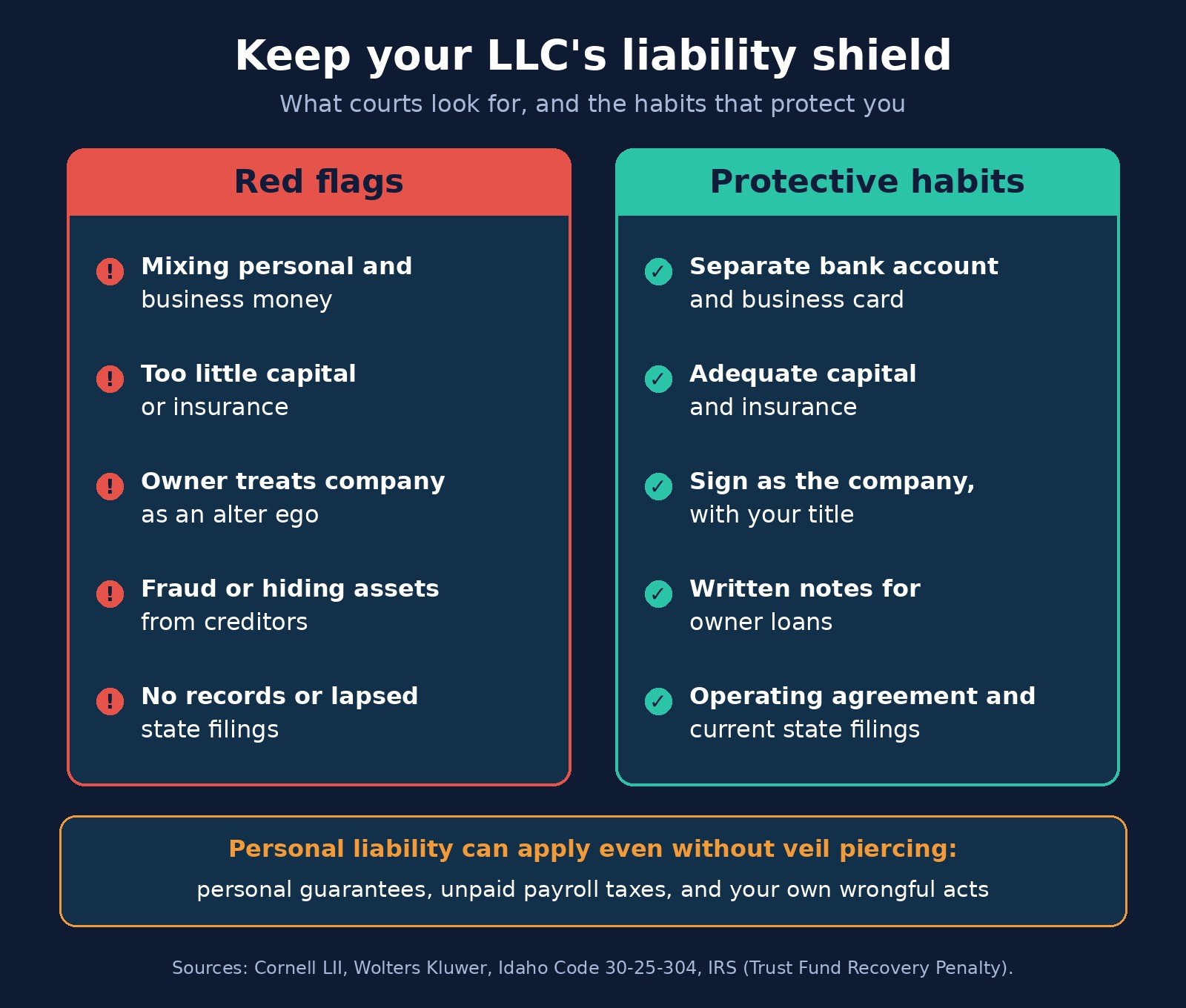
Most of the protection comes down to treating the business as a separate entity every day. Wolters Kluwer’s checklist and the factors courts use point to the same habits:
- Open a business bank account and card, and use them only for business. Pay yourself through documented draws, distributions or payroll rather than paying personal bills from the LLC. Wolters Kluwer recommends a dedicated business checking account and business credit card. You’ll usually need an EIN to open one; see how to apply for an EIN online.
- Put money in, and keep enough there. Fund the LLC with enough capital for its realistic risks, and record your contribution. Don’t strip the account to zero when the company owes money.
- Carry business insurance. General liability or professional liability coverage pays claims that would otherwise test the veil, and shows the business is set up to meet its obligations.
- Sign everything as the company. Use the full legal name with “LLC” and your title, for example “Acme Design LLC, by Jane Smith, Member.” Wolters Kluwer advises signing contracts using your official title and the company name. Invoices, websites and email signatures should use the company name too. If you operate under a trade name, our DBA vs LLC guide explains how the two fit together.
- Paper any money moving between you and the LLC. If you lend the LLC money or it lends you money, write a short promissory note with repayment terms and follow it.
- Have an operating agreement, even with one member. Wolters Kluwer says it’s particularly important, including for single-member LLCs where separation is harder to show. Our LLC operating agreement guide covers what to include.
- Keep the LLC in good standing. File annual reports, pay state fees and keep a registered agent on file. A dissolved or delinquent company is easier to attack.
- Keep clean books. Separate bookkeeping makes it easy to prove the company’s money was the company’s. Our guide to cash vs accrual accounting covers the basics.
- Write down big decisions. Formal meetings aren’t required for most LLCs, but a short written record of major decisions (taking a loan, buying equipment, adding a member) shows the business is run as its own entity.
If you’re still setting up, our step-by-step guide to how to start an LLC builds these habits in from day one.
When you’re personally liable even without veil piercing
Veil piercing isn’t the only way owners end up paying business debts. Several situations bypass the LLC’s protection entirely, no court finding of misconduct needed:
- Personal guarantees. Landlords, lenders and card issuers often ask small-business owners to guarantee debts personally. Once you sign, you’ve agreed to pay if the company doesn’t. For SBA-backed loans, federal rules say holders of at least a 20 percent ownership interest generally must guarantee the loan.
- Unpaid payroll taxes. If your LLC withholds income and payroll taxes from employees’ pay but doesn’t send them to the IRS, the IRS can assess the Trust Fund Recovery Penalty against any responsible person who willfully fails to pay. The penalty equals the unpaid trust fund tax, and the IRS says it can then take collection action against your personal assets.
- Your own wrongful acts. An LLC protects you from the company’s debts, not from your own negligence or misconduct. If you personally injure someone or commit fraud, you can be sued directly.
- Operating as a sole proprietor by mistake. If you never actually formed the LLC, or it was administratively dissolved, there may be no veil to pierce. The sole proprietorship vs LLC comparison explains the difference in liability.
What about “reverse” veil piercing?
Ordinary veil piercing lets a company’s creditor reach the owner. Reverse veil piercing runs the other way: a creditor of the owner asks a court to reach the company’s assets, usually because the owner moved personal assets into the business to hide them. Fewer courts allow it and the rules vary by state, but it’s another reason to keep personal and business assets clearly separated in both directions.
Corporations vs LLCs: how veil piercing differs
| Corporation | LLC | |
|---|---|---|
| Can the veil be pierced? | Yes | Yes |
| Who’s at risk | Shareholders (and sometimes directors) | Members (and sometimes managers) |
| Formalities | Bylaws, meetings and minutes expected; lapses can count against owners | Many state statutes say skipping formalities alone isn’t a ground for liability |
| Main risk factors | Commingling, undercapitalization, alter ego, fraud, formalities | Commingling, undercapitalization, alter ego, fraud |
| Highest-risk owners | Small, closely held companies | Single-member and closely held LLCs |
LII notes that veil piercing is most common in close corporations. For a full structural comparison, see LLC vs corporation.
Piercing the corporate veil: frequently asked questions
What does piercing the corporate veil mean?
Piercing the corporate veil means a court disregards a corporation’s or LLC’s limited liability and holds its owners personally liable for the company’s debts or judgments. Courts do it only in unusual cases, typically when the company wasn’t really separate from its owners and respecting that separation would be unfair, such as after fraud.
Can you pierce the corporate veil of an LLC?
Yes. Courts in many states apply veil-piercing rules to LLCs, looking at factors like commingled funds, inadequate capital and fraud. Many state LLC laws say that failing to observe formalities, such as not holding meetings, is not by itself a reason to hold members liable.
What is the most common reason courts pierce the veil?
For small businesses, mixing personal and business money is the most common warning sign, especially combined with an underfunded company that can’t pay its debts. Fraud, such as moving assets out to avoid a creditor, is the strongest trigger. Courts weigh all the facts rather than relying on one factor.
Is a single-member LLC easier to pierce?
It tends to be, in practice. One-owner businesses blur personal and business finances more easily, and research on corporations found piercing becomes more likely as the number of owners falls. A single-member LLC with its own bank account, capital, insurance and operating agreement is much harder to pierce.
Does having an operating agreement protect me?
It helps but isn’t enough by itself. An operating agreement documents that the LLC is a separate business with its own rules, which matters most for single-member LLCs. You still need separate finances, adequate capital and honest dealings with creditors to keep the liability shield.
Can I be personally liable for my LLC’s debts without veil piercing?
Yes. You’re personally liable for any business debt you personally guaranteed, for your own negligence or wrongdoing, and potentially for unpaid payroll taxes the business withheld from employees, through the IRS Trust Fund Recovery Penalty. Veil piercing is only one route to an owner’s personal assets.
What is undercapitalization?
Undercapitalization means a company doesn’t have enough money, assets or insurance to cover the obligations it can reasonably expect to face. There’s no fixed amount; it’s judged against the business’s risks. Courts treat it as one factor in deciding whether to pierce the veil.
The bottom line
Piercing the corporate veil is a rare exception to limited liability, but it does happen, and small and single-owner companies are the most likely targets. Keep the LLC’s money separate, fund and insure it properly, sign as the company, document money moving between you and the business, and keep state filings current. Remember that personal guarantees, unpaid payroll taxes and your own conduct can create personal liability regardless. If you face a veil-piercing claim or run a higher-risk business, talk to a business attorney licensed in your state.

The Teck Hustlers Editorial Team covers technology, business, finance and gaming news for readers who want the story behind the headline. Every article is researched, written and edited by our in-house team, checked against company announcements, filings and reputable reporting, and updated when new facts emerge. We focus on what each development means for founders, professionals, investors and everyday users. Have a tip or a correction? Reach us through our contact page.