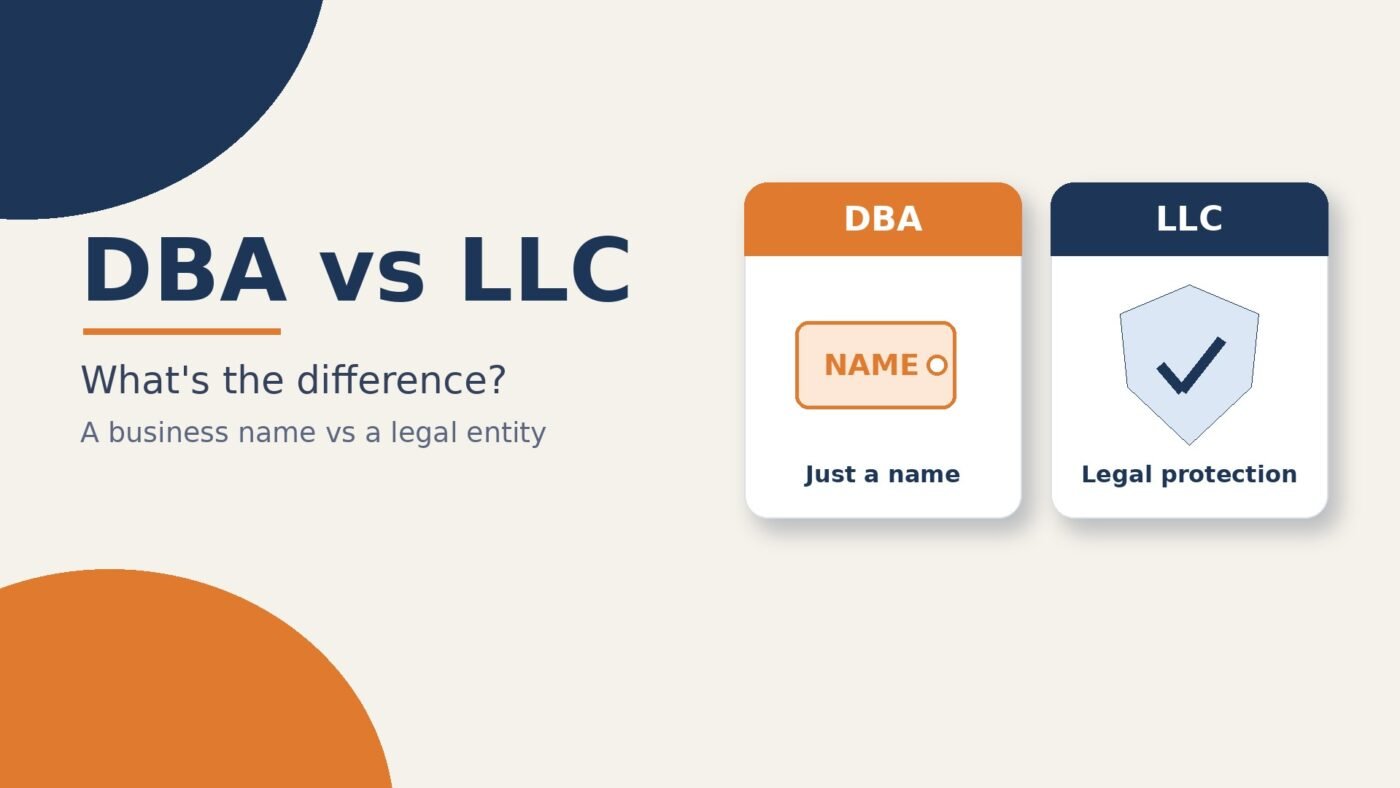
A DBA is a name, and an LLC is a business. A DBA (“doing business as”) lets you operate under a name other than your own legal name or your company’s legal name, but it creates no separate legal entity and does not protect your personal assets. An LLC (limited liability company) is a legal entity formed with your state that generally keeps business debts and lawsuits away from your house, car and savings. You can also use both: form an LLC for protection, then file a DBA so the LLC can trade under a friendlier brand name.
This guide compares the two side by side, explains how each one affects your taxes, bank account and EIN, and walks through which setup makes sense for a side hustle, a freelance business or a growing small company in the US.
Not legal or tax advice: this is general information based on guidance from the U.S. Small Business Administration (SBA) and the IRS. Rules and fees vary by state and county, so check with your state’s business filing office or a professional before you file.
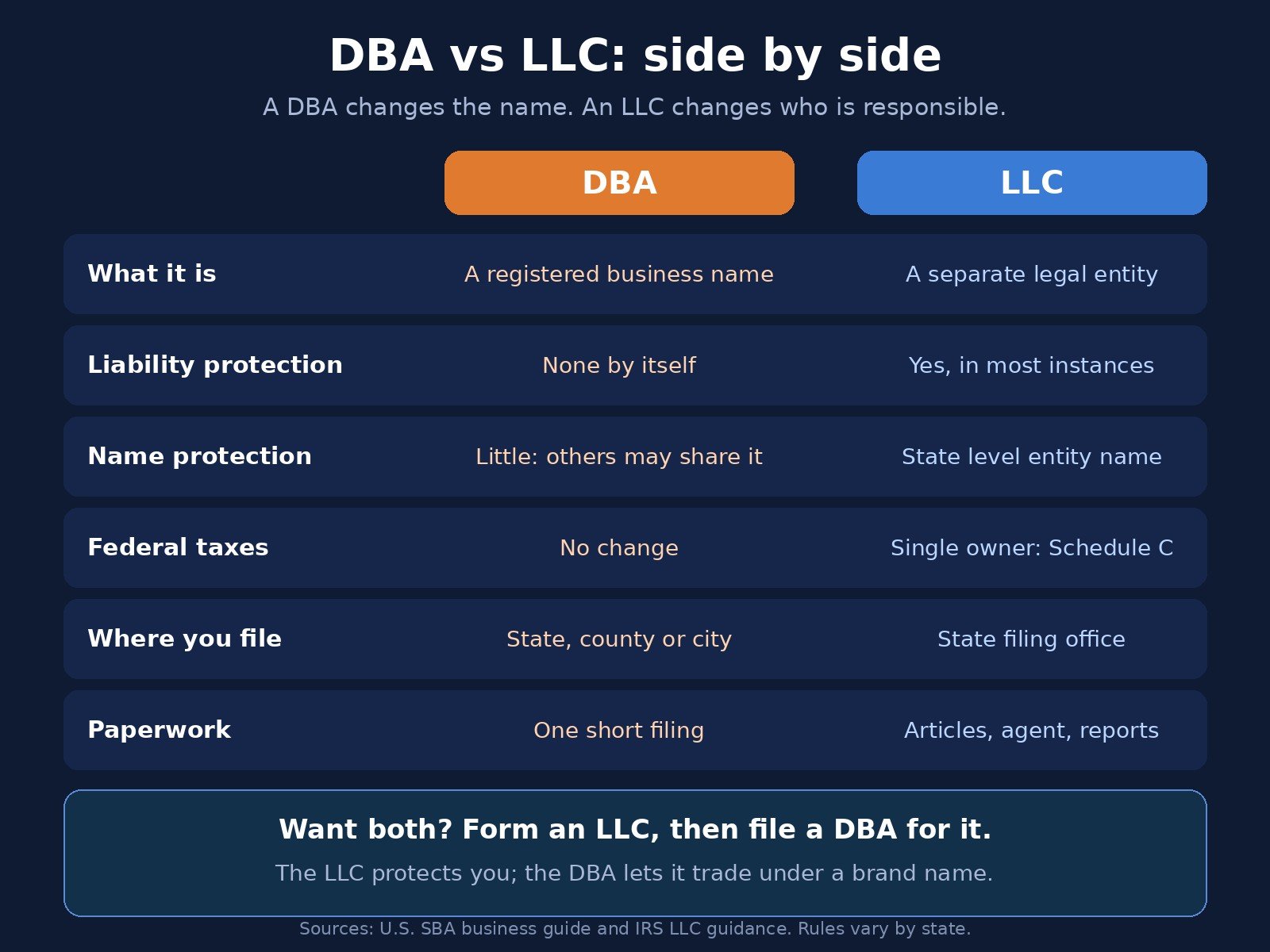
DBA vs LLC at a glance
| DBA (trade name) | LLC | |
|---|---|---|
| What it is | A registered business name | A separate legal entity created under state law |
| Where you file | State, county or city, depending on where you are | Your state’s business filing office (usually the Secretary of State) |
| Personal liability protection | None by itself | Yes, in most instances |
| Name protection | Little: others in your state may use the same DBA | State level: most states won’t register a duplicate entity name |
| Federal taxes | No change: taxed as whoever owns it | Single owner: reported on your personal return by default; can elect corporate or S corp tax |
| Paperwork | One short filing, sometimes renewals or a newspaper notice | Articles of organization, a registered agent, often annual reports |
| Best for | Low-risk solo work under a brand name | Businesses with real risk, clients, inventory or partners |
The rest of this article unpacks each row, with links to the official sources.
What is a DBA?
DBA stands for “doing business as.” The SBA notes that it is also called a trade name, fictitious name or assumed name, and that you might need to register it with the state, county or city where your business is located. In other words, the same thing can show up on a government form under four different labels.
A DBA does one job: it tells the public who is really behind a business name. If Maria Lopez runs a freelance design business called “Brightline Studio,” the DBA filing links that name to her. Without it, many places would expect her to do business only as “Maria Lopez.”
What a DBA does not do matters just as much:
- It does not create a company. If you are one person with no registered entity, you are a sole proprietor, and the SBA says you are automatically considered a sole proprietorship when you do business without registering as anything else. Adding a DBA just gives that sole proprietorship a name.
- It does not protect your personal assets. A sole proprietorship has no separate entity, so the SBA says you can be held personally liable for the business’s debts and obligations, DBA or not.
- It does not lock up the name. The SBA says registering a DBA doesn’t provide legal protection by itself, and that multiple businesses can go by the same DBA in one state.
So why bother? Because in many places it is required if you use a name other than your own, and because it makes you look and operate like a business. The SBA points out that a DBA plus an EIN lets you open a business bank account, so clients can pay “Brightline Studio” instead of you personally.
What is an LLC?
An LLC is a business structure created by filing with your state. The IRS describes it as a business structure allowed by state statute, owned by “members,” and notes that most states allow single-member LLCs with just one owner.
The main reason people form one is liability. According to the SBA, LLCs protect you from personal liability in most instances, so your personal assets like your vehicle, house and savings won’t be at risk if the LLC faces bankruptcy or lawsuits. “In most instances” is doing real work there: the protection depends on keeping business and personal money separate and following your state’s rules.
Forming an LLC usually means filing articles of organization with your state, naming a registered agent, and ideally writing an operating agreement. The SBA describes articles of organization as a simple document with the company name, address, members and registered agent, and says an operating agreement is widely recommended even where a state doesn’t require one. For the full filing walkthrough, see our guide on how to start an LLC in 7 steps.
The key differences between a DBA and an LLC
1. Liability: the difference that matters most
This is the real dividing line. A DBA is a label on top of you. An LLC is a separate legal “person” that owns its own contracts and debts. If a client sues over a project, a DBA-only sole proprietor is personally on the hook, while an LLC owner is generally shielded, as long as they have kept the business properly separate. The SBA suggests a sole proprietorship can suit low-risk businesses and owners testing an idea, and an LLC suits medium- or higher-risk businesses and owners with significant personal assets to protect.
Neither one replaces insurance. The SBA notes that even LLC and corporation protection has limits, and business insurance can fill the gaps.
2. Name protection
People often file a DBA thinking it reserves their brand. It usually doesn’t. The SBA lists four separate ways to register a business name, and they protect different things:
| Registration | What it protects |
|---|---|
| Entity name (your LLC’s legal name) | State level: in most cases no one else in your state can register the same entity name |
| DBA | No legal protection by itself, but it may be legally required |
| Trademark | Federal level, within your industry |
| Domain name | Your website address, for as long as you renew it |
If the name itself is valuable to you, run a proper search before you file anything. Our checklist on how to find out if a business name is taken covers state, trademark and domain searches.
3. Taxes: often the same for one owner
Many people expect an LLC to change their taxes. For a single owner, by default, it usually doesn’t. The IRS treats a one-member LLC as a “disregarded entity” unless it elects otherwise, and the owner reports the business on Schedule C of their Form 1040, the same schedule a sole proprietor uses. The owner also pays self-employment tax in the same manner as a sole proprietorship.
A DBA changes nothing about taxes at all. It is just a name, so the income is taxed as the income of whoever owns it.
The difference is flexibility. An LLC with two or more members is taxed as a partnership by default, and any LLC can file Form 8832 to be taxed as a corporation. The SBA also notes an LLC can be taxed as a C corp or S corp. A DBA-only sole proprietor has none of those options. Either way, if nobody withholds tax from your business income, plan for quarterly estimated taxes.
4. Cost and paperwork
A DBA is the lighter lift: usually one form with a county clerk or state office, and in some places a renewal or a published notice. An LLC means a state filing fee, a registered agent, and in many states an ongoing report. Fees vary widely by state and structure; the SBA says that in most cases the total cost to register a business is less than $300. Check your own state and county office for the current amount rather than relying on a third-party table.
One piece of paperwork you can likely skip: FinCEN’s beneficial ownership (BOI) report. In March 2025, FinCEN issued a rule that exempts all entities created in the United States from BOI reporting, so older articles telling new LLCs to file one are out of date.
5. EIN and banking
Both setups can get you a business bank account. A sole proprietor with a DBA can open one with a DBA and an EIN, per the SBA. A single-member LLC with no employees technically doesn’t need an EIN for income tax, but the IRS says it can get one if a bank or state requires it, and most banks will ask. Getting an EIN is free; see our walkthrough on how to apply for an EIN online.
Name changes are simpler than people fear. The IRS says a sole proprietor or an LLC doesn’t need a new EIN just because it changes its business name.
Can an LLC have a DBA?
Yes, and it is common. Your LLC’s legal name might be “Lopez Creative LLC,” but you want customers to see “Brightline Studio.” Filing a DBA for the LLC lets it trade under that brand while the LLC keeps providing the liability protection. The SBA gives a similar example: a business with the entity name Springfield Electronic Accessories using TechBuddy as its DBA.
This is also how one LLC can run several brands. A single company can file a DBA for each product line or service instead of forming a new LLC for each one. Keep in mind that every brand still sits inside the same LLC, so a problem in one line of business can reach the assets of the whole company.
DBA or LLC: which should you choose?
Use these questions to decide. They are a starting point, not a substitute for advice on your specific situation.
A DBA on its own may be enough if:
- You work alone and the risk of being sued is low (writing, tutoring, simple design or digital products).
- You want a brand name on invoices and a bank account, but you are still testing the idea.
- You have few personal assets at stake and you carry suitable insurance.
An LLC makes more sense if:
- Your work could cause real financial harm to a client or someone else (physical services, events, products people use or eat, handling client data or money).
- You sign contracts, leases or loans for the business.
- You have a home, savings or other assets you want kept apart from the business.
- You have a business partner, or plan to bring one in.
- You might later want to be taxed as an S corp.
An LLC plus a DBA fits if:
- You want liability protection but your legal name is clunky or already used, or
- You plan to run more than one brand under one company.
Many side hustlers start with a DBA (or just their own name) and form an LLC once the business has steady clients, bigger contracts or more risk. If you are still picking what to build, our list of online side business ideas with low startup costs can help you gauge how much risk each one carries.
How to set up each one
Filing a DBA
- Check where your state requires DBAs to be filed: the SBA says requirements vary by business structure, state, county and municipality.
- Search the name in your state’s and county’s records, and check trademarks and domains.
- File the form (often called a fictitious business name statement or assumed name certificate) and pay the fee.
- Complete any publication or renewal steps your location requires.
- Get an EIN if you want one, then open a business bank account in the DBA name.
Forming an LLC
- Choose a name that meets your state’s rules and isn’t already registered.
- Pick a registered agent in your state.
- File articles of organization with your state and pay the fee.
- Write an operating agreement.
- Get an EIN, open a business bank account, and check local licenses.
- Note any annual report deadlines your state sets.
Our LLC formation guide covers each step in more detail.
Common mistakes to avoid
- Thinking a DBA protects you. It doesn’t. If protection is the goal, you need an entity such as an LLC.
- Mixing money after forming an LLC. Paying personal bills from the business account undercuts the separation that protection depends on. Keep one business account and send invoices in the business’s name.
- Assuming a DBA reserves your brand. Others may file the same DBA. A trademark is the federal tool for brand protection.
- Forgetting renewals. Some DBAs and many LLC reports have recurring deadlines. Put them in your calendar the day you file.
- Using a name you can’t legally use. Even with a DBA, the SBA reminds owners that trademark infringement laws still apply.
DBA vs LLC: frequently asked questions
Is a DBA the same as an LLC?
No. A DBA is only a registered business name. An LLC is a separate legal entity formed with your state that generally protects the owner’s personal assets from business debts and lawsuits. A DBA can belong to a sole proprietor or to an LLC.
Does a DBA protect my personal assets?
No. A DBA does not create a separate entity, so a sole proprietor with a DBA is still personally liable for the business’s debts and obligations. Liability protection comes from forming an entity such as an LLC or corporation.
Is an LLC taxed differently from a DBA?
Usually not, for one owner. A single-member LLC is a disregarded entity by default, so the owner reports income on Schedule C and pays self-employment tax just like a sole proprietor. The LLC’s advantage is the option to elect corporate or S corp taxation later.
Can an LLC have a DBA?
Yes. An LLC can file a DBA to do business under a name other than its legal name, and one LLC can hold several DBAs for different brands. The LLC’s liability protection covers business done under its DBAs.
Do I need a DBA if I have an LLC?
Only if you want to operate under a name that is different from the LLC’s exact legal name. If you do business as “Lopez Creative LLC,” no DBA is needed. If you market yourself as “Brightline Studio,” most places expect a DBA filing.
Do I need a new EIN if I add a DBA?
Generally no. The IRS says sole proprietors and LLCs don’t need a new EIN just for a business name change. You do need a new EIN in other cases, such as when a sole proprietor incorporates or forms a partnership.
Which is cheaper, a DBA or an LLC?
A DBA is usually cheaper and simpler because it is a single name filing. An LLC has a state filing fee, a registered agent and often ongoing reports. Exact fees depend on your state and county.
The bottom line
The DBA vs LLC choice comes down to one question: do you just need a business name, or do you need protection? A DBA gives your work a brand name and can help you open a business bank account, but it leaves you personally responsible for everything the business owes. An LLC creates a separate entity that generally shields your personal assets, usually without changing taxes for a single owner. If you want both a brand name and protection, form an LLC and file a DBA for it. Check your state and county rules before filing, and talk to a professional if your situation is complicated. This article is general information, not legal or tax advice.

The Teck Hustlers Editorial Team covers technology, business, finance and gaming news for readers who want the story behind the headline. Every article is researched, written and edited by our in-house team, checked against company announcements, filings and reputable reporting, and updated when new facts emerge. We focus on what each development means for founders, professionals, investors and everyday users. Have a tip or a correction? Reach us through our contact page.