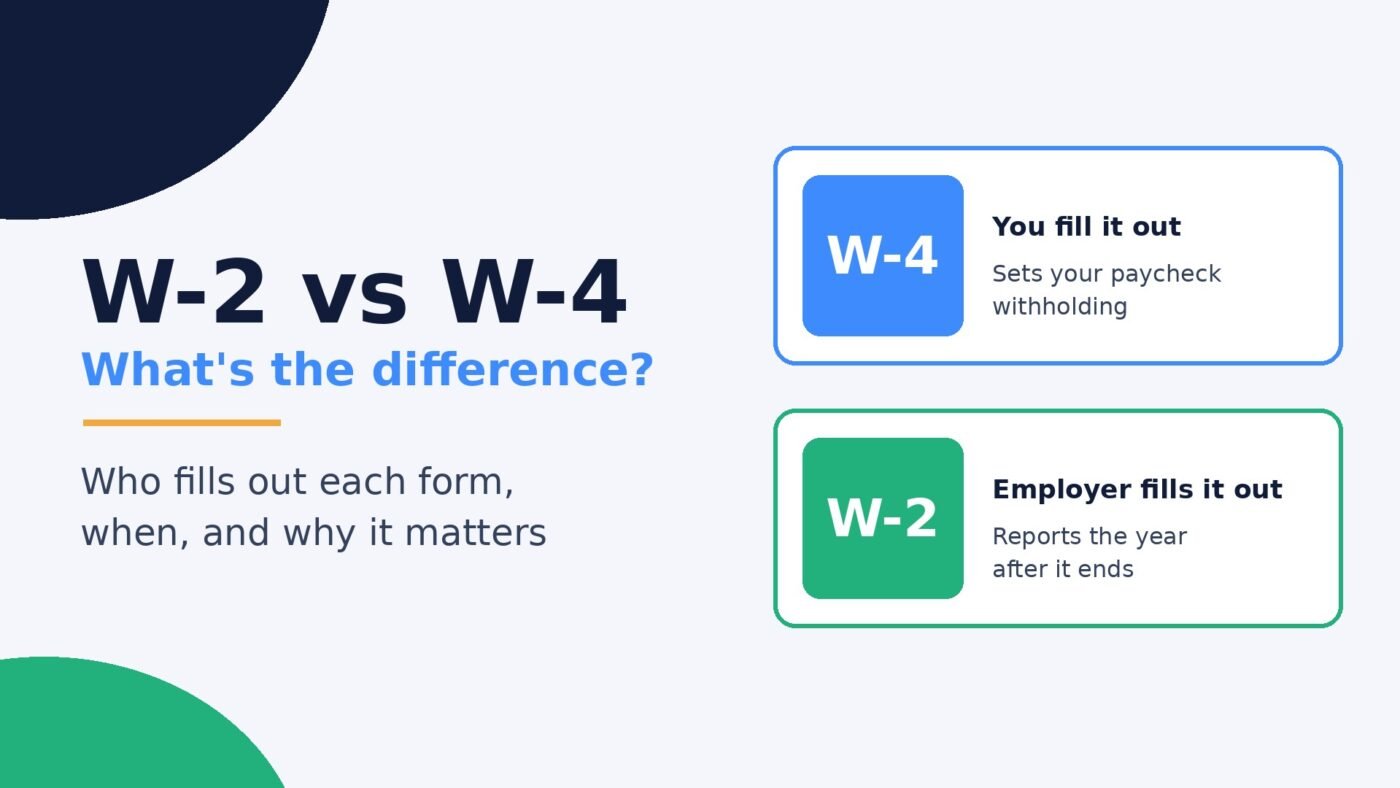
A W-4 is the form you fill out and give your employer so payroll knows how much federal income tax to withhold from each paycheck. A W-2 is the form your employer fills out after the year ends, showing what you were paid and how much tax was actually withheld. You use the W-2 to file your tax return. In short, the W-4 is the instruction and the W-2 is the receipt. The W-4 stays with your employer. The W-2 goes to you, and a copy goes to the Social Security Administration.
The two forms are easy to mix up because they come from the same payroll system and the names differ by one digit. This guide covers who fills out each one and when, what the key boxes and steps mean, what changed on the 2026 versions, and how to use last year’s W-2 to fix your W-4 so you don’t get a surprise bill or an oversized refund. It’s general education, not tax advice.
W-2 vs W-4 at a glance
| Form W-4 | Form W-2 | |
|---|---|---|
| Official name | Employee’s Withholding Certificate | Wage and Tax Statement |
| Who fills it out | You, the employee | Your employer (usually through payroll software) |
| When | When you start a job, and any time your situation changes | Once a year, after the calendar year ends |
| Looks | Forward: controls future paychecks | Backward: reports the year that just ended |
| Who gets it | Your employer keeps it. It isn’t sent to the IRS unless requested | You, the SSA, and often your state or city tax agency |
| What it changes | Your take-home pay | Nothing on its own. You use it to file your return |
| Deadline | None set by law for a new hire, but without one you’re taxed at the default rate | 2026 W-2s are due by February 1, 2027 |
What is a W-4?
Form W-4 tells your employer your filing status, whether you have more than one job, which credits and deductions to account for, and whether you want extra tax taken out. Payroll plugs those answers into the IRS withholding tables to decide how much federal income tax to take from each check. The IRS says to consider filling out a new W-4 each year and whenever your personal or financial situation changes.
A W-4 only covers federal income tax. It doesn’t change Social Security or Medicare tax, which are set by law at 6.2% and 1.45% of your wages. Many states have their own withholding form, so you may fill out a state version too.
The five steps on the 2026 W-4
The current form has no “allowances.” Those were dropped after the 2019 version, which is why the IRS still refers to allowances only for 2019 or earlier Forms W-4. The 2026 Form W-4 has five steps, and only Steps 1 and 5 are required for everyone:
- Step 1, personal information: name, address, Social Security number and filing status (single or married filing separately, married filing jointly, or head of household).
- Step 2, multiple jobs or spouse works: fill this in if you have more than one job at a time or you file jointly and your spouse also works. You can use the IRS Tax Withholding Estimator, the worksheet on page 3, or check a box if there are only two jobs in total.
- Step 3, dependents and other credits: if your total income will be $200,000 or less ($400,000 or less if married filing jointly), multiply qualifying children under 17 by $2,200 and other dependents by $500, according to the 2026 form.
- Step 4, other adjustments: (a) other income that has no withholding, such as interest or dividends; (b) deductions beyond the standard deduction; (c) any extra tax you want withheld per pay period.
- Step 5, sign: the form isn’t valid unless you sign it.
If you skip Step 4(b), your withholding is based on the standard deduction. Our standard deduction 2026 guide has the current amounts.
New on the 2026 W-4: tips, overtime and car-loan interest
The Deductions Worksheet on page 4 of the 2026 W-4 now has lines for the new deductions created by the 2025 tax law. If you expect to claim them, you can enter estimates so less tax is withheld during the year:
- Qualified tips: up to $25,000 if your total income is less than $150,000 ($300,000 if married filing jointly).
- Qualified overtime: the “and-a-half” part of time-and-a-half pay, up to $12,500 ($25,000 if married filing jointly), with the same income limits.
- Qualified passenger vehicle loan interest: up to $10,000 if your total income is less than $100,000 ($200,000 if married filing jointly).
- Seniors 65 or older: $6,000 per qualifying person if total income is less than $75,000 ($150,000 if married filing jointly).
Those limits are the worksheet’s simplified version. The full rules for each deduction are on your tax return, so be conservative with your estimates. Over-estimating means too little is withheld and you owe at filing time.
Claiming “exempt”
You can claim exemption from federal income tax withholding for 2026 only if you had no federal income tax liability in 2025 and expect none in 2026 (Form W-4 instructions). The exemption lasts one calendar year. To stay exempt, you have to give your employer a new W-4 by February 15 of the next year. If you don’t, payroll goes back to withholding as if you were single with no adjustments (IRS Topic 753). Social Security and Medicare are still withheld either way.
What happens if you don’t turn one in, and when changes kick in
According to IRS Topic 753:
- If you don’t give your employer a properly completed W-4, they must withhold as if you’re single or married filing separately with nothing entered in Steps 2, 3 or 4.
- When you hand in a revised W-4, your employer must put it into effect no later than the start of the first payroll period ending on or after the 30th day after they get it. Most payroll systems do it sooner.
- Submitting a W-4 with no reasonable basis that results in too little withholding can bring a $500 penalty.
- Employers must keep W-4s for at least four years.
What is a W-2?
Form W-2, the Wage and Tax Statement, is your employer’s year-end summary of your pay and withholding. Every employer in a trade or business that pays an employee must file one for each employee who had income, Social Security or Medicare tax withheld, or who would have had income tax withheld except for claiming exempt (IRS). For wages paid after 2025, a W-2 is also required when pay reaches the reporting threshold even with no tax withheld. The 2026 W-2 instructions say that threshold rose from $600 to $2,000.
When you get your W-2
Employers normally have to furnish W-2s by January 31 and file them with the SSA by the same date. For the 2026 tax year, January 31, 2027 falls on a Sunday, so the 2026 General Instructions for Forms W-2 and W-3 set the due date for both at February 1, 2027. You’ll get one from every employer you worked for during the year, even if you left. Your employer sends Copy A to the SSA and gives you Copies B, C and 2. Copy B is for your federal return, Copy C is for your records and Copy 2 is for state or local returns.
The W-2 boxes that matter most
| Box | What it shows | Why you care |
|---|---|---|
| 1 | Wages, tips, other compensation | Your taxable wages for federal income tax. This goes on your Form 1040. |
| 2 | Federal income tax withheld | The tax already paid through payroll. This is what your W-4 controlled. |
| 3 and 4 | Social Security wages and tax | Box 4 should be 6.2% of box 3. Box 3 is capped at the wage base, $184,500 for 2026. |
| 5 and 6 | Medicare wages and tax | Box 6 is 1.45% of box 5, plus 0.9% on wages over $200,000. |
| 12 | Coded items | Things like 401(k) deferrals (code D) and employer health coverage cost (code DD). New 2026 codes TP and TT are covered below. |
| 13 | Checkboxes | Shows if you were in a workplace retirement plan, which can affect IRA deductions. |
| 15 to 20 | State and local | State and local wages and income tax withheld. |
Sources: box descriptions and the $184,500 cap from the 2026 W-2 instructions; Social Security and Medicare rates from IRS Topic 751.
Why box 1 is often lower than boxes 3 and 5
This confuses a lot of people. Box 1 leaves out pre-tax elective deferrals, such as your contributions to a traditional 401(k) or 403(b). Box 3 (Social Security wages) still includes them (W-2 instructions). So if you put money into a traditional 401(k), your box 1 wages will be lower than your Social Security wages. That’s normal. Box 1 can also differ from your salary because of pre-tax health premiums or taxable fringe benefits. Our what is a 401(k) guide explains how those deferrals work, and gross vs net income covers why your paycheck is smaller than your salary.
What’s new on the 2026 W-2
The 2026 W-2 instructions list several changes tied to the 2025 tax law (P.L. 119-21):
- Box 12, code TP: total cash tips reported to the employer.
- Box 12, code TT: total qualified overtime compensation.
- Box 12, code TA: employer contributions to an employee’s or dependent’s Trump account.
- Box 14 is split: box 14a is the old “Other” box, and new box 14b shows the Treasury Tipped Occupation Code.
If you earn tips or overtime, these entries are what you’ll use to figure the new deductions on your return. Check that they look right when your W-2 arrives.
How the W-4 and W-2 work together
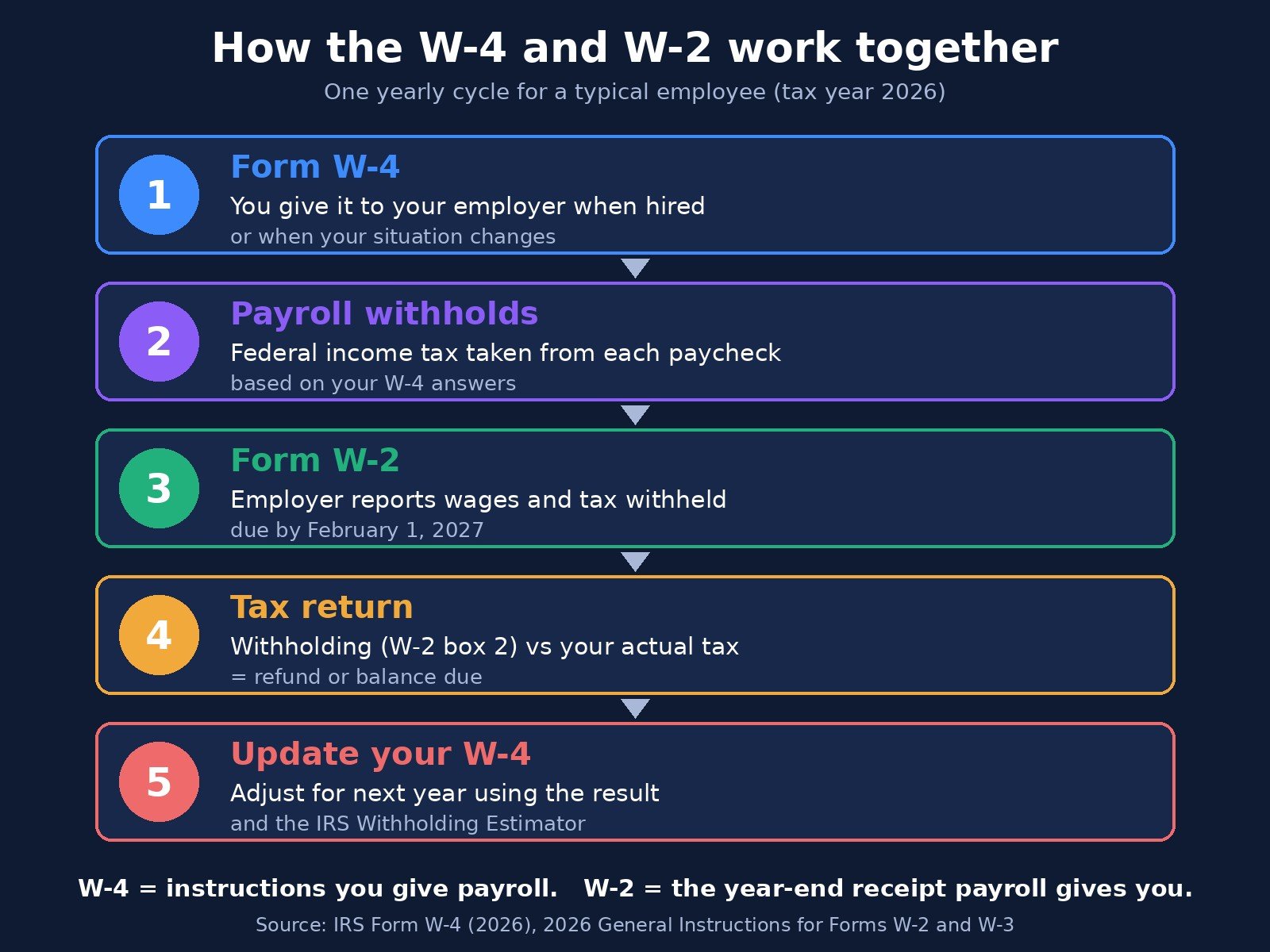
Think of it as a loop that repeats every year:
- You fill out a W-4 when you’re hired.
- Each payday, payroll uses it to withhold federal income tax.
- After December 31, your employer adds up the year and issues your W-2. Box 2 is the total of all that withholding.
- You file your return. If box 2 is more than your actual tax, you get a refund. If it’s less, you owe.
- You use that result to adjust your W-4 for next year.
A big refund feels nice, but it means you lent the government money at zero interest all year. A big balance due can come with an underpayment penalty. A well-tuned W-4 gets you close to zero either way.
How to use last year’s W-2 to fix your W-4
- Compare box 2 with your actual tax. On your Form 1040, compare total tax with the federal income tax withheld from your W-2s. The gap is how far off your withholding was.
- Run the IRS Tax Withholding Estimator. The IRS estimator asks for your most recent pay stub and tells you what to put on a new W-4. The W-4 recommends using it if you start mid-year, have several jobs, or have income like dividends, bonuses or business income.
- Use Step 4(c) for simple fixes. If you owed $1,200 last year and get paid 24 times a year, adding $50 per paycheck in Step 4(c) covers a similar gap. (That’s just arithmetic, not a prediction of your taxes.)
- Update after life changes. Marriage, divorce, a new baby, a second job or a spouse starting work all change the math.
- Turn it in to payroll, usually through your HR or payroll portal, then check your next pay stub.
If you have side income from freelancing, you can either raise withholding at your day job through Step 4(a) or 4(c) or make quarterly payments. Our guide to estimated taxes for the self-employed covers the second option, and how to start a side hustle while working full-time covers the bigger picture.
What if your W-2 is missing or wrong?
IRS Topic 154 lays out the steps if your W-2 isn’t available by February 1, 2027 or has mistakes:
- Check your IRS online account for individuals.
- If it’s not there, contact your employer, including a former employer, and ask for it or for a corrected W-2c.
- If you still don’t have it by the end of February, call the IRS at 800-829-1040. Have your details and the employer’s name, address and EIN if you know it. The IRS will contact the employer and send you Form 4852.
- If the W-2 still doesn’t arrive in time, you can file using Form 4852, a substitute W-2, with your best estimate of wages and withholding from pay stubs. The IRS notes Form 4852 can’t be used to figure the deductible amount of qualified overtime or qualified tips.
- If the real W-2 shows up later with different numbers, file an amended return on Form 1040-X.
Your final pay stub of the year is the best backup. It usually shows year-to-date wages and withholding.
For small business owners hiring their first employee
If you’re the one running payroll, the roles flip:
- Collect a W-4 from each new employee and keep it for at least four years. If an employee doesn’t give you one, withhold at the single or married filing separately rate with no adjustments (Topic 753).
- Issue W-2s to employees and file Copy A with the SSA, along with Form W-3, by the due date. For 2026 wages that’s February 1, 2027. Late or incorrect W-2s can bring per-form penalties, listed in the “Penalties” section of the W-2 instructions.
- You need an EIN to file W-2s. If you’ve lost yours, see how to find your EIN number.
- Classify workers correctly. Employees get W-4s and W-2s. Independent contractors don’t. Our 1099 vs W-2 guide explains the difference.
W-2 and W-4 vs W-9 and 1099
These come in matching pairs. For employees, the W-4 goes in and the W-2 comes out. For independent contractors, the W-9 goes in (it gives the client your taxpayer ID) and a 1099 comes out (it reports what the client paid you). The difference is that no tax is withheld on contractor pay in most cases, so contractors handle their own income and self-employment tax.
| Employee | Independent contractor | |
|---|---|---|
| Form you give the payer | W-4 | W-9 |
| Form the payer gives you | W-2 | 1099-NEC (or other 1099) |
| Taxes withheld from pay | Yes: income tax, Social Security, Medicare | Usually none |
Frequently asked questions
What is the main difference between a W-2 and a W-4?
A W-4 is filled out by the employee and tells the employer how much federal income tax to withhold from future paychecks. A W-2 is filled out by the employer after the year ends and reports the wages paid and taxes actually withheld. You use the W-2 to file your tax return.
Do I send my W-4 to the IRS?
No. You give your W-4 to your employer, who keeps it on file for at least four years. The IRS can ask the employer for it, but you don’t mail it in.
When will I get my W-2 for 2026?
Employers must furnish 2026 W-2s by February 1, 2027, because January 31, 2027 falls on a Sunday. If you haven’t received it by then, check your IRS online account and contact your employer.
How often should I update my W-4?
The IRS suggests reviewing it every year and whenever your life or finances change, such as marriage, a new child, a second job or a big refund or balance due. Your employer must apply a new W-4 by the first payroll period ending on or after the 30th day after receiving it.
What happens if I don’t fill out a W-4?
Your employer must withhold federal income tax as if you’re single or married filing separately with no other adjustments. For many married people or parents, that means more tax withheld than needed.
Can I claim exempt on my W-4?
Only if you had no federal income tax liability last year and expect none this year. An exempt W-4 lasts one calendar year, and you must file a new one by February 15 to stay exempt. Social Security and Medicare are still withheld.
Why doesn’t my W-2 box 1 match my salary?
Box 1 shows taxable wages, which leave out pre-tax deductions such as traditional 401(k) contributions and some health premiums. Box 3 and box 5 include 401(k) deferrals, so they are often higher than box 1.
The bottom line
The W-4 is what you tell payroll. The W-2 is what payroll tells you and the government after the year is over. Fill out the W-4 carefully, check it whenever your life changes, and use each year’s W-2 and tax return to fine-tune it. If you also do freelance work, read 1099 vs W-2 next to see how contractor income is taxed differently.

The Teck Hustlers Editorial Team covers technology, business, finance and gaming news for readers who want the story behind the headline. Every article is researched, written and edited by our in-house team, checked against company announcements, filings and reputable reporting, and updated when new facts emerge. We focus on what each development means for founders, professionals, investors and everyday users. Have a tip or a correction? Reach us through our contact page.