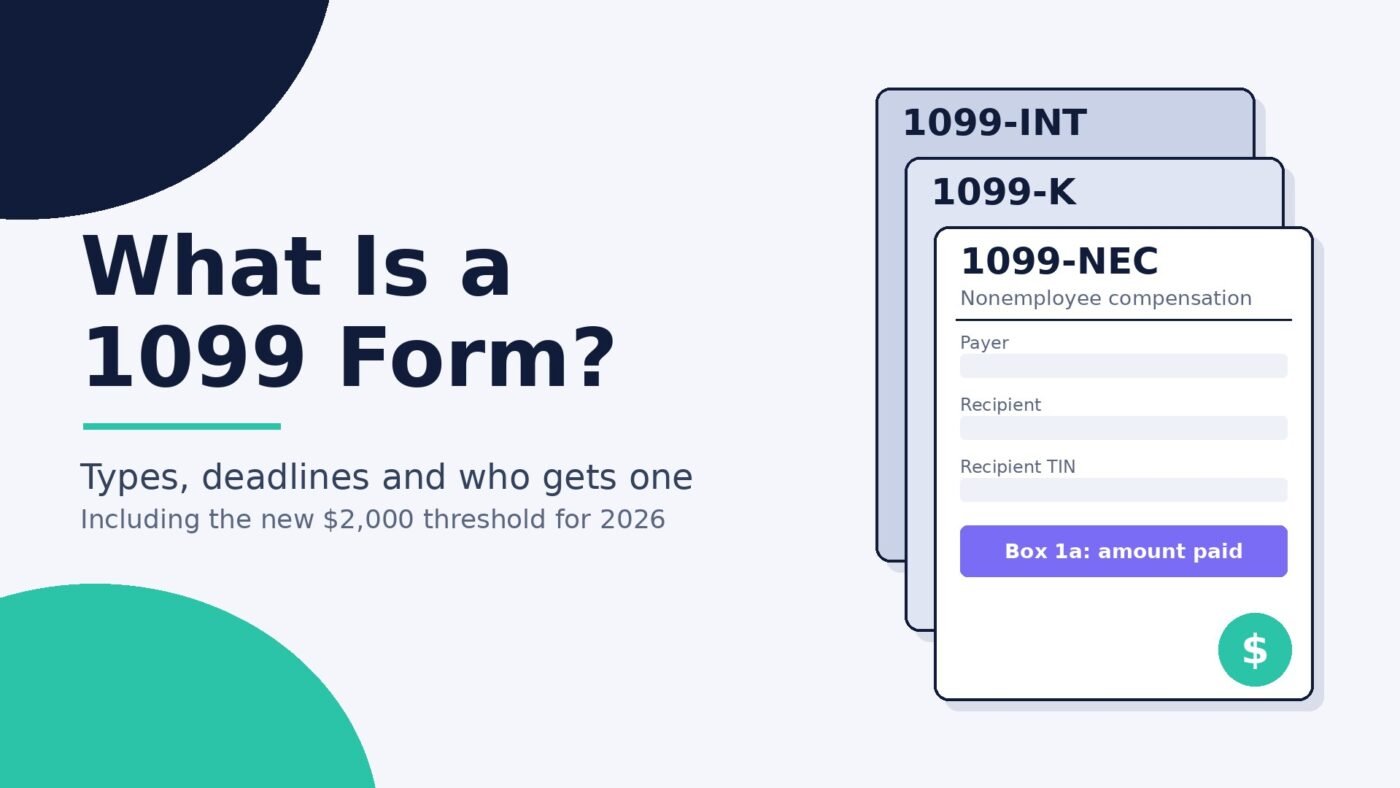
A 1099 form is an IRS information return that reports money you received during the year that wasn’t paid as wages on a W-2. The business, bank, broker or payment platform that paid you files it with the IRS and sends you a copy, so both of you have the same record. Freelancers usually get a Form 1099-NEC for their work, but there are other 1099s for interest, dividends, rent, retirement withdrawals and card or app payments. Getting a 1099 doesn’t mean tax was withheld, and not getting one doesn’t make the income tax-free.
If a client just asked for your W-9 or a 1099 showed up in your mailbox, this guide explains what the form is, which type you’re likely to see, the new 2026 reporting thresholds, the deadlines, and what to do with it at tax time. Figures come from IRS Publication 1099 (2026), the Instructions for Forms 1099-MISC and 1099-NEC (Rev. December 2026) and other IRS pages linked below.
Not tax advice: this is general information based on IRS publications. Your situation may differ, so check with a tax professional if you’re unsure.
How a 1099 works
The IRS gets a copy of most income you earn from someone else. If you’re an employee, that’s your W-2. For almost everything else, it’s a form in the 1099 family. The flow looks like this:
- Before paying you, a business usually asks for a Form W-9 with your name, address and taxpayer ID number (your SSN or an EIN).
- During the year, it pays you in full. With a few exceptions, nothing is withheld for taxes.
- After the year ends, it adds up what it paid you. If the total reaches the reporting threshold for that type of payment, it files a 1099 with the IRS and sends you a copy.
- At tax time, you report the income on your return. The IRS can match what you report against the 1099s filed under your number.
A 1099 is filed by the payer, not by you. You don’t fill one out to receive money, and you don’t attach your copy to your return in most cases. You use it as a record of what to report.
One limit matters a lot: the rules for 1099-NEC and 1099-MISC only cover payments made in the course of a trade or business. The IRS instructions state plainly that personal payments are not reportable. If a neighbor pays you to paint their fence, they don’t file a 1099. Your income is still taxable, though.
The most common types of 1099
There are more than a dozen forms in the 1099 series. These are the ones regular people and small business owners run into most. Thresholds and due dates are from the Guide to Information Returns in Publication 1099 (2026).
| Form | What it reports | Who usually sends it | Reporting threshold (2026) |
|---|---|---|---|
| 1099-NEC | Pay for services by a non-employee | Clients of freelancers and contractors | $2,000 or more |
| 1099-MISC | Rent, royalties, prizes, other income | Businesses paying rent, royalties or awards | $2,000 or more for most boxes; $10 for royalties |
| 1099-K | Card and payment app/marketplace payments for goods or services | Card processors, payment apps, online marketplaces | All card payments; apps and marketplaces over $20,000 and over 200 transactions |
| 1099-INT | Interest income | Banks, credit unions | $10 or more (higher in some cases) |
| 1099-DIV | Dividends and distributions | Brokers, funds, companies | $10 or more |
| 1099-B | Sales of stocks and other securities | Brokers | All amounts |
| 1099-R | Retirement plan, IRA, pension and annuity distributions | Plan administrators, IRA custodians | $10 or more |
| 1099-G | Unemployment pay, state and local tax refunds | Government agencies | $10 or more for refunds and unemployment |
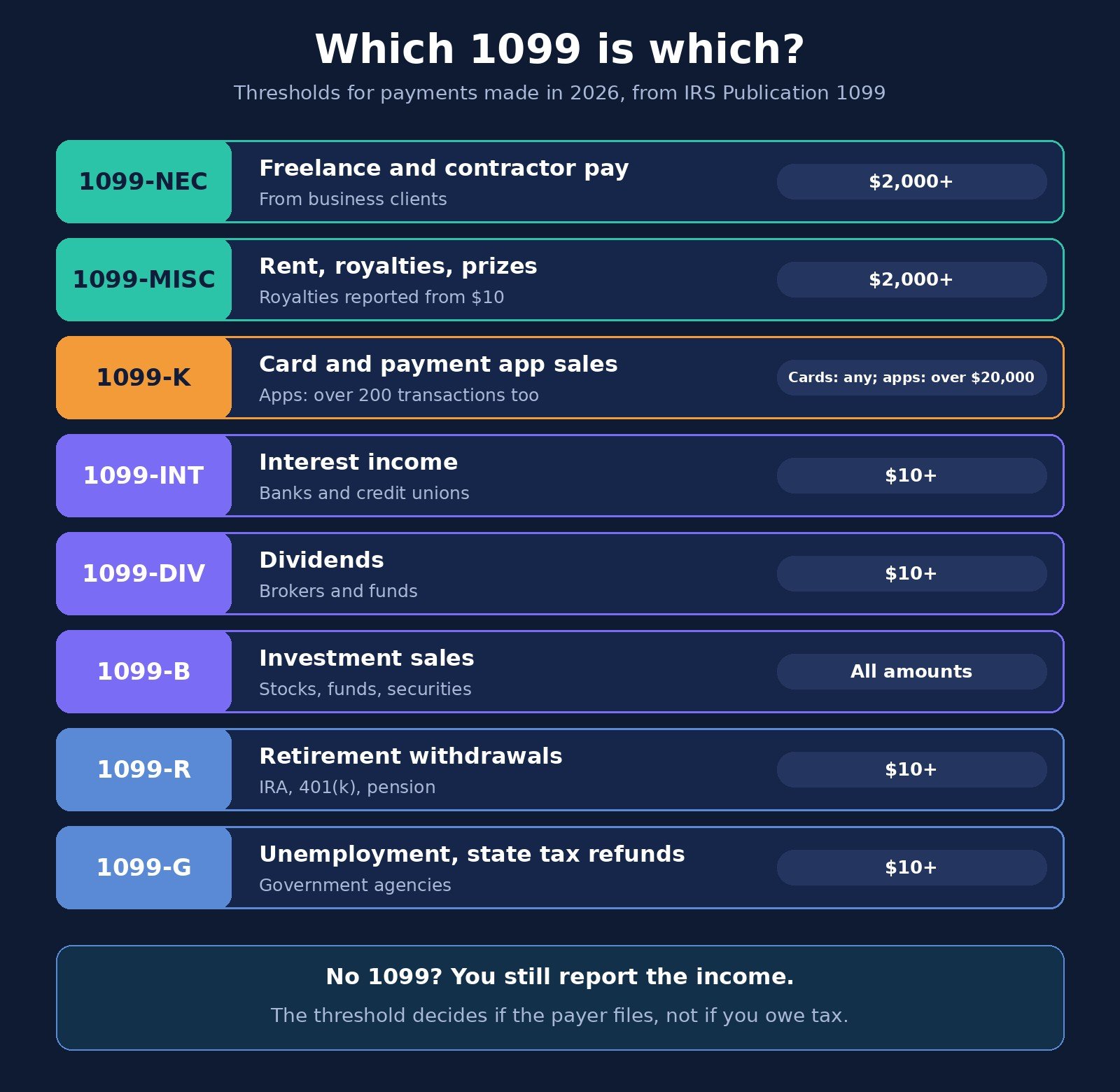
For side hustlers, the big three are the 1099-NEC, the 1099-MISC and the 1099-K. The rest mostly show up if you have savings, investments or retirement accounts.
1099-NEC vs 1099-MISC
These two get confused because freelance pay used to be reported on the 1099-MISC. Now it has its own form.
Form 1099-NEC: pay for your work
“NEC” stands for nonemployee compensation. According to the IRS instructions, a business files a 1099-NEC for each person it paid at least $2,000 during 2026 for services performed by someone who is not its employee (including parts and materials), and for payments to attorneys for legal services. If you’re a freelance writer, designer, developer, virtual assistant, consultant or independent contractor, this is your form. Starting with the December 2026 revision, the compensation amount goes in box 1a.
Form 1099-MISC: other business payments
The 1099-MISC covers payments that aren’t for services. For 2026, the same instructions list at least $10 in royalties, at least $600 in gross proceeds paid to an attorney (such as a settlement), and at least $2,000 in rents, prizes and awards, other income payments, medical and health care payments, and crop insurance proceeds, among a few others. If you rent office space or equipment to a business, or you win a prize from a company contest, you may get a 1099-MISC.
| 1099-NEC | 1099-MISC | |
|---|---|---|
| Main use | Pay for services by non-employees | Rent, royalties, prizes, other income |
| Typical recipient | Freelancers, contractors, consultants | Landlords, authors, prize winners |
| 2026 threshold | $2,000 | $2,000 for most boxes; $10 royalties; $600 attorney gross proceeds |
| Due to the IRS | January 31 | February 28 on paper, March 31 if e-filed |
| Due to you | January 31 | January 31 (February 15 for boxes 8 and 10) |
Older articles, and even some IRS summary pages, still show $600 for both forms. That was the rule for payments made before 2026. The IRS page “Am I required to file a Form 1099?” confirms the 1099-NEC threshold is $600 for payments before 2026 and $2,000 for payments in 2026, with inflation adjustments after that.
Form 1099-K: card and payment app sales
The 1099-K reports payments you received through credit and debit cards, payment apps and online marketplaces for goods or services. Two rules apply, per Publication 1099:
- Card payments: reportable at all amounts. If a processor handles card payments for your business, expect a 1099-K.
- Payment apps and marketplaces: reportable only if your payments for goods or services total more than $20,000 and you have more than 200 transactions in the year.
The IRS’s Understanding your Form 1099-K page adds two points worth knowing. Platforms may send you a 1099-K even when you’re under those numbers, and some states have lower thresholds. Money from friends and family as a gift or to repay a shared expense isn’t payment for goods or services. If you use Venmo for both, our guide to Venmo fees and limits covers how its business and personal accounts differ.
A quick note on overlap: if a client pays you through a card or payment app, the IRS instructions say those payments are reported on a 1099-K by the payment company and are not subject to reporting on a 1099-NEC or 1099-MISC. Either way, count the income once on your return, not twice.
Who gets a 1099 (and who doesn’t)
You’ll typically get a 1099 if, during the year, you:
- Did $2,000 or more of freelance or contract work for one business client (2026 payments)
- Earned $10 or more in interest or dividends from a bank or brokerage
- Sold stocks, funds or other securities through a broker
- Took money out of an IRA, 401(k) or pension
- Received unemployment benefits or a state tax refund
- Took card payments, or crossed the 1099-K threshold on an app or marketplace
You usually won’t get a 1099-NEC or 1099-MISC if:
- A client paid you less than the threshold for the year
- Your client is an individual paying for personal services, not a business
- Your business is a corporation. Publication 1099 says payments to corporations are generally not reportable, with exceptions such as medical and health care payments and payments to attorneys
- You’re an employee. Your wages go on a W-2 instead
There’s one more case where the dollar threshold doesn’t matter: if a payer withheld federal income tax under the backup withholding rules, it must file a 1099-NEC or 1099-MISC regardless of the amount. Backup withholding is 24% and usually kicks in when you don’t give a payer a valid taxpayer ID on your W-9.
1099 deadlines
All of these are for income from the previous calendar year. From the Publication 1099 guide table:
| Form | Copy to you | Copy to the IRS |
|---|---|---|
| 1099-NEC | January 31 | January 31 (paper or e-file) |
| 1099-MISC | January 31 (February 15 if boxes 8 or 10 are used) | February 28 paper, March 31 e-file |
| 1099-K | January 31 | February 28 paper, March 31 e-file |
| 1099-INT, 1099-DIV, 1099-R, 1099-G | January 31 | February 28 paper, March 31 e-file |
| 1099-B | February 15 | February 28 paper, March 31 e-file |
If a due date lands on a Saturday, Sunday or legal holiday, the IRS moves it to the next business day. January 31, 2027 is a Sunday, so 1099s for 2026 income that are due “January 31” are due on Monday, February 1, 2027. The IRS tax calendar lists the exact dates each year.
Many forms are delivered electronically now, especially from banks, brokers and payment apps. If you agreed to e-delivery, check your account’s tax documents section rather than waiting for the mail.
You got a 1099. Now what?
- Check it against your records. Compare the amount with your invoices, bank deposits or account statements. Our guide on how to invoice a client shows how to keep records that make this easy.
- Check your name and taxpayer ID. They should match what you put on your W-9.
- Report it on the right part of your return. Freelance income from a 1099-NEC generally goes on Schedule C as business income, where you can subtract business expenses. Interest and dividends go elsewhere on your Form 1040.
- Remember self-employment tax. Clients don’t withhold Social Security, Medicare or income tax from 1099-NEC pay. The IRS says you have to file a return if your net earnings from self-employment were $400 or more.
- Plan for next year. Because nothing is withheld, most freelancers pay quarterly. Our guide to estimated taxes for the self-employed walks through it, and the 2026 IRS mileage rate can cut your taxable profit if you drive for work.
What if you didn’t get a 1099, or it’s wrong?
No 1099? You still report the income
This trips up a lot of new freelancers. The threshold only decides whether the payer has to file the form. It doesn’t decide whether you owe tax. The IRS says it directly: whether or not you receive a 1099-K, you must still report any income on your tax return, and the same principle applies to income that never shows up on a 1099-NEC. If a client paid you $1,500 in 2026 and sent no form, that $1,500 still goes on your return.
If you expected a form and it’s past the deadline, contact the payer first. Many forms are simply late or went to an old address. You don’t have to wait for a missing 1099 to file if your own records show what you earned.
Wrong amount or details? Ask for a corrected form
If the amount, your name or your taxpayer ID is wrong, contact the payer and ask them to issue a corrected 1099. Payers file corrections with the IRS using the CORRECTED box described in Publication 1099. Keep a copy of your invoices or statements that show the right figure. Don’t simply report a number that doesn’t match the 1099 without being able to show why, because the IRS matches returns against the forms it receives.
1099 vs W-2 in one minute
A W-2 is for employees. Your employer withholds income tax, Social Security and Medicare from each paycheck and pays its share of payroll taxes. A 1099-NEC is for independent contractors. You get paid in full and handle your own taxes, including self-employment tax, usually through quarterly estimated payments. Which form you get depends on whether you’re legally an employee or a contractor, not on what you and the client prefer. Many side hustlers get both: a W-2 from a day job and 1099s from freelance work.
If your freelance income is growing, it may be time to think about structure. Compare a sole proprietorship vs LLC, and later, whether an S corp election makes sense. Neither changes the fact that your clients will still send 1099s to an LLC taxed as a sole proprietorship.
For business owners: sending 1099s
If you pay contractors, you’re the one filing. A few habits keep it painless:
- Collect a W-9 before the first payment. It gives you the exact name and taxpayer ID to use. Our W-9 guide explains what to look for.
- Track payments by contractor through the year. At year end, total what you paid each one and compare it with the threshold for that form.
- Skip payments made by card or payment app. Those are generally reported by the platform on a 1099-K.
- E-file if you have 10 or more. The IRS says that if you have 10 or more information returns, you must file them electronically. Its IRIS portal lets you e-file 1099s online.
- File on time. Late or incorrect forms can trigger penalties. Publication 1099 points to the IRS information return penalties page for current amounts, and small businesses with $5 million or less in average gross receipts get lower maximum penalties.
Need an EIN so contractors and clients aren’t passing your Social Security number around? See how to apply for an EIN online. It’s free from the IRS.
Frequently asked questions
What is a 1099 form in simple terms?
A 1099 is an IRS form that reports money you were paid that wasn’t wages, such as freelance pay, interest, dividends or retirement withdrawals. The payer sends one copy to the IRS and one to you, and you use it to report that income on your tax return.
Do I have to pay taxes on a 1099?
The income on a 1099 is generally taxable, and in most cases nothing was withheld. Freelance income on a 1099-NEC is also subject to self-employment tax once your net earnings reach $400. You owe tax on the income whether or not you get the form.
What is the 1099 threshold for 2026?
For payments made in 2026, businesses file a 1099-NEC when they pay a non-employee $2,000 or more for services, up from $600 before 2026. Most 1099-MISC boxes also use $2,000, royalties use $10, and payment apps file a 1099-K only above $20,000 and 200 transactions.
What’s the difference between a 1099-NEC and a 1099-MISC?
A 1099-NEC reports pay for services by someone who isn’t an employee, like a freelancer or contractor. A 1099-MISC reports other business payments, such as rent, royalties, prizes and awards. They also have different IRS filing deadlines.
When should I receive my 1099?
Most 1099s, including the 1099-NEC, 1099-K, 1099-INT and 1099-R, must reach you by January 31. The 1099-B and certain 1099-MISC forms are due by February 15. When the date falls on a weekend or holiday, it moves to the next business day.
What if I made less than $2,000 from a client?
The client generally doesn’t have to send you a 1099-NEC for 2026, but you still have to report the income. The threshold only decides whether the payer files the form, not whether the money is taxable.
Is a 1099 the same as a W-9?
No. A W-9 is the form you fill out to give a payer your name and taxpayer ID. A 1099 is the form the payer later files to report what it paid you. The W-9 comes first and supplies the details for the 1099.
Bottom line
A 1099 is the IRS’s record of non-wage income. Freelancers mostly deal with the 1099-NEC, which for 2026 payments kicks in at $2,000 per client, plus the 1099-K if they sell through payment apps or take cards. Check every form against your own records, ask for a correction when something’s off, and report all of your income even when no 1099 arrives. Since nothing is withheld, set money aside through the year so tax season isn’t a surprise.

The Teck Hustlers Editorial Team covers technology, business, finance and gaming news for readers who want the story behind the headline. Every article is researched, written and edited by our in-house team, checked against company announcements, filings and reputable reporting, and updated when new facts emerge. We focus on what each development means for founders, professionals, investors and everyday users. Have a tip or a correction? Reach us through our contact page.