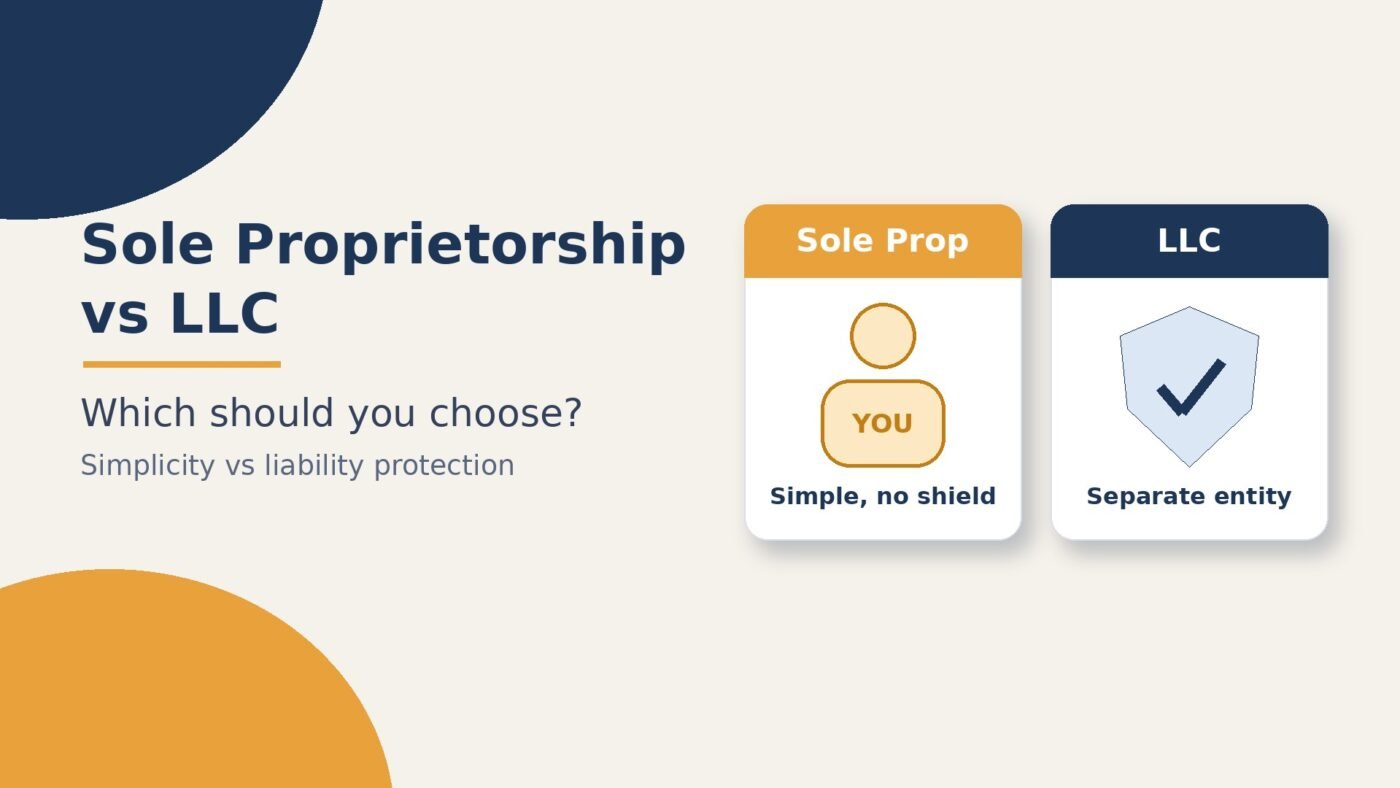
A sole proprietorship is what you are by default when you start doing business on your own without registering a company: it’s cheap and simple, but you and the business are legally the same, so you’re personally on the hook for its debts. An LLC is a separate business you form with your state. It costs more and adds some paperwork, but it generally shields your personal assets from business debts and lawsuits. For federal taxes, a one-owner LLC is taxed just like a sole proprietorship unless you choose otherwise, so the real trade-off is liability protection versus cost and admin.
This guide compares the two side by side, explains where the LLC shield stops, shows what each costs to run, and gives you a checklist for deciding when it’s time to form an LLC.
Not legal or tax advice: this is general information based on SBA and IRS guidance for US businesses. State rules and fees differ, so check your state’s official website and talk to an attorney or tax professional about your situation.
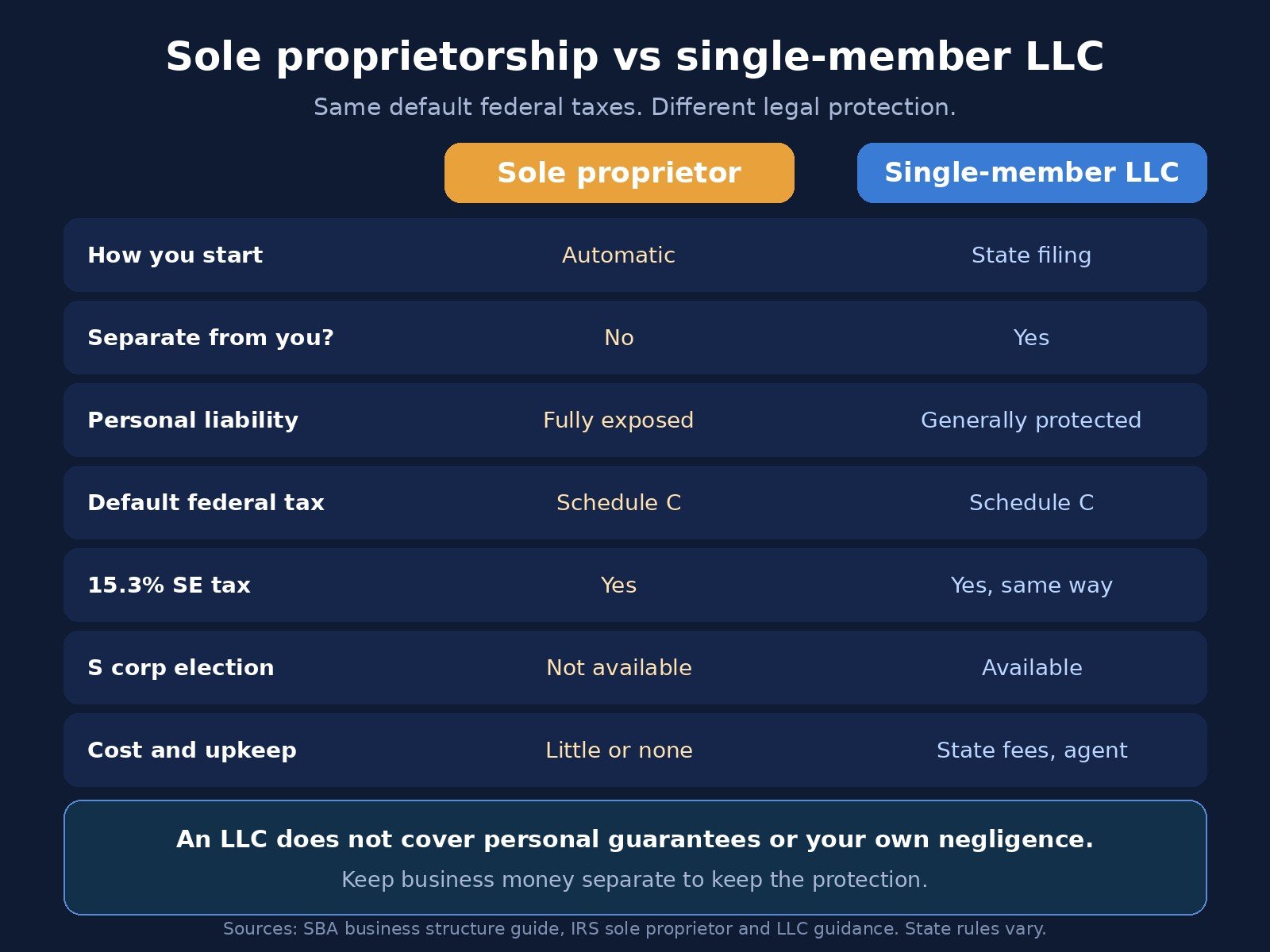
Sole proprietorship vs LLC at a glance
| Sole proprietorship | LLC (one owner) | |
|---|---|---|
| How you start | Automatic once you do business alone; no state formation filing | File articles of organization with your state |
| Legal status | Not separate from you | A separate legal entity |
| Personal liability | You’re personally liable for business debts | Personal assets generally protected, with limits |
| Default federal tax | Schedule C on your Form 1040 | Same: Schedule C, as a “disregarded entity” |
| Self-employment tax | Yes, on net earnings | Yes, in the same way |
| Tax options | None: always taxed on your personal return | Can elect to be taxed as an S corp or C corp |
| Startup cost | Little or none (licenses and a DBA may apply) | State filing fee, plus a registered agent |
| Ongoing upkeep | Minimal | State reports or taxes in many states, separate records |
| Owners | One person only | One or more members |
What is a sole proprietorship?
A sole proprietorship is the simplest way to run a business. The SBA says you’re automatically considered a sole proprietorship if you do business activities but don’t register as any other kind of business. Selling crafts online, freelancing or walking dogs for cash all count. The IRS defines a sole proprietor as someone who owns an unincorporated business by themselves.
The catch is that a sole proprietorship doesn’t create a separate business entity. Per the SBA, your business assets and liabilities aren’t separate from your personal ones, and you can be held personally liable for the debts and obligations of the business. You can still use a trade name instead of your own name by registering a DBA; our DBA vs LLC guide explains how that works and why a DBA doesn’t add any protection.
What is an LLC?
A limited liability company is a business structure created by filing with your state. According to the SBA, an LLC protects you from personal liability in most instances, so your vehicle, house and savings generally aren’t at risk if the LLC goes bankrupt or is sued. An LLC can have one owner (a single-member LLC) or several, and it needs a registered agent in the state where you file.
LLCs also have tax flexibility that sole proprietorships don’t. The SBA notes an LLC can be taxed as a C corp or S corp, though most small LLCs keep the default treatment. If you decide to form one, our step-by-step guide on how to start an LLC covers the filing.
Liability: the biggest difference
This is the main reason people form an LLC. As a sole proprietor, if the business owes money it can’t pay, or a customer wins a lawsuit against it, creditors can go after your personal bank account, car or home, because legally there’s no separate business to stop at.
With an LLC, business debts and claims generally belong to the LLC. If it fails, you can lose what you put into it, but your personal assets are usually off the table.
What the LLC shield doesn’t cover
The SBA’s wording is “in most instances,” and that matters. An LLC generally won’t protect you from:
- Personal guarantees. Many banks, landlords and card issuers ask small business owners to sign personally. If you do, you owe that debt no matter what structure you use.
- Your own mistakes. If you personally cause harm through negligence or wrongdoing, you can usually be sued directly. The LLC protects you from the business’s debts, not from your own conduct.
- Some taxes. Owners or responsible people can stay liable for certain business taxes; the Washington Department of Revenue, for example, notes LLC members are not typically liable for debts other than taxes.
- Treating the LLC like your personal wallet. If you mix personal and business money or ignore your state’s requirements, a court may decide the LLC isn’t really separate from you. Keep a separate business bank account and records.
Business insurance covers some of the same risks, and the SBA suggests it to fill in gaps in coverage. Many owners use both: an LLC for structure, insurance for claims.
Taxes: often the same by default
A lot of people assume an LLC saves taxes. By default, a one-owner LLC doesn’t change your federal taxes at all.
Sole proprietorship taxes
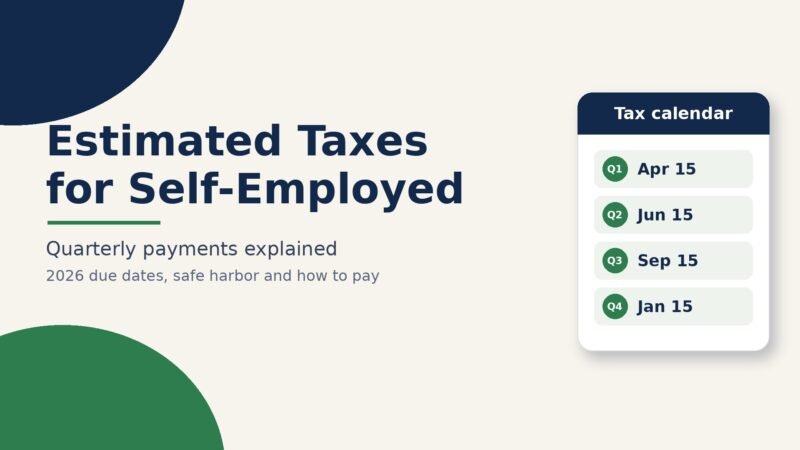
As a sole proprietor you report business profit or loss on Schedule C with your Form 1040, pay self-employment tax on Schedule SE, and usually make estimated payments with Form 1040-ES. Self-employment tax is Social Security and Medicare for people who work for themselves, and the IRS sets it at 15.3%: 12.4% for Social Security and 2.9% for Medicare. Because nothing is withheld, see our guide to quarterly estimated taxes.
Single-member LLC taxes
The IRS treats a one-owner LLC as a sole proprietorship (a disregarded entity) by default, unless it elects to be taxed as a corporation. The owner of a single-member LLC is subject to self-employment tax in the same manner as a sole proprietorship. Same Schedule C, same 15.3% self-employment tax, same estimated payments.
One difference: if a disregarded LLC has employees, the IRS treats it as separate from its owner for employment taxes, so payroll filings use the LLC’s name and EIN.
LLCs with two or more owners
A sole proprietorship can only have one owner. An LLC with two or more members is treated as a partnership by default, which means a partnership return and K-1s for each member. If you’re starting with a partner, a sole proprietorship isn’t an option, so you’re choosing between a general partnership and an LLC.
The S corp option
This is where an LLC can change your taxes. An eligible LLC can elect S corporation treatment with Form 2553. You then pay yourself a reasonable salary through payroll, and only the salary pays Social Security and Medicare tax. It adds payroll and an extra return, so it usually only pays off once profit is steady. A sole proprietorship can’t make this election. We cover the details in LLC vs S corp.
Costs and paperwork
Sole proprietorship: no formation filing. You may still need local business licenses or permits, and a DBA registration if you use a name other than your own. The SBA notes that if you do business under your own legal name, you won’t need to register anywhere.
LLC: you pay a state filing fee to form it, appoint a registered agent, and keep up with whatever your state requires afterward. Fees vary by state; the SBA says in most cases the total cost to register a business is less than $300. Ongoing costs are where states really differ. California, for example, charges an annual tax of $800 on every LLC doing business or organized there, due even in years the LLC isn’t doing business, until it’s canceled. Other states charge an annual report fee, and a few have publication requirements. Check your Secretary of State and state tax agency for current numbers.
LLCs also come with a few habits worth building: a separate bank account, contracts and invoices in the LLC’s name, and an operating agreement, which the SBA says is widely recommended even where it isn’t required. If you do business in more than one state, you may also need to foreign qualify there, with fees in each state.
Pros and cons
Sole proprietorship
- Pros: free or nearly free to start, no state formation filing, full control, simplest taxes and records.
- Cons: unlimited personal liability, one owner only, no S corp option, and the SBA notes it can be hard to raise money because banks are hesitant to lend to sole proprietorships.
LLC
- Pros: liability protection in most instances, can add owners, can elect S corp or C corp taxes later, and a registered business name can look more established to clients.
- Cons: formation and ongoing state fees, a registered agent, more record-keeping, and no federal tax savings by default.
When to stay a sole proprietor and when to form an LLC
A sole proprietorship usually makes sense if:
- You’re testing an idea or running a small side hustle. The SBA calls sole proprietorships a good choice for low-risk businesses and owners who want to test their business idea.
- The work carries little risk of injury, property damage or large debts, such as writing, tutoring online or selling digital products.
- You don’t have significant personal assets to protect yet, and insurance covers the main risks.
- Your state’s annual LLC costs would eat a big share of a small profit.
An LLC is worth it if:
- Your work involves physical risk, client property, employees or contracts with real money at stake. The SBA suggests LLCs for medium- or higher-risk businesses and owners with significant personal assets.
- You own a home or have savings you’d hate to lose to a business claim.
- You’re starting with a partner, or plan to.
- Your profit is growing to the point where an S corp election might be worth exploring.
- Clients or platforms ask you to contract as a business entity.
Plenty of people start as a sole proprietor, using one of our online side business ideas to test demand, and form an LLC once the business has real revenue or real risk. Nothing stops you from switching later.
How to switch from a sole proprietorship to an LLC
- Pick a name and check availability with your Secretary of State.
- Choose a registered agent (you, if your state allows it, or a service).
- File articles of organization and pay the state fee. Our how to start an LLC guide walks through it.
- Write an operating agreement, even for a one-person LLC.
- Sort out your EIN. The IRS says a single-member LLC can use your sole proprietor EIN if it doesn’t elect corporate or S corp taxation and has no employees or excise taxes. Otherwise, get one free from the IRS; see how to apply for an EIN online.
- Open a business bank account in the LLC’s name and move business money there.
- Update everything else: licenses, permits, contracts, payment platforms, invoices and your website, so customers deal with the LLC, not you personally.
Common mistakes to avoid
- Forming an LLC to save taxes. By default, a single-member LLC pays exactly the same federal tax as a sole proprietorship.
- Assuming an LLC makes you untouchable. Personal guarantees and your own negligence aren’t covered.
- Mixing money. Paying personal bills from the LLC account weakens the separation that gives you protection.
- Forgetting annual requirements. Missed reports or state taxes can lead to penalties or losing good standing.
- Thinking a DBA protects you. A DBA is just a name; you’re still a sole proprietor.
- Not updating contracts after switching. If you keep signing in your own name, you may still be personally on the hook.
Sole proprietorship vs LLC: frequently asked questions
Is an LLC better than a sole proprietorship?
Not always. An LLC generally protects your personal assets from business debts and lawsuits, which a sole proprietorship doesn’t, but it costs more and adds state paperwork. For a low-risk side hustle, a sole proprietorship can be enough. For riskier work or a growing business, an LLC is usually worth it.
Does an LLC pay less tax than a sole proprietorship?
Not by default. The IRS treats a single-member LLC as a disregarded entity, so you file the same Schedule C and pay the same 15.3% self-employment tax as a sole proprietor. An LLC can lower taxes only if it elects S corp status and profit is high enough to cover the extra costs.
Do I need to register a sole proprietorship?
You don’t file formation papers with the state; you become a sole proprietor automatically when you start doing business alone. You may still need local licenses or permits, and a DBA registration if you use a business name other than your legal name.
How much does it cost to form an LLC?
It depends on your state. The SBA says the total cost to register a business is less than $300 in most cases, but ongoing costs vary. California, for example, charges an $800 annual tax on every LLC. Check your Secretary of State and state tax agency for current fees.
Can a sole proprietor have employees?
Yes. A sole proprietor can hire employees but then needs an EIN and must handle payroll filings such as Form 941 and W-2s, as the IRS lists for sole proprietors.
Can I switch from a sole proprietorship to an LLC later?
Yes. Form the LLC with your state, open a business bank account, and move licenses, contracts and payment accounts into the LLC’s name. A single-member LLC can keep using your sole proprietor EIN if it doesn’t elect corporate taxes and has no employees or excise taxes.
What is the difference between a single-member LLC and a sole proprietorship?
For federal taxes, usually nothing: both report on Schedule C. Legally, the single-member LLC is a separate entity that generally shields your personal assets, while a sole proprietorship is just you doing business.
The bottom line
The sole proprietorship vs LLC choice comes down to liability versus simplicity. A sole proprietorship is free to start and easy to run, but your personal assets back every business debt. An LLC costs more and adds state upkeep, but it generally keeps business problems away from your personal life, lets you add partners and opens the door to an S corp election later. Taxes are the same by default. If your work is low-risk and small, starting as a sole proprietor is reasonable; once real money, real risk or a partner is involved, form an LLC. This article is general information, not legal or tax advice.

The Teck Hustlers Editorial Team covers technology, business, finance and gaming news for readers who want the story behind the headline. Every article is researched, written and edited by our in-house team, checked against company announcements, filings and reputable reporting, and updated when new facts emerge. We focus on what each development means for founders, professionals, investors and everyday users. Have a tip or a correction? Reach us through our contact page.