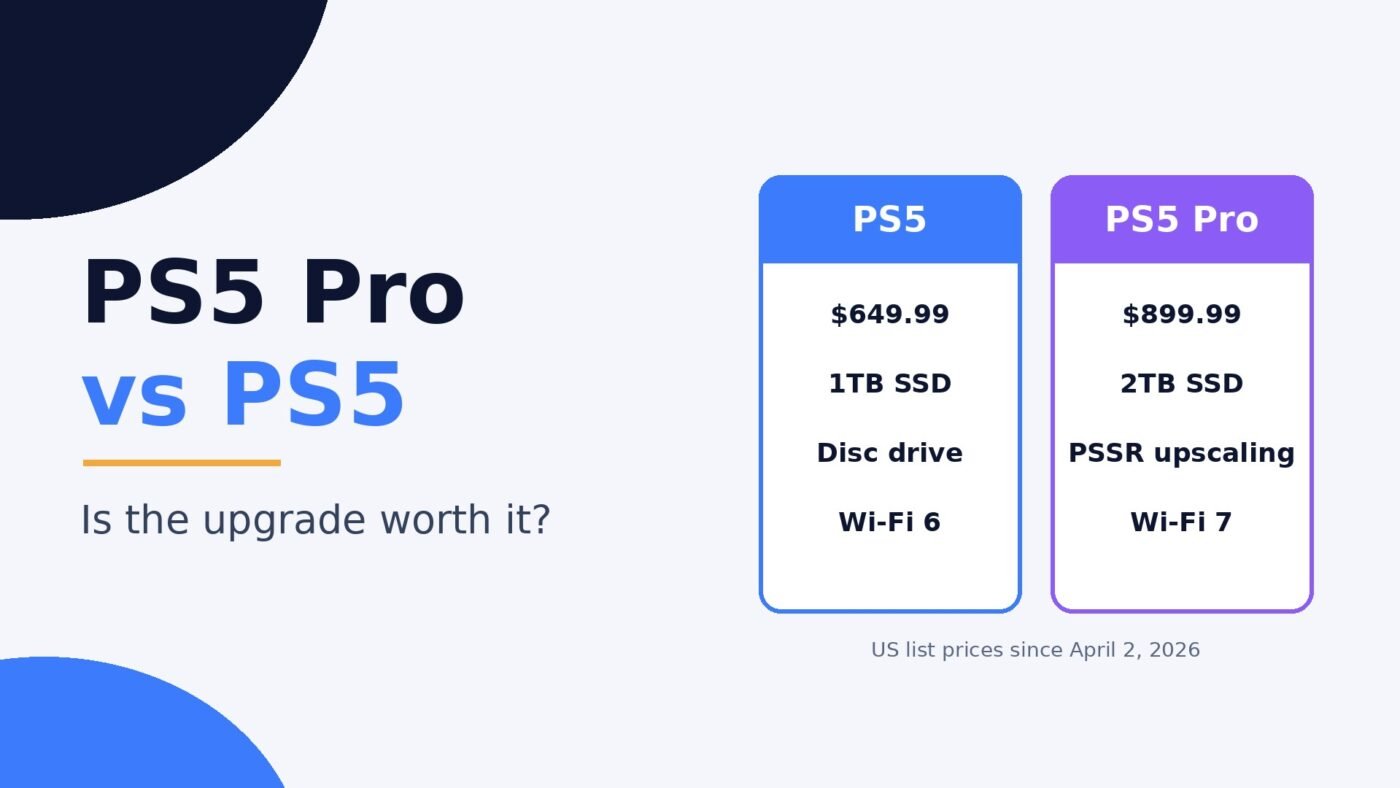
The PS5 Pro and the standard PS5 play exactly the same games. The Pro has a much bigger graphics chip, faster ray tracing, Sony’s AI upscaler (PSSR), a 2TB SSD and Wi-Fi 7, so Pro Enhanced games look sharper and run more smoothly on a 4K TV. It costs $899.99 in the US, $250 more than the disc PS5. If you have a 4K TV and care about image quality, the Pro is the better console. If you play on a 1080p screen, or you’re buying on a budget, the regular PS5 gets you the same library for less.
This guide compares the two consoles on price, performance, storage and features, explains what the upgraded PSSR changed in 2026, looks at how GTA 6 actually runs on each, and ends with a simple “who should buy which” list. Prices are US list prices as of November 2026 and are linked to their sources.
Quick verdict
- Buy the PS5 Pro if you play on a 4K TV, want the best version of big releases like GTA 6, and don’t mind buying the disc drive separately if you use discs.
- Buy the standard PS5 if you play on a 1080p or 1440p screen, mostly play smaller or older games, or want the cheapest way into the PS5 library.
- Already own a PS5? Upgrade only if you have a good 4K TV and play a lot of Pro Enhanced games. Every game you own already runs on the console you have.
PS5 Pro vs PS5 at a glance
| PS5 (slim) | PS5 Digital Edition | PS5 Pro | |
|---|---|---|---|
| US list price (since April 2, 2026) | $649.99 | $599.99 | $899.99 |
| Disc drive | Included | Optional add-on | Optional add-on |
| Storage | 1TB SSD | 825GB SSD (current model) | 2TB SSD |
| GPU | RDNA 2-based, 10.3 TFLOPS | Same as PS5 | 67% more compute units, 28% faster memory, up to 45% faster rendering |
| Ray tracing | Yes | Yes | Rays cast at 2x to 3x the speed of PS5 |
| AI upscaling (PSSR) | No | No | Yes |
| Wi-Fi | Wi-Fi 6 (802.11ax) | Wi-Fi 6 (802.11ax) | Wi-Fi 7 |
| Game library | All PS5 games, 8,500+ PS4 games | Same | Same |
Price: what each console really costs in 2026
Sony has raised console prices twice since the Pro launched. The PS5 Pro launched on November 7, 2024 at $699.99. After the latest increase, effective April 2, 2026, US prices are:
- PS5 (with disc drive): $649.99
- PS5 Digital Edition: $599.99
- PS5 Pro: $899.99
So the Pro costs $250 more than the disc PS5 and $300 more than the Digital Edition. Some older reviews still quote $699 or $749. Those prices no longer apply.
The disc drive math
The PS5 Pro ships without a disc drive. If you own physical games or watch 4K Blu-rays, you need Sony’s add-on drive, which is $79 at PlayStation Direct. That makes a disc-capable Pro about $979, roughly $330 more than a disc PS5. If you’re all-digital, ignore this and compare $899.99 with $599.99.
Refurbished and stock
Sony sells Certified Refurbished consoles at PlayStation Direct, usually for less than new. Stock of both consoles, especially the Pro, has been tight around the GTA 6 launch and Black Friday, and some marketplace sellers list the Pro far above Sony’s price (GamesRadar+). Treat anything well above $899.99 as a reseller markup, not the real price.
Performance: what the Pro actually changes
Almost all of the Pro’s upgrade is in graphics. Sony lists three headline changes in its official announcement.
A bigger GPU and faster ray tracing
The Pro’s GPU has 67% more compute units than the PS5 and 28% faster memory, which Sony says adds up to up to 45% faster rendering in games. Its ray tracing hardware can cast rays at “double, and at times triple” the speed of the regular PS5. For context, the standard PS5’s GPU is an AMD RDNA 2-based chip rated at 10.3 TFLOPS. Our explainer on what GPU is in the PS5 covers that chip in more detail.
In practice, developers use the extra power in one of three ways: higher resolution at the same frame rate, a steadier frame rate, or extra effects like ray-traced reflections and shadows. On the base PS5 you often choose between a sharp “fidelity” mode at 30fps and a softer “performance” mode at 60fps. On the Pro, many enhanced games try to give you both at once. Insomniac’s Pro mode for Marvel’s Spider-Man 2, for example, combines Fidelity mode’s 4K and ray tracing with Performance mode’s 60fps, according to Sony’s PS5 Pro page.
PSSR, and the 2026 upgrade
PlayStation Spectral Super Resolution (PSSR) is the Pro’s machine-learning upscaler. A game renders at a lower resolution, for example 1440p, and PSSR rebuilds a sharper 4K image from it. It’s the console version of what Nvidia DLSS and AMD FSR do on PC. The regular PS5 doesn’t have it.
The first version of PSSR was uneven, with shimmering and flicker in some games. In March 2026 Sony rolled out an upgraded PSSR through a system update. It is built on the algorithm Sony co-developed with AMD under Project Amethyst, and Sony says it improves image stability and fine detail. A system setting called “Enhance PSSR Image Quality” applies the new model to older PSSR games too, and since a September 2026 system update that setting is on by default. It only affects games that already support PSSR. It doesn’t add upscaling to every game.
Pro Enhanced games and Game Boost
The biggest gains only appear in games patched for the Pro. These carry a “PS5 Pro Enhanced” label, and Sony says there are over 100 of them. Unpatched games can still benefit from PS5 Pro Game Boost, which Sony says may stabilize or improve performance in supported PS4 and PS5 games. “May” is the key word: results vary by game, and some games look and run the same on both consoles.
What doesn’t change
- The games. The Pro plays all PS5 games and over 8,500 PS4 games. There are no Pro-only games.
- Controllers and accessories. The DualSense, DualSense Edge, PS VR2, PlayStation Portal and Sony’s Pulse headsets all work with both consoles, per Sony.
- The processor is not the focus. Sony’s announced upgrades are GPU, ray tracing and upscaling. Games limited by the CPU don’t suddenly double their frame rate. GTA 6 is the clearest example.
GTA 6 on PS5 vs PS5 Pro
GTA 6 is the reason many people are looking at the Pro right now, so it’s worth being precise. Before launch, Rockstar said the game targets 30 frames per second on consoles and that the Pro version adds “improved clarity through PlayStation Spectral Super Resolution (PSSR) and ray-traced shadows only available on PlayStation 5 Pro” (quoted by Digital Foundry).
Digital Foundry’s post-launch testing found:
- Same base resolution: both consoles render at 1440p. The Pro upscales to 4K with PSSR. The base PS5 uses a simpler spatial upscale and looks softer.
- Same frame rate target: 30fps on both, with no 40fps or 60fps mode.
- Steadier on Pro: the Pro held 30fps through most of Digital Foundry’s testing, with brief dips in extreme scenes. The base PS5 more often slipped into the high 20s during heavy traversal and combat.
- Extra effects on Pro: ray-traced shadows that the base PS5 doesn’t get.
So for GTA 6, the Pro gives you a cleaner, more stable picture, not a faster game. That’s a real improvement on a big 4K TV, but much less noticeable on a 1080p screen. For more on the game itself, see our GTA 6 map guide and GTA 6 price and editions.
Storage, disc drive and Wi-Fi 7
Storage
The Pro comes with a 2TB SSD, double the 1TB in the disc PS5. The current PS5 Digital Edition has 825GB, after Sony quietly cut it from 1TB in 2025 (The Verge). Part of every SSD is reserved for system software, so usable space is lower on all three. Big modern games take a lot of space, so the Pro’s extra storage is worth real money. If you buy a standard PS5, you can add an M.2 SSD later. Our guide to the best SSDs for a PS5 upgrade walks through it.
Disc drive
Only the standard PS5 includes a disc drive. Both the Digital Edition and the Pro use the same detachable add-on drive, which needs an internet connection to pair the first time, according to Sony.
Wi-Fi 7
The Pro supports Wi-Fi 7, while the standard PS5 tops out at Wi-Fi 6 (802.11ax). You only benefit with a Wi-Fi 7 router, and a wired Ethernet connection still beats both for online play. Our Wi-Fi 7 explainer covers what the standard actually improves.
PS5 Slim vs original PS5
If you’re comparing the current PS5 with the launch model, the difference is mostly size and storage, not speed. The slim model from late 2023 is more than 30% smaller by volume, has a detachable disc drive, two front USB-C ports and a 1TB SSD, which is 175GB more than the original. The CPU, GPU and memory are the same, so games perform the same. If you already own an original PS5, there’s no performance reason to move to a slim.
Which one should you buy?
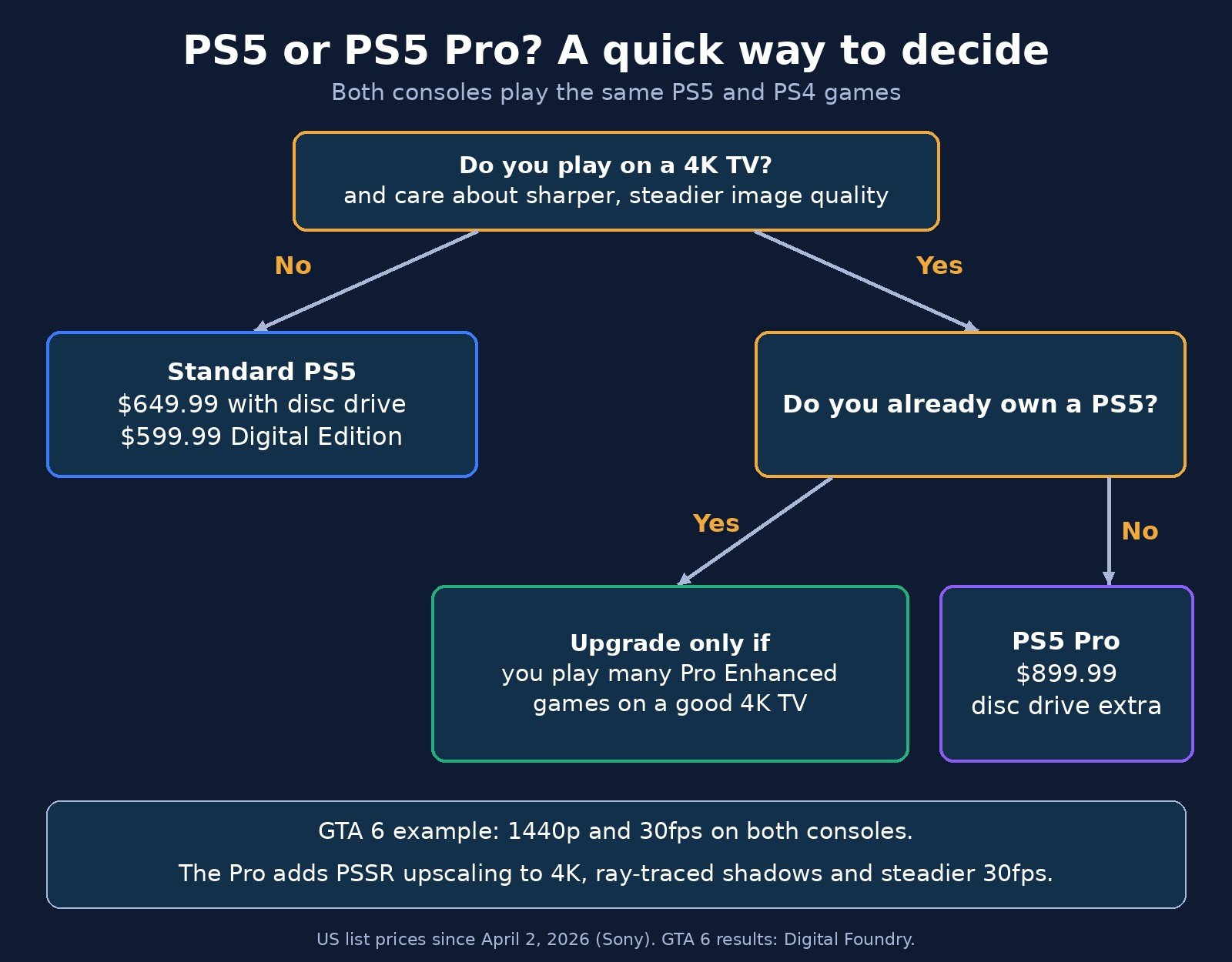
The PS5 Pro makes sense if you:
- Play on a 4K TV or monitor, ideally one with 120Hz and VRR.
- Mostly play big new releases, many of which ship with Pro modes.
- Notice and care about image quality: shimmering, soft textures, frame drops.
- Want 2TB of storage without buying an extra SSD.
The standard PS5 makes sense if you:
- Play on a 1080p TV or monitor, where much of PSSR’s benefit is lost.
- Play mostly indies, sports, fighting or older games that aren’t Pro Enhanced.
- Want physical discs without paying extra for a drive.
- Would rather spend the $250 to $300 difference on games, a second controller or PlayStation Plus.
If you already own a PS5
The upgrade is a much harder sell. You’d pay $899.99 for a console that plays the same games, minus whatever you get for your old one. It’s most worth it for someone with a high-end 4K TV who plays several big releases a year. If you’re still on a 1080p screen, a better TV will change more than a Pro will. Our OLED vs QLED and HDMI vs DisplayPort guides help with the display side.
Frequently asked questions
What is the difference between the PS5 and PS5 Pro?
The PS5 Pro has a more powerful GPU with 67% more compute units, faster ray tracing, PSSR AI upscaling, a 2TB SSD and Wi-Fi 7. It plays the same games as the PS5 but runs Pro Enhanced games with sharper images, steadier frame rates or extra effects.
How much does the PS5 Pro cost?
The PS5 Pro’s US list price is $899.99 since April 2, 2026. The standard PS5 is $649.99 and the PS5 Digital Edition is $599.99. The Pro has no disc drive. Sony’s add-on drive is sold separately.
Is the PS5 Pro worth it?
It’s worth it if you play on a 4K TV and care about image quality in big new games. On a 1080p screen, or if you mostly play games that aren’t Pro Enhanced, the standard PS5 delivers most of the experience for $250 less.
Does GTA 6 run better on PS5 Pro?
Yes, but not faster. GTA 6 targets 30fps on both consoles at a 1440p base resolution. On the Pro it is upscaled to 4K with PSSR, adds ray-traced shadows and holds 30fps more consistently, according to Digital Foundry.
Can the PS5 Pro play all PS5 and PS4 games?
Yes. The PS5 Pro plays all PS5 games and over 8,500 PS4 games, the same as the standard PS5. There are no games exclusive to the Pro.
Does the PS5 Pro come with a disc drive?
No. The PS5 Pro is digital-only out of the box. To play discs, you need Sony’s detachable disc drive, the same one that fits the PS5 Digital Edition.
What is PSSR on PS5 Pro?
PSSR (PlayStation Spectral Super Resolution) is the PS5 Pro’s AI upscaler. Games render at a lower resolution and PSSR reconstructs a sharper, near-4K image. An upgraded version arrived in March 2026 and is applied by default to supported games.
The bottom line
The PS5 Pro is the best way to play PS5 games, but not a different kind of console. You pay $250 more than a disc PS5 for a bigger GPU, better ray tracing, PSSR upscaling, double the storage and Wi-Fi 7, and you only see most of that on a 4K screen in Pro Enhanced games. GTA 6 sums it up: same 30fps, but a cleaner and steadier picture. If that matters to you and your TV can show it, buy the Pro. If not, the standard PS5 plays everything for less.

The Teck Hustlers Editorial Team covers technology, business, finance and gaming news for readers who want the story behind the headline. Every article is researched, written and edited by our in-house team, checked against company announcements, filings and reputable reporting, and updated when new facts emerge. We focus on what each development means for founders, professionals, investors and everyday users. Have a tip or a correction? Reach us through our contact page.