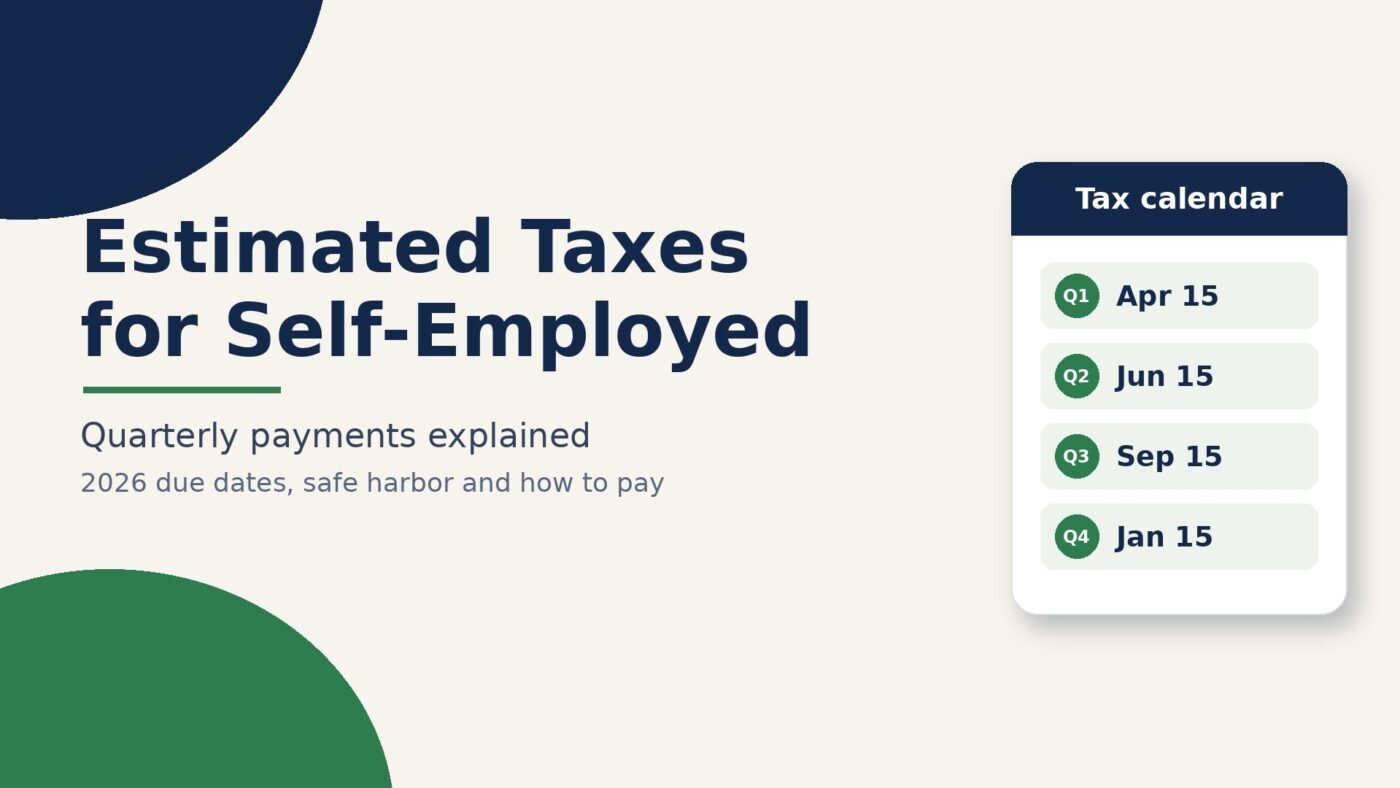
If you are self-employed in the US, you generally pay your federal taxes four times a year through estimated tax payments, because no employer is withholding tax from your income. The IRS says you generally need to make estimated payments if you expect to owe $1,000 or more when you file. You figure the amount with Form 1040-ES, and the payments cover both income tax and self-employment tax. For the 2026 tax year, the due dates are April 15, June 15 and September 15, 2026, and January 15, 2027.
This guide explains who has to pay, how to work out each payment, the simplest way to avoid the underpayment penalty, and how to pay the IRS online. It is written for freelancers, contractors and side hustlers who have just started earning 1099 or self-employment income.
Not tax advice: this is general information based on IRS guidance for the 2026 tax year. Your situation may differ, so check with a tax professional or enrolled agent before making decisions.
Do you have to pay estimated taxes?
According to the 2026 Form 1040-ES instructions, you generally must pay estimated tax for 2026 if both of these are true:
- You expect to owe at least $1,000 in tax for 2026 after subtracting your withholding and refundable credits.
- You expect your withholding and refundable credits to be less than the smaller of:
- 90% of the tax on your 2026 return, or
- 100% of the tax shown on your 2025 return (110% if your 2025 adjusted gross income was more than $150,000, or more than $75,000 if you are married filing separately).
In plain terms: if you have a side business or freelance income and nobody is taking tax out of it, you will usually cross the $1,000 line quickly, and quarterly payments are expected.
There is one useful exception. The IRS says you do not have to pay estimated tax for the current year if you had no tax liability for the prior year, were a US citizen or resident alien for the whole year, and your prior tax year covered a full 12 months. That often applies to people who were students or not working last year.
Separately, you must file Schedule SE and pay self-employment tax if your net earnings from self-employment were $400 or more. So even a small side hustle can create a tax bill, whether or not you end up needing quarterly payments.
2026 estimated tax deadlines
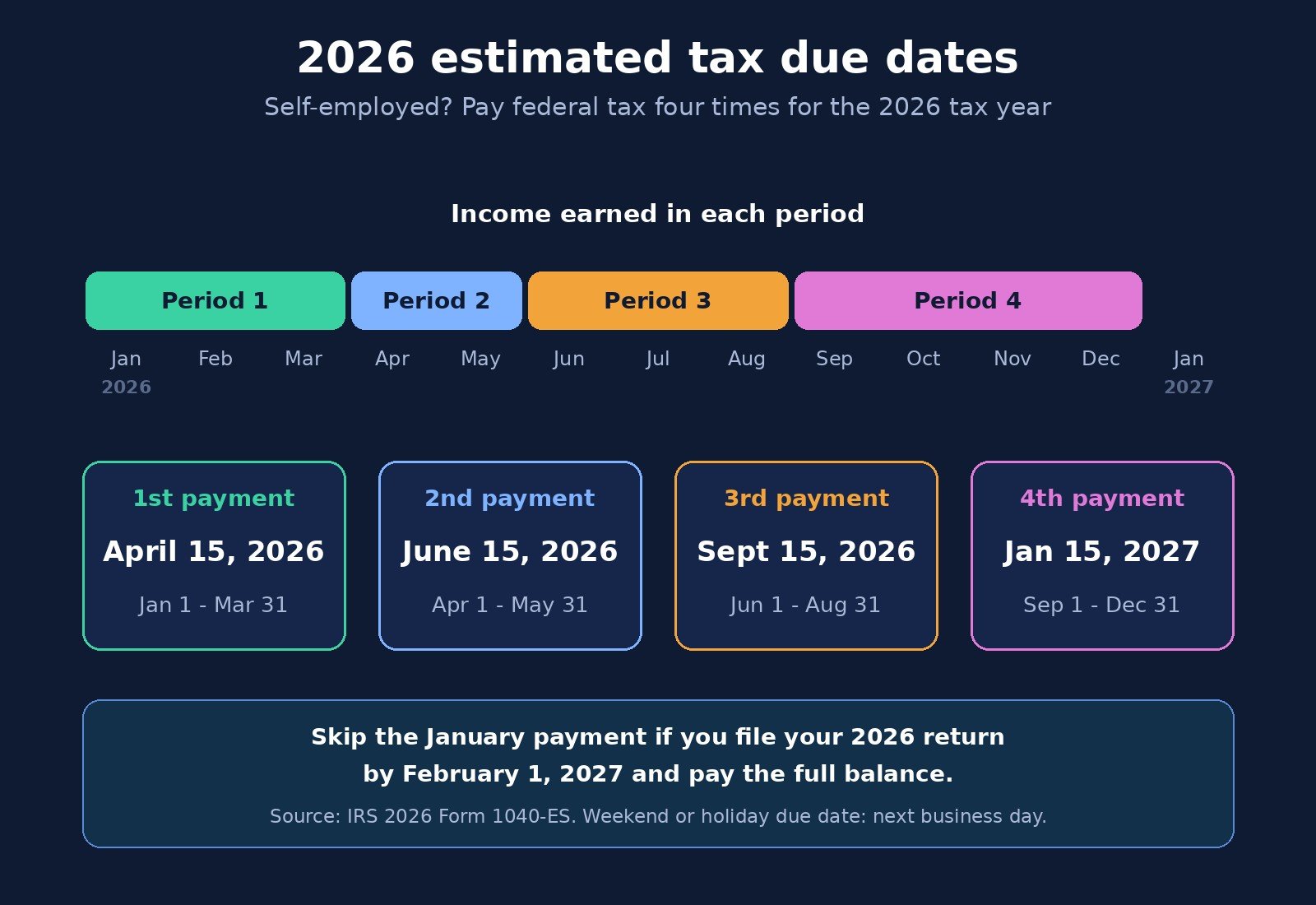
The IRS splits the year into four payment periods, but they are not equal quarters. The table combines the 2026 due dates from Form 1040-ES with the income period each payment covers.
| Payment | Income earned | Due date (2026 tax year) | Months covered |
|---|---|---|---|
| 1st | January 1 to March 31, 2026 | April 15, 2026 | 3 |
| 2nd | April 1 to May 31, 2026 | June 15, 2026 | 2 |
| 3rd | June 1 to August 31, 2026 | September 15, 2026 | 3 |
| 4th | September 1 to December 31, 2026 | January 15, 2027 | 4 |
A few timing rules worth knowing, all from the IRS:
- Weekends and holidays: if a due date falls on a Saturday, Sunday or legal holiday, a payment made on the next business day is on time.
- Skipping January: you don’t have to make the January 15, 2027 payment if you file your 2026 return by February 1, 2027 and pay the entire balance with it.
- Paying more often is fine: you can pay weekly or monthly as long as you have paid enough by the end of each period.
- Mailed payments: the postmark date counts as the payment date, but the 2026 Form 1040-ES warns that the postmark is the date USPS processes the item, which may be later than the day you mail it. Paying online avoids that risk.
As of this update (November 2026), the next deadline is the fourth 2026 payment on January 15, 2027. The 2027 schedule follows the same pattern, but confirm the exact dates on the 2027 Form 1040-ES once the IRS publishes it.
What estimated taxes actually cover
New freelancers are often surprised by the size of the bill because estimated tax covers two things, not one. The IRS notes that estimated tax pays income tax and other taxes such as self-employment tax.
Self-employment tax
Self-employment tax is your Social Security and Medicare contribution. An employee splits it with their employer; when you work for yourself you pay both halves. The IRS sets the self-employment tax rate at 15.3%: 12.4% for Social Security and 2.9% for Medicare.
- It is not charged on your whole profit. The 1040-ES worksheet has you multiply net profit by 92.35% first.
- The 12.4% Social Security part only applies up to a cap. For 2026, the first $184,500 of combined wages and net self-employment earnings is subject to it. The 2.9% Medicare part has no cap.
- Higher earners can owe an extra 0.9% Additional Medicare Tax above $200,000 (single), $250,000 (married filing jointly) or $125,000 (married filing separately).
- You can deduct the employer-equivalent portion (half) of self-employment tax when figuring your adjusted gross income. It reduces income tax, not the self-employment tax itself.
Income tax
On top of that, your business profit is added to any other income and taxed at your normal federal income tax rates, after deductions. That is why there is no single “correct” percentage to set aside: it depends on your total income, filing status and deductions. The Estimated Tax Worksheet in Form 1040-ES walks through it line by line.
How to calculate your quarterly payment
There are two practical approaches. Most people starting out use the first one if they can.
Method 1: base it on last year’s tax (the safe harbor)
If you pay at least 100% of the total tax shown on your prior-year return (110% if your prior-year AGI was over $150,000, or $75,000 married filing separately), spread across the four due dates, you generally avoid the underpayment penalty even if you end up owing more when you file.
- Find the “total tax” line on your 2025 return.
- Multiply it by 100% (or 110% if the higher-income rule applies to you).
- Subtract any tax you expect to have withheld in 2026, for example from a day job.
- Divide what is left by four and pay that amount by each due date.
Example: your 2025 total tax was $8,000, your AGI was under $150,000, and nothing is withheld. Paying $2,000 on each of the four 2026 due dates meets the 100% test. If your business grew and you owe more in April 2027, you pay the balance with your return, generally without an estimated tax penalty. Remember that you still owe the full tax, so keep money aside for that balance.
This method does not work well in your first year of self-employment if last year’s tax was tiny but this year’s will be large, or if you had no prior-year return. In that case, use Method 2.
Method 2: estimate this year’s tax
Here you aim to pay at least 90% of the tax you expect for the current year. The IRS suggests using your prior-year return as a starting point, then adjusting.
- Estimate your net profit for the year: expected business income minus business expenses.
- Work out self-employment tax with the Self-Employment Tax and Deduction Worksheet in Form 1040-ES.
- Estimate income tax on your total expected taxable income using the Estimated Tax Worksheet and the 2026 tax rate schedules included in the form.
- Add them up, subtract expected withholding and credits, and divide by the number of payments left.
- Recheck each quarter. If your income changes, the IRS says to simply complete another worksheet and adjust the next payment.
Worked example: self-employment tax on $40,000 profit
Using the rates in the 2026 Self-Employment Tax and Deduction Worksheet, and assuming no wages from a job:
| Step | Calculation | Result |
|---|---|---|
| Net profit | Business income minus expenses | $40,000.00 |
| Net earnings subject to SE tax | $40,000 × 92.35% | $36,940.00 |
| Medicare part | $36,940 × 2.9% | $1,071.26 |
| Social Security part | $36,940 × 12.4% (under the $184,500 cap) | $4,580.56 |
| Self-employment tax | Medicare + Social Security | $5,651.82 |
| Deduction for half of SE tax | $5,651.82 × 50% | $2,825.91 (reduces AGI for income tax) |
That is the self-employment tax only. Income tax comes on top and depends on your full situation, so run the full worksheet rather than relying on this example.
If your income is uneven
Freelance income is often lumpy. If you earned most of it late in the year, equal payments can look like underpayments for the early quarters. The IRS lets you use the annualized income installment method (Form 2210, Schedule AI) to make unequal payments that match when you actually earned the money. Form 1040-ES also points you to this method if you have a large change in income after March 31, 2026. If you use it, you file Form 2210 with Schedule AI with your return.
How to pay estimated taxes
You can pay online, by phone, by mail or through the IRS2Go app. The options listed in the 2026 Form 1040-ES compare like this:
| Method | Cost or access | Good to know |
|---|---|---|
| IRS Online Account | Requires an IRS account sign-in | Make estimated payments and see your payment history, so you can check what you have paid |
| IRS Direct Pay | No cost | Pay from checking or savings; no sign-in required |
| Debit card, credit card or digital wallet | Processor fee, varies by provider | Paid through third-party processors listed at IRS.gov/payments |
| EFTPS | No fee | Requires enrollment first; useful if you also make business tax deposits |
| Check or money order with a 1040-ES voucher | Postage | Payable to “United States Treasury”; write “2026 Form 1040-ES” and your SSN on it |
Paying with IRS Direct Pay, step by step
- Go to IRS Direct Pay and choose to make a payment.
- Choose the estimated tax option, apply it to Form 1040-ES, and select 2026 as the tax period. Choosing the wrong year is a common mistake, especially for the January payment, which still belongs to 2026.
- Verify your identity with details from a previous tax return.
- Enter your bank routing and account numbers and the amount, then pick the payment date.
- Save the confirmation number with your records.
Use your Social Security number (or ITIN) for individual estimated payments. If you have an EIN for your business, that number is for business filings; our guide on applying for an EIN online explains when a sole proprietor needs one.
What happens if you pay late or too little
If you don’t pay enough through withholding and estimated payments, or pay late, you may owe the underpayment of estimated tax penalty. Key points from the IRS:
- The penalty is calculated on the amount of the underpayment, how long it stayed unpaid, and the published quarterly interest rates for underpayments. It works like interest, charged per payment period, not a flat fee.
- For individuals the rate is the federal short-term rate plus 3 percentage points, reset each quarter. For October to December 2026 it is 7% a year, compounded daily. Check the current quarterly rates for later periods.
- You can owe the penalty even if you are due a refund when you file, if your payments were late.
- Generally you avoid it if you owe less than $1,000 after withholding and credits, or you paid the 90% / 100% / 110% amounts described above.
- It may be waived or reduced for a casualty, disaster or other unusual circumstance, or if you retired after age 62 or became disabled and had reasonable cause. See the Form 2210 instructions.
If you missed a payment, the practical fix is to pay as soon as you can, since the penalty grows with each day an underpayment stays unpaid. Then get the next payment in on time.
Have a regular job too? Use withholding instead
If you have a W-2 job alongside your side hustle, you may not need to send quarterly payments at all. The IRS says you can ask your employer to withhold more tax by filing a new Form W-4, which has a line for extra withholding per paycheck. The Tax Withholding Estimator can help you size it. Extra withholding can cover the tax on your side income, including self-employment tax, so you have one less deadline to track.
A simple system to stay on track
- Open a separate savings account for taxes. Move a share of every client payment into it the day it arrives. It works the same way as a sinking fund for any big, predictable bill.
- Put the four dates in your calendar with a reminder a week before each one.
- Track income and expenses monthly. Clear records make the worksheet easy. Consistent, numbered invoices help; see how to invoice a client as a freelancer.
- Recheck after each quarter. If income jumped or dropped, rerun the worksheet before the next payment.
- Keep every confirmation and check the totals in your IRS Online Account before you file.
If your side income is growing into a real business, our guide on how to start an LLC covers structure and taxes. A single-member LLC does not, by itself, remove the need for estimated payments.
Don’t forget state estimated taxes
Everything above covers federal tax. Many states with an income tax have their own estimated payment rules, forms and due dates. Check your state revenue department’s website, or ask your tax preparer, so you don’t end up owing the state money at filing time.
Frequently asked questions
Do I have to pay quarterly taxes if I’m self-employed?
Usually, yes. You generally must make estimated tax payments if you expect to owe at least $1,000 in federal tax after withholding and credits. The main exception is if you had zero tax liability for the full prior year and were a US citizen or resident all year.
When are quarterly estimated taxes due for 2026?
For the 2026 tax year, payments are due April 15, 2026, June 15, 2026, September 15, 2026 and January 15, 2027. You can skip the January payment if you file your 2026 return by February 1, 2027 and pay the full balance.
How much should I pay in estimated taxes?
To generally avoid a penalty, pay the smaller of 90% of this year’s expected tax or 100% of last year’s total tax (110% if last year’s AGI was over $150,000, or $75,000 if married filing separately), split across the four due dates. Use the Form 1040-ES worksheet to figure it.
What is the self-employment tax rate?
The self-employment tax rate is 15.3%: 12.4% for Social Security and 2.9% for Medicare. It applies to 92.35% of your net profit, and for 2026 the Social Security part stops after $184,500 of combined wages and self-employment earnings.
What happens if I miss a quarterly tax payment?
You may owe an underpayment penalty that works like interest on the amount you were short, for the days it was unpaid. The rate is set quarterly; it was 7% a year for October to December 2026. Paying as soon as possible limits it.
Can I pay estimated taxes all at once?
Yes. Form 1040-ES says you can pay all of your 2026 estimated tax by April 15, 2026, or in four amounts. You can also pay more often than quarterly, as long as enough is paid by each due date.
Do I need to pay estimated taxes on 1099 income if I also have a W-2 job?
Not if your withholding covers it. You can raise withholding at your job with a new Form W-4 instead of making quarterly payments. If withholding falls short and you’ll owe $1,000 or more, estimated payments are generally needed.
The bottom line
If you work for yourself, the IRS expects you to pay tax as you earn. For 2026, that means payments by April 15, June 15 and September 15, 2026, and January 15, 2027. The easiest way to stay out of penalty trouble is to pay at least 100% of last year’s tax (110% for higher earners) in four installments, or 90% of this year’s tax if you can estimate it well. Remember that the bill includes 15.3% self-employment tax as well as income tax. Pay online with Direct Pay or your IRS Online Account, keep a separate tax savings account, and recheck your numbers every quarter. This article is general information, not tax advice; a tax professional can confirm the right amounts for you.

The Teck Hustlers Editorial Team covers technology, business, finance and gaming news for readers who want the story behind the headline. Every article is researched, written and edited by our in-house team, checked against company announcements, filings and reputable reporting, and updated when new facts emerge. We focus on what each development means for founders, professionals, investors and everyday users. Have a tip or a correction? Reach us through our contact page.