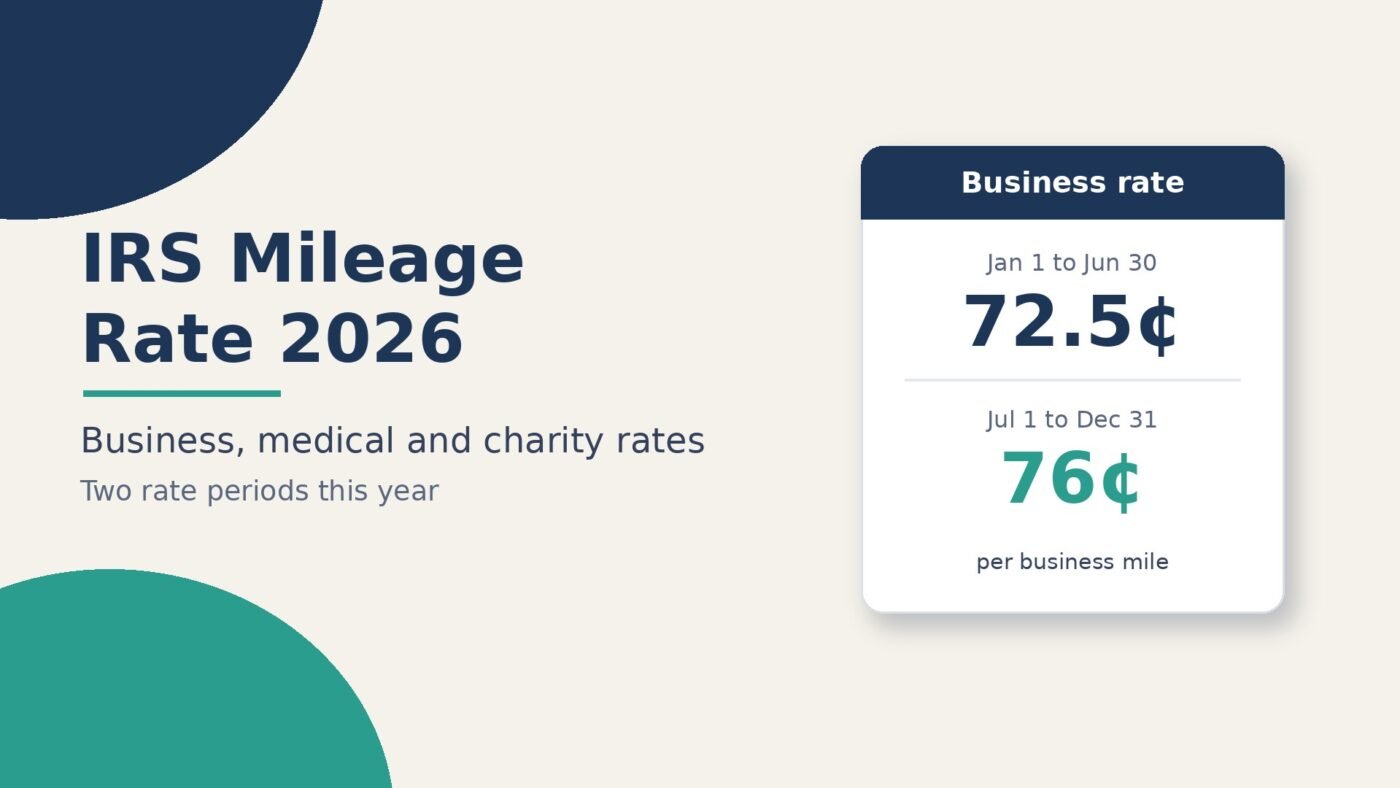
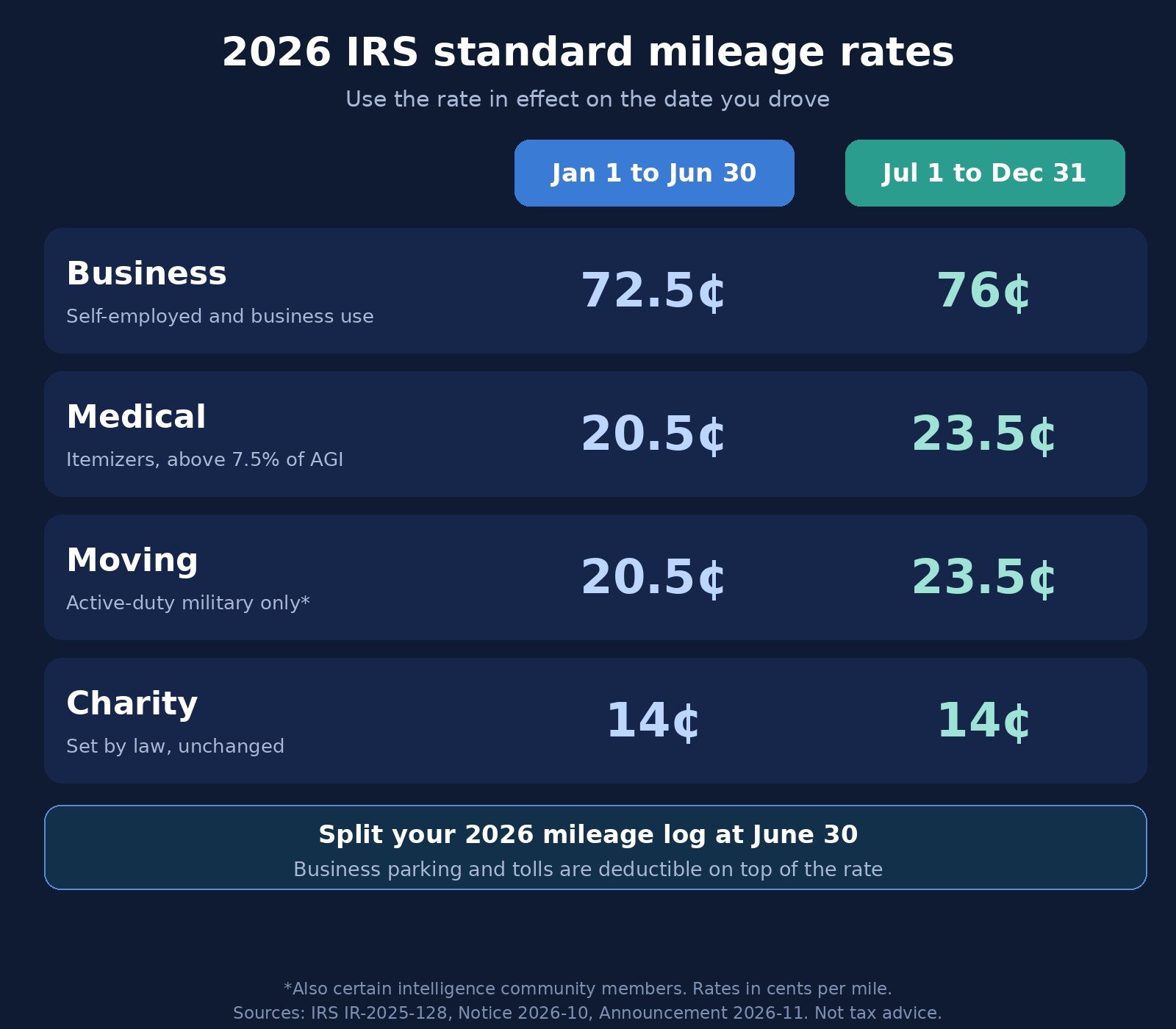
The 2026 IRS standard mileage rate for business is 72.5 cents per mile for miles driven from January 1 to June 30, 2026, and 76 cents per mile for miles driven from July 1 to December 31, 2026. The medical and military moving rate is 20.5 cents for the first half of the year and 23.5 cents for the second half. The charity rate stays at 14 cents per mile all year. The IRS raised the rates in the middle of the year because fuel prices went up.
This guide explains which rate applies to which miles, who is actually allowed to deduct mileage, what counts as a business mile, and how to keep a mileage log that holds up. Every rate below comes straight from the IRS.
Not tax advice: this is general information based on IRS publications linked throughout. Your situation may differ, so check with a tax professional if you’re unsure.
2026 IRS mileage rates at a glance
For the first time since 2022, 2026 has two sets of rates. The IRS set the original 2026 numbers in IR-2025-128, issued December 29, 2025, then revised them for the second half of the year in Announcement 2026-11. The IRS standard mileage rates page lists both periods.
| Purpose | Jan 1 to Jun 30, 2026 | Jul 1 to Dec 31, 2026 |
|---|---|---|
| Business (self-employed and business use) | 72.5 cents per mile | 76 cents per mile |
| Medical | 20.5 cents per mile | 23.5 cents per mile |
| Moving (active-duty military and certain intelligence community members only) | 20.5 cents per mile | 23.5 cents per mile |
| Charity | 14 cents per mile | 14 cents per mile |
The rates apply to cars, vans, pickups and panel trucks, and the IRS says they cover fully electric and hybrid vehicles as well as gasoline and diesel ones.
Why the rate changed in the middle of 2026
The IRS normally sets mileage rates once, just before the year starts. In July 2026 it published Announcement 2026-11 in Internal Revenue Bulletin 2026-29, which says the change “results from recent increases in the price of fuel.” It raised the business rate from 72.5 to 76 cents and the medical and moving rate from 20.5 to 23.5 cents.
The charity rate didn’t move because Congress sets it, not the IRS. The announcement notes that the charitable rate is fixed by section 170(i) of the tax code at 14 cents per mile.
The last midyear change was in 2022, when the business rate went from 58.5 cents to 62.5 cents for the second half of that year, as shown on the IRS rate history table.
Which 2026 rate applies to your miles
The rule is simple: the date you drove decides the rate. Announcement 2026-11 says the new rates apply to transportation expenses “paid or incurred” on or after July 1, 2026, while the original rates from Notice 2026-10 still apply to anything before that date.
That means you can’t just multiply your full-year mileage by 76 cents. Split your 2026 log at June 30 and total each half separately. If your mileage app only gives you one annual number, export the trips by date before you file.
Worked example
Here’s a simple illustration with made-up mileage. Say you run a mobile repair side business and your log shows:
- 4,000 business miles from January through June
- 3,000 business miles from July through December
| Period | Business miles | Rate | Deduction |
|---|---|---|---|
| Jan 1 to Jun 30 | 4,000 | $0.725 | $2,900 |
| Jul 1 to Dec 31 | 3,000 | $0.76 | $2,280 |
| Total | 7,000 | $5,180 |
Business parking fees and tolls go on top of that. IRS Publication 463 says you can deduct business-related parking fees and tolls in addition to the standard mileage rate. Parking at your regular workplace doesn’t count, because that’s commuting.
Who can deduct mileage in 2026
This is where most confusion comes from. A published rate doesn’t mean everyone who drives for work gets a deduction.
- Self-employed people can. Freelancers, gig workers, sole proprietors and single-member LLC owners who drive for their business can deduct business miles. IRS Topic 510 says self-employed car expenses go on Schedule C (or Schedule F for farmers).
- Most W-2 employees can’t. Notice 2026-10 explains that the One, Big, Beautiful Bill Act made the ban on miscellaneous itemized deductions permanent, which includes unreimbursed employee travel. So if your employer doesn’t reimburse you, you generally can’t deduct the miles yourself.
- Some employees still can. The same notice lists exceptions: Armed Forces reservists, fee-basis state or local government officials, certain performing artists, and eligible educators. Topic 510 says the first three use Form 2106.
If you’re working out whether a side business should be a sole proprietorship or an LLC, our guide to sole proprietorship vs LLC covers it. Mileage works the same way for both on Schedule C.
What counts as a business mile
The biggest trap is commuting. Pub 463 is blunt: you can’t deduct the cost of driving between your home and your main or regular place of work, “no matter how far your home is,” and making business calls on the way doesn’t change that.
Miles that generally do count, based on the examples in Publication 463:
- Driving from one client or customer to another during the day
- Round trips from a qualifying home office to a client’s location
- Trips to a temporary work location, such as a one-week training session at a different office
- Business errands like picking up supplies or going to the bank for the business
Miles that don’t count:
- Home to your regular office or shop and back
- If you have no regular office and no home office, the trip from home to your first business stop and from your last stop back home
- Personal side trips. Pub 463 does say a minimal personal stop, like lunch between two business stops, doesn’t break up business use
Standard mileage rate vs actual expenses
The standard rate is optional. You can instead deduct the business share of what the car actually costs you. The IRS suggests that if you qualify for both, figure your deduction both ways and see which is larger.
| Standard mileage rate | Actual expenses | |
|---|---|---|
| How it works | Business miles times the IRS rate | Business-use percentage of real car costs |
| What you track | Miles, dates, places, purpose | All of that plus every receipt |
| Costs included | Gas, repairs, insurance, depreciation are built into the rate | Gas, oil, repairs, tires, insurance, registration, licenses, depreciation or lease payments |
| Parking and tolls | Deductible on top | Deductible |
| Best for | High mileage, simple records | Expensive cars, low mileage, high running costs |
Rules for using the standard rate
According to Topic 510 and Pub 463:
- Owned car: you must choose the standard rate in the first year the car is used in your business. In later years you can pick either method.
- Leased car: if you choose the standard rate, you must use it for the whole lease, including renewals.
- Five or more cars at once: you can’t use the standard rate for any of them if they’re used for business at the same time, as in a fleet.
- Depreciation history: you can’t use it if you’ve claimed MACRS depreciation, a Section 179 deduction, or the special depreciation allowance on that car.
One more detail for people who later sell the car: part of the business rate counts as depreciation. Notice 2026-10 puts that portion at 35 cents per mile for 2026, which reduces the car’s basis.
Medical and charity mileage
Medical miles are driving to get medical care for you, your spouse or your dependents. They only help if you itemize. IRS Topic 502 says medical expenses are deductible on Schedule A only to the extent they exceed 7.5% of your adjusted gross income, and that transportation can be either gas and oil or the medical mileage rate, plus tolls and parking.
Charity miles are miles you drive while volunteering for a qualified charity. The rate is 14 cents for all of 2026. The usual charitable contribution rules apply, which IRS Publication 526 explains.
Moving miles are only for active-duty military members moving under orders for a permanent change of station and, starting in 2026, certain members of the intelligence community, per IR-2025-128.
Mileage reimbursement from an employer
Many companies use the IRS business rate as their reimbursement rate. The rate is a benchmark, not a federal requirement to pay that much. What the IRS rate does is set the amount that’s “deemed substantiated”: Announcement 2026-11 applies the 76-cent rate to mileage allowances paid to an employee on or after July 1, 2026, for driving done on or after that date.
Under an accountable plan, where you report your mileage to your employer and return any excess, reimbursements at or under the IRS rate generally aren’t taxable income. Pub 463 covers accountable plans in detail. If your employer reimbursed you at 72.5 cents for July miles, it’s worth asking HR whether they adopted the new rate.
How to keep a mileage log the IRS will accept
A deduction is only as good as your records. Pub 463 says you should record business use “at or near the time” it happens, and that a log you update weekly counts as a timely kept record. For each business trip, write down:
- The date (this matters more than usual in 2026, because of the July 1 split)
- Where you went, the destination or client
- Why, the business purpose in a few words
- The miles driven, from odometer readings or a GPS app
- Parking and tolls, with receipts where you can get them
Also note your odometer on January 1 and December 31 so you can show total miles for the year. A paper notebook, a spreadsheet or an app all work as long as the details are there. Delivery and rideshare drivers can usually export trip data from the platform, which helps, but check that it includes miles driven between jobs, not just with a passenger or order on board. Our roundup of side gig apps covers the platforms themselves.
Keep the records. Pub 463 says you generally need to keep them for 3 years from the date you file the return, and longer for cars you depreciate.
Where to claim the mileage deduction
- Self-employed: Schedule C (Form 1040), or Schedule F for farming, per Topic 510.
- Reservists, fee-basis officials and qualified performing artists: Form 2106.
- Medical miles: Schedule A, if you itemize.
- Charity miles: as a charitable contribution under the rules in Publication 526.
Mileage lowers your self-employment profit, which also lowers the income your quarterly payments are based on. If you pay estimated tax, see our guide to estimated taxes for the self-employed. And if you bill clients for travel, our guide on how to invoice a client shows how to list it as a line item.
Past IRS mileage rates
Use the rate for the year (and, in split years, the period) you drove the miles. From the IRS rate history:
| Period | Business | Medical or military moving | Charity |
|---|---|---|---|
| 2026 (Jul 1 to Dec 31) | 76 cents | 23.5 cents | 14 cents |
| 2026 (Jan 1 to Jun 30) | 72.5 cents | 20.5 cents | 14 cents |
| 2025 | 70 cents | 21 cents | 14 cents |
| 2024 | 67 cents | 21 cents | 14 cents |
| 2023 | 65.5 cents | 22 cents | 14 cents |
| 2022 (Jul 1 to Dec 31) | 62.5 cents | 22 cents | 14 cents |
| 2022 (Jan 1 to Jun 30) | 58.5 cents | 18 cents | 14 cents |
The 2027 rates haven’t been announced yet. The IRS usually publishes the next year’s rates near the end of the year; the 2026 rates came out on December 29, 2025.
Common mileage deduction mistakes
- Using 76 cents for the whole year. Miles from January to June use 72.5 cents.
- Counting your commute. Home to your regular workplace is personal, even if it’s long.
- Rebuilding the log in April. A log made from memory months later is weaker than one kept as you go.
- Claiming both methods. You pick the standard rate or actual expenses for a car in a given year, not both. Parking and tolls are the only add-ons with the standard rate.
- Missing the first-year choice. If you used actual expenses with MACRS depreciation in the car’s first business year, you can’t switch to the standard rate later for that car.
- Assuming W-2 miles are deductible. Unless you’re in one of the listed exceptions, unreimbursed employee mileage isn’t deductible.
FAQ
What is the IRS mileage rate for 2026?
For business driving, it’s 72.5 cents per mile from January 1 to June 30, 2026, and 76 cents per mile from July 1 to December 31, 2026. Medical and military moving miles are 20.5 cents, then 23.5 cents. Charity miles are 14 cents all year.
Why are there two IRS mileage rates in 2026?
The IRS raised the business and medical rates starting July 1, 2026, in Announcement 2026-11, saying the change was due to recent increases in fuel prices. Miles driven before July 1 still use the original rates from Notice 2026-10.
Can I use 76 cents for all my 2026 miles?
No. The 76-cent business rate only applies to miles driven on or after July 1, 2026. Multiply your January to June business miles by 72.5 cents and your July to December miles by 76 cents, then add them together.
Can W-2 employees deduct mileage in 2026?
Generally no. Unreimbursed employee travel is a miscellaneous itemized deduction, and that category is permanently disallowed. Exceptions include Armed Forces reservists, fee-basis state or local officials, certain performing artists and eligible educators.
Does the IRS mileage rate apply to electric cars?
Yes. The IRS says the standard mileage rates apply to fully electric and hybrid vehicles as well as gasoline and diesel vehicles.
Can I deduct parking and tolls on top of the mileage rate?
Yes, business-related parking fees and tolls are deductible in addition to the standard mileage rate. Parking at your regular place of work is a commuting cost and isn’t deductible.
What do I need in a mileage log?
For each business trip, record the date, destination, business purpose and miles driven, at or near the time of the trip. A log updated weekly counts as timely. Keep the records for at least 3 years after you file.
Bottom line
For 2026, business miles are worth 72.5 cents through June 30 and 76 cents from July 1, so split your log at the midpoint and total each half. Make sure the miles are real business miles, not commuting, keep a log with dates and purposes as you go, and add business parking and tolls on top. If you’re self-employed, it all goes on Schedule C. If you’re thinking about setting up a formal business, start with how to start an LLC and, once profits grow, our comparison of LLC vs S corp.

The Teck Hustlers Editorial Team covers technology, business, finance and gaming news for readers who want the story behind the headline. Every article is researched, written and edited by our in-house team, checked against company announcements, filings and reputable reporting, and updated when new facts emerge. We focus on what each development means for founders, professionals, investors and everyday users. Have a tip or a correction? Reach us through our contact page.