A 401(k) is a retirement savings account offered by an employer. You choose a percentage of each paycheck to put in, the money is invested (usually in mutual funds or target-date funds), and it grows with tax advantages until you retire. With a traditional 401(k) you skip income tax on the money now and pay it when you withdraw; with a Roth 401(k) you pay tax now and qualified withdrawals later are tax-free. Many employers also add a matching contribution, which is the closest thing to free money most workers will ever be offered.
This guide explains how a 401(k) works in plain English, the difference between traditional and Roth, the official contribution limits for 2026 and 2027, how employer matching and vesting work, the rules for getting money out, and what to do with your account when you change jobs. It is general information for U.S. workers, not personal financial or tax advice.
What is a 401(k), in plain English?
The name comes from section 401(k) of the U.S. Internal Revenue Code, the part of the tax law that created this kind of plan. The IRS describes it as a qualified deferred compensation plan: you agree to have part of your pay “deferred” into the plan instead of paid to you as cash today.
Three things make a 401(k) different from an ordinary savings or brokerage account:
- It runs through your employer. Contributions come straight out of your paycheck through payroll. You cannot open a regular 401(k) on your own at a bank (self-employed people have a separate option, covered below).
- It has tax benefits. Either the money goes in before income tax (traditional) or it comes out tax-free later (Roth).
- It has rules about access. In exchange for the tax break, the government expects you to leave the money alone until retirement age. Withdrawals before age 59½ usually trigger an extra tax.
If you work for a public school, hospital or nonprofit, you may be offered a 403(b) instead, and many state and local government workers get a 457(b). They work in a very similar way and, as the IRS 2027 limits announcement shows, they share the same employee contribution limit as a 401(k).
How does a 401(k) work? Step by step
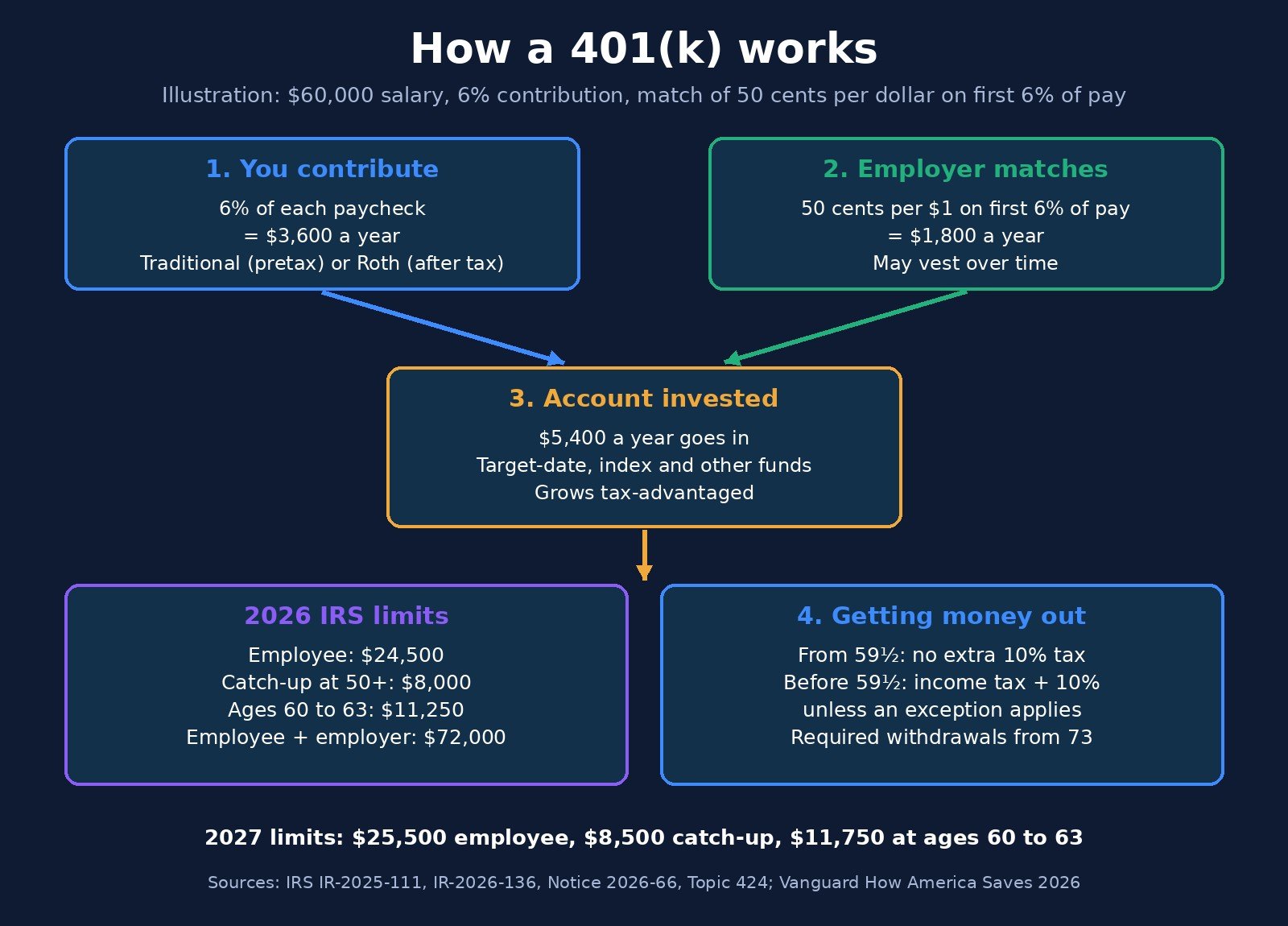
- You enroll. Your employer’s HR or benefits portal lets you sign up and pick a contribution rate, for example 6% of pay. Many newer plans enroll you automatically and you can change or stop it.
- Money leaves each paycheck. That percentage is taken from every paycheck before it reaches your bank account.
- Your employer may add more. If the plan has a match, the company puts in extra money based on what you contribute.
- You choose investments. The plan offers a menu of funds. If you don’t choose, your money goes into the plan’s default fund, often a target-date fund.
- It grows tax-advantaged. Dividends and gains inside the account are not taxed each year.
- You withdraw in retirement. After 59½ you can take money out without the early-withdrawal tax, and from age 73 you generally must start taking minimum withdrawals from traditional money.
A simple example
Here is an illustration with round numbers (not a prediction of returns). Maya earns $60,000 a year and sets her 401(k) to 6% of pay. That is $3,600 a year from her paychecks. Her employer matches 50 cents per dollar on the first 6% of pay, so it adds $1,800. Together, $5,400 goes into her account each year, and only $3,600 of it came from her.
Because Maya chose the traditional option, that $3,600 is left out of her taxable wages for federal income tax (it does not appear in box 1 of her W-2). It still counts as wages for Social Security and Medicare tax, so her take-home pay falls by a little less than $3,600. If you want to see how deductions like this change your paycheck, our guide to gross vs net income walks through it.
Traditional vs Roth 401(k)
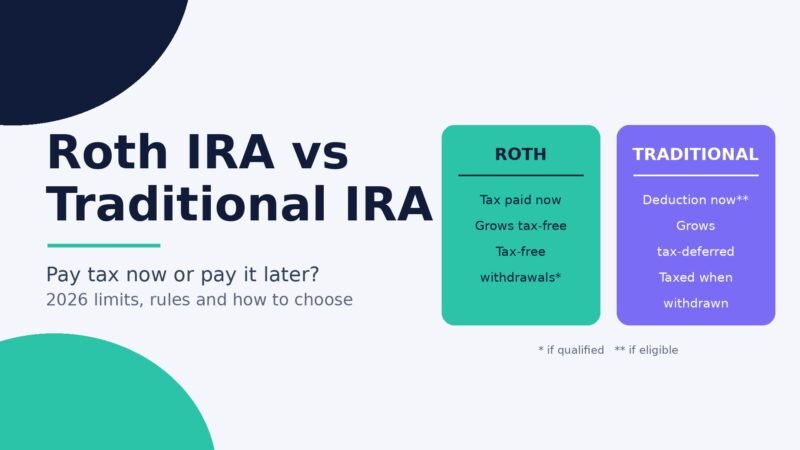
Most plans now offer both. You can split your contributions between them, but the total still has to stay under one annual limit. The difference is when you pay income tax:
| Traditional 401(k) | Roth 401(k) | |
|---|---|---|
| Money goes in | Before federal income tax (lowers your taxable income now) | After tax (no break now) |
| Growth | Tax-deferred | Tax-free if withdrawals are qualified |
| Withdrawals in retirement | Taxed as ordinary income | Tax-free if the account is at least 5 years old and you are 59½, disabled or deceased (IRS) |
| Required minimum distributions | Yes, generally from age 73 | None while the owner is alive (IRS) |
| Often suits | People who expect a lower tax rate in retirement | People early in their career or who expect higher taxes later |
The same “pay tax now or later” logic applies to IRAs, which we break down in Roth IRA vs traditional IRA.
401(k) contribution limits for 2026 and 2027
The IRS adjusts the limits every year for inflation. The 2026 figures come from IRS news release IR-2025-111, and the 2027 figures were announced on November 12, 2026 in IR-2026-136 and Notice 2026-66.
| Limit | 2026 | 2027 |
|---|---|---|
| Employee contributions (traditional + Roth combined) | $24,500 | $25,500 |
| Catch-up contribution, age 50+ | $8,000 | $8,500 |
| Total employee maximum, age 50+ | $32,500 | $34,000 |
| Higher catch-up for ages 60, 61, 62 and 63 | $11,250 | $11,750 |
| Total of employee + employer contributions (section 415(c)) | $72,000 | $75,000 |
| IRA limit, for comparison | $7,500 | $7,500 |
A few things people miss:
- The employee limit is per person, not per plan. If you change jobs mid-year, contributions at both employers count toward the same $24,500 (2026) limit.
- Employer money does not use up your limit. Matching and profit-sharing contributions count toward the larger total limit ($72,000 for 2026) instead, as the IRS contribution limits page explains.
- Higher earners’ catch-ups must be Roth. Under SECURE 2.0, if your FICA wages from the employer in the prior year were above the IRS threshold, your catch-up contributions have to go in as Roth. Notice 2026-66 sets that threshold at $150,000 for 2026 and raises it to $155,000 (based on 2026 wages) for 2027 catch-ups.
- Your plan can set lower limits. Some plans cap contributions as a percentage of pay.
How 401(k) matching works
An employer match is extra money your company puts in when you contribute. It is usually written as a formula: the company pays a certain amount per dollar you save, up to a percentage of your pay.
Vanguard’s How America Saves 2026 report, which covers the plans it administers, gives a good picture of what is normal:
- The most common formula is 50 cents per dollar on the first 6% of pay, which is worth up to 3% of salary.
- Multi-tier formulas such as $1 per dollar on the first 3% of pay plus 50 cents on the next 2% are also common (worth up to 4%).
- The average promised match was 4.7% of pay, and the median was 4.0%.
- Only 4% of Vanguard plans made no employer contribution of any kind.
The practical rule: contribute at least enough to get the full match. In Maya’s example, contributing 4% instead of 6% would cost her $600 of employer money every year. If cash is tight, a budget framework such as the 50/30/20 rule can help you find room for it.
Automatic enrollment
Many workers never choose to join; they are signed up by default. Vanguard reports that 61% of its plans used automatic enrollment in 2025, and those plans had a 94% participation rate versus 64% in plans where workers had to opt in. For most 401(k) plans set up after December 29, 2022, automatic enrollment is now required by law starting with 2025 plan years: the default rate must be at least 3% and no more than 10%, rising by one percentage point a year until it reaches at least 10% (capped at 15%), with exceptions for new and small businesses (26 U.S.C. 414A; IRS IR-2025-09). You can always opt out or pick a different rate.
Vesting: when the employer money is really yours
Money you contribute from your own paycheck is always 100% yours. Employer contributions can come with a vesting schedule, meaning you earn ownership of them over time. If you leave before you are fully vested, you forfeit the unvested part. The IRS shows the two common schedules:
| Years of service | Cliff vesting | Graded vesting |
|---|---|---|
| 1 | 0% | 0% |
| 2 | 0% | 20% |
| 3 | 100% | 40% |
| 4 | 100% | 60% |
| 5 | 100% | 80% |
| 6 | 100% | 100% |
Many plans vest immediately. Check your Summary Plan Description or your benefits statement before you resign; waiting a few more weeks can sometimes be worth thousands.
What can you invest in?
Unlike a brokerage account, a 401(k) gives you a fixed menu chosen by the plan. According to Investor.gov, options are often mutual funds, and target-date funds are a popular choice. Typical menus include:
- Target-date funds, which hold a mix of stocks and bonds and gradually get more conservative as the year in their name (your rough retirement year) gets closer.
- Index funds that track a market such as the S&P 500. See our guides on investing in index funds and investing in the S&P 500.
- Actively managed stock and bond funds, which usually charge higher fees.
- Stable value or money market funds for lower-risk cash.
Look at each fund’s expense ratio. Over decades, a fee difference of even a fraction of a percent adds up. The people who choose the plan’s menu have a legal duty to act in participants’ interest; our explainer on fiduciary duty covers what that means.
Getting money out: withdrawals, penalties and loans
Normal withdrawals (59½ and older)
Once you reach 59½, you can withdraw without the extra tax (if your plan allows it while you still work there). Traditional money is taxed as ordinary income when it comes out.
Early withdrawals and the 10% extra tax
Take money out before 59½ and, on top of income tax, you generally owe a 10% additional tax unless an exception applies. The IRS list of exceptions for 401(k)s includes:
- Leaving your job during or after the year you turn 55 (age 50 for many public safety workers), for money in that employer’s plan.
- Total and permanent disability, or death.
- Up to $5,000 per child for birth or adoption expenses.
- One emergency personal expense withdrawal per year of up to $1,000.
- Unreimbursed medical expenses above 7.5% of adjusted gross income.
- A series of substantially equal periodic payments.
Some plans also offer hardship withdrawals for an “immediate and heavy financial need.” These still face income tax and usually the 10% extra tax, and the IRS notes they cannot be rolled over.
401(k) loans
If your plan allows loans, the IRS caps the amount at the lesser of $50,000 or the greater of $10,000 or 50% of your vested balance. You generally repay through payroll within five years, with payments of principal and interest at least quarterly. If you miss payments, the unpaid balance can be treated as a taxable distribution (IRS loan FAQs). A loan avoids the early-withdrawal tax, but the money you borrow is out of the market while it is repaid.
Required minimum distributions
You generally must start withdrawing from traditional 401(k) money at age 73. If you are still working and your plan allows it, you may be able to delay until you retire (unless you own 5% or more of the company). Missing an RMD can cost a 25% excise tax on the amount you should have taken, reduced to 10% if you fix it within two years.
What happens to your 401(k) when you leave a job?
Your vested balance stays yours. You usually have four options:
- Leave it in the old plan, if the plan allows it. Fine if the funds are good and cheap, but easy to lose track of.
- Roll it into your new employer’s 401(k), if that plan accepts rollovers. Keeps everything in one place.
- Roll it into an IRA, which usually gives you far more investment choices.
- Cash it out. Usually the worst choice: income tax plus the 10% extra tax if you are under 59½ and no exception applies.
Ask for a direct rollover (the money moves straight from one provider to the other). If a check is paid to you instead, you generally have 60 days to deposit it into another plan or IRA to avoid tax, as IRS Topic 413 explains.
401(k) vs IRA: the short version
| 401(k) | IRA | |
|---|---|---|
| Who opens it | Your employer | You, at any brokerage |
| 2026 contribution limit | $24,500 (+$8,000 at 50+) | $7,500 (+$1,100 at 50+) |
| Employer match | Often | No |
| Investment choice | Plan menu only | Almost anything |
| Loans | Possible if the plan allows | Not allowed |
Limits are from IR-2025-111; the loan rule is from the IRS loan FAQs. You can have both. A common order is: contribute to the 401(k) up to the full match, then consider an IRA for more investment choice, then go back to the 401(k) if you still have money to save.
Self-employed? Look at a solo 401(k)
If you run a business with no employees other than yourself (and your spouse), the IRS allows a one-participant 401(k), often called a solo 401(k). You can contribute both as the “employee” and as the “employer,” which can allow much larger contributions than an IRA. It is worth a look for freelancers and side hustlers, especially if you are already paying estimated taxes or run a single-member LLC. If you are not sure whether you count as an employee or a contractor, see 1099 vs W-2.
How to get started with your 401(k)
- Log into your benefits portal and confirm whether you are already enrolled and at what rate.
- Find the match formula and set your rate high enough to get all of it.
- Choose traditional, Roth or a mix.
- Pick your investments, or check that the default fund suits your timeline and fees.
- Name a beneficiary.
- Check the vesting schedule.
- Turn on automatic yearly increases, or raise your rate by 1% each time you get a raise.
For context, Vanguard found the average participant deferred 7.6% of pay in 2025, and employee plus employer contributions averaged 12.1%. New to investing in general? Start with our beginner’s guide to investing.
Frequently asked questions
What is a 401(k) in simple terms?
A 401(k) is a retirement account through your job. You put a percentage of each paycheck into it, often your employer adds a match, the money is invested, and it grows with tax benefits until you withdraw it in retirement, usually after age 59½.
How much can I put in a 401(k) in 2026?
For 2026 the employee limit is $24,500. If you are 50 or older you can add an $8,000 catch-up, for $32,500 total, and people aged 60 to 63 get a higher $11,250 catch-up. For 2027 the limit rises to $25,500 with an $8,500 catch-up.
What is a 401(k) match?
A 401(k) match is money your employer adds based on what you contribute. A common formula is 50 cents for every dollar you save, up to 6% of your pay, which is worth 3% of your salary. You only get it if you contribute, so aim for at least the full match.
Can I take money out of my 401(k) early?
Usually yes, but withdrawals before age 59½ are taxed as income and generally hit with an extra 10% tax unless an exception applies, such as leaving your job in or after the year you turn 55, disability, or up to $5,000 for a birth or adoption. A plan loan may be an alternative.
Is a Roth or traditional 401(k) better?
A traditional 401(k) gives you a tax break now and taxes withdrawals later; a Roth 401(k) taxes the money now and lets qualified withdrawals come out tax-free. Roth tends to suit people who expect a higher tax rate in retirement; traditional suits people who expect a lower one. Splitting between both is allowed.
What happens to my 401(k) if I quit?
Your own contributions and any vested employer money stay yours. You can usually leave the account in the old plan, roll it into your new employer’s plan, or roll it into an IRA. Cashing out triggers income tax and, under 59½, usually the 10% extra tax.
Is a 401(k) worth it if my employer doesn’t match?
Often still yes, because of the tax benefits and high contribution limit, but compare it with an IRA. Without a match, an IRA may offer cheaper and broader investments up to its $7,500 limit (2026), and you can still use the 401(k) for savings beyond that.
The bottom line
A 401(k) is one of the simplest ways to build retirement savings because it runs on autopilot from your paycheck. Get the full employer match, choose between traditional and Roth based on when you would rather pay tax, keep fees low, and leave the money alone until retirement. Check your plan’s own documents for its match, vesting and loan rules, and revisit your contribution rate every year when the IRS raises the limits.

The Teck Hustlers Editorial Team covers technology, business, finance and gaming news for readers who want the story behind the headline. Every article is researched, written and edited by our in-house team, checked against company announcements, filings and reputable reporting, and updated when new facts emerge. We focus on what each development means for founders, professionals, investors and everyday users. Have a tip or a correction? Reach us through our contact page.