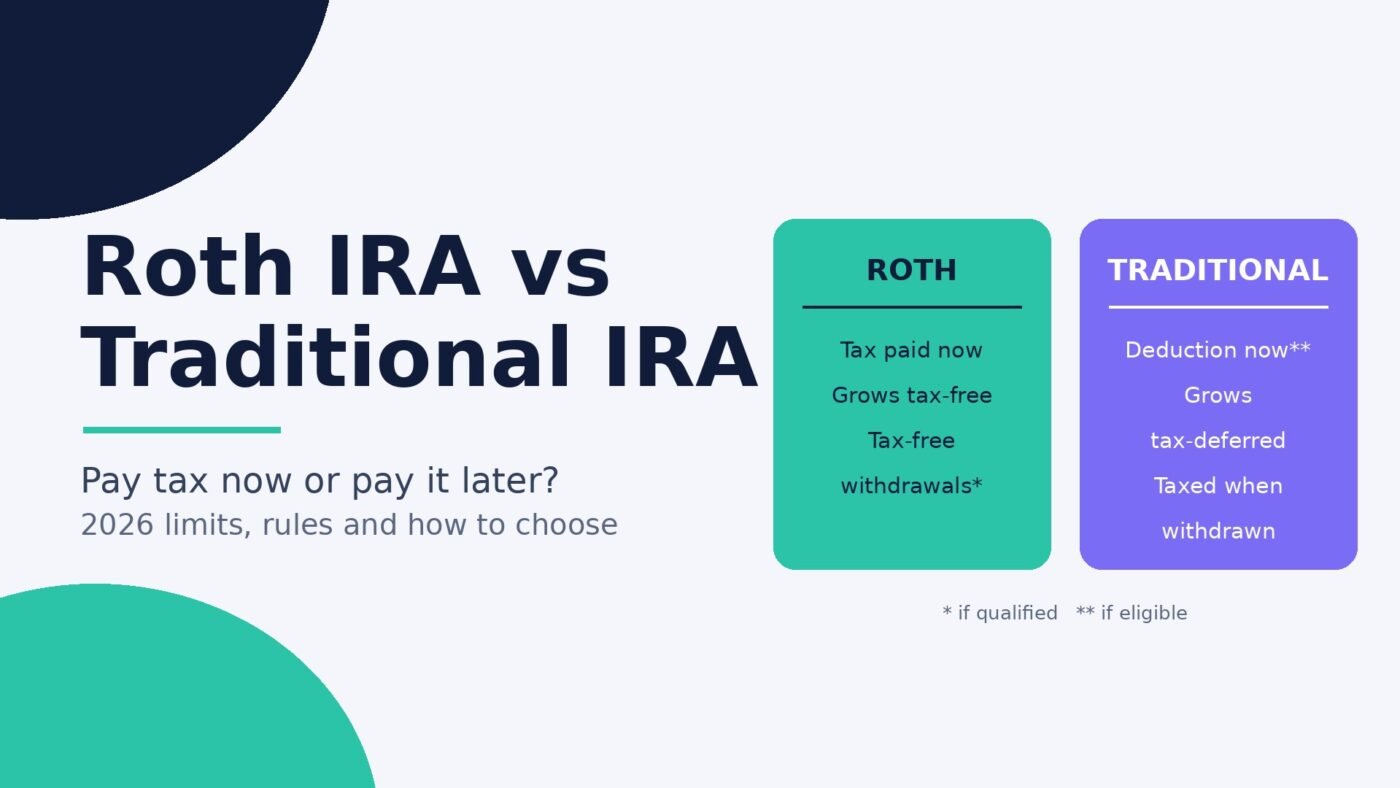
The difference between a Roth IRA and a traditional IRA is when you pay income tax. With a Roth IRA you contribute money you’ve already paid tax on, and qualified withdrawals in retirement are tax-free. With a traditional IRA your contributions may be tax-deductible now, but withdrawals are taxed as income later. If your tax rate today is lower than you expect it to be in retirement, a Roth usually comes out ahead. If it’s higher today, a traditional IRA usually wins. If you can’t tell, splitting between the two is a reasonable hedge.
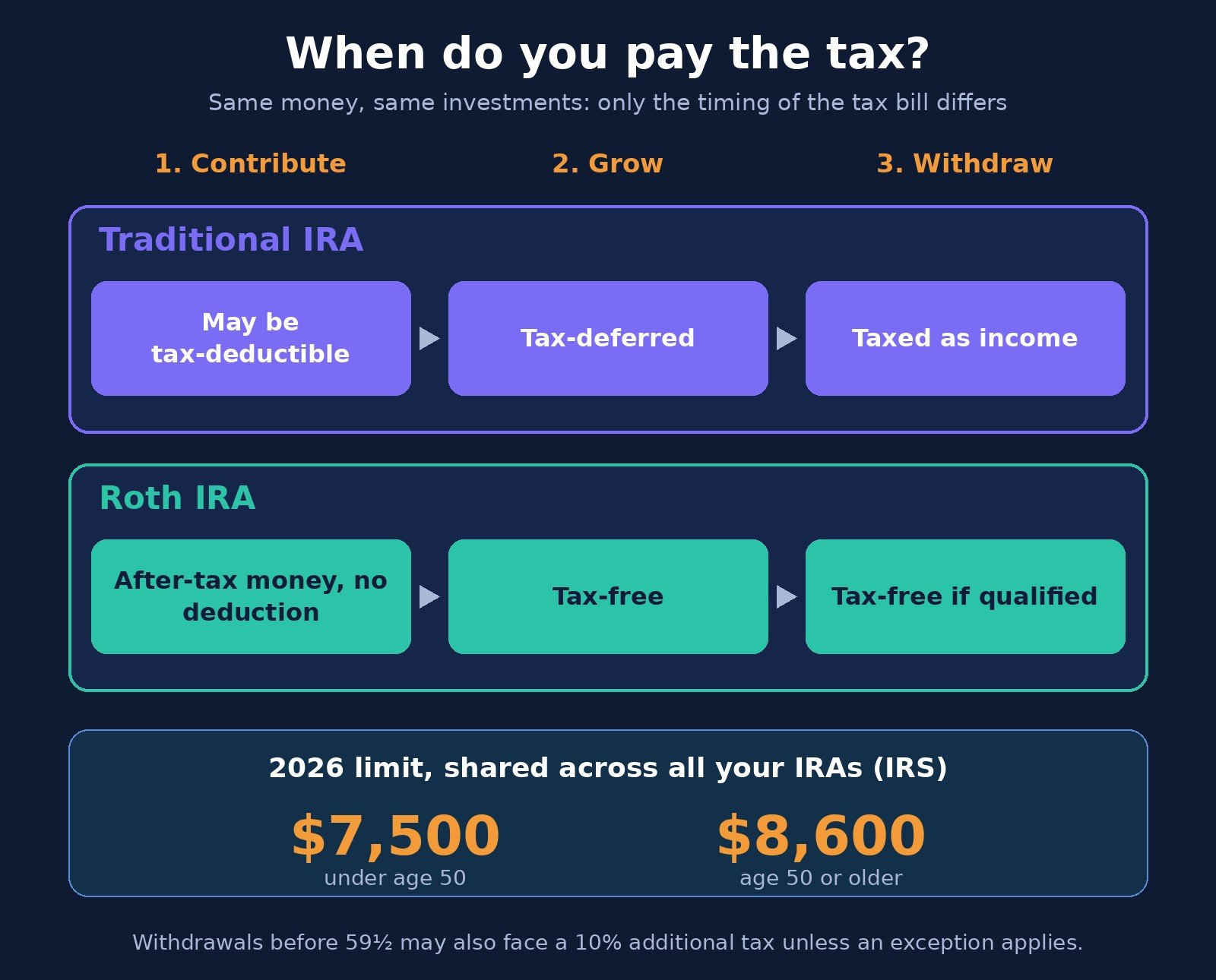
Both accounts share the same 2026 contribution limit of $7,500, or $8,600 if you’re 50 or older, according to the IRS 2026 cost-of-living announcement. That limit covers all your IRAs combined, so you choose how to divide it, not whether you get two limits.
Not financial or tax advice: this is general information based on IRS publications for US taxpayers. Your situation may differ, so check with a tax professional or financial planner before making big decisions.
The core difference: pay tax now or pay it later
An IRA (individual retirement arrangement) is a personal retirement account you open at a bank, brokerage or fund company. Inside it, investments grow without yearly tax on dividends or gains. The two main flavors differ only in when the IRS takes its share.
- Traditional IRA: you may be able to deduct your contributions, which lowers this year’s taxable income. The money grows tax-deferred, and withdrawals are taxed as ordinary income.
- Roth IRA: according to the IRS Roth IRA page, you can’t deduct contributions, but if you meet the requirements, qualified distributions are tax-free, including all the growth.
A simple worked example
Here’s the logic with round, hypothetical numbers. Say you have $1,000 of pre-tax income to save and your tax rate is 20% both now and in retirement, and the investment doubles before you withdraw it.
- Traditional: you put in the full $1,000 (deducted), it grows to $2,000, and you pay 20% tax on withdrawal. You keep $1,600.
- Roth: you pay 20% tax first, so $800 goes in. It grows to $1,600, and the qualified withdrawal is tax-free. You keep $1,600.
Same result. The Roth only wins if your rate in retirement is higher than it is today, and the traditional IRA only wins if your rate in retirement is lower. That’s the whole decision in one sentence; everything else in this article is about the rules that can tilt it.
Roth IRA vs traditional IRA at a glance
| Feature | Roth IRA | Traditional IRA |
|---|---|---|
| Tax break | None now; qualified withdrawals are tax-free | Contributions may be deductible now; withdrawals are taxed |
| 2026 contribution limit | $7,500 combined across all IRAs ($8,600 if 50+), or your taxable compensation if less | |
| Income limit to contribute | Yes. 2026 phase-out: $153,000–$168,000 single, $242,000–$252,000 married filing jointly | No income limit to contribute, but the deduction can phase out if you or your spouse have a workplace plan |
| Age limit to contribute | None | None (the age 70½ cutoff was repealed starting in 2020) |
| Early withdrawals (before 59½) | Your contributions come out first; earnings may face tax and a 10% additional tax | Taxable, plus a 10% additional tax unless an exception applies |
| Required minimum distributions | None during the owner’s lifetime | Yes, starting for the year you reach 73 |
| Best fit | Lower tax rate now than you expect later; long time horizon; want flexibility | Higher tax rate now than you expect later; want a deduction this year |
2026 IRA contribution limits
For 2026, the total you can put into all of your traditional and Roth IRAs is the smaller of $7,500 ($8,600 if you’re 50 or older) or your taxable compensation for the year. The age-50 catch-up rose to $1,100 for 2026 under a SECURE 2.0 change that now indexes it to inflation, per the IRS news release (IR-2025-111).
- The limit is shared. If you’re under 50 and put $4,000 into a traditional IRA, you can add up to $3,500 to a Roth IRA for the same year.
- You need earned income. Wages, salary and net self-employment earnings count. Investment income doesn’t. If you earned $3,000 this year, $3,000 is your cap.
You also get extra time. IRS Publication 590-A says contributions for a year can be made until the due date of your tax return for that year, not including extensions, which for most people means mid-April of the following year.
The IRS normally announces the next year’s limits in the fall. As of November 12, 2026, it had not yet published 2027 IRA limits, so the 2026 figures here are the latest official numbers.
Roth IRA income limits for 2026
You can contribute the full amount to a Roth IRA only if your modified adjusted gross income (MAGI) is below the bottom of the phase-out range. Inside the range your allowed contribution shrinks, and above it you can’t contribute directly. The 2026 ranges are:
- Single or head of household: $153,000 to $168,000
- Married filing jointly: $242,000 to $252,000
- Married filing separately: $0 to $10,000 (not adjusted for inflation)
Traditional IRA deduction limits for 2026
Anyone with earned income can contribute to a traditional IRA. Whether you can deduct it depends on workplace plans. If neither you nor your spouse is covered by a retirement plan at work, the phase-outs don’t apply and the contribution is fully deductible. If someone is covered, the deduction phases out over these 2026 income ranges:
- Single, covered by a workplace plan: $81,000 to $91,000
- Married filing jointly, the contributing spouse is covered: $129,000 to $149,000
- Not covered, but married to someone who is: $242,000 to $252,000
- Married filing separately, covered: $0 to $10,000
A nondeductible traditional IRA contribution is allowed, but it gives you no up-front break and adds paperwork (you track that after-tax basis on Form 8606). For most people above the deduction range but below the Roth range, a Roth contribution is simpler.
Withdrawals: the rules that actually trip people up
The 10% early-withdrawal tax
Money taken from an IRA before age 59½ is generally an early distribution. According to IRS Topic 557, you owe a 10% additional tax on the part of an early distribution that’s included in income, on top of regular income tax, unless an exception applies. The IRS exceptions table includes, for IRAs, qualified higher-education expenses, up to $10,000 for a qualified first-time home purchase, unreimbursed medical expenses above 7.5% of AGI, and one emergency personal expense distribution per year of up to $1,000.
Why the Roth is more flexible before retirement
Roth withdrawals follow ordering rules set out in IRS Publication 590-B: your regular contributions come out first, then conversions, then earnings. Because you already paid tax on your contributions, taking back the amount you put in generally isn’t taxable. Only the earnings portion of a non-qualified withdrawal can be taxed and hit with the 10% additional tax.
The Roth 5-year rule
For earnings to come out tax-free, a Roth withdrawal must be a qualified distribution. Per Publication 590-B, that means it’s made after the 5-year period that begins with the first tax year you contributed to any Roth IRA, and it’s made after you reach 59½, because you’re disabled, to a beneficiary after your death, or for a first home (up to a $10,000 lifetime limit).
Required minimum distributions
Traditional IRAs make you start withdrawing eventually. The IRS RMD FAQs say you must take your first required minimum distribution for the year you reach age 73, though you can delay that first one until April 1 of the following year. Missing an RMD can trigger a 25% excise tax on the shortfall, reduced to 10% if you fix it within two years.
Roth IRAs don’t require withdrawals while the original owner is alive; RMD rules apply only to beneficiaries after the owner’s death. If you’d like to leave money invested as long as possible, or pass it on, that’s a real advantage for the Roth.
Which is better for you?
No account is better for everyone. Use your tax rate now versus later as the tiebreaker, then check the other factors.
A Roth IRA usually makes sense if:
- You’re early in your career or expect your income to rise, so your tax rate today is likely lower than later.
- Your income is low this year, for example a student, a new freelancer or a gap year, so a deduction wouldn’t save much.
- You want access to your contributions without tax or the 10% additional tax if life happens.
- You don’t want required withdrawals at 73, or you’d like to leave tax-free money to heirs.
- You earn too much to deduct a traditional IRA contribution but are under the Roth phase-out.
A traditional IRA usually makes sense if:
- You’re in a high bracket now and expect lower income in retirement.
- You qualify for the full deduction (no workplace plan, or income below the phase-out) and want to lower this year’s tax bill.
- A lower AGI this year helps you elsewhere, such as qualifying for a credit.
- Your income is above the Roth phase-out, so a direct Roth contribution isn’t available.
When splitting makes sense
Nobody knows future tax rates. Putting part of your limit in each account gives you a mix of taxable and tax-free money to draw from in retirement, which lets you manage your taxable income year by year. If you already have a big pre-tax 401(k) at work, adding Roth money is often the more useful diversification.
Quick decision checklist
- Do you have earned income this year? If not, you can’t contribute (spousal IRAs are an exception for married couples filing jointly).
- Is your MAGI above the Roth phase-out? If yes, a direct Roth contribution is out.
- Can you deduct a traditional contribution? If you have a workplace plan and you’re above the deduction range, the traditional IRA loses its main perk.
- Is your tax rate now lower or higher than you expect in retirement? Lower → Roth. Higher → traditional. Unsure → split.
- Might you need the money before 59½? That tilts toward Roth.
For freelancers and side hustlers
If you’re self-employed, Publication 590-A counts your net earnings from self-employment, reduced by the deductible part of self-employment tax and your retirement-plan deductions, as compensation. A side hustle can therefore make you IRA-eligible even if you have no W-2 job, and it caps your contribution at those net earnings.
- Low-profit years favor the Roth. If your first year of freelancing barely breaks even, a deduction is worth little and Roth money is locked in at a low rate.
- The IRA limit may be too small. Self-employed people can also use a SEP IRA or a solo 401(k). The IRS COLA table lists a 2026 SEP maximum contribution of $72,000, and the 401(k) employee deferral limit is $24,500. Those plans have their own formulas, so compare them before you assume an IRA is your only option.
- Check the Saver’s Credit. If your income is modest, contributions to either IRA may earn a tax credit. For 2026 the income limits are $80,500 for married couples filing jointly, $60,375 for heads of household and $40,250 for singles.
- Plan for the tax hit. A traditional IRA deduction can lower what you owe, which matters when you’re already paying quarterly estimated taxes.
If you’re deciding how to structure the business itself, our guide to sole proprietorship vs LLC covers how each setup reports income.
Converting a traditional IRA to a Roth
You can move money from a traditional IRA into a Roth IRA. Publication 590-A lists three ways: a 60-day rollover, a trustee-to-trustee transfer, or a same-trustee transfer. The catch is tax: you include in income any converted amount that would have been taxable if you’d simply withdrawn it. Conversions made in 2018 or later also can’t be undone (recharacterized).
Conversions are popular in low-income years, such as between jobs or early in retirement before other income starts, because you pay tax on the converted amount at a lower rate. Some high earners also contribute to a nondeductible traditional IRA and then convert it, often called a backdoor Roth. If you have other pre-tax IRA money, the tax math gets more complicated, so run it past a tax professional first. Converted amounts have their own 5-year clock for the 10% additional tax if you’re under 59½.
Common mistakes to avoid
- Counting the limit twice. $7,500 is the total for all IRAs, not $7,500 each.
- Contributing to a Roth with income above the range. Excess contributions are taxed each year they stay in the account until corrected.
- Leaving cash uninvested. An IRA is just a container. If the money sits in a settlement fund, it won’t grow much. Many beginners use broad index funds or an S&P 500 fund inside the account.
- Forgetting the deadline. Contributions for a tax year can be made until the return due date, not later, and extensions don’t count.
- Raiding a Roth’s earnings early. Contributions come out first, but earnings withdrawn before the account is qualified can be taxed and penalized.
If you’re still building the habit of saving at all, a simple plan like the 50/30/20 rule can help you find money for an IRA each month.
Frequently asked questions
Is a Roth IRA or a traditional IRA better?
Neither is better for everyone. A Roth IRA is usually better if your tax rate now is lower than you expect it to be in retirement, and a traditional IRA is usually better if your tax rate now is higher. If you can’t predict it, splitting your contributions between both is a common hedge.
Can I have both a Roth IRA and a traditional IRA?
Yes. You can own both and contribute to both in the same year, but the 2026 limit of $7,500 ($8,600 if you’re 50 or older) applies to your combined contributions across all IRAs.
What is the Roth IRA income limit for 2026?
For 2026, the ability to contribute to a Roth IRA phases out between $153,000 and $168,000 of modified AGI for single filers and heads of household, and between $242,000 and $252,000 for married couples filing jointly. Above the top of the range you can’t contribute directly.
Can I contribute to an IRA if I have a 401(k) at work?
Yes. A workplace plan doesn’t stop you from contributing to an IRA. It can reduce or eliminate the deduction for a traditional IRA contribution once your income passes the phase-out range, which for 2026 is $81,000 to $91,000 for single filers covered by a workplace plan.
Can I withdraw my Roth IRA contributions at any time?
Generally yes. Under IRS ordering rules, your regular Roth contributions come out first, and since you already paid tax on them, withdrawing them generally isn’t taxable. Earnings are different: taking them out before the withdrawal is qualified can trigger income tax and a 10% additional tax.
What happens if I withdraw from a traditional IRA before 59½?
The withdrawal is generally added to your taxable income, and you usually owe a 10% additional tax on top unless an exception applies, such as up to $10,000 for a first home, qualified higher-education costs, or certain medical expenses.
Do Roth IRAs have required minimum distributions?
No, not during the original owner’s lifetime. Traditional IRAs require withdrawals starting for the year you reach age 73, but Roth IRA RMD rules apply only to beneficiaries after the owner dies.
Can I open a Roth IRA for my side hustle income?
Yes, if you have net earnings from self-employment. The IRS counts those net earnings, after certain deductions, as compensation, so a side hustle can make you eligible. Your contribution can’t exceed that compensation or the annual limit, whichever is less.
Bottom line
Roth vs traditional comes down to one question: is your tax rate lower now or later? Pay tax now with a Roth if you expect to be in a higher bracket in retirement, or take the deduction now with a traditional IRA if you expect a lower one. Both share the 2026 limit of $7,500 ($8,600 at 50+), the Roth has income limits, the traditional deduction can phase out with a workplace plan, and only the traditional IRA forces withdrawals at 73. If you’re torn, splitting is fine, and starting either one beats waiting. Once the account is open, see our beginner’s guide to investing in the S&P 500 for a simple way to invest it. This article is general information, not financial or tax advice.

The Teck Hustlers Editorial Team covers technology, business, finance and gaming news for readers who want the story behind the headline. Every article is researched, written and edited by our in-house team, checked against company announcements, filings and reputable reporting, and updated when new facts emerge. We focus on what each development means for founders, professionals, investors and everyday users. Have a tip or a correction? Reach us through our contact page.