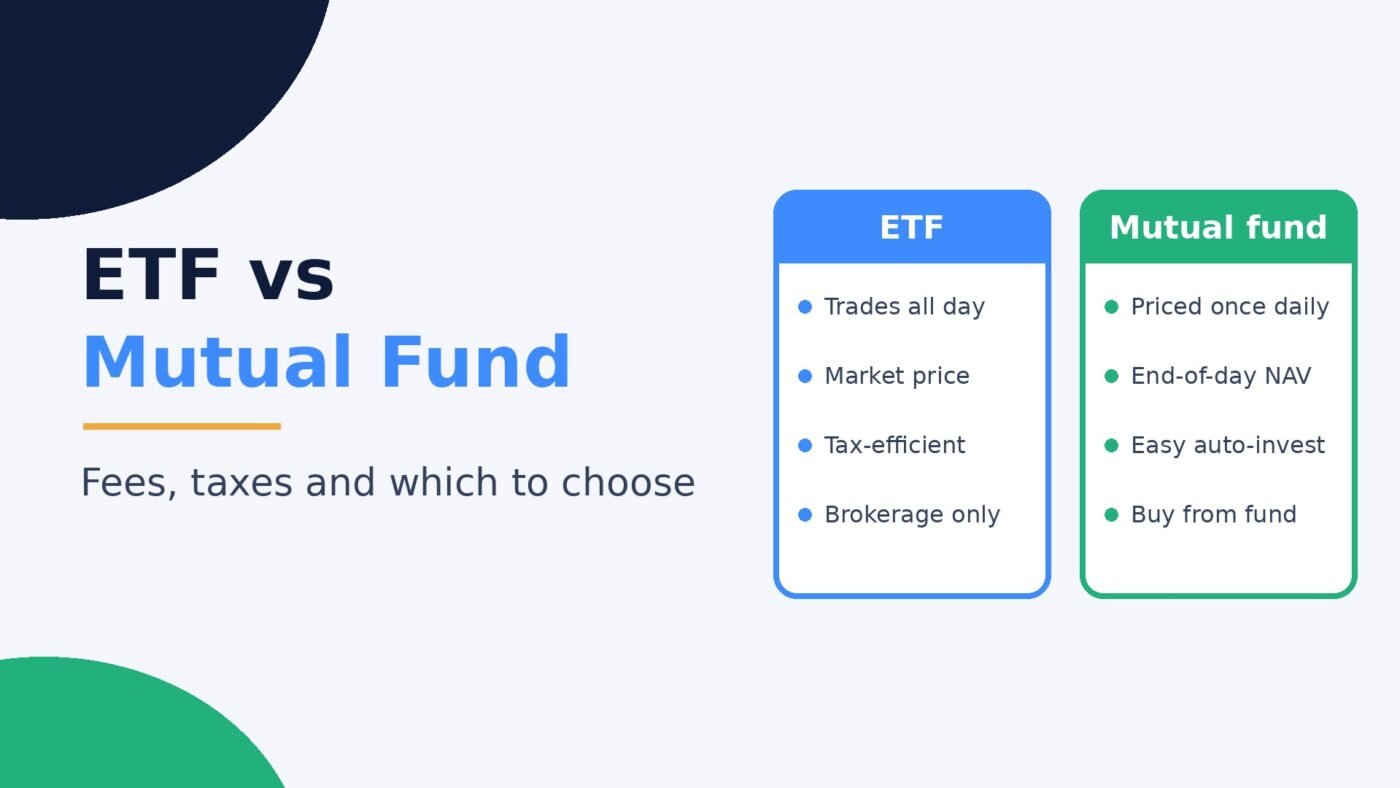
An ETF and a mutual fund can hold exactly the same stocks or bonds. The difference is the wrapper. ETFs trade on a stock exchange all day at a market price and are usually more tax-efficient in a regular brokerage account. Mutual funds are bought and sold once a day at the fund’s net asset value (NAV), and they make automatic investing of fixed dollar amounts easy. In a 401(k) or IRA the tax difference goes away, so cost and convenience decide (SEC Investor.gov).
This guide covers how the two compare on trading, fees, taxes and minimums, with the latest industry cost data, a fee example you can follow and a simple way to choose. It is general education for U.S. investors, not personal investment advice.
ETF vs mutual fund at a glance
| Feature | ETF | Mutual fund |
|---|---|---|
| How you buy and sell | On a stock exchange through a brokerage account | From the fund company or through a broker |
| Price you get | Market price, changes during the trading day | NAV, calculated once at the end of each business day |
| Can the price differ from the holdings’ value? | Yes, it can trade at a small premium or discount to NAV | No, you always transact at NAV (plus or minus fees) |
| Typical ongoing cost | Expense ratio, plus any trading costs such as the bid/ask spread | Expense ratio, plus possible sales loads, 12b-1 fees or redemption fees |
| Capital gains distributions in a taxable account | Usually fewer, thanks to in-kind creations and redemptions | More common, because the fund may sell holdings to pay out cash |
| Inside a 401(k) or IRA | No tax difference | No tax difference |
| Automatic investing of a fixed dollar amount | Depends on your broker (needs fractional shares) | Built in at most fund companies |
| Minimum to start | Price of one share, or less with fractional shares | Set by the fund; some have none, some require hundreds or thousands of dollars |
| Index or active? | Both exist | Both exist |
What is a mutual fund?
A mutual fund is an SEC-registered investment company that pools money from many investors and buys a portfolio of stocks, bonds, money market instruments or a mix of them. Each share is a slice of that portfolio. You buy shares from the fund, or through a broker or adviser, and when you sell, the fund buys them back from you at the next calculated NAV (Investor.gov: Mutual Funds).
That last point matters. Mutual fund shares are “redeemable,” so if lots of investors sell at once, the fund has to come up with cash. That is the root of most of the tax differences covered below.
What is an ETF?
An exchange-traded fund (ETF) also pools money into a portfolio and also registers with the SEC, but its shares trade on a stock exchange like a single stock. Retail investors cannot buy ETF shares from the fund or sell them back to it; you trade with other investors through a brokerage account, at whatever the market price is at that moment (Investor.gov: ETFs).
Behind the scenes, large firms called authorized participants create and redeem ETF shares in big blocks, often by swapping baskets of the underlying securities rather than cash. This keeps the market price close to the value of the holdings and is the reason ETFs tend to pay out fewer capital gains.
The key differences, explained
1. Trading and pricing
If you place an order for a mutual fund at 10 a.m., you will not know your exact price until the fund calculates its NAV after the market closes. Everyone who buys or sells that day gets the same price.
An ETF order fills at the market price when it executes, and that price moves all day. It usually stays close to NAV, but the SEC notes it “may vary significantly” at times, so you could pay a bit more (a premium) or receive a bit less (a discount) than the holdings are worth (Investor.gov). Using limit orders and avoiding the first and last minutes of the trading day are common ways to keep that cost small.
For a long-term investor, intraday trading is rarely an advantage. It mostly matters if you want to control your exact entry price, or if you would trade frequently, which tends to hurt returns anyway.
2. Fees and expenses
Both types charge an annual expense ratio, taken out of fund assets, so you never see a bill. Beyond that, the fee structures differ:
- Mutual funds may charge a sales load (a commission to the selling broker, paid when you buy or when you sell), 12b-1 fees for distribution, redemption fees, exchange fees or account fees. The SEC says 12b-1 fees typically apply to mutual funds but not ETFs, and shareholder fees are uncommon for ETFs (Investor.gov fees bulletin). Its own example: a $10,000 purchase with a 5% front-end load puts only $9,500 to work.
- ETFs may come with a brokerage commission (many brokers now charge none for online ETF trades, but check yours) and always involve the bid/ask spread, the gap between the price buyers pay and sellers get. Spreads are tiny for big, heavily traded ETFs and can be wide for thinly traded ones.
Are ETFs always cheaper? No. According to the Investment Company Institute, the asset-weighted average expense ratio in 2025 was 0.40% for equity mutual funds (a figure that includes pricier active funds), 0.14% for index equity ETFs and 0.09% for index bond ETFs (ICI, March 2026). But index equity mutual funds averaged just 0.05% on the same asset-weighted basis, because most of that money sits in a handful of very low-cost giant index funds (ICI Research Perspective, “Trends in the Expenses and Fees of Funds, 2025”). The fair comparison is fund versus fund, not wrapper versus wrapper.
Small differences add up. The table below is a simple hypothetical, not a prediction: $10,000 invested for 20 years, assuming a steady 6% return each year before fees, with the expense ratio subtracted from that return.
| Expense ratio | Value after 20 years | Cost vs the 0.05% fund |
|---|---|---|
| 0.05% | $31,770 | — |
| 0.14% | $31,235 | $535 |
| 0.40% | $29,736 | $2,034 |
| 1.00% | $26,533 | $5,237 |
The lesson is that the fee level matters far more than the wrapper. A 0.05% index mutual fund beats a 0.50% ETF on cost every year.
3. Taxes
This is the biggest real difference, and it only applies in a taxable brokerage account.
When mutual fund investors redeem, the fund may have to sell securities to raise cash. If those sales produce gains, the fund must distribute them to everyone still in the fund, and you owe tax even if you never sold a share yourself. ETFs mostly meet redemptions by handing over securities in kind instead of selling them, so far fewer gains get realized. The SEC sums it up: ETFs “typically have fewer capital gains distributions – and thus lower taxes – than mutual funds” (Investor.gov).
The gap shows up in the data. Citing Morningstar figures, State Street reports that only 7% of ETFs paid a capital gain distribution in 2025, compared with 52% of mutual funds. Among equity funds it was 6% of ETFs versus 57% of mutual funds, and even among passive funds it was 4% of ETFs versus 41% of mutual funds (State Street Investment Management, Feb 2026). Note that State Street is an ETF provider, so treat it as industry data rather than a neutral referee; the direction matches what the SEC says.
A few points people often miss:
- ETFs are not tax-free. You still owe tax on dividends they pay and on your own gain when you sell.
- Capital gain distributions are always treated as long-term and are reported to you on Form 1099-DIV, whichever fund type paid them (IRS Topic 404).
- In a 401(k), IRA or Roth IRA there is no tax difference between the two, according to the SEC. Distributions inside those accounts are not taxed each year.
4. Minimums and automatic investing
The SEC notes that some mutual funds set relatively low minimums, and ETF shares can often be bought for relatively low dollar amounts (Investor.gov). In practice, mutual fund minimums vary by fund and can run from nothing to several thousand dollars, so check the prospectus. With an ETF, your minimum is the price of one share, or less if your broker sells fractional shares.
Where mutual funds still shine is automation. You can tell most fund companies to invest exactly $200 every payday and they will buy fractional fund shares to the penny. Some brokers now offer the same for ETFs, but not all. Also, reinvesting ETF dividends can be “more complicated” than with mutual funds and may involve extra commissions, depending on your broker (Investor.gov: ETFs).
5. Active vs passive
People sometimes treat “ETF” as a synonym for “index fund.” It is not. Both ETFs and mutual funds can follow a passive strategy (track an index) or an active one (a manager picks investments). Active funds of either type usually cost more than index funds, and active funds’ trading can generate more taxable gains.
Index fund vs ETF vs mutual fund: clearing up the confusion
These three terms overlap, which is why so many searches mix them up:
- Index fund describes the strategy: tracking an index such as the S&P 500.
- ETF and mutual fund describe the wrapper: how the fund is bought, sold and priced.
So an S&P 500 index fund can be an ETF or a mutual fund, and many fund companies offer both versions of the same index. If you are starting out, our guides to investing in index funds and how to invest in the S&P 500 walk through the steps for either.
Which should you choose?
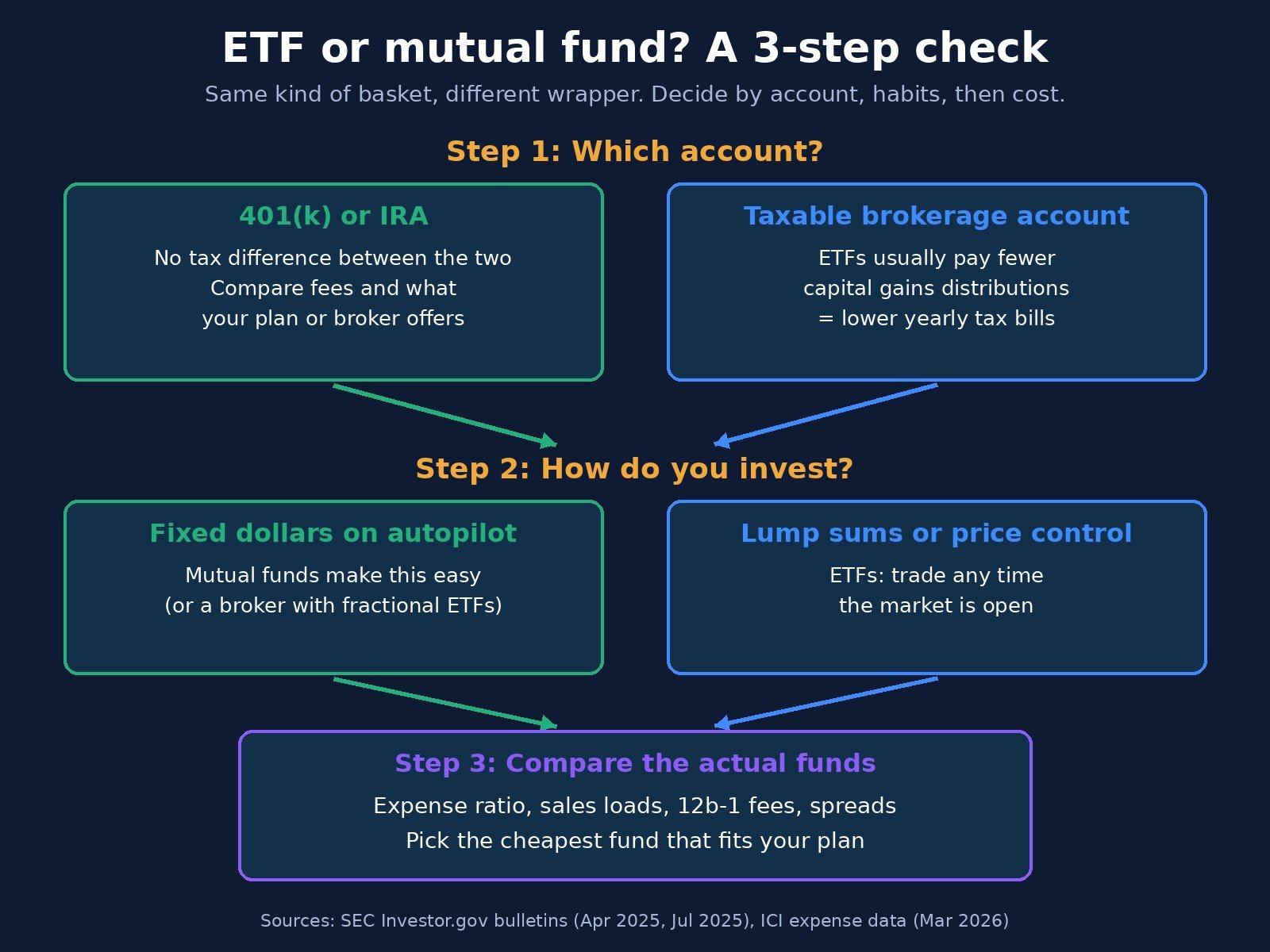
Start with the account, then the fund, then the wrapper.
An ETF is often the better fit if…
- You are investing in a taxable brokerage account and want to keep yearly tax bills from fund distributions low.
- You want to buy funds from many fund companies in one brokerage account.
- You want to control your trade price with limit orders, or you invest in lump sums.
- The ETF version of the fund you want is the cheaper one.
A mutual fund is often the better fit if…
- You are investing through a 401(k) or similar workplace plan, where the menu is often mostly mutual funds and collective trusts. See our guide to how a 401(k) works.
- You want to invest an exact dollar amount automatically every week or month without thinking about share prices.
- The mutual fund is in a tax-advantaged account like an IRA, so the ETF tax edge does not apply, and the fund is as cheap or cheaper. Our Roth IRA vs traditional IRA guide explains those accounts.
- You hold your account directly at a fund company and like keeping things in one place.
Quick scenarios
| Situation | Leaning | Why |
|---|---|---|
| Roth IRA, $300 a month on autopilot | Either; mutual fund is simplest | No tax difference in an IRA; automatic dollar investing is built in |
| Taxable account, $20,000 lump sum for the long term | ETF | Fewer capital gains distributions in a taxable account |
| 401(k) at work | Whatever low-cost option your plan offers | Choice is limited to the plan menu; compare expense ratios |
| Adviser recommends a fund with a sales load | Ask about no-load or ETF alternatives | A 5% load costs $500 on $10,000 before you earn anything |
Before you invest at all, make sure you have an emergency fund, since neither ETFs nor mutual funds are insured and both can lose value (Investor.gov).
ETFs to be careful with
The ETF label covers some very different products. Leveraged and inverse ETFs aim to deliver a multiple, or the opposite, of an index’s return for a single day, and most reset daily. The SEC warns that their returns over weeks or months “can differ significantly” from what the name suggests and can bring “significant and sudden losses” for buy-and-hold investors (Investor.gov: Leveraged and Inverse ETFs).
Also, not everything with “ETF” in its name is a registered fund. The SEC points out that some exchange-traded products, such as exchange-traded notes and some commodity trusts, are not registered under the Investment Company Act and work differently. Check the prospectus before you buy.
What’s changing: one fund, both share types
The line between the two is starting to blur. On November 17, 2025, the SEC granted Dimensional Fund Advisors an order allowing a fund to offer an ETF share class alongside its mutual fund share classes in the same portfolio (SEC Release IC-35786). Vanguard had long used a similar structure for its index funds. Other managers have applied for the same relief, so you may increasingly see the same strategy offered both ways, letting you pick the wrapper that suits your account.
Switching from mutual funds to ETFs
- In an IRA or 401(k): selling one fund and buying another inside the account does not create a taxable event, so switching is mostly about fees and options.
- In a taxable account: selling a mutual fund to buy an ETF realizes any gain you have, and that gain is taxable. If your gains are large, it can make sense to keep the old fund, stop reinvesting its distributions, and direct new money into the ETF instead.
- If your fund itself converts to an ETF: the fund will notify you. Shares already in a brokerage account convert automatically, but shares held directly with the fund company need a brokerage account, and any fractional shares may be cashed out, which can be taxable (SEC bulletin on mutual fund conversions).
For anything involving big gains, a tax professional can run the numbers for your situation.
Frequently asked questions
What is the main difference between an ETF and a mutual fund?
An ETF trades on a stock exchange throughout the day at a market price, while a mutual fund is bought from and sold back to the fund once a day at its net asset value. Both pool investors’ money into a portfolio and both can be index or actively managed.
Are ETFs better than mutual funds?
Not automatically. ETFs are usually more tax-efficient in a taxable account and easy to trade, but a low-cost index mutual fund can be just as cheap or cheaper. In a 401(k) or IRA there is no tax difference, so compare expense ratios and other fees fund by fund.
Are ETFs cheaper than mutual funds?
On average, ETFs are cheaper than the mutual fund universe as a whole, which includes many active funds. ICI data for 2025 shows an average 0.14% for index equity ETFs versus 0.40% for equity mutual funds, but index equity mutual funds averaged 0.05%. Compare specific funds.
Why are ETFs more tax-efficient than mutual funds?
Most ETF redemptions happen in kind, with securities handed over instead of sold, so the fund realizes fewer capital gains. Mutual funds often sell holdings to pay redeeming investors cash, and any gains must be distributed to remaining shareholders, who owe tax on them in a taxable account.
Should I use an ETF or a mutual fund in my Roth IRA?
Either works. The SEC says there is no tax difference between ETFs and mutual funds in a tax-advantaged account like an IRA, so choose based on the fund’s costs, whether your broker supports automatic investing, and which one is easier for you to keep investing in.
Can I lose money in an ETF or a mutual fund?
Yes. Neither is guaranteed or insured by the FDIC or any government agency, according to the SEC. Their value rises and falls with the investments they hold, and you can lose some or all of your money.
Is an index fund an ETF or a mutual fund?
It can be either. “Index fund” describes the strategy of tracking an index, while ETF and mutual fund describe how the fund is bought, sold and priced. Many companies offer the same index in both forms.
The bottom line
ETFs and mutual funds are two wrappers for the same idea: a diversified basket in one purchase. In a taxable brokerage account, an ETF usually saves you tax on fund distributions. In a 401(k) or IRA, that edge disappears and the cheapest suitable fund wins, whichever form it takes. Avoid sales loads and high expense ratios, skip leveraged and inverse ETFs unless you fully understand them, and choose the setup that makes it easiest for you to keep investing. New to all this? Start with our beginner’s guide to investing.

The Teck Hustlers Editorial Team covers technology, business, finance and gaming news for readers who want the story behind the headline. Every article is researched, written and edited by our in-house team, checked against company announcements, filings and reputable reporting, and updated when new facts emerge. We focus on what each development means for founders, professionals, investors and everyday users. Have a tip or a correction? Reach us through our contact page.