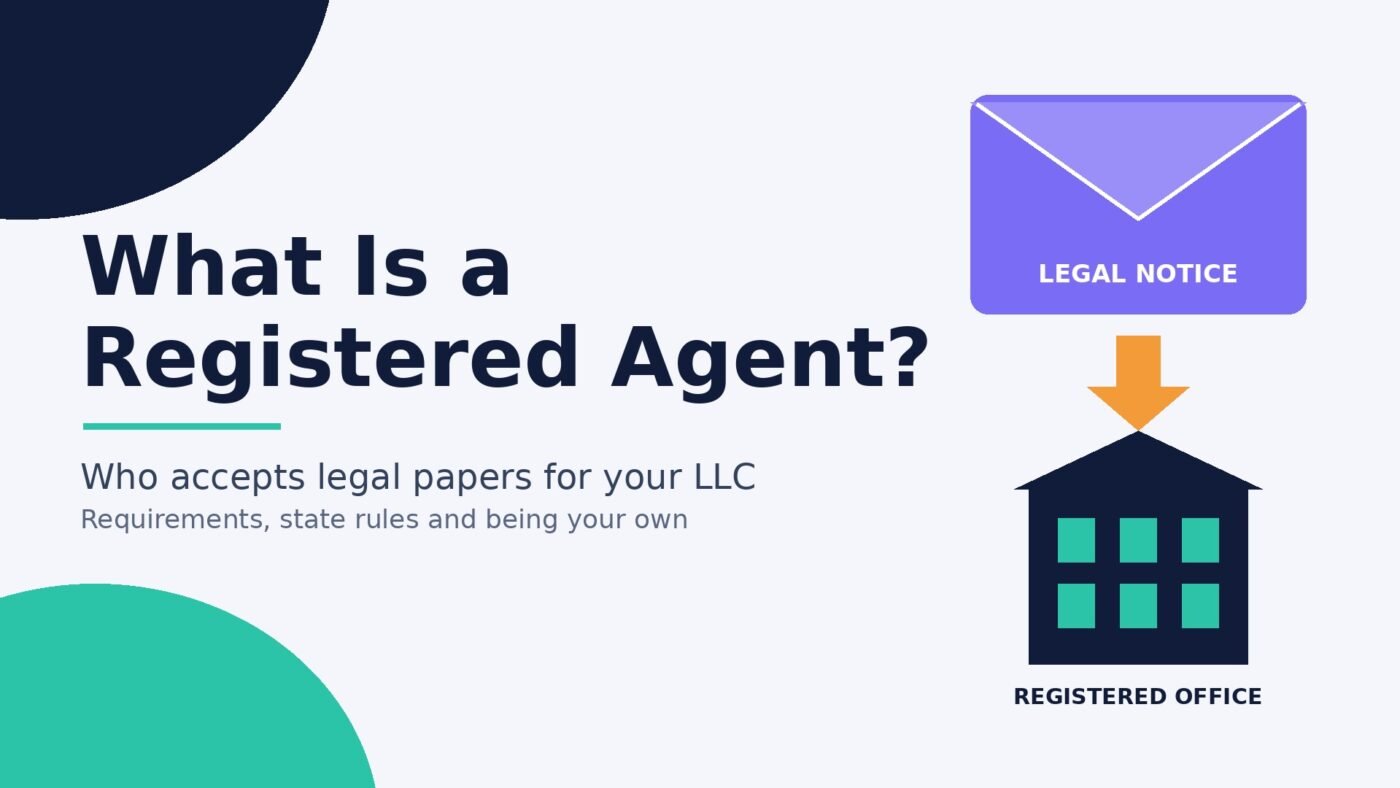
A registered agent is the person or company your LLC or corporation officially names to receive legal papers on its behalf, such as a lawsuit (called service of process), along with official notices from the state. The agent must have a physical street address in the state where the business is registered and be available there during normal business hours. You can usually be your own registered agent if you meet your state’s rules, or you can pay a commercial registered agent service to do it.
If you’re filling out LLC paperwork for the first time, the “registered agent” box can look like a trap that forces you to buy something. It isn’t. Every state that requires one lets a qualifying individual serve, and that individual can be you. This guide explains what the job involves, who’s allowed to do it, how the rules differ in a few big states, and how to decide between doing it yourself and hiring a service. State rules here come straight from state statutes and secretary of state pages, linked inline.
Not legal advice: this is general information. Registered agent rules are set by each state, so check your own state’s business filing office before you file.
What does a registered agent do?
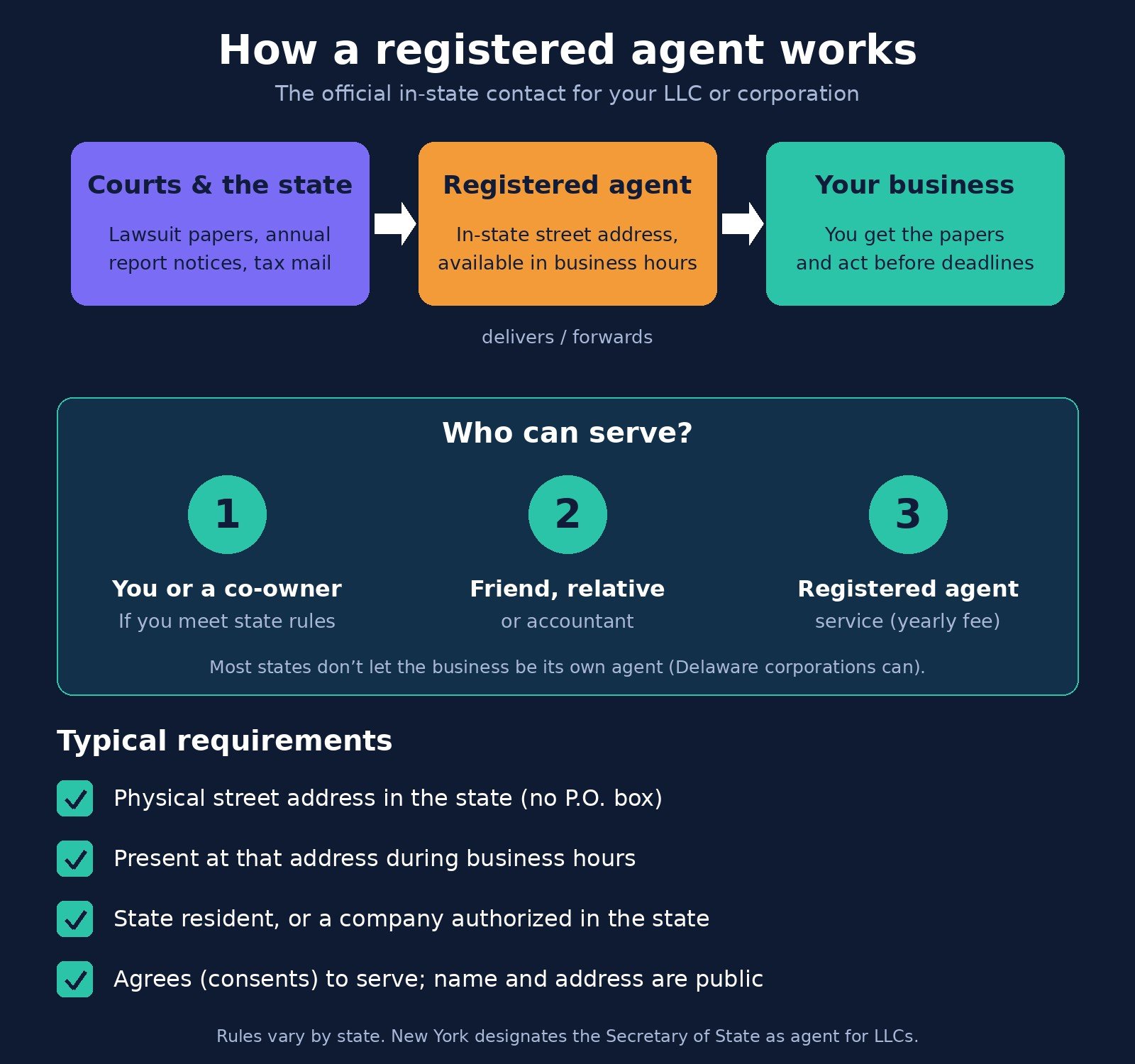
The U.S. Small Business Administration puts it simply: a registered agent receives official papers and legal documents on behalf of your company, and it must be located in the state where you register. In practice, the job comes down to a few tasks:
- Accepting service of process. If someone sues your business, the court papers (usually a summons and complaint) can be delivered to your registered agent. Because these papers start a deadline to respond, they need to reach you quickly.
- Receiving official state mail. Annual report reminders, tax notices and other government correspondence often go to the registered agent’s address. Delaware’s law, for example, requires a corporation’s agent to forward the annual report notice to the company.
- Forwarding everything promptly. Florida’s LLC law spells out the core duty: the agent must forward any process, notice or demand to the company at the address the company most recently gave the agent.
- Being reachable at a fixed place. The agent has to be at a real street address in the state, during business hours, so a process server can actually hand over the papers.
A registered agent doesn’t run your business, sign contracts or own anything. Naming someone as your agent doesn’t make them a member or owner of your LLC.
Other names for a registered agent
States don’t all use the same label, which causes a lot of confusion. You may see:
- Agent for service of process: California’s term. The California Secretary of State says corporations, LLCs, limited partnerships and limited liability partnerships are required by statute to designate one.
- Resident agent: an older term. Delaware’s corporation law says references to a “resident agent” mean the registered agent.
- Statutory agent: used in some states, as Wolters Kluwer notes.
They all describe the same role. The address of the agent is often called the registered office.
Do you need a registered agent for an LLC?
In almost every case, yes. According to the SBA, if your business is an LLC, corporation, partnership or nonprofit corporation, you’ll need a registered agent in your state before you file. Your registered agent’s name and address go on the formation document itself, whether your state calls it Articles of Organization or a Certificate of Formation. If you’re still at the planning stage, our step-by-step guide to starting an LLC shows where this fits.
Sole proprietors who haven’t formed an entity don’t file formation documents, so they don’t appoint a registered agent. If you’re still deciding whether to form an LLC at all, see sole proprietorship vs LLC. Registering a trade name alone doesn’t create an entity either; our DBA vs LLC guide explains the difference.
The New York exception: New York works differently. Every New York LLC must designate the Secretary of State as its agent for service of process and give an address where the state can mail copies of any papers it receives. Naming a separate registered agent is allowed but optional under New York’s LLC law.
If your LLC does business in other states and registers there as a “foreign” LLC, you’ll generally need an agent in each of those states too. The SBA’s guide covers foreign qualification in more detail.
Who can be a registered agent?
Most states give you three practical options: yourself (or another owner or manager), a trusted person such as a friend, relative or accountant, or a company that offers registered agent services. Whoever you pick has to meet your state’s requirements.
Common requirements
- An in-state street address. A P.O. box doesn’t count. Florida’s filing instructions say the agent must have a physical street address in Florida, and Texas says the registered office must be a street address where service of process may be personally served, not solely a mailbox service.
- Residency or authorization. Individuals generally must live in the state. Companies acting as agents must be authorized to do business there. In California, an agent must be an individual who is a California resident or a corporation that has filed under Section 1505.
- Availability. The agent must be reliably present to accept papers. Delaware’s law says an individual agent must be generally present at a designated location in the state at sufficiently frequent times to accept service of process, and an agent can’t do the job only through a virtual office or mail forwarding service.
- Consent. The person or company has to agree to serve. In Texas, anyone named as registered agent since January 1, 2010, must have consented in written or electronic form. In Florida, the agent must sign the filing to accept the obligations.
Can you be your own registered agent?
Usually, yes. If you meet the residency and address rules and can be at that address during business hours, you can name yourself. Florida’s instructions say directly that a manager, member or managing member may be listed to accept service for the LLC. California’s Secretary of State notes that small corporations often designate an officer or director as their agent.
The catch is privacy. California warns that the agent’s name and physical street address is a public record, open to all. If you work from home, that means your home address shows up in the state’s public business search.
Can your LLC be its own registered agent?
Usually not. California says a business entity cannot act as its own agent for service of process, and Florida says an entity cannot serve as its own registered agent. Texas says the same, though an officer, owner or employee may serve. There are exceptions: Delaware’s corporation law, for instance, lists “the corporation itself” as an allowed agent for a Delaware corporation. Don’t assume either way; check your state’s statute or filing instructions.
Registered agent rules in five states
Here’s how the rules look in a few of the states where many small businesses form. This isn’t a full list; your state’s business filing office has the final word.
| State | What it’s called | Who can serve | Notable rule |
|---|---|---|---|
| California | Agent for service of process | A California resident, or a corporation with a Section 1505 certificate on file | The entity can’t be its own agent; the agent’s name and street address are public |
| Delaware | Registered agent (formerly resident agent) | The corporation itself, a Delaware resident, or an authorized business entity (corporation rules) | Agents can’t operate solely through a virtual office or mail forwarding |
| Florida | Registered agent | A Florida resident or an authorized business entity whose business address matches the registered office | The agent must file a written acceptance of the appointment |
| New York | Agent for service of process | The Secretary of State must be designated; a separate registered agent is optional | The state mails copies of process to the address you provide |
| Texas | Registered agent | A Texas resident, or an organization authorized to do business in Texas with an office at the registered office address | The entity can’t be its own agent; the agent must consent; the entity must continuously maintain an agent and office |
Be your own agent, ask someone you trust, or hire a service?
There’s no single right answer. It depends on where you work, how often you travel and how much you care about keeping your address private.
| You (owner or manager) | Friend, relative or accountant | Registered agent service | |
|---|---|---|---|
| Cost | No fee | Usually no fee, but you’re asking a favor | Ongoing yearly fee (compare providers) |
| Privacy | Your address is public record | Their address is public record | The service’s address goes on the public record |
| Availability | You must be at the address in business hours | Depends on their schedule and reliability | Staffed office during business hours |
| Speed of notice | Instant, since papers come to you | Depends on how quickly they pass things on | Most scan and notify you; check how fast |
| Being served | A process server may show up at your door | They get served on your behalf | The service is served, not you |
| Multi-state | Only works in your home state | Only works in their state | Many cover several states |
Being your own agent makes sense if
- You live and work in the state where the LLC is formed
- You (or a coworker) are at a fixed street address during business hours most days
- You’re comfortable with that address appearing in public business records
A registered agent service makes sense if
- You formed the LLC in a state where you don’t live, or you’ve registered in several states
- You work from home and don’t want your home address on the public record
- You travel a lot or don’t keep regular hours at one location
- You’d rather not be handed a lawsuit in front of customers or neighbors
If you hire a service, read what’s included. Some charge extra for mail scanning, compliance reminders or additional states. Avoid any provider that pressures you into bundled services you didn’t ask for, and remember that some government steps, such as getting an EIN from the IRS, are free when you do them yourself.
What happens if you don’t have a registered agent?
States take this seriously because the agent is how courts and regulators reach your business. Consequences vary, but they can include:
- Losing your business entity. Texas says failing to continuously maintain a registered agent and office may result in the involuntary termination of a Texas entity, or revocation of an out-of-state entity’s registration.
- Forfeiture after an agent resigns. In Delaware, if a corporation’s agent resigns and the corporation doesn’t name a new one within 30 days of the resignation filing, the Secretary of State shall declare the charter forfeited.
- Being shut out of court. Under Florida law, an LLC that doesn’t comply with the registered agent rules may not bring or maintain a lawsuit in a Florida court until it fixes the problem, and a court can order a penalty of $5 a day or $500, whichever is less.
- Lawsuits you never hear about. If a plaintiff can’t reach your agent, courts can allow other methods. In California, after diligent attempts fail, a court can order service through the Secretary of State’s office, which charges a $50 statutory fee. You may not see the papers in time, and a missed deadline can lead to a default judgment against your business.
Keep your agent information current the same way you keep your operating agreement and other company records up to date.
How to change your registered agent
You can switch agents whenever you want, for example if you move, hire a service, or want to take the job back yourself. The general process:
- Line up the new agent and get their consent. Some states require written acceptance.
- File your state’s change-of-agent form with the secretary of state or business filing office and pay the fee. In Texas, it’s Form 401, and the filing fee is $15 for most entities.
- Update your records and tell the old agent so they stop accepting papers for you.
- Repeat in every state where your LLC is registered, if you use different agents in different states.
Agents can resign too, but they must give notice first. In Texas, when an agent resigns, the appointment terminates on the 31st day after the Secretary of State receives notice, which gives you time to name a replacement. Don’t ignore that notice.
Registered agent vs registered office vs business address
- Registered agent: the person or company that accepts legal papers and official notices.
- Registered office: the agent’s street address in the state. Delaware’s law defines it as the address of the registered agent, and it need not be a place where the corporation does business.
- Principal office or mailing address: where your business actually operates or gets mail. It can be a different address, even in another state, and in some states a P.O. box is fine for mailing only.
Frequently asked questions
What is a registered agent?
A registered agent is the person or company an LLC, corporation or similar business names to receive lawsuits (service of process) and official state notices on its behalf. The agent must have a physical street address in the state and be available there during normal business hours, then forward what arrives to the business.
Do I need a registered agent for my LLC?
Yes, in nearly every state. The SBA says LLCs, corporations, partnerships and nonprofit corporations need a registered agent in the state before they file. New York is a notable exception: the Secretary of State is designated as the agent for service of process, and naming a separate registered agent is optional.
Can I be my own registered agent?
Usually, yes. You need to meet your state’s rules, which typically mean living in the state, having a physical street address there (not a P.O. box), and being available at that address during business hours. Your name and address will appear in public state records.
Can I use a P.O. box for my registered agent address?
No. States require a physical street address so legal papers can be delivered in person. Texas, for example, requires a street address where papers can be personally served, and Florida doesn’t accept a P.O. box for the registered agent address.
Does the registered agent have to be in the same state as the LLC?
Yes. The agent must have a street address in the state where the LLC is formed or registered. If you register your LLC in more than one state, you need an agent in each state.
Is a registered agent the same as an LLC owner?
No. A registered agent only receives legal papers and official notices. Being named as the agent doesn’t give someone ownership, management authority or the right to sign for the business, though an owner can also serve as the agent.
What happens if I don’t have a registered agent?
Your business can lose good standing or be terminated, depending on the state. Texas says failing to maintain an agent may lead to involuntary termination. You also risk missing a lawsuit, which can lead to a default judgment.
How do I change my registered agent?
File your state’s change-of-agent form with the secretary of state and pay the fee, after the new agent agrees to serve. In Texas, that’s Form 401 with a $15 fee for most entities. Update your records and repeat in any other state where your business is registered.
Bottom line
A registered agent is your business’s official mailbox for lawsuits and state notices, tied to a real street address in the state. Most owners can do the job themselves for free if they live in the state, keep regular hours at one address and don’t mind that address being public. If privacy, travel or multi-state registration is a concern, a registered agent service is the simpler route. Whichever you pick, keep the information current, because the cost of a missed notice can be far higher than the cost of the agent. Once your agent is sorted, the next decisions are usually your operating agreement and how your LLC will be taxed; our LLC vs S corp guide covers that choice.

The Teck Hustlers Editorial Team covers technology, business, finance and gaming news for readers who want the story behind the headline. Every article is researched, written and edited by our in-house team, checked against company announcements, filings and reputable reporting, and updated when new facts emerge. We focus on what each development means for founders, professionals, investors and everyday users. Have a tip or a correction? Reach us through our contact page.