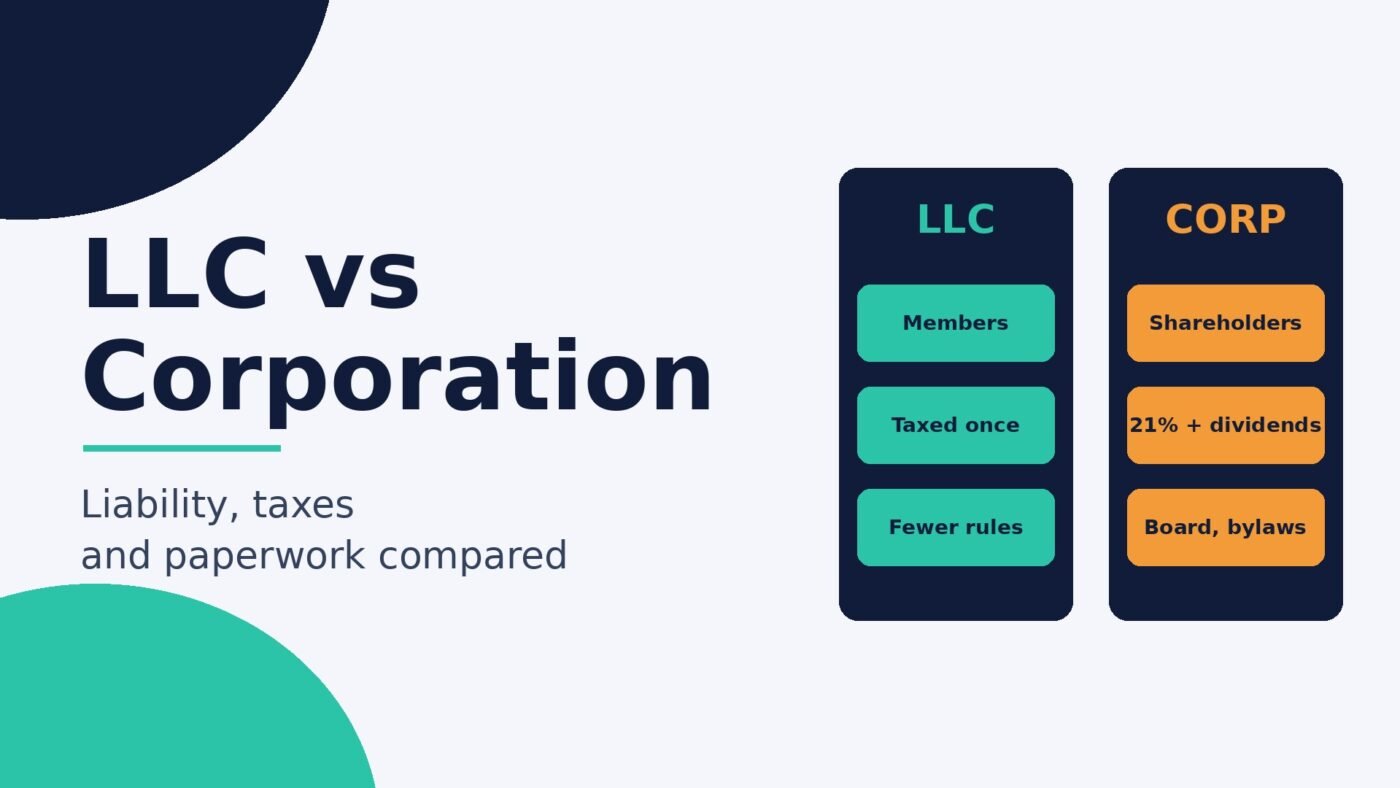
An LLC and a corporation both shield your personal assets from the business’s debts and lawsuits. The big differences are taxes and paperwork. By default, an LLC’s profit passes through to the owners’ personal tax returns and is taxed once, and the company runs on a flexible operating agreement. A corporation is a separate taxpayer that pays a flat 21% federal tax on its profit, its owners pay tax again on dividends, and it has to keep a board of directors, bylaws, meetings and minutes. Most small businesses and side hustles start as LLCs; companies that plan to raise venture money or sell stock usually incorporate.
That’s the short version. The longer one matters, because the choice affects how much tax you pay, how much admin you sign up for, and who can invest in you later. Below we compare the two on liability, taxes, paperwork and fundraising, walk through a simplified tax example, and finish with a checklist for picking one. Every rule and number links to the IRS or SBA page it comes from.
Not tax or legal advice: this covers general federal rules. State law, state taxes and fees vary, so check with your state and a CPA or attorney before you file.
LLC vs corporation at a glance
| LLC | Corporation (C corp by default) | |
|---|---|---|
| Owners are called | Members | Shareholders |
| What owners hold | Membership interests (percentages) | Shares of stock |
| Personal liability | Owners generally not personally liable | Owners generally not personally liable |
| Formation document | Articles of organization | Articles of incorporation |
| Internal rulebook | Operating agreement | Bylaws |
| Who runs it | Members, or managers they choose | Board of directors, which appoints officers |
| Default federal tax | Pass-through: disregarded entity (one owner) or partnership (two or more) | Company pays a flat 21%; dividends taxed again |
| Self-employment tax | Members generally pay it on their share of profit | Owners who work there get a salary with payroll taxes; dividends aren’t subject to them |
| Can choose a different tax treatment? | Yes: can elect to be taxed as a C corp or S corp | Can elect S corp status if eligible |
| Federal return | Schedule C (one owner) or Form 1065 (two or more) | Form 1120 (or 1120-S as an S corp) |
| Raising outside money | Possible, but investors often prefer stock | Built for it: sell shares, issue classes of stock |
| Best fit | Freelancers, side hustles, small owner-run businesses | Startups raising venture capital, companies planning to go public or issue stock |
What an LLC is
A limited liability company is a business structure created under state law. The IRS describes it as a business structure allowed by state statute, and notes that each state sets its own rules. The owners are called members. Most states don’t restrict who they can be, so members may include individuals, corporations, other LLCs and foreign entities, and there’s no maximum number of members. Most states also allow single-member LLCs.
The SBA’s summary is that an LLC lets you take advantage of the benefits of both the corporation and partnership business structures: you get a liability shield like a corporation, with the simpler pass-through taxes of a partnership. You form one by filing articles of organization with your state, and you set the internal rules (who owns what, how profit is split, what happens if someone leaves) in an LLC operating agreement.
If you’re starting from scratch, our guide on how to start an LLC covers the filing steps and state costs.
What a corporation is
A corporation is also formed under state law, by filing articles of incorporation. Owners buy stock: the IRS says that in forming a corporation, prospective shareholders exchange money, property, or both, for the corporation’s capital stock. Shareholders elect a board of directors, the board appoints officers (CEO, treasurer and so on), and bylaws set the rules.
The SBA calls a corporation a legal entity that’s separate from its owners that can make a profit, be taxed and be held legally liable. It also notes the cost to form one is higher than other structures and that corporations need more extensive record-keeping, operational processes and reporting.
Every new corporation is a C corp for federal tax purposes unless it elects S corp status. “Inc.,” “Corp.” and “Corporation” are just name endings; they all mean the same kind of entity. If you’re weighing the two corporate tax statuses, see our S corp vs C corp guide.
Liability protection: mostly a tie
This is the part people expect to be different, and it mostly isn’t. The SBA’s comparison table lists “Owners are not personally liable” for both LLCs and corporations. In both cases, if the business can’t pay a debt or loses a lawsuit, creditors generally go after the company’s assets, not your house or savings. The SBA does describe corporations as offering the strongest protection, but for a typical small business the practical shield is similar.
Either shield can fail if you don’t treat the business as separate from yourself. Mixing personal and business money, signing personal guarantees on loans, or skipping required filings can all give a court reason to hold owners personally responsible. Keep a separate business bank account (you’ll need a free EIN to open one), sign contracts in the company’s name, and keep up with your state’s annual reports and your registered agent. Liability protection also doesn’t cover your own professional mistakes or anything you personally guarantee, which is why many owners also buy business insurance.
How LLC and corporation taxes differ
Taxes are where the two really split. The key idea: an LLC is a legal structure that gets to pick its federal tax treatment, while a corporation starts with corporate tax and can only switch to S corp treatment if it qualifies.
LLC: pass-through by default
The IRS doesn’t have a separate “LLC tax.” Instead, it treats an LLC as something it already knows. According to the IRS, a domestic LLC with at least two members is classified as a partnership unless it files Form 8832 to be treated as a corporation, and an LLC with one member is treated as a disregarded entity, separate from its owner only for liability, not for income tax.
- Single-member LLC: profit goes on your personal return, usually on Schedule C, just like a sole proprietorship.
- Multi-member LLC: the LLC files a partnership return on Form 1065 and gives each member a Schedule K-1 showing their share, which they report on their own returns.
Either way the profit is taxed once, at the owners’ personal rates. The catch is self-employment tax. The SBA notes that members of an LLC are considered self-employed and must pay Social Security and Medicare on their earnings. The IRS puts the self-employment tax rate at 15.3%: 12.4% for Social Security and 2.9% for Medicare, with the Social Security part applying to the first $184,500 of combined earnings in 2026. You can deduct the employer-equivalent half when figuring your adjusted gross income. Owners of pass-through businesses may also qualify for the qualified business income deduction of up to 20%, subject to limits.
Because no tax is withheld from LLC profit, most owners pay through quarterly estimated taxes.
Corporation: taxed twice when profit is paid out
A C corporation is, in the IRS’s words, a separate taxpaying entity. It files Form 1120 and pays federal income tax on its own profit. IRS Publication 542 says corporations figure their tax by multiplying taxable income by 21%, a flat rate with no brackets.
When the company pays after-tax profit to shareholders as dividends, they pay tax again. The IRS spells it out: profit is taxed to the corporation when earned, then taxed to shareholders when distributed as dividends, which creates a double tax. The corporation gets no deduction for dividends it pays, and shareholders can’t deduct the corporation’s losses. Qualified dividends are taxed at capital gain rates of 0%, 15% or 20%, depending on your income.
Two things soften this. Profit the corporation keeps and reinvests is taxed only once, at 21%. And salary paid to an owner who works in the business is a deductible expense for the company, taxed to the owner as normal wages with payroll taxes, so it isn’t double-taxed.
A simplified example
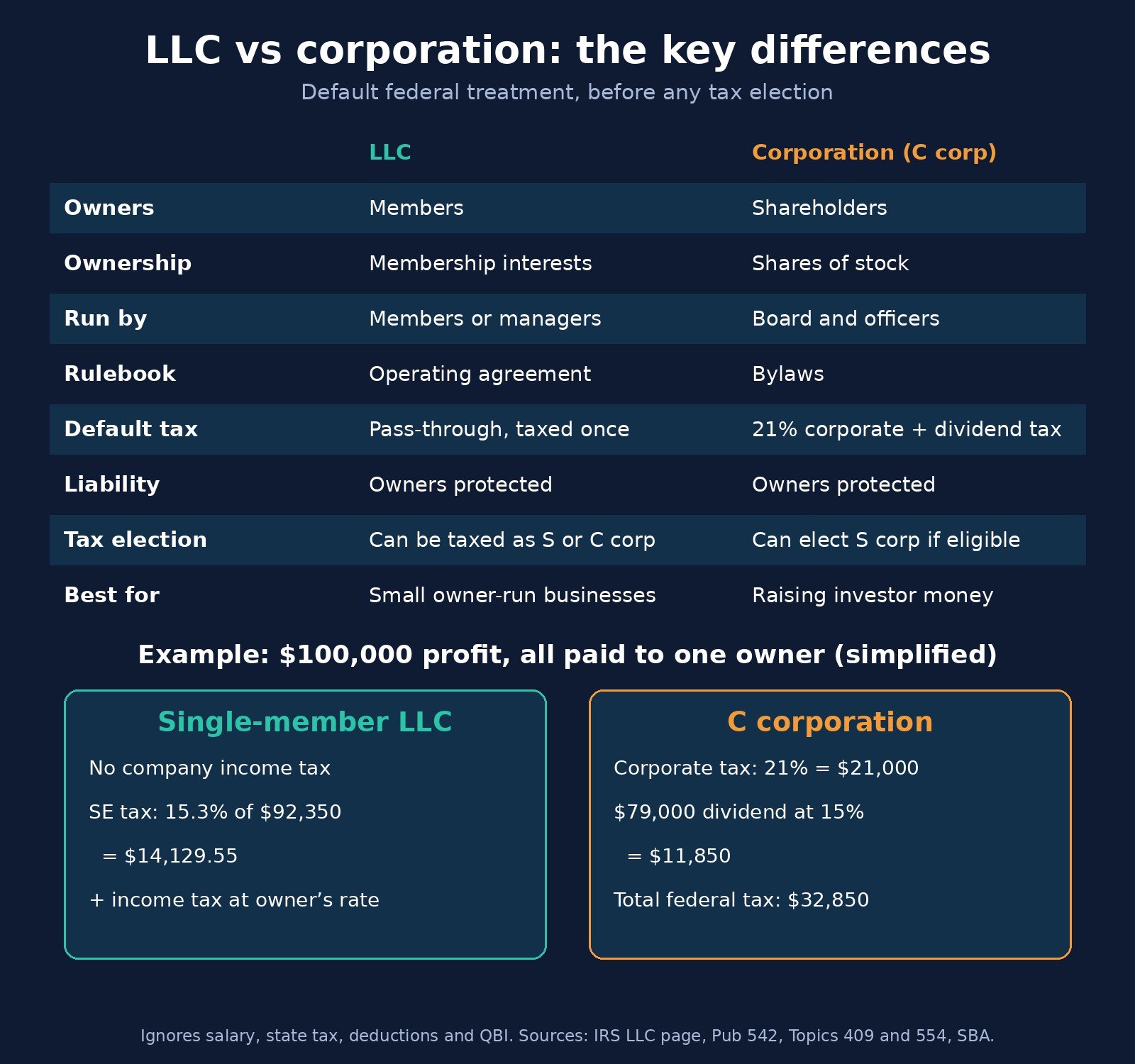
Say a one-owner business earns $100,000 of profit and the owner takes all of it out. This deliberately ignores salary, state taxes, deductions and the QBI deduction, so treat it as an illustration of the structure, not a tax estimate.
- As a single-member LLC (default): the business pays no federal income tax. The owner reports the $100,000 on their personal return. Self-employment tax generally applies to 92.35% of net earnings, so 15.3% of $92,350 is $14,129.55. On top of that, the owner pays federal income tax on the profit at their own bracket, with a deduction for half the self-employment tax.
- As a C corp paying it all as a dividend: the company pays 21% corporate tax, or $21,000. The remaining $79,000 goes to the owner as a qualified dividend; at a 15% rate that’s another $11,850. Total federal income tax: $32,850. Dividends aren’t subject to self-employment or payroll tax.
So which is cheaper? It depends on the owner’s personal tax bracket and on how much profit stays in the company. An owner in a lower bracket who takes everything out usually does better as a pass-through LLC. A company that reinvests most of its profit may prefer the flat 21%. Real-world numbers change once you add a salary, state tax and deductions, which is exactly why this decision belongs on a CPA’s desk.
The middle ground: an LLC taxed as an S corp
You don’t have to choose between “LLC taxes” and “corporate taxes” only. The SBA notes that it’s possible for an LLC to be taxed as a C corp, S corp, or a nonprofit. The popular option is the S corp election: the LLC stays an LLC under state law, but the IRS taxes it as an S corporation. Profit still passes through and is taxed once, and the owner takes a reasonable salary with payroll taxes plus distributions that aren’t subject to self-employment tax. S corps must meet IRS eligibility rules, including no more than 100 shareholders and one class of stock. Our LLC vs S corp guide covers when that election starts to pay off.
Paperwork, management and ongoing rules
Here’s where an LLC usually wins for a small team. The SBA lists the documents each one needs: an LLC files articles of organization and is widely advised to have an operating agreement, while every state requires a corporation to file articles of incorporation, and corporations adopt bylaws that set officer and shareholder duties.
| Task | LLC | Corporation |
|---|---|---|
| Form the company | Articles of organization | Articles of incorporation (lists shares, directors) |
| Internal rules | Operating agreement, written how you like | Bylaws, plus shareholder agreements if needed |
| Management | Member-managed or manager-managed | Board of directors and officers |
| Meetings and minutes | Usually not required by state law | Board and shareholder meetings with minutes are standard |
| Issuing ownership | Update the operating agreement | Issue shares and keep a stock ledger |
| Annual state filings | Annual or biennial report in most states | Annual report in most states; some charge franchise tax |
Filing fees depend on your state. The SBA says that in most cases the total cost to register your business will be less than $300, though fees vary by state and structure. Both structures need a registered agent, and both usually need an EIN.
An LLC’s flexibility is a real advantage. Members can split profits in ways that don’t match ownership percentages if the operating agreement says so, and a solo owner can run everything without holding formal meetings. A corporation’s formality is the price of a structure that outsiders understand instantly.
Raising money and bringing in new owners
If you plan to raise outside money, the corporation has the edge. The SBA notes that corporations have an advantage when it comes to raising capital because they can sell stock, which can also help attract employees through stock-based pay. Venture investors typically expect a C corp so they can buy preferred stock, and a C corp has no limit on the number or type of shareholders.
Ownership changes are smoother, too. The SBA says a corporation has a completely independent life separate from its shareholders, so it can keep going relatively undisturbed when a shareholder sells. LLCs, by contrast, can have a limited life in many states: when a member joins or leaves, some states may require the LLC to be dissolved and re-formed unless the operating agreement already covers buying, selling and transferring ownership. That’s a strong reason to write a solid operating agreement from day one.
An LLC can still take on partners, lenders and even investors, and many profitable small businesses never need anything more.
When an LLC is the better pick
- You’re a freelancer, consultant, creator or side hustler who wants liability protection without corporate admin.
- You have one owner or a small group of partners and no plans to sell stock to investors.
- You want pass-through taxes now, with the option to elect S corp treatment once profit grows.
- You want flexible profit splits and simple management.
- You’re moving up from a sole proprietorship or DBA and want the business separated from your personal assets.
When a corporation is the better pick
- You plan to raise venture capital or angel money soon, or investors have asked you to incorporate.
- You want to grant stock options to employees or issue different classes of stock.
- You expect to reinvest most of your profit for years rather than pay it out.
- You hope to go public or be acquired, and want a structure buyers and banks already know.
- You want an S corp with a classic corporate setup and meet the eligibility rules.
If you’re unsure, many owners start with an LLC because it’s cheaper to run and easier to change. Startups that already know they’ll raise venture money often incorporate from the start to avoid a conversion later.
Can you switch later?
Yes, but it isn’t free. On the tax side, an LLC can change how the IRS treats it by filing Form 8832; the IRS says an election generally can’t take effect more than 75 days before it’s filed or more than 12 months after. An eligible LLC or corporation can elect S status with Form 2553.
Changing the legal entity itself, say converting an LLC into a corporation, is a state filing, and the SBA warns that converting may have restrictions based on your location and could have tax consequences or lead to unintended dissolution. You may also need a new EIN when ownership or structure changes. Get professional help before converting.
LLC vs corporation: frequently asked questions
Is an LLC or a corporation better for a small business?
For most small, owner-run businesses an LLC is the better starting point. It gives the same basic liability protection as a corporation with less paperwork, and its profit is taxed once on the owners’ returns by default. A corporation makes more sense if you plan to raise investor money, issue stock or reinvest most profits.
Do LLCs pay less tax than corporations?
Not always. A default LLC avoids corporate tax, so profit is taxed once, but owners pay self-employment tax of 15.3% on most of their earnings plus income tax at their own rates. A C corp pays a flat 21% and owners pay tax again on dividends. Which costs less depends on your bracket and how much profit you take out.
Is an LLC a corporation?
No. An LLC is a separate type of entity created under state LLC laws, while a corporation is formed under corporate laws and owned through stock. An LLC can, however, elect to be taxed as a C corp or S corp, so it can be treated like a corporation for federal tax purposes while staying an LLC under state law.
What is the difference between LLC and Inc.?
“Inc.” means the business is incorporated, that is, it’s a corporation with shareholders, a board and bylaws. “LLC” means it’s a limited liability company with members and an operating agreement. Both protect owners from business debts; they differ in default taxes, formalities and how ownership is held.
Can a one-person business be a corporation?
Yes. One person can form a corporation and act as its only shareholder, director and officer, though they still need to follow corporate formalities such as bylaws and records. A single-member LLC is usually simpler for a solo owner.
Can an LLC have investors?
Yes. An LLC can sell membership interests, and the IRS notes there’s no maximum number of members. But many venture investors prefer or require a C corp so they can buy preferred stock, so startups planning a venture round usually incorporate.
The bottom line
Both an LLC and a corporation protect your personal assets. An LLC is simpler to run and taxes profit once by default, which suits most freelancers, side hustles and small businesses. A corporation adds formality and a second layer of tax on dividends, but it’s the structure investors and stock markets are built around. Start with what fits your plans for the next few years, write a solid operating agreement or bylaws, and get a CPA to run your numbers before you file.

The Teck Hustlers Editorial Team covers technology, business, finance and gaming news for readers who want the story behind the headline. Every article is researched, written and edited by our in-house team, checked against company announcements, filings and reputable reporting, and updated when new facts emerge. We focus on what each development means for founders, professionals, investors and everyday users. Have a tip or a correction? Reach us through our contact page.