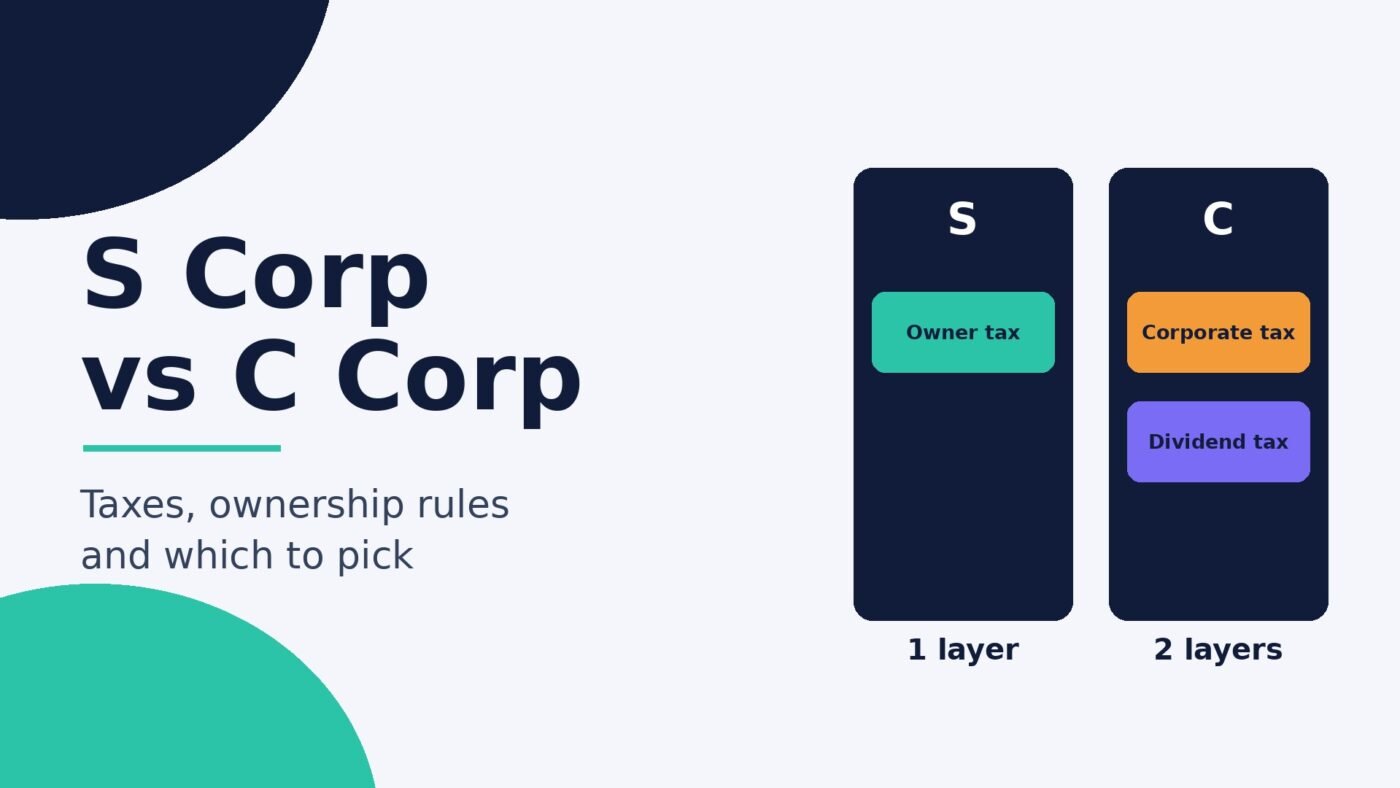
A C corp and an S corp are the same kind of company under state law. The difference is how the IRS taxes them. A C corporation pays federal income tax on its own profit at a flat 21%, and its shareholders pay tax again on any dividends they receive. An S corporation has made a tax election that passes its profit and losses through to the owners’ personal tax returns, so the profit is taxed once. In exchange, an S corp has to follow strict ownership rules: no more than 100 shareholders, only certain kinds of owners, and one class of stock.
If you’re incorporating or deciding how your LLC should be taxed, this is one of the first real forks in the road. Pick wrong and you can pay more tax than you need to, or lock out the investors you want later. Below: how each is taxed, who can own each, the forms and deadlines, and a checklist for choosing. Every rule and number links to the IRS or SBA page it comes from.
Not tax or legal advice: this is general information about federal rules. State taxes differ, and your numbers matter, so run your situation past a CPA or tax professional before you elect or switch.
S corp vs C corp at a glance
| C corporation | S corporation | |
|---|---|---|
| What it is | The default way the IRS taxes a corporation | A corporation (or eligible LLC) that elected S status with Form 2553 |
| Federal income tax on profit | Paid by the company at a flat 21% | Generally none at the company level; profit passes through to owners |
| Tax on money paid to owners | Dividends taxed again on owners’ returns | Profit is taxed once on owners’ returns, whether or not it’s distributed |
| Business losses | Stay in the company; shareholders can’t deduct them | Pass through to owners, subject to limits |
| Number of owners | No limit | No more than 100 shareholders |
| Who can own shares | Anyone, including other companies, funds and non-US investors | Individuals, certain trusts and estates; no partnerships, corporations or non-resident aliens |
| Classes of stock | Multiple (common, preferred) | One class only |
| Federal tax return | Form 1120, due the 15th day of the 4th month after year-end | Form 1120-S, due the 15th day of the 3rd month after year-end |
| QBI deduction for owners | No | Owners may qualify for up to 20% |
| Best fit | Startups raising venture money, companies planning to reinvest profit or go public | Profitable owner-run small businesses that pay out most of their profit |
What “S corp” and “C corp” actually mean
The names come from the parts of the Internal Revenue Code that govern each: Subchapter C and Subchapter S. They aren’t two different kinds of business you form with your state. You form a corporation by filing articles of incorporation with your state, and as far as state corporate law is concerned, that’s simply a corporation. It gets the same liability shield either way. The SBA describes a corporation as a legal entity that’s separate from its owners that offers the strongest protection from personal liability, with more record-keeping and reporting than other structures.
A new corporation is a C corp by default. It becomes an S corp only if it qualifies and files an election with the IRS. That’s why people often say an S corp is “a tax status, not an entity.” It’s also why an LLC can be taxed as an S corp: the IRS lets an eligible LLC make the same election (more on that below).
Both types need the same state-level basics: a registered agent, an EIN (which you can get from the IRS for free), bylaws, a board of directors, and records of shareholder and board decisions.
How C corps and S corps are taxed
This is where the two really split, and it’s the reason most small businesses care about the choice at all.
C corp: two layers of tax
A C corp is its own taxpayer. It reports its income and deductions on Form 1120 and pays tax on its taxable income. IRS Publication 542 says corporations figure their tax by multiplying taxable income by 21%. That’s a flat rate, with no brackets.
When the company pays some of its after-tax profit to shareholders as dividends, the shareholders pay tax on those dividends too. The IRS spells this out on its corporation page: profit is taxed to the corporation when earned, and then is taxed to the shareholders when distributed as dividends, which creates a double tax. The company also doesn’t get a deduction for the dividends it pays, and shareholders can’t deduct the corporation’s losses.
Qualified dividends are taxed at the lower capital gain rates rather than ordinary income rates, and those rates are 0%, 15% or 20% depending on your taxable income. Lighter, but still a second tax on the same dollars.
The double tax only bites when money leaves the company as dividends. Profit the C corp keeps and reinvests is taxed once, at 21%. Salaries paid to owner-employees are deductible business expenses for the company and taxed as wages to the owner, just like any employee’s paycheck.
S corp: one layer, on your personal return
An S corp files Form 1120-S, but it’s mainly an information return. According to the IRS, S corps pass corporate income, losses, deductions and credits through to their shareholders, who report them on their personal returns and pay tax at their individual rates. That’s how an S corp avoids double taxation.
Each owner gets a Schedule K-1 showing their share of the profit. You owe tax on your share even if the company keeps the cash in its bank account, which is worth remembering if you plan to reinvest heavily. There are a few exceptions where an S corp itself owes tax: the IRS notes S corps are responsible for tax on certain built-in gains and passive income, which mostly matters for older C corps that converted.
Because the tax lands on your personal return, S corp owners usually pay federal tax through quarterly estimated payments or extra withholding from their own salary.
A simplified example
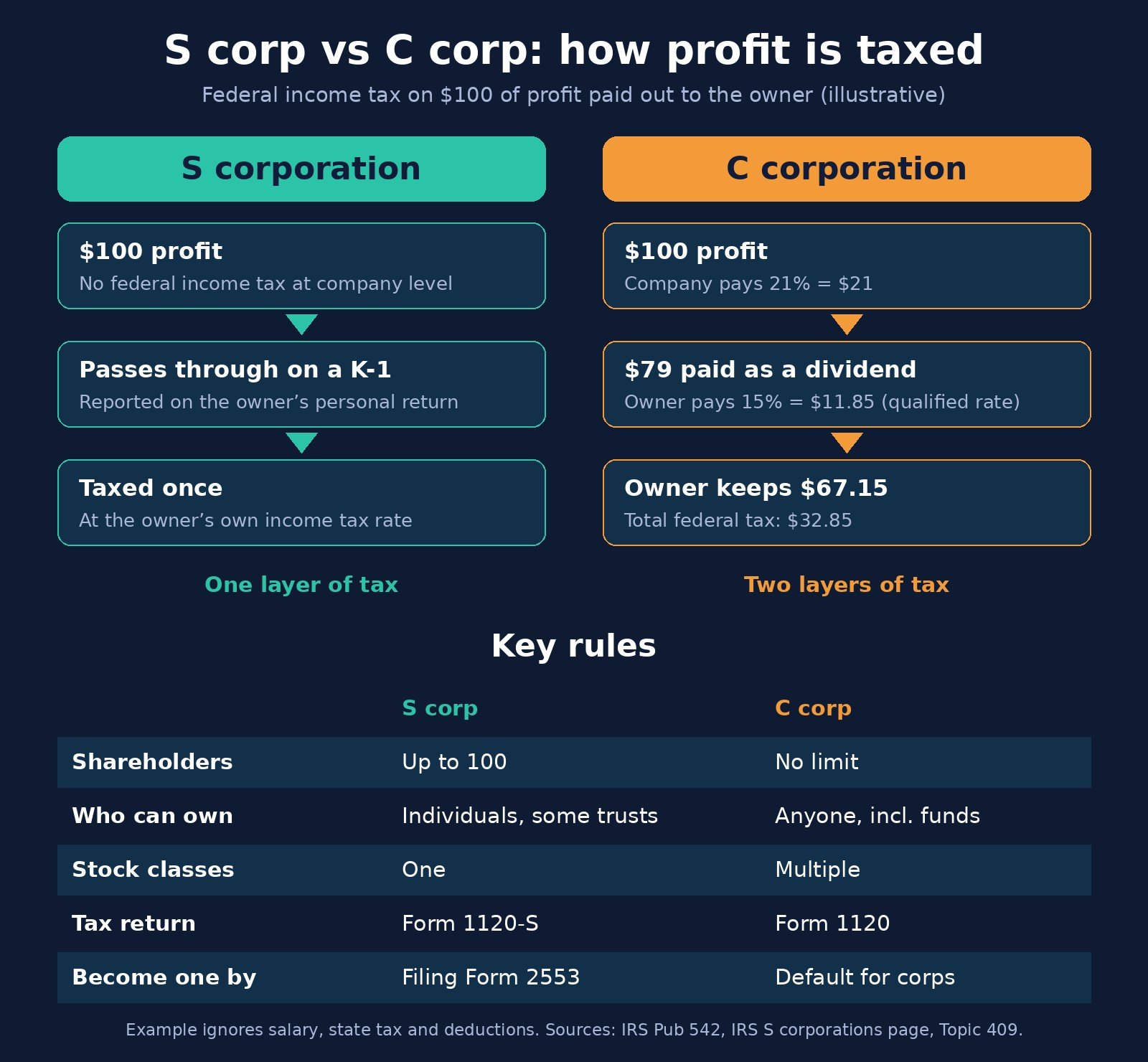
Say a one-owner company earns $100,000 of taxable profit and the owner wants all of it. To keep the math honest, this ignores salary, state tax and deductions, and assumes the owner’s dividends fall in the 15% qualified dividend bracket.
- As a C corp: the company pays 21% corporate tax, or $21,000. It pays the remaining $79,000 to the owner as a dividend. At a 15% qualified dividend rate, the owner owes $11,850. Total federal income tax: $32,850.
- As an S corp: the company pays no federal income tax. The full $100,000 shows up on the owner’s personal return and is taxed once at their own ordinary income rates.
Which one costs less depends on the owner’s personal tax rate and on how much profit stays in the business. A C corp that reinvests most of its profit pays just the 21% for now. An S corp owner in a high personal bracket may pay more on the same profit in the year it’s earned, but avoids the second layer when the cash comes out. Salary, state taxes and the QBI deduction all change the real numbers.
Paying yourself: salary and the reasonable compensation rule
In both types, an owner who works in the business is an employee and gets a W-2 salary with payroll taxes. Social Security and Medicare total 15.3% of wages, split 7.65% each between employer and employee (up to the Social Security wage base).
The S corp angle is that profit paid out as a distribution, rather than salary, isn’t subject to those payroll taxes. That’s the main reason owners of profitable service businesses elect S status. But the IRS doesn’t let you take everything as a distribution. It says S corps must pay reasonable compensation to a shareholder-employee for their services before making non-wage distributions, and it has the authority to reclassify distributions as wages. A salary that’s far below what you’d pay someone else to do your job is the classic audit flag. Our LLC vs S corp guide walks through how this salary-plus-distributions setup works in practice.
The QBI deduction
Owners of pass-through businesses, including S corps, may be able to take the qualified business income deduction. The IRS says it lets eligible taxpayers deduct up to 20 percent of their qualified business income, subject to limits based on income, the type of business and W-2 wages paid. C corps aren’t on the list; their owners don’t get this deduction on corporate profit.
Ownership rules: who can own each
A C corp can have any number of shareholders of any kind: individuals, other corporations, partnerships, venture funds and foreign investors. It can also issue different classes of stock, such as preferred shares that get paid first.
An S corp has to stay inside a tight box. The IRS lists the requirements for S corporation status:
- Be a domestic (US) corporation
- Have only allowable shareholders: individuals, certain trusts and estates, but not partnerships, corporations or non-resident aliens
- Have no more than 100 shareholders. The Form 2553 instructions note that spouses, and members of a family, can be treated as one shareholder for this count
- Have only one class of stock
- Not be an ineligible corporation, such as certain financial institutions and insurance companies
Break one of these rules, for example by selling shares to a company or a non-resident investor, and the S election can terminate. That’s why S corps often put share transfer limits in their shareholder agreements. It’s also the main reason venture-backed startups are almost always C corps: funds typically want preferred stock, and many investors are entities that can’t own S corp shares.
Paperwork and deadlines
Electing S corp status: Form 2553
To become an S corp, the corporation must file Form 2553, signed by all the shareholders. Timing matters. Under the Form 2553 instructions, you file either:
- No more than 2 months and 15 days after the start of the tax year you want the election to take effect, or
- At any time during the tax year before the one it should take effect
For a calendar-year business that wants S status from January 1, that window closes in mid-March. Missed it? The IRS offers relief for late elections if you had reasonable cause and meet the conditions, which include filing within 3 years and 75 days of the intended effective date.
Annual returns
- C corp: Form 1120, generally due by the 15th day of the 4th month after the tax year ends (April 15 for a calendar year). There’s an exception for fiscal years ending June 30.
- S corp: Form 1120-S, generally due by the 15th day of the 3rd month after the tax year ends, which is mid-March for a calendar-year company. Owners need their K-1s to file their own returns, so the earlier deadline isn’t optional.
Which should you pick?
A C corp usually makes sense if
- You plan to raise money from venture capital funds, angel groups or other companies, or offer preferred stock
- You have, or expect, foreign owners or more than 100 shareholders
- You want to reinvest most of the profit to grow, so little is paid out as dividends
- You may want to go public or be acquired by a larger company someday
- Your personal tax rate is high and you’d rather leave profit taxed at 21% inside the company for now
An S corp usually makes sense if
- You’re a US owner (or small group of US owners) running a profitable business
- You take most of the profit out each year rather than reinvesting it
- Your profit is comfortably above a reasonable salary for your role, so the distribution portion is meaningful
- You expect losses early on and want them to flow to your personal return (within the basis and at-risk limits)
- You want the QBI deduction on business profit
If neither list fits yet, for example your side business earns a modest profit, you may not need a corporation at all. A sole proprietorship or single-member LLC keeps taxes and paperwork simple; see sole proprietorship vs LLC to compare.
LLC vs S corp vs C corp
An LLC is a state entity type, like a corporation. By default the IRS taxes a one-owner LLC like a sole proprietorship and a multi-owner LLC like a partnership, so the profit passes through and is subject to self-employment tax. An LLC can also choose to be taxed as a corporation, and an eligible LLC that elects S status on Form 2553 doesn’t need to file Form 8832 separately.
Many owners form an LLC, start with default taxation, and elect S status once profit is high enough to justify payroll. Our LLC vs S corp comparison covers that decision in depth, and the step-by-step guide to starting an LLC and LLC operating agreement guide cover the setup.
Switching between S corp and C corp
- C corp to S corp: file Form 2553 within the deadline, as long as you meet every eligibility test. Watch the built-in gains tax if the company holds assets that went up in value while it was a C corp.
- S corp to C corp: you can revoke the election, and it also ends automatically if you break an eligibility rule. Under the Form 2553 instructions, once an election ends you generally need IRS consent to elect S status again before the 5th tax year after the termination took effect.
Frequently asked questions
What is the main difference between an S corp and a C corp?
Taxes. A C corp pays federal income tax on its profit at a flat 21%, and shareholders pay tax again on dividends. An S corp passes profit and losses through to its owners’ personal returns, so profit is taxed once. Under state law they’re the same kind of corporation with the same liability protection.
Is an S corp better than a C corp for a small business?
Often, for a profitable owner-run business that pays out most of its profit, because it avoids the second layer of tax and owners may get the QBI deduction. A C corp is usually better if you plan to raise venture capital, have foreign or corporate owners, need more than one class of stock, or want to reinvest most profit.
How many shareholders can an S corp have?
No more than 100. Shareholders must be individuals, certain trusts or estates; partnerships, corporations and non-resident aliens can’t own S corp shares. A married couple can be counted as one shareholder.
What is the C corp tax rate?
The federal corporate income tax rate is a flat 21% of taxable income, per IRS Publication 542. Shareholders also pay tax on dividends, at 0%, 15% or 20% for qualified dividends. States may add their own corporate tax.
Can an LLC be an S corp or a C corp?
An LLC can be taxed as either. An eligible LLC can elect S corp status by filing Form 2553, or choose to be taxed as a C corp. It stays an LLC under state law; only its federal tax treatment changes.
When is the deadline to elect S corp status?
File Form 2553 no more than 2 months and 15 days after the start of the tax year you want it to take effect, or any time during the year before. For a calendar-year business, that’s mid-March. The IRS offers relief for late elections in some cases.
Do S corp owners have to take a salary?
Yes, if they work in the business. The IRS requires S corps to pay shareholder-employees reasonable compensation before taking distributions, and it can reclassify distributions as wages subject to payroll taxes if the salary is too low.
Bottom line
Choose a C corp if you’re building something that needs outside investors, multiple share classes or room to reinvest profit at a flat 21%. Choose an S corp if you’re a US owner running a profitable business, you take most of the money out, and you’re willing to run payroll and pay yourself a reasonable salary. Both give the same liability protection; the decision is about taxes and who can own the company. Before you file Form 2553 or incorporate, run your actual numbers with a tax professional, then get the basics in place: a registered agent, an EIN, and clean books so you know your true profit.

The Teck Hustlers Editorial Team covers technology, business, finance and gaming news for readers who want the story behind the headline. Every article is researched, written and edited by our in-house team, checked against company announcements, filings and reputable reporting, and updated when new facts emerge. We focus on what each development means for founders, professionals, investors and everyday users. Have a tip or a correction? Reach us through our contact page.