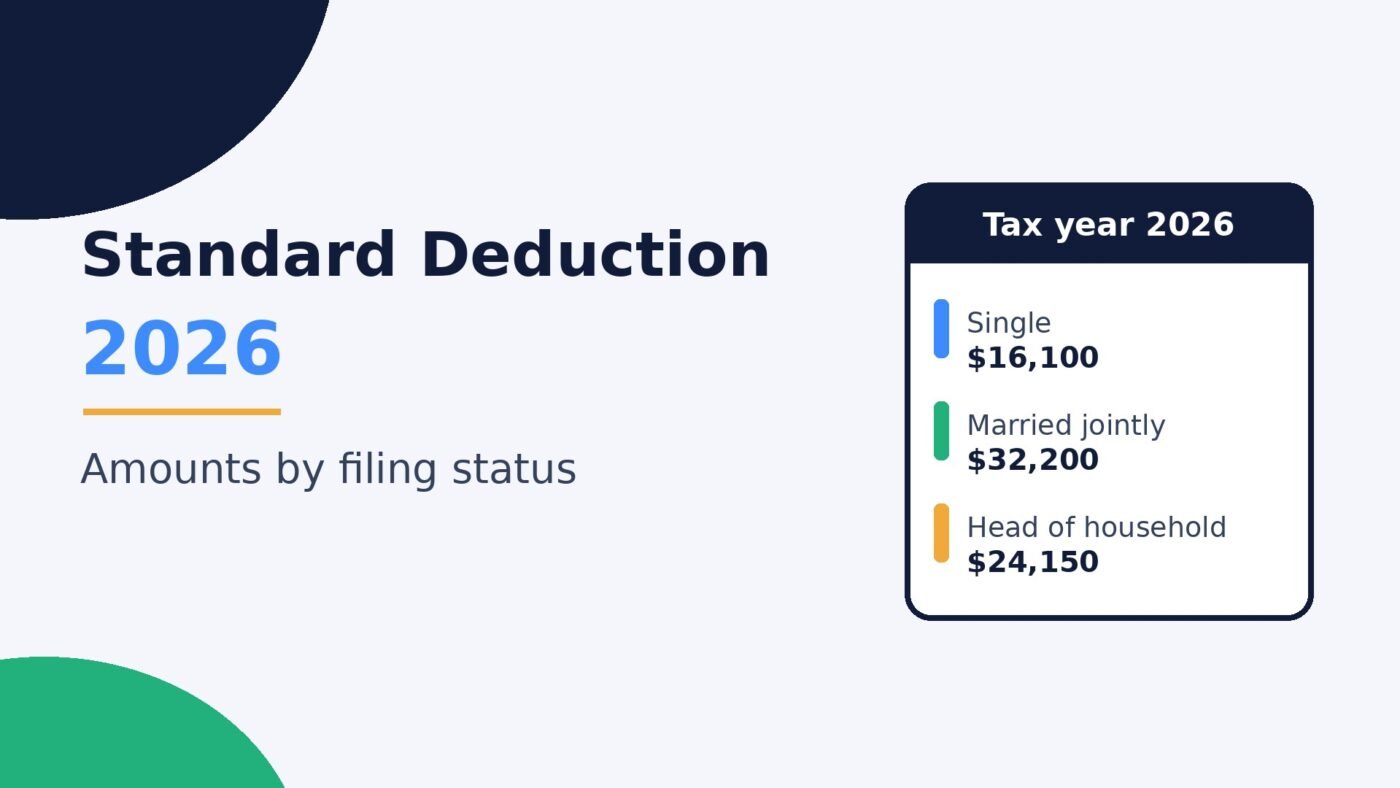
The 2026 standard deduction is $16,100 for single filers and married couples filing separately, $32,200 for married couples filing jointly and qualifying surviving spouses, and $24,150 for heads of household. These are the official IRS amounts for tax year 2026, the return most people will file in early 2027 (IRS Rev. Proc. 2025-32). If you are 65 or older or blind, you add an extra amount on top, and a separate senior deduction can lower your taxable income further.
This guide gives you every 2026 figure in one place, compares it with 2025 and the newly announced 2027 amounts, and walks through the rules for seniors, dependents and people deciding whether to itemize. It is general information for U.S. federal income tax, not personal tax advice. State rules are different.
2026 standard deduction amounts by filing status
The IRS published the tax year 2026 numbers on October 9, 2025, in IR-2025-103, after the One, Big, Beautiful Bill Act (the law the IRS now calls the Working Families Tax Cuts) made the higher standard deduction permanent and raised it again.
| Filing status | 2026 standard deduction |
|---|---|
| Single | $16,100 |
| Married filing jointly | $32,200 |
| Qualifying surviving spouse | $32,200 |
| Head of household | $24,150 |
| Married filing separately | $16,100 |
Your filing status is decided by your situation on the last day of the year. If you are not sure whether you qualify as head of household (generally unmarried and paying more than half the cost of keeping up a home for a qualifying person), check the IRS rules before you file, because that status is worth $8,050 more in standard deduction than filing single in 2026.
Standard deduction 2025 vs 2026 vs 2027
People search for all three years at once because the tax year and the filing year are different. The 2025 amounts apply to returns filed in 2026, the 2026 amounts to returns filed in 2027, and the 2027 amounts, announced on November 5, 2026, to returns filed in 2028.
| Filing status | 2025 (filed in 2026) | 2026 (filed in 2027) | 2027 (filed in 2028) |
|---|---|---|---|
| Single / married filing separately | $15,750 | $16,100 | $16,600 |
| Married filing jointly / surviving spouse | $31,500 | $32,200 | $33,200 |
| Head of household | $23,625 | $24,150 | $24,925 |
| Extra for 65+ or blind (married, per person) | $1,600 | $1,650 | $1,700 |
| Extra for 65+ or blind (unmarried) | $2,000 | $2,050 | $2,100 |
From 2026 to 2027 the joint amount rises by $1,000, the single amount by $500 and the head of household amount by $775. The amounts are adjusted for inflation every year, so expect a new table each fall.
What is the standard deduction?
The IRS defines it simply: the standard deduction is a specific dollar amount that reduces the amount of income on which you’re taxed. You don’t need receipts or proof of spending. You just claim the amount for your filing status, and it is subtracted from your adjusted gross income (AGI) to get your taxable income.
The alternative is to itemize, which means listing specific deductible expenses on Schedule A, such as mortgage interest, state and local taxes and charitable gifts. You take whichever is larger, not both. Because the standard deduction is now fairly high, most households take it.
A deduction is not the same as a tax credit. A deduction lowers the income that gets taxed; a credit lowers the tax bill itself, dollar for dollar. If you are still working out what your AGI is, our guide to gross vs net income explains the different “income” numbers on a pay stub and a return.
Worked example: a single filer earning $60,000
This is an illustration only and ignores credits, other deductions and state tax. Say you are single, your AGI is $60,000 and you take the 2026 standard deduction:
- $60,000 AGI minus $16,100 standard deduction = $43,900 taxable income.
- Using the 2026 single brackets published by the IRS (10% on income up to $12,400, then 12% up to $50,400, per the IRS Working Families Tax Cuts page): 10% of $12,400 = $1,240, plus 12% of the next $31,500 = $3,780.
- Federal income tax before credits: $5,020.
Without the deduction, all $60,000 would be taxed, and part of it would fall into the 22% bracket. The deduction keeps the first $16,100 of this person’s income completely out of federal income tax.
Extra standard deduction if you’re 65 or older or blind
If you are 65 or older at the end of the year, or blind, you get an additional standard deduction on top of the basic amount. If you are both 65+ and blind, you get it twice. For 2026 the extra amount is $1,650 per qualifying person, or $2,050 if you are unmarried and not a surviving spouse.
| 2026 situation | Basic | Additional | Total standard deduction |
|---|---|---|---|
| Single, 65+ | $16,100 | $2,050 | $18,150 |
| Single, 65+ and blind | $16,100 | $4,100 | $20,200 |
| Head of household, 65+ | $24,150 | $2,050 | $26,200 |
| Married filing jointly, one spouse 65+ | $32,200 | $1,650 | $33,850 |
| Married filing jointly, both 65+ | $32,200 | $3,300 | $35,500 |
The separate $6,000 senior deduction (2025 to 2028)
The 2025 tax law added a new, temporary deduction for seniors that sits on top of everything above. According to the IRS fact sheet FS-2025-03:
- It is worth up to $6,000 per eligible person ($12,000 for a married couple if both qualify) for tax years 2025 through 2028.
- You must be 65 on or before the last day of the tax year.
- It phases out once modified AGI goes over $75,000 ($150,000 for joint filers).
- You can claim it whether you itemize or take the standard deduction.
- You need a valid Social Security number on the return, and married couples must file jointly.
The IRS says you claim it on Schedule 1-A (Form 1040). So a single 67-year-old with modified AGI under $75,000 could deduct $18,150 (standard deduction plus the extra for age) and up to $6,000 more through the senior deduction, $24,150 in total for 2026. Unlike the standard deduction, the $6,000 senior deduction is not indexed to inflation, according to the Congressional Research Service.
Standard deduction for dependents in 2026
If someone else can claim you as a dependent, such as a student or a teenager with a part-time job, your standard deduction is limited. For 2026 it is the greater of $1,350 or your earned income plus $450, but never more than the normal amount for your filing status (Rev. Proc. 2025-32).
- Teen with $5,000 of summer job wages: $5,000 + $450 = $5,450, which is more than $1,350, so the standard deduction is $5,450.
- Student with only $900 of interest income and no job: interest is not earned income, so the standard deduction is $1,350.
- Dependent earning $20,000: $20,450 would be above the single limit, so it is capped at $16,100.
For 2027 the dependent figures rise to $1,400 or earned income plus $500 (Rev. Proc. 2026-35). Young people earning money through gig work or freelancing should also read up on Form 1099 and estimated taxes for the self-employed, because self-employment tax works differently from income tax.
Who can’t take the standard deduction?
A few groups are not allowed to use it. According to IRS Topic 551, you can’t take the standard deduction if:
- You are married filing separately and your spouse itemizes. If one spouse itemizes, both must.
- You were a nonresident alien or dual-status alien during the year (with some exceptions, such as a nonresident married to a U.S. citizen or resident who chooses to be treated as a resident).
- You file a return for a period of less than 12 months because your annual accounting period changed.
- The return is for an estate, trust, common trust fund or partnership.
Standard deduction vs itemizing: which should you choose?
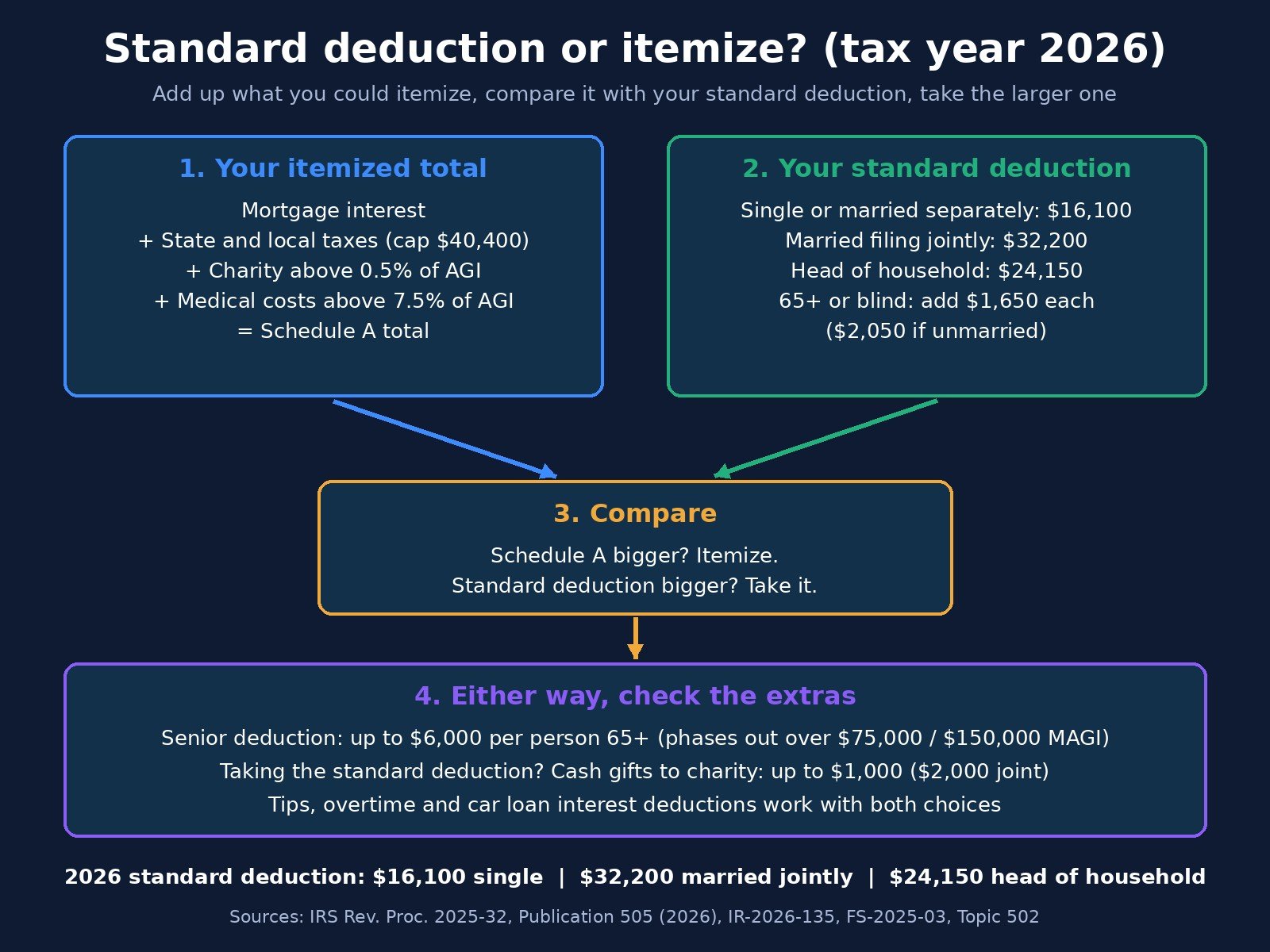
The IRS rule is straightforward: itemize if your allowable itemized deductions are greater than your standard deduction, or if you can’t use the standard deduction. Tax software runs the comparison for you, but it helps to know what counts.
| Standard deduction | Itemized deductions (Schedule A) | |
|---|---|---|
| Amount | Fixed by filing status ($16,100 / $32,200 / $24,150 for 2026) | Sum of your qualifying expenses |
| Records needed | None for the deduction itself | Receipts, Form 1098, tax bills, charity acknowledgments |
| Typical items | n/a | Mortgage interest, state and local taxes, charitable gifts, medical costs above 7.5% of AGI |
| Charity | New for 2026: up to $1,000 cash ($2,000 joint) deductible on top | Deductible, but only the part above 0.5% of AGI from 2026 |
| Extras for 65+ / blind | Yes, added to the basic amount | No additional standard deduction (the $6,000 senior deduction still applies) |
| Best for | Renters, most workers, people with modest deductible costs | Homeowners with large mortgage interest, high state and local taxes, big donors or high medical bills |
Rule changes for itemizers in 2026
- Higher SALT cap. The deduction for state and local income, sales and property taxes is limited to $40,400 ($20,200 married filing separately) for 2026. The cap shrinks once modified AGI is above $505,000, but not below $10,000 (IRS Pub 505).
- Charity floor. If you itemize, you can only deduct charitable contributions above 0.5% of your AGI.
- Overall limit for high earners. The IRS notes that for 2026 your overall itemized deductions may be reduced; this mainly affects people in the top bracket.
Worked example: close calls
Here is an illustration with made-up round numbers. A married couple filing jointly with $160,000 of AGI paid $17,000 of mortgage interest, $11,500 of state and local taxes and gave $5,000 in cash to qualified charities in 2026.
- The charity floor is 0.5% × $160,000 = $800, so only $4,200 of the gifts counts if they itemize.
- Itemized total: $17,000 + $11,500 + $4,200 = $32,700.
- Standard route: $32,200 standard deduction plus up to $2,000 of the new non-itemizer cash charity deduction = $34,200.
Even though their itemized total beats the plain standard deduction by $500, the standard route wins once the new charity deduction is counted. That’s why it pays to run both numbers instead of stopping at “my itemized total is bigger.”
The bunching strategy
If you’re close to the line every year, some people “bunch” deductible costs, such as making two years of charitable gifts in one year, so they itemize in one year and take the standard deduction the next. Whether that helps depends on your numbers and the 0.5% floor, so model it before acting.
Other 2026 deductions you can take with the standard deduction
Taking the standard deduction doesn’t mean giving up every other break. Several deductions are taken separately from the standard-vs-itemized choice:
- Cash gifts to charity (new from 2026): up to $1,000, or $2,000 for joint filers, if you don’t itemize. Gifts to donor-advised funds and supporting organizations don’t qualify, and you need records such as receipts or bank statements (IR-2026-135).
- Senior deduction, tips, qualified overtime and qualified car loan interest: the IRS says each of these 2025 to 2028 deductions is available to both itemizing and non-itemizing taxpayers, with income limits.
- Adjustments to income, such as deductible traditional IRA contributions, the deductible part of self-employment tax and HSA contributions, come off before you reach AGI. Pretax contributions to a workplace plan like a traditional 401(k) are usually left out of your taxable wages to begin with. See our Roth vs traditional IRA guide for how the IRA side works.
If you run a side business, business costs like the 2026 IRS mileage rate go on Schedule C, not Schedule A, so you can deduct them and still take the standard deduction. That’s one reason 1099 contractors and single-member LLC owners should track expenses carefully all year.
How to claim the standard deduction
- Pick your filing status on Form 1040. The amount follows from it.
- Tick the age and blindness boxes if they apply to you or your spouse. The IRS says you claim the additional amount by checking the boxes for age or blindness on Form 1040.
- Check whether someone can claim you as a dependent. If so, use the dependent formula above.
- Enter the standard deduction on the Form 1040 line for “standard deduction or itemized deductions.” Tax software fills this in automatically.
- Add Schedule 1-A if you qualify for the senior deduction or the tips, overtime or car loan interest deductions.
- Keep records of cash charitable gifts if you plan to use the non-itemizer charity deduction.
If you pay quarterly estimated tax, use the 2026 standard deduction when you estimate your taxable income for the year; the IRS worksheet in Publication 505 walks through it.
Frequently asked questions
What is the standard deduction for 2026?
For tax year 2026 the standard deduction is $16,100 for single filers and married filing separately, $32,200 for married filing jointly and qualifying surviving spouses, and $24,150 for heads of household, according to IRS Rev. Proc. 2025-32.
What is the standard deduction for 2026 for seniors over 65?
A single filer 65 or older gets $16,100 plus an extra $2,050, or $18,150. A married couple filing jointly where both are 65+ gets $32,200 plus $1,650 each, or $35,500. Separately, each person 65+ may deduct up to $6,000 more through the senior deduction if modified AGI is under $75,000 ($150,000 joint).
What is the standard deduction for 2027?
The IRS announced on November 5, 2026 that the 2027 standard deduction is $16,600 for single and married filing separately, $33,200 for married filing jointly and $24,925 for heads of household. These apply to returns filed in 2028.
Is the 2026 standard deduction used on the taxes I file in 2027?
Yes. The tax year 2026 amounts apply to the return you file in early 2027. The return you file in 2026 (for tax year 2025) uses the 2025 amounts: $15,750 single, $31,500 married filing jointly and $23,625 head of household.
Can I take the standard deduction and itemize?
No. You choose one or the other each year, whichever lowers your taxable income more. But some deductions, like the senior deduction, the tips and overtime deductions and the new non-itemizer charity deduction, can be taken along with the standard deduction.
Do I need receipts for the standard deduction?
No. The standard deduction is a flat amount and needs no proof of spending. You still need records for anything else you claim, such as cash charitable gifts under the new non-itemizer deduction.
What is the standard deduction for a dependent in 2026?
A dependent’s 2026 standard deduction is the greater of $1,350 or earned income plus $450, capped at the regular amount for their filing status ($16,100 for a single filer).
The bottom line
For 2026 returns, the numbers to remember are $16,100 single, $32,200 married filing jointly and $24,150 head of household, plus $1,650 or $2,050 extra if you’re 65+ or blind. Most people will take the standard deduction, but run the itemizing comparison if you own a home, pay high state and local taxes or give a lot to charity, and remember that the new $1,000/$2,000 charity deduction and the $6,000 senior deduction can change the math. Check the IRS figures for your filing year, and talk to a tax professional if your situation is complicated.

The Teck Hustlers Editorial Team covers technology, business, finance and gaming news for readers who want the story behind the headline. Every article is researched, written and edited by our in-house team, checked against company announcements, filings and reputable reporting, and updated when new facts emerge. We focus on what each development means for founders, professionals, investors and everyday users. Have a tip or a correction? Reach us through our contact page.