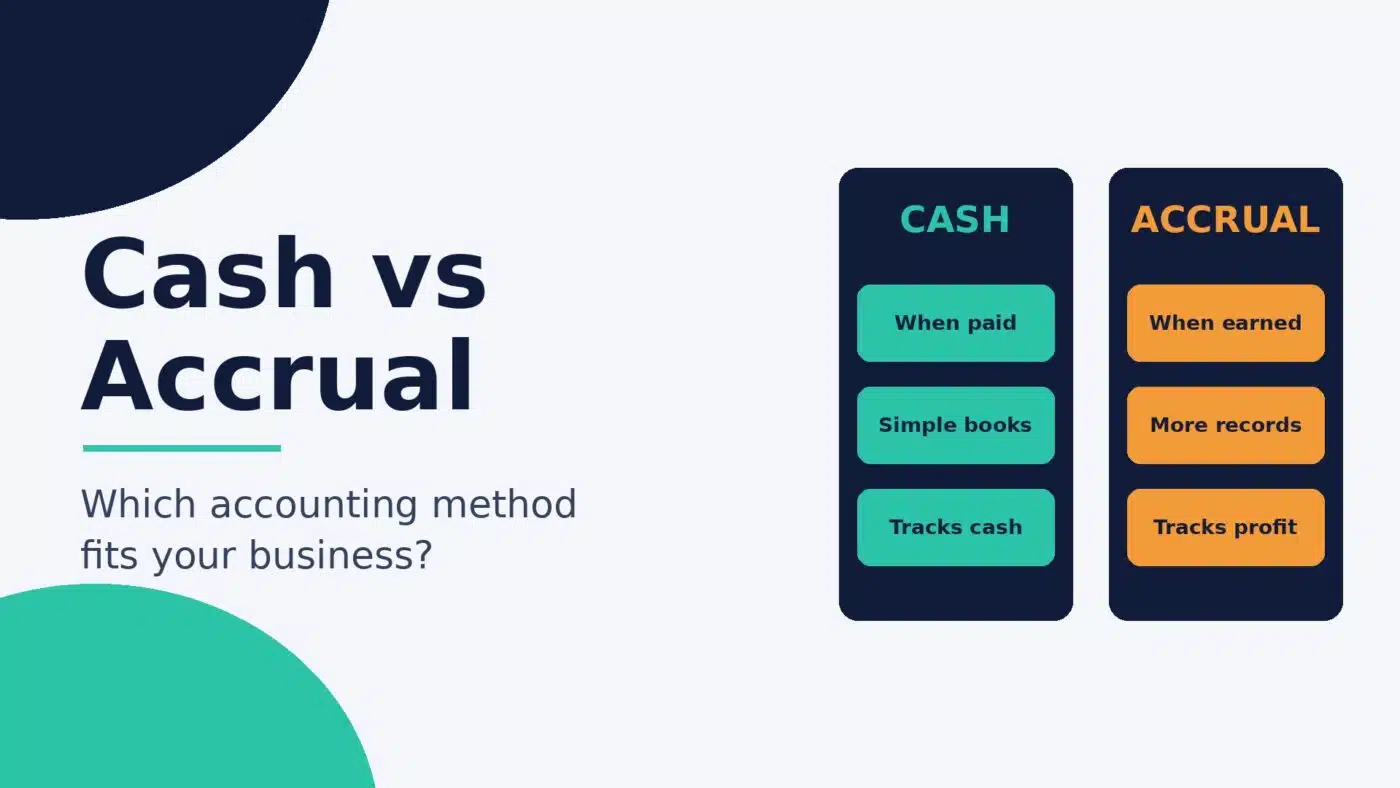
Cash accounting records income when the money actually lands in your account and expenses when you actually pay them. Accrual accounting records income when you earn it (usually when the work is done or the invoice goes out) and expenses when you owe them, no matter when the cash moves. Cash is simpler and is what most freelancers and small service businesses use. Accrual gives a truer picture of profit each month and is required for some larger businesses. For tax years starting in 2026, C corporations and partnerships with a C corporation partner can generally use cash only if their average annual gross receipts for the prior three years are $32 million or less.
The method you pick decides when income and expenses hit your books and your tax return. Over the life of a business the totals end up the same; what changes is timing, and timing affects which tax year you pay in, how healthy your monthly numbers look, and what a lender sees. Below we explain both methods, run one invoice through each, cover the IRS rules that apply in 2026, and finish with a checklist for choosing. Every rule links to the IRS page it comes from.
Not tax or accounting advice: this covers general U.S. federal rules. Talk to a CPA before you choose or change a method, especially if you sell products or have partners.
Cash vs accrual accounting at a glance
| Cash basis | Accrual basis | |
|---|---|---|
| Income is recorded | When payment is received (or made available to you) | When it’s earned, even if the customer hasn’t paid |
| Expenses are recorded | When you pay them | When you owe them and the goods or services have been provided |
| Tracks money owed to you? | No accounts receivable | Yes, accounts receivable |
| Tracks bills you owe? | No accounts payable | Yes, accounts payable |
| What it shows best | Cash flow: what’s in the bank | Profit: what you earned in a period |
| Bookkeeping effort | Lower | Higher; usually needs software or a bookkeeper |
| Control over tax timing | Some: income is taxed when collected | Less: income is taxed when earned |
| Bad debts | No deduction for unpaid invoices (they were never income) | Unpaid invoices that become worthless can be deducted |
| GAAP financial statements | Not GAAP | Required under GAAP |
| Who typically uses it | Freelancers, sole proprietors, small service businesses | Product sellers, growing companies, businesses with investors or loans |
What is cash basis accounting?
Cash basis accounting follows the money. IRS Publication 538 says that under the cash method you include in your gross income all items of income you actually or constructively received during the tax year, and you generally deduct expenses in the tax year you actually pay them. If you invoice a client in March and they pay in May, the income belongs to May. If you get a bill in June and pay it in July, the expense belongs to July.
It’s the default for most small operators. The IRS’s small-business guide notes that most individuals and many sole proprietors with no inventory use the cash method because the records are easier to keep. If you mostly work from a bank account and a stack of client invoices, you’re probably already thinking in cash terms.
Constructive receipt: “available” counts as received
Cash basis isn’t “income counts whenever I decide to deposit it.” Income is constructively received when an amount is credited to your account or made available to you without restriction, even if you haven’t touched it. A payment sitting in your PayPal or Stripe balance on December 31 counts for that year. Timing is based on when you could get the money, not when you choose to move it.
Prepaid expenses don’t all count right away
Paying early doesn’t always pull the deduction forward. Under the cash method, an expense you pay in advance is generally deductible only in the year it applies to, unless it qualifies for the IRS’s 12-month rule: the benefit can’t extend beyond 12 months after it begins or the end of the following tax year, whichever comes first. Paying a one-year software subscription in December can usually be deducted that year; prepaying three years of insurance can’t.
What is accrual accounting?
Accrual accounting follows the work. Under an accrual method, the IRS says you generally report income in the year it is earned and deduct or capitalize expenses in the year incurred, and that the purpose is to match income and expenses in the correct year.
The IRS uses two tests to decide “earned” and “incurred”:
- Income counts when the all events test is met: everything has happened that fixes your right to be paid, and you can figure the amount with reasonable accuracy. For a freelancer that’s typically when the job is done and billable.
- Expenses count when the liability is fixed and economic performance has occurred, meaning you’ve actually received the goods or services. The IRS’s own example: office supplies received and billed in December but paid in January are deductible in December’s year.
To make this work, your books carry two extra accounts: accounts receivable (what customers owe you) and accounts payable (what you owe suppliers). That’s the main reason accrual takes more effort, and it’s also why it shows a more honest monthly profit. If you sent $20,000 of invoices in a month but collected only $5,000, accrual shows the $20,000 you earned; cash shows only the $5,000.
One invoice, two methods: a worked example
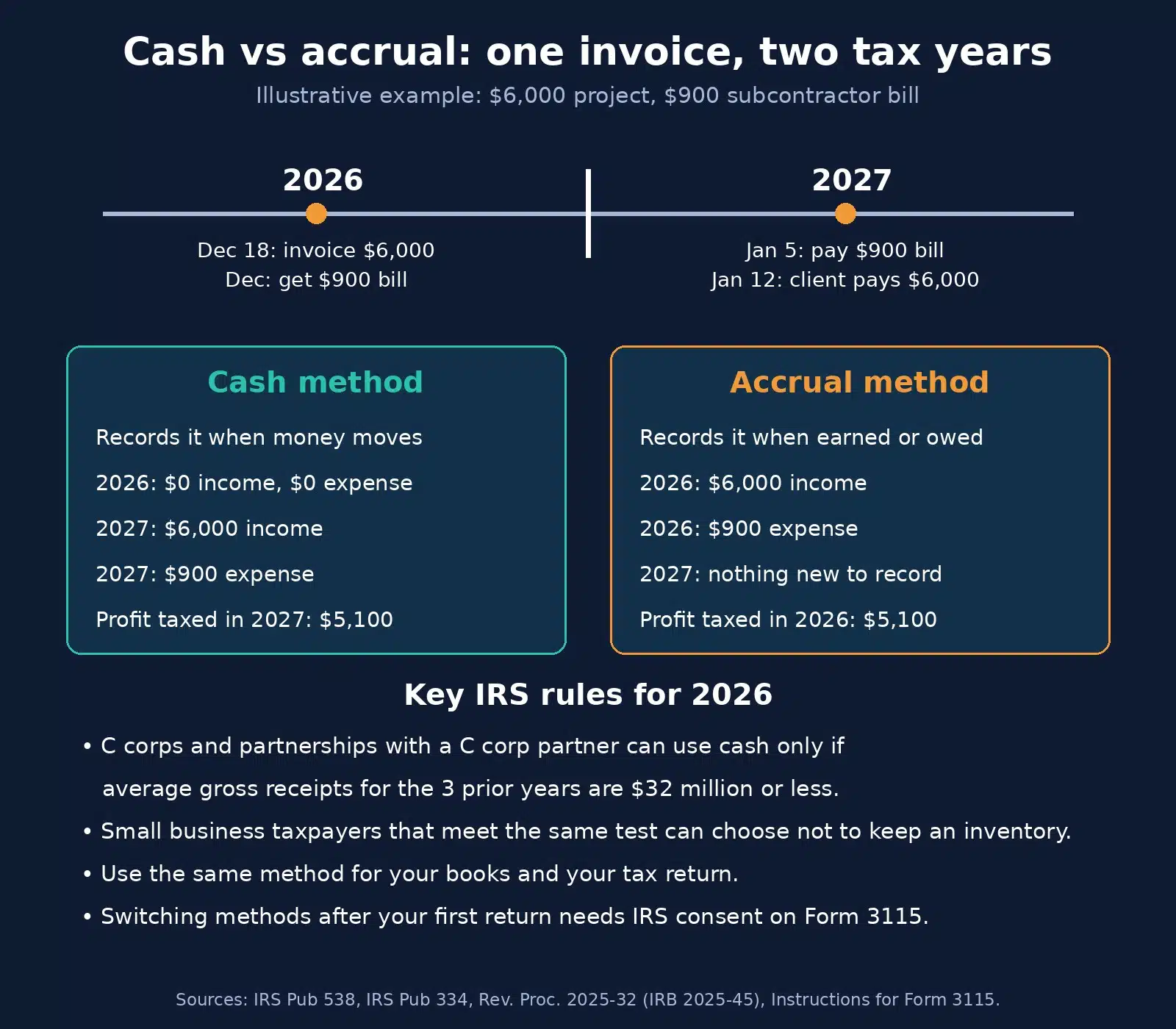
Here’s a simple, made-up case to show how timing shifts between tax years. A freelance designer finishes a $6,000 project and invoices the client on December 18, 2026. In December she also receives a $900 bill from a subcontractor who helped on the job. The client pays on January 12, 2027, and she pays the subcontractor on January 5, 2027.
- Cash method: nothing for this project shows up in 2026. In 2027 she records $6,000 of income and a $900 expense, so the $5,100 profit is taxed on her 2027 return.
- Accrual method: the $6,000 is earned in December 2026 and the $900 bill is incurred then too, so the $5,100 profit belongs to 2026, even though no cash moved until January.
Same profit, different tax year. Now imagine the client never pays. Under cash, the $6,000 was never income, so there’s nothing to write off; the IRS says you can’t take a bad debt deduction for amounts you never included in income. Under accrual, the $6,000 was already taxed as income, so once the debt is worthless it can be deducted as a business bad debt.
Pros and cons of each method
Cash basis
- Pro: simple. Your bank statement is basically your ledger. No receivables or payables to track.
- Pro: you pay tax on money you actually have. You’re not taxed on invoices still waiting to be paid.
- Pro: some timing flexibility. Paying a deductible bill before December 31 moves the deduction into this year (within the prepaid-expense limits above).
- Con: misleading monthly results. A month where three clients pay late can look like a loss, and a month where they all pay at once looks like a windfall.
- Con: hides what’s owed. Your books don’t show who owes you money or which bills are coming due, so you have to track those separately.
- Con: limited use outside taxes. Cash-basis statements aren’t GAAP, which can matter for larger loans and investors.
Accrual basis
- Pro: true profit by period. Income and the costs that produced it land in the same month or year.
- Pro: full picture. Receivables and payables are on the books, so you can see collections problems early.
- Pro: what serious outside parties expect. Xero notes that GAAP requires accrual accounting for publicly traded companies and many larger businesses, and investors and bigger lenders often want GAAP-style statements.
- Con: more work. You need software or a bookkeeper who records invoices and bills, not just bank transactions.
- Con: tax before cash. You can owe tax on income you haven’t collected yet, which can squeeze a small business that offers long payment terms.
IRS rules: who can use the cash method in 2026?
Most small businesses can choose. The IRS says no single accounting method is required of all taxpayers, as long as yours clearly reflects income and you use it consistently. You also have to use the same accounting method to figure your taxable income and to keep your books, so you can’t keep accrual books and file on cash. Sole proprietors and single-member LLCs indicate their method on line F of Schedule C. The limits below are the ones that catch businesses.
C corporations and partnerships with a C corp partner: the $32 million test
Publication 538 lists the entities that generally cannot use the cash method: a C corporation, a partnership that has a C corporation as a partner, and a tax shelter. The exception is a corporation or partnership (other than a tax shelter) that meets the gross receipts test. You figure it by adding gross receipts for the three prior tax years and dividing by three.
The threshold is adjusted for inflation each year. For taxable years beginning in 2026, an entity meets the test if its average annual gross receipts for the prior three-year period don’t exceed $32,000,000 (Rev. Proc. 2025-32). The 2025 figure was $31 million. An entity that fails the test must change to an accrual method for the year it fails and file Form 3115. S corporations and sole proprietors aren’t on the excluded list, though the inventory rule below can still apply. If you’re still choosing a structure, our S corp vs C corp and LLC vs corporation guides cover the bigger differences.
Businesses with inventory
The old rule was that if you sell products you must use accrual for sales and purchases. That still applies to larger businesses, but small business taxpayers get a way out. If you qualify as a small business taxpayer (you meet the same inflation-adjusted gross receipts test and aren’t a tax shelter), you can choose not to keep an inventory and instead treat it as non-incidental materials and supplies, or follow how you treat inventory in your financial statements or books. If you do choose to keep an inventory, you generally must use accrual for it and value it each year. For an online store or reseller, this decision is worth a conversation with a tax pro.
Mixing methods (hybrid)
You can combine methods if the result clearly reflects your income and you use it consistently, with some limits. The IRS says that if you use cash for income you must use cash for expenses, and if you use accrual for expenses you must use accrual for income. A common hybrid is accrual for inventory purchases and sales with cash for everything else. You can also use different methods for two separate businesses if each keeps complete, separate books.
Which method should your business use?
Cash basis is usually the better fit if:
- You’re a freelancer, consultant, creator or side hustler selling services.
- You don’t carry inventory, or you qualify for the small-business inventory exception.
- Clients pay within weeks, not months, so cash and earnings don’t drift far apart.
- You do your own books and want them simple.
- Nobody (lender, investor, buyer) is asking for GAAP statements.
Accrual basis is usually the better fit if:
- You’re a C corporation (or partnership with a C corp partner) that doesn’t meet the gross receipts test. Then it isn’t a choice.
- You sell products and keep an inventory.
- You invoice on long terms (net 60, net 90) or have big receivables, and you need to know what you really earned each month.
- You collect money upfront for work you deliver later, such as subscriptions, retainers or deposits.
- You plan to raise investor money, take a large bank loan or sell the business.
Plenty of businesses start on cash and switch when they grow. If you’re registering a new business now, our guides to starting an LLC and sole proprietorship vs LLC cover the setup side.
How to switch from cash to accrual (or back)
Your first method is free to choose. The IRS says you choose an accounting method when you file your first tax return and don’t need approval for that initial choice. After that, a change from cash to accrual or the reverse is a change in accounting method that requires IRS approval, which you request on Form 3115.
Many common small-business changes qualify for automatic consent. According to the Instructions for Form 3115:
- You must use the automatic procedures if you’re eligible for them; the list of eligible changes is in Rev. Proc. 2022-14 and its updates.
- No user fee is charged for an automatic change request.
- You attach the original Form 3115 to your timely filed return for the year of change and send a signed copy to the IRS National Office.
- Switching usually creates a one-time catch-up amount (a section 481(a) adjustment) so nothing is counted twice or missed. A negative adjustment is generally taken in the year of change; a positive one is generally spread over four tax years.
In practice, switching to accrual means adding up everything customers owed you and everything you owed suppliers on the first day of the new year. That’s the kind of calculation to hand to a CPA.
Keeping books under either method
- Keep business money separate. A dedicated business bank account makes either method far easier, and it’s essential if you have an LLC.
- Number and date every invoice. Even on cash basis, you need to know who owes you what. Most accounting apps can show reports either way; see our roundup of AI accounting software.
- Watch December. On cash basis, payments that arrive or become available by December 31 are that year’s income, so plan your quarterly estimated taxes around when money actually comes in.
- Know your numbers. Whichever method you use, know the difference between gross and net income so you price work with your real costs in mind.
- Match your 1099s. Clients report what they paid you in a calendar year on a Form 1099, which lines up with cash-basis timing. Accrual-basis freelancers may report income in a different year from the one on the form, so keep the reconciliation in your records.
Cash vs accrual accounting: frequently asked questions
What is the main difference between cash and accrual accounting?
The difference is timing. Cash accounting records income when you receive the money and expenses when you pay them. Accrual accounting records income when you earn it and expenses when you owe them, regardless of when cash changes hands. Over time the totals match; the year or month they land in differs.
Which is better for a small business, cash or accrual?
For most freelancers and small service businesses, cash is better because it’s simpler and you’re only taxed on money you’ve collected. Accrual is better if you hold inventory, invoice on long payment terms, collect money upfront for future work, or need GAAP-style statements for investors or larger loans.
Can a small business use cash accounting for taxes?
Usually, yes. Sole proprietors and S corporations without inventory can generally use cash. C corporations and partnerships with a C corporation partner can use it for tax years beginning in 2026 if their average annual gross receipts for the prior three years are $32 million or less and they aren’t a tax shelter.
Can I use cash accounting if I sell products?
Often, yes. A small business taxpayer that meets the gross receipts test can choose not to keep an inventory and treat it as non-incidental materials and supplies, or follow its books. If you choose to keep an inventory, you generally have to use accrual for purchases and sales.
Can I switch from cash to accrual accounting?
Yes, but after your first return you need IRS consent, requested on Form 3115. Many changes qualify for automatic consent with no user fee: you attach Form 3115 to your timely filed return and send a signed copy to the IRS. A section 481(a) adjustment catches up any income or expenses so nothing is counted twice.
Can I keep accrual books but file taxes on a cash basis?
Generally no. The IRS says you must use the same accounting method to figure your taxable income and to keep your books. You can, however, run separate management reports in your software, as long as your official books and return use the same method.
The bottom line
Cash accounting tells you what’s in the bank; accrual accounting tells you what you earned. If you’re a freelancer or a small service business without inventory, cash basis is usually the practical choice and the one the IRS expects most sole proprietors to use. If you sell products, bill on long terms, collect upfront, or are heading toward investors or a large loan, accrual gives you numbers you can rely on, and C corporations above the $32 million test for 2026 have to use it anyway. Pick deliberately on your first return, keep your books on the same method, and talk to a CPA before filing Form 3115 to switch.

The Teck Hustlers Editorial Team covers technology, business, finance and gaming news for readers who want the story behind the headline. Every article is researched, written and edited by our in-house team, checked against company announcements, filings and reputable reporting, and updated when new facts emerge. We focus on what each development means for founders, professionals, investors and everyday users. Have a tip or a correction? Reach us through our contact page.