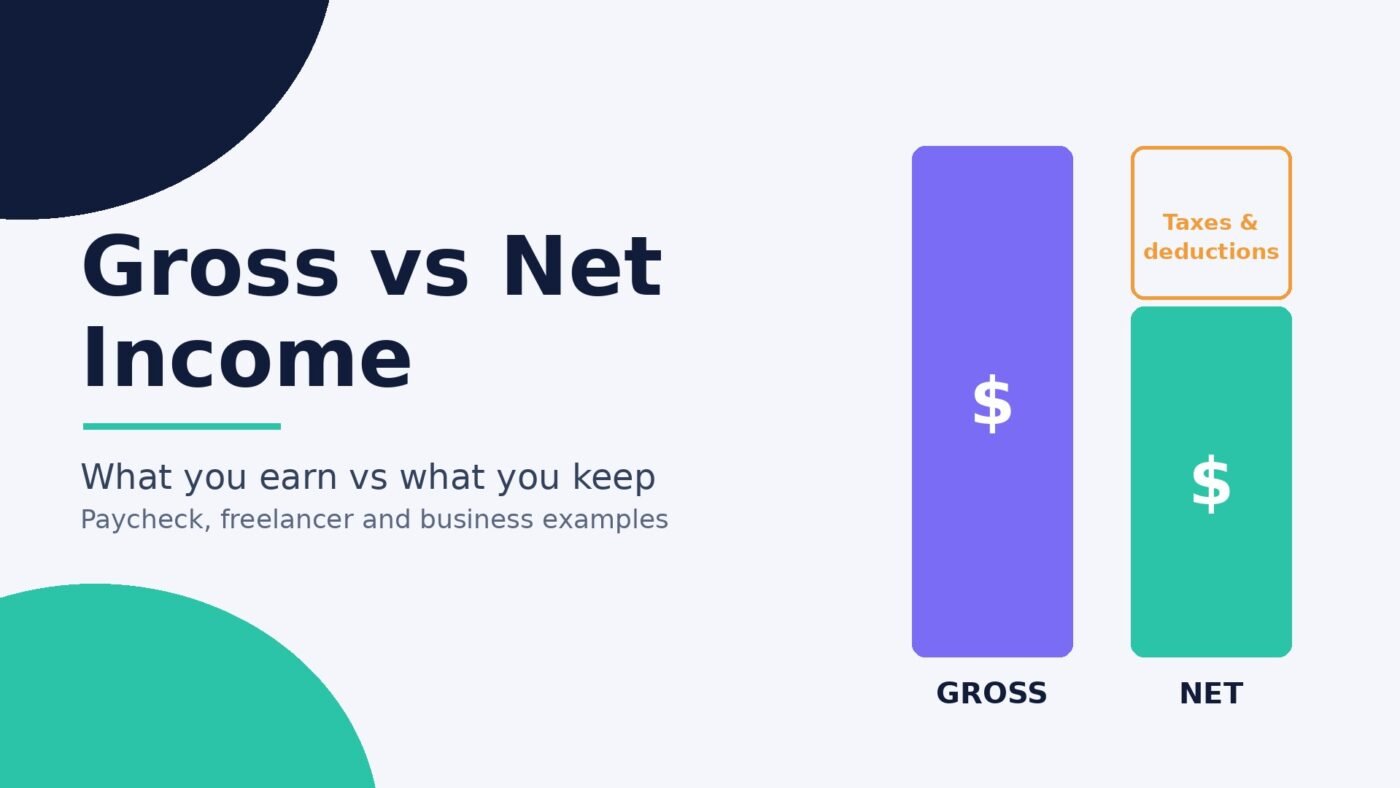
Gross income is the full amount you earn before anything is taken out. Net income is what’s left after taxes and other deductions. For an employee, gross pay is the salary or hourly total on your offer letter, and net pay is the amount that actually lands in your bank account. For a business or freelancer, gross is the money coming in, and net is the profit left after expenses. Use net for budgeting; lenders and tax forms usually start from gross.
The two numbers can be far apart, which is why a $60,000 salary doesn’t mean $5,000 a month in your account. This guide explains both terms for paychecks, freelance income and small businesses, walks through a full paycheck example, and shows which number to use for budgets, loans and taxes. Payroll tax rates come from the Social Security Administration’s 2026 fact sheet and IRS Topic 751.
Not tax or financial advice: this is general information. Your own deductions depend on your employer, state and tax situation.
Gross vs net income at a glance
The idea is the same everywhere: gross is before, net is after. What gets subtracted changes depending on who you are.
| Gross income | Net income | What’s subtracted | |
|---|---|---|---|
| Employee | Salary or hourly pay before deductions (gross pay) | Take-home pay deposited each payday (net pay) | Income taxes, Social Security, Medicare, benefits, retirement contributions |
| Freelancer | Everything clients paid you | Profit after business expenses | Business expenses; then you pay your own taxes |
| Business | Revenue (or gross profit: revenue minus cost of goods sold) | Net income, the “bottom line” profit | Cost of goods, operating expenses, interest, taxes |
One memory trick: gross is the big number at the top of a pay stub or income statement, and net is the smaller number at the bottom.
What is gross income?
Gross income is your total earnings before any deductions. If you’re paid hourly, gross pay for a pay period is your hourly rate times your hours. Someone working 20 hours at $15 an hour earns $300 gross for that week, as the Social Security Administration’s Ticket to Work guide puts it. If you’re salaried, your annual gross pay is the salary in your offer, and each paycheck’s gross is that salary divided by the number of pay periods.
To turn per-paycheck gross pay into an annual figure, multiply by how often you’re paid:
- Weekly: 52 paychecks a year
- Every two weeks (biweekly): 26 paychecks
- Twice a month (semimonthly): 24 paychecks
- Monthly: 12 paychecks
For tax purposes, gross income is broader than your paycheck. The IRS describes it as your total income from all sources, including wages, tips, interest, dividends, capital gains, business income, retirement income and other taxable income. So a side hustle, a savings account and a part-time job all add to your gross income for the year.
What is net income?
Net income is what remains after deductions. On a paycheck, it’s your take-home pay: the amount deposited into your account. Your pay stub lists each deduction between the gross line and the net line, and it’s worth reading at least once, because mistakes do happen.
For a business, net income is profit after every cost has been paid, including taxes. That’s why it’s called the bottom line: it’s literally the last line of an income statement.
Net income can also be negative. A freelancer who spends more on equipment and software in a slow year than clients paid them has a net loss for that year, even though their gross income was positive.
What comes out of a paycheck
The gap between gross and net pay is made of two kinds of deductions: the ones the law requires and the ones you chose.
Required deductions
- Social Security tax: 6.2% of your wages, up to a yearly cap. For 2026, that cap (the wage base) is $184,500. Wages above it aren’t hit by Social Security tax for the rest of the year.
- Medicare tax: 1.45% of all wages, with no cap. Together with Social Security, that’s the 7.65% employee rate you’ll often see called FICA.
- Additional Medicare tax: your employer withholds an extra 0.9% on wages over $200,000 in a calendar year.
- Federal income tax withholding: based on your pay and the Form W-4 you gave your employer. This is an estimate of your yearly tax, not the final bill.
- State and local income tax: depends on where you live and work. Some states have none.
Voluntary or benefit deductions
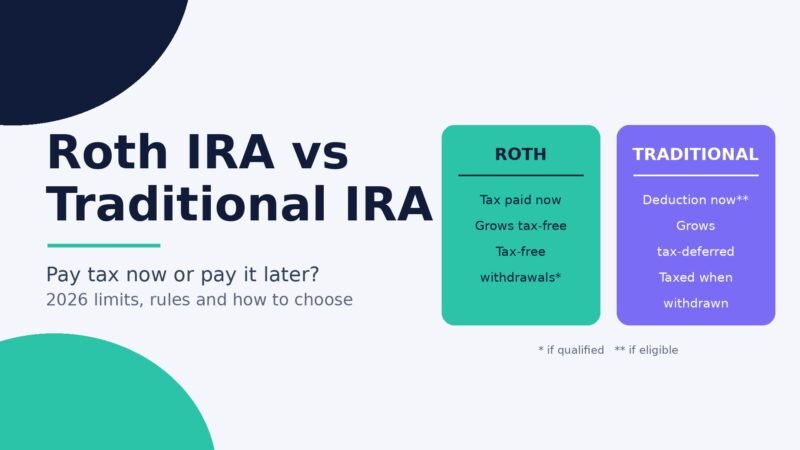
- Retirement contributions, such as a 401(k). Traditional contributions usually reduce your taxable wages; if you’re weighing pre-tax against Roth-style savings, our Roth IRA vs traditional IRA guide covers the same “tax now or later” trade-off.
- Health, dental and vision insurance premiums
- Health savings account (HSA) or flexible spending account (FSA) contributions
- Life or disability insurance, union dues, or other items you signed up for
Some deductions, like wage garnishments or child support orders, aren’t optional either, but they only apply in specific cases.
Worked example: one paycheck from gross to net
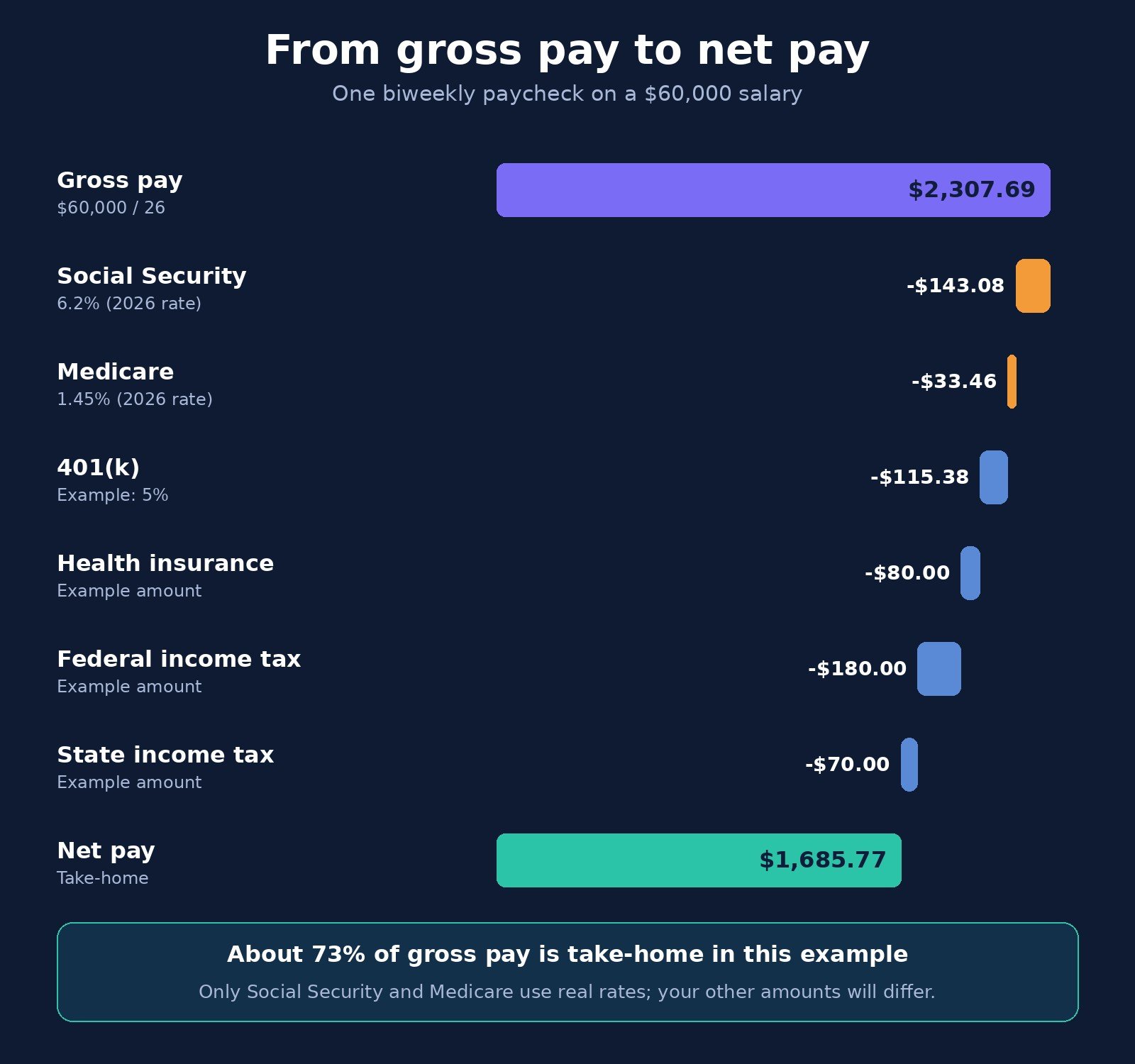
Here’s how a $60,000 salary paid every two weeks might break down. Social Security and Medicare use the real 2026 rates. The other amounts are example figures picked to show how the math works; your income tax, benefits and state tax will be different.
| Line | How it’s figured | Amount |
|---|---|---|
| Gross pay | $60,000 ÷ 26 | $2,307.69 |
| Social Security tax | 6.2% of gross | −$143.08 |
| Medicare tax | 1.45% of gross | −$33.46 |
| 401(k) contribution | Example: 5% of gross | −$115.38 |
| Health insurance premium | Example amount | −$80.00 |
| Federal income tax withheld | Example amount (set by your W-4) | −$180.00 |
| State income tax withheld | Example amount | −$70.00 |
| Net pay | Gross minus $621.92 in deductions | $1,685.77 |
In this example, about 73% of gross pay reaches the bank account. Over 26 paychecks, that’s roughly $43,830 of take-home pay from a $60,000 salary. For simplicity the example applies Social Security and Medicare to the full gross; pre-tax health premiums can shrink that base slightly.
Want a quick reality check on your own numbers? Take the net pay from your last stub, multiply by your number of paychecks, and compare it with your salary. The ratio tells you how much of every gross dollar you actually keep.
Gross vs net income for freelancers and side hustlers
If you’re self-employed, nobody withholds anything for you. Clients pay the full invoice, and the money that hits your account is gross income. A Form 1099 from a client, if you get one, also reports the gross amount paid, not your profit.
Your net income is your business profit: gross receipts minus deductible business expenses, which sole proprietors report on Schedule C. For example, a freelance designer who invoices $80,000 in a year and spends $14,000 on software, a laptop and other business costs has $66,000 of net profit (example figures).
That net figure matters because it’s what the taxes are based on:
- Self-employment tax is 15.3%, covering both the employee and employer shares of Social Security (12.4%) and Medicare (2.9%). You owe it once net earnings from self-employment reach $400.
- Income tax is figured on your total income after expenses, adjustments and deductions.
Two practical habits follow. Track expenses all year, because every legitimate expense lowers net profit and therefore tax. And set aside part of each payment, since you’ll likely need to send the IRS quarterly estimated taxes. Your take-home “net” as a freelancer is really your profit minus the tax you set aside.
Clean records start with clean paperwork: send proper invoices, keep the W-9s clients request, and keep business money in its own account.
Gross vs net income for a business
On an income statement, “gross” usually means gross profit, not total revenue. The steps run from top to bottom:
- Revenue: all sales.
- Gross profit: revenue minus the cost of goods sold (COGS), such as inventory or materials.
- Operating income: gross profit minus operating expenses like rent, software, payroll and marketing.
- Net income: operating income minus interest and taxes.
Here’s a simple online store, using example numbers:
| Line | Amount | Share of revenue |
|---|---|---|
| Revenue | $120,000 | 100% |
| Cost of goods sold | −$48,000 | |
| Gross profit | $72,000 | 60% (gross margin) |
| Operating expenses | −$40,000 | |
| Operating income | $32,000 | 26.7% |
| Interest | −$2,000 | |
| Taxes | −$6,000 | |
| Net income | $24,000 | 20% (net margin) |
Gross margin tells you whether your pricing covers the cost of what you sell. Net margin tells you whether the whole business makes money after overhead. A shop can have a healthy gross margin and still lose money if rent and ads eat everything below that line.
How business profit reaches your personal tax return depends on structure. A sole proprietor or single-member LLC reports it on their own return by default; our sole proprietorship vs LLC comparison explains the differences.
Which number to use, and when
| Situation | Use | Why |
|---|---|---|
| Monthly budget | Net | It’s the money you can actually spend or save |
| Loan, mortgage or credit applications | Gross (usually) | Debt-to-income ratio is based on gross monthly income |
| Comparing job offers | Both | Salaries are quoted gross; benefits costs and state taxes change net |
| Filing taxes | Gross, then adjusted | The return starts with total income and subtracts adjustments and deductions |
| Judging a business | Both | Gross margin shows pricing; net income shows real profit |
Budgeting: start from net
Budget rules work on take-home pay. The 50/30/20 rule, for example, splits after-tax income into needs, wants and savings. Budgeting from gross makes it look like you have more money than you do. Freelancers should use profit minus the tax they set aside.
Borrowing: lenders look at gross
The Consumer Financial Protection Bureau defines your debt-to-income ratio as all your monthly debt payments divided by your gross monthly income. Its example: $2,000 in monthly debt payments on $6,000 of gross monthly income is a 33% ratio. Because the ratio uses gross, it can make a payment look more affordable than it feels once your net pay arrives, so check the payment against your net budget too.
Taxes: gross, AGI and taxable income
On a tax return, gross income isn’t the number you’re taxed on. The IRS explains that adjusted gross income (AGI) is your total income from all sources minus certain adjustments, such as deductible IRA contributions, student loan interest and the deductible part of self-employment tax. AGI appears on line 11 of Form 1040. Your standard or itemized deduction then comes off AGI to give taxable income. So there are really three steps: gross income, then AGI, then taxable income.
Common mix-ups
- “My salary is what I’ll get paid.” A quoted salary is gross. Expect a noticeably smaller number on each paycheck.
- “The 1099 amount is my income.” It’s your gross from that client. Expenses come off before you know your profit.
- “Net income and taxable income are the same.” Not quite. Net pay is after withholding; taxable income is a tax-return figure after adjustments and deductions.
- “A bigger refund means I earned more.” A refund just means more was withheld than you owed. Changing your W-4 shifts money between your net pay and your refund.
Frequently asked questions
What is the difference between gross and net income?
Gross income is the total you earn before any deductions. Net income is what’s left after taxes and other deductions, such as benefits and retirement contributions. For employees, net income is take-home pay. For businesses, net income is profit after all expenses, interest and taxes.
Is salary gross or net?
A salary is almost always quoted as gross, meaning before taxes and deductions. Your paychecks will be lower because Social Security, Medicare, income taxes and any benefit or retirement deductions come out first.
How do I calculate net income from gross income?
Subtract every deduction from gross pay. For a paycheck, that means federal, state and local income tax withholding, Social Security (6.2%), Medicare (1.45%), and items like 401(k) contributions and insurance premiums. Your pay stub lists each one, so the simplest check is to add them up.
Do lenders use gross or net income?
Most lenders use gross income. The debt-to-income ratio, which lenders use to judge whether you can handle a new payment, divides your monthly debt payments by your gross monthly income, according to the Consumer Financial Protection Bureau.
Should I budget with gross or net income?
Budget with net income, because it’s the money you actually receive. If you’re self-employed, budget from your profit after setting aside money for income tax and self-employment tax, since nothing is withheld from client payments.
Is gross income the same as gross profit?
For a person, gross income is total earnings. For a business, “gross” on an income statement usually means gross profit: revenue minus the cost of goods sold. Net income comes after operating expenses, interest and taxes are also subtracted.
What percentage of gross pay is take-home pay?
It varies with income, state, tax withholding and benefits, so there’s no single percentage. In our $60,000 example, about 73% of gross pay was take-home. The only number that is the same for nearly every employee is the 7.65% for Social Security and Medicare, up to the Social Security wage base.
Bottom line
Gross is what you earn; net is what you keep. Employees see the gap on every pay stub as taxes, Social Security, Medicare and benefits. Freelancers see it as business expenses and the taxes they must pay themselves. Businesses see it as the distance between gross profit and the bottom line. Plan your spending with net income, expect lenders to ask about gross, and keep your records good enough that you always know both numbers.

The Teck Hustlers Editorial Team covers technology, business, finance and gaming news for readers who want the story behind the headline. Every article is researched, written and edited by our in-house team, checked against company announcements, filings and reputable reporting, and updated when new facts emerge. We focus on what each development means for founders, professionals, investors and everyday users. Have a tip or a correction? Reach us through our contact page.