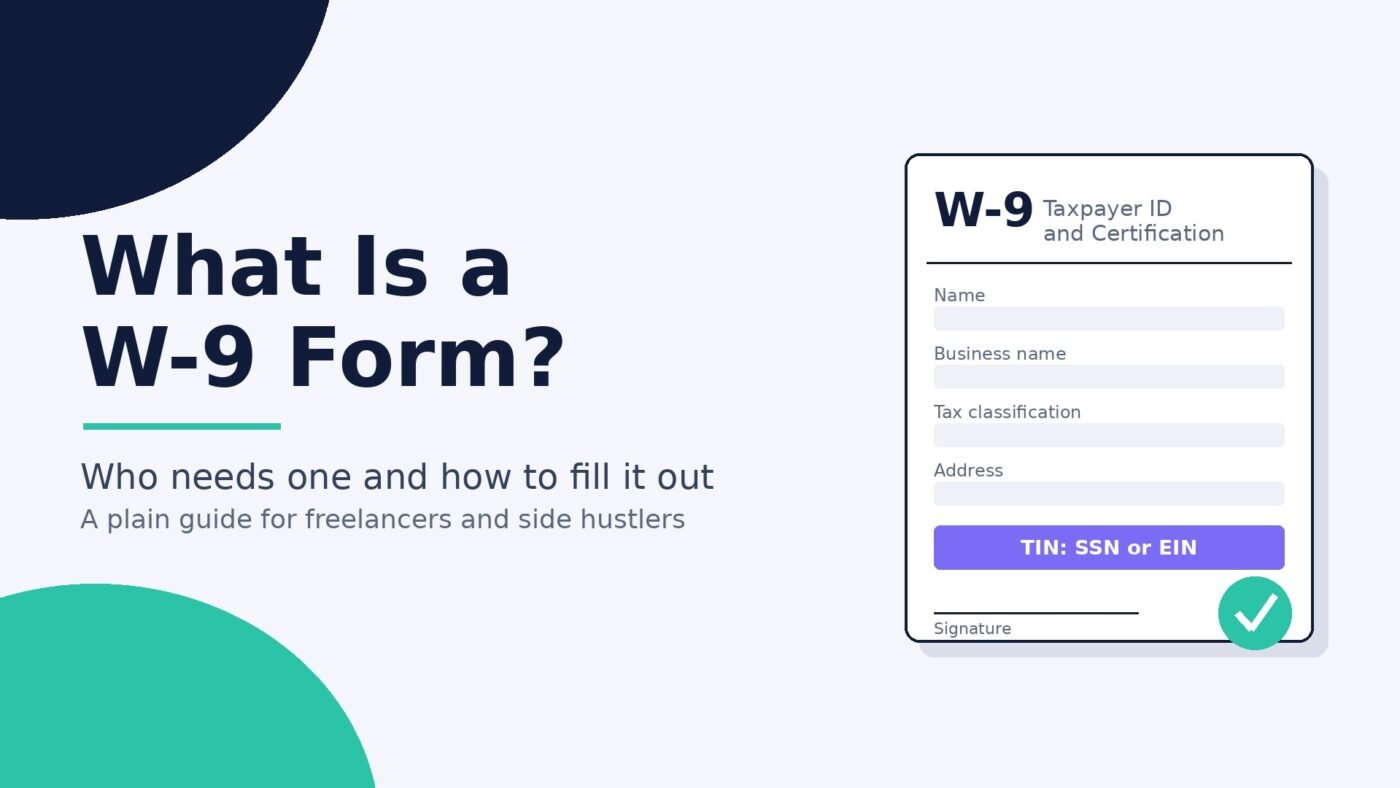
A W-9 is an IRS form you fill out to give a business your legal name, address and taxpayer identification number (TIN), which is usually your Social Security number or an EIN. Its official name is “Request for Taxpayer Identification Number and Certification.” The business keeps it on file and uses it to report what it paid you, often on a Form 1099-NEC. You give the W-9 to the person who asked for it, not to the IRS, and it doesn’t calculate or withhold any tax by itself.
If you’ve just landed your first freelance client or side gig and they sent you a W-9, this guide walks through what it’s for, whether you actually need to fill it out, how to complete each line, and what happens after you send it. Everything here comes from the current Form W-9 (Rev. March 2024) and other IRS pages linked throughout.
Not tax advice: this is general information based on IRS publications. Your situation may differ, so check with a tax professional if you’re unsure.
What a W-9 is used for
Businesses and financial institutions have to file information returns with the IRS when they pay you certain kinds of money or handle certain transactions for you. To file those returns correctly, they need your exact name and TIN. The W-9 is how they get it. The IRS About Form W-9 page says you use it to provide your correct TIN to someone who must report, for example:
- Income paid to you
- Real estate transactions
- Mortgage interest you paid
- Acquisition or abandonment of secured property
- Cancellation of debt
- Contributions you made to an IRA
The form’s own instructions list the information returns it feeds, including Form 1099-NEC (nonemployee compensation), 1099-MISC, 1099-INT, 1099-DIV, 1099-B, 1099-K, 1099-S and Form 1098. For most side hustlers and freelancers, the one that matters is the 1099-NEC, which reports what a client paid you for your work.
Signing the W-9 also certifies a few things under penalties of perjury: that your TIN is correct, that you’re not subject to backup withholding (or that you’re exempt), that you’re a U.S. person, and that any FATCA exemption code you entered is correct.
Who needs to fill out a W-9
You’ll usually be asked for a W-9 if you’re a U.S. person and you’re being paid outside a regular employer-employee relationship. Common examples:
- Freelancers and independent contractors. The IRS tells businesses that once they’ve decided someone is an independent contractor, “the first step is to have the contractor complete Form W-9.”
- Single-member LLCs, partnerships and corporations that sell services to other businesses.
- Bank and brokerage customers. Banks and brokers often ask for a W-9 (or a substitute form built into the account application) so they can report interest, dividends and sales.
- Landlords and people selling real estate, so the payer or closing agent can report rents or sale proceeds.
Who should not fill out a W-9
- Regular employees. If you’re on payroll, your employer gives you a Form W-4 for withholding and reports your pay on a W-2. A W-9 isn’t the right form for that job.
- Foreign persons. The form says to use Form W-9 only if you are a U.S. person, including a resident alien. Nonresident aliens and foreign entities give the requester the appropriate Form W-8 (such as W-8BEN) or Form 8233 instead. A disregarded U.S. LLC that has a foreign owner also uses a W-8.
Not sure whether a client should treat you as a contractor or an employee? That’s a separate question from the W-9. The form just collects your details; it doesn’t decide your worker status.
How to fill out a W-9, line by line
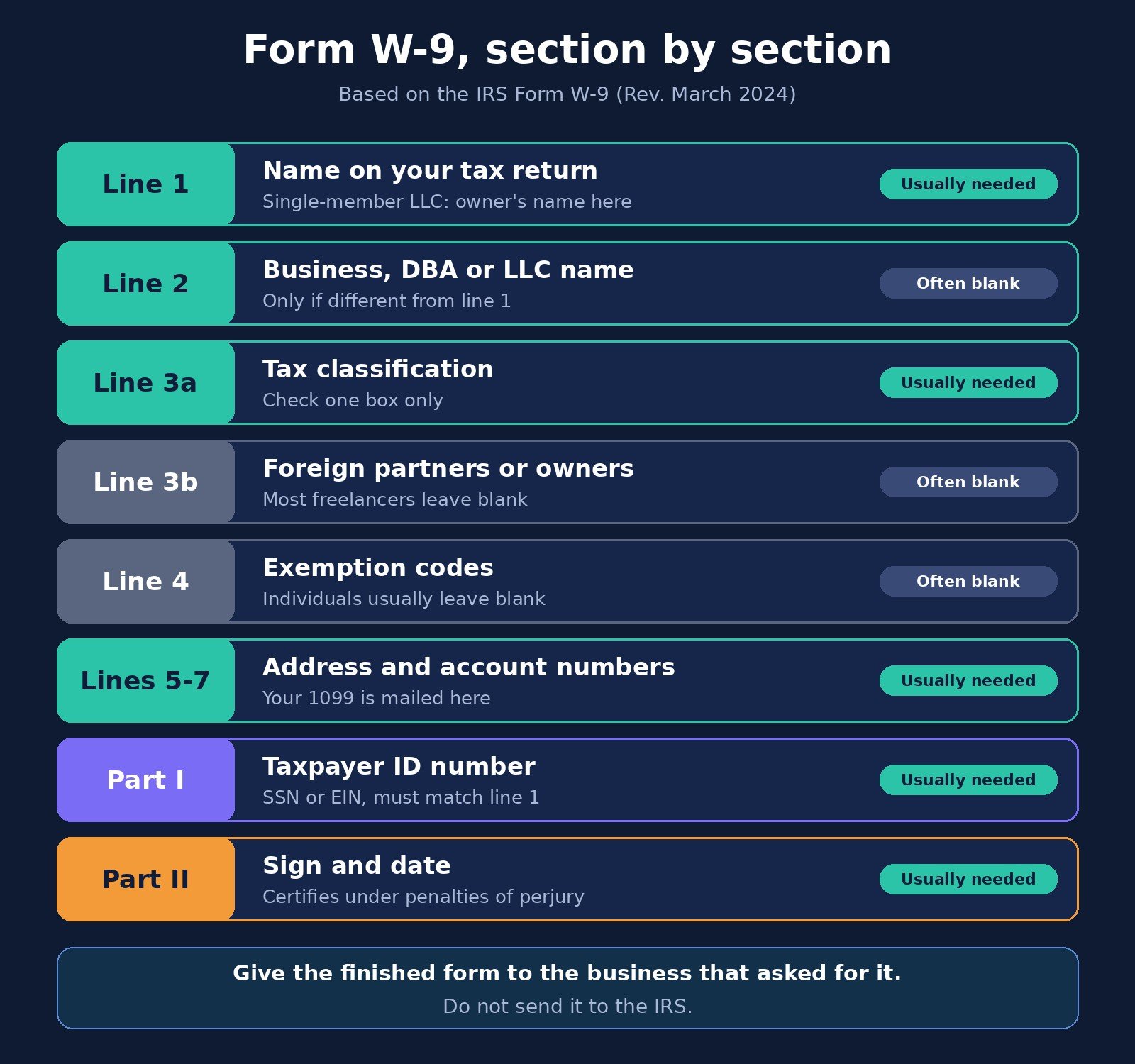
The form is one page to fill in, followed by five pages of instructions. Here’s what goes in each box, based on the official W-9 instructions. Always download a fresh copy from IRS.gov or use the form your client sends, as long as it matches.
Line 1: Name
This line is required. Enter the name that appears on your tax return.
- Individual or sole proprietor: your own name as shown on your Form 1040.
- Single-member LLC that’s a disregarded entity: the owner’s name goes here, not the LLC’s name. This is the most common mistake on the form.
- Partnership, multi-member LLC, C corp or S corp: the entity’s name as shown on its tax return.
If you changed your last name and haven’t told the Social Security Administration, the instructions say to enter your first name, the last name on your Social Security card, and your new last name.
Line 2: Business name
Enter your business name, trade name, “doing business as” (DBA) name or disregarded LLC name here, if it’s different from line 1. A sole proprietor with a DBA puts their own name on line 1 and the DBA on line 2. If you’re weighing a DBA against forming an LLC, see our guide to DBA vs LLC.
Line 3a: Federal tax classification
Check exactly one box for the person or entity named on line 1:
| If line 1 is a(n)… | Check this box |
|---|---|
| Individual or sole proprietor | Individual/sole proprietor |
| Single-member LLC owned by an individual (disregarded) | Individual/sole proprietor (the owner’s classification) |
| LLC taxed as a partnership | LLC, and enter P |
| LLC that elected C corp or S corp taxation | LLC, and enter C or S |
| Corporation | C corporation or S corporation |
| Partnership | Partnership |
| Trust or estate | Trust/estate |
The March 2024 revision changed this line to make one rule clear: a disregarded LLC does not check the “LLC” box. It checks the box for its owner’s classification instead. If your LLC has elected S corp status, you’d check LLC and write S. Our explainer on LLC vs S corp covers when that election makes sense.
Line 3b: Foreign partners, owners or beneficiaries
This box was new in the 2024 revision. It only applies if you checked Partnership, Trust/estate, or LLC with a P classification on line 3a, and you’re giving the W-9 to a partnership, trust or estate that you own an interest in. In that case, check it if you have any foreign partners, owners or beneficiaries. Sole proprietors and most freelancers leave it blank.
Line 4: Exemptions
These codes apply only to certain entities, not individuals. The instructions say that generally, individuals (including sole proprietors) are not exempt from backup withholding, so most people leave both exemption boxes empty. The FATCA code only matters for accounts held outside the United States.
Lines 5 to 7: Address and account numbers
Enter your street address, city, state and ZIP code. This is where the requester will mail your information returns, such as your 1099. If it differs from the address they already have, the instructions say to write “NEW” at the top. Line 7 for account numbers is optional; you’ll rarely need it as a freelancer.
Part I: Taxpayer identification number
Enter either your Social Security number (SSN) or your employer identification number (EIN), not both. The TIN must match the name on line 1, or you risk backup withholding. If you don’t have an SSN and aren’t eligible for one, your TIN is your IRS individual taxpayer identification number (ITIN), which goes in the SSN boxes. More on choosing between an SSN and EIN in the next section.
Part II: Signature and date
Sign and date the form. For payments to a contractor, the form says you must give your correct TIN but technically don’t have to sign the certification unless you’ve been told you previously gave a wrong TIN. In practice, most clients won’t accept an unsigned W-9, so sign it. If the IRS has notified you that you’re subject to backup withholding for underreporting interest or dividends, cross out item 2 of the certification before signing.
SSN or EIN on a W-9?
This comes down to how your business is set up:
- Sole proprietor without an EIN: use your SSN.
- Sole proprietor with an EIN: the form says you may enter either one, though in its “What Name and Number To Give the Requester” table it notes that the IRS encourages you to use your SSN.
- Single-member LLC (disregarded): enter the owner’s SSN, or the owner’s EIN if the owner has one. Don’t enter the LLC’s EIN just because the LLC has one, unless the LLC is taxed as a corporation or partnership.
- LLC taxed as a partnership or corporation, or any corporation: use the entity’s EIN.
Plenty of freelancers get a free EIN precisely so they don’t have to hand their Social Security number to every new client. A sole proprietor can have one, and you can still use it on W-9s. Our step-by-step guide shows how to apply for an EIN online directly with the IRS.
If you’ve applied for a TIN but don’t have it yet, the form lets you write “Applied For” in Part I, then sign and give it to the requester. Be aware of the catch: the 60-day grace period only covers interest, dividends and certain payments on readily tradable instruments. For other payments, including nonemployee pay, the requester instructions say they are subject to backup withholding right away until you provide your number.
W-9 vs W-4 vs 1099 vs W-8BEN
These forms get mixed up all the time. Here’s how they differ:
| Form | Who fills it out | What it does | Goes to the IRS? |
|---|---|---|---|
| W-9 | U.S. contractors, vendors, account holders | Gives the payer your name, address and TIN | No, the requester keeps it |
| W-4 | Employees | Tells your employer how much income tax to withhold from your paycheck | No, your employer keeps it |
| 1099-NEC | The business that paid you | Reports what it paid you as a nonemployee during the year | Yes, and you get a copy |
| W-8BEN | Foreign individuals | Certifies foreign status instead of a W-9 | No, the requester keeps it |
The short version: the W-9 comes first and feeds the 1099. Your client uses the details from your W-9 to fill out your 1099-NEC after the year ends.
What happens after you send a W-9
Your client files your W-9 away. Nothing goes to the IRS at that point. The IRS tells businesses to keep the W-9 on file for four years in case questions come up.
After the year ends, the business adds up what it paid you. If the total reaches the reporting threshold, it files a Form 1099-NEC with the IRS and sends you a copy. That threshold changed in 2026. According to the IRS page “Am I required to file a Form 1099?”, the threshold is $600 for payments made before 2026 and $2,000 for payments made in 2026, with inflation adjustments after that described in Publication 1099. Some older guides still quote $600 for everything, so check the year.
Here’s the part people miss: the threshold only decides whether the business must file a 1099. It doesn’t change whether the money is taxable. All of your self-employment income counts, whether or not you get a 1099 for it. Since no tax is withheld from contractor payments, most freelancers need to pay as they go. Our guide to estimated taxes for the self-employed explains how.
A client may also ask for a W-9 before your first payment even if you might not cross the threshold. That’s normal. Many businesses collect one from every vendor up front.
Backup withholding and penalties
If you don’t give a valid TIN, payers may have to hold back part of what they pay you. The form explains that under certain conditions, payers must withhold and pay to the IRS 24% of the payment. This is called backup withholding. Payments that can be hit include interest, dividends, rents, royalties and nonemployee pay.
You can be subject to backup withholding if you don’t give your TIN, don’t certify it when required, the IRS tells the payer your TIN is wrong, or the IRS tells you that you underreported interest and dividends. The W-9 also lists these penalties:
- $50 for each failure to furnish your correct TIN, unless it’s due to reasonable cause and not willful neglect
- $500 civil penalty for a false statement with no reasonable basis that results in no backup withholding
- Possible criminal penalties, including fines or imprisonment, for willfully falsifying certifications
The fix for almost all of this is simple: fill the form out accurately and send it promptly.
Is it safe to send a W-9?
A W-9 contains your SSN or EIN, your name and your address, which is exactly what an identity thief wants. A few precautions help:
- Confirm the request is real. Only send a W-9 to a client or institution you actually do business with. If a request arrives out of the blue, check with the company through a phone number or contact you already know.
- Be wary of “IRS” emails. The form itself notes that the IRS does not initiate contact with taxpayers by email. The IRS doesn’t ask you for a W-9; payers do.
- Avoid plain email attachments when you can. Use the client’s secure vendor portal, an encrypted file share or an e-signature tool. The IRS lets requesters accept electronic W-9s as long as the system meets certain requirements, including an electronic signature under penalties of perjury.
- Consider an EIN. Giving clients an EIN instead of your SSN keeps your Social Security number in fewer inboxes.
For business owners: collecting W-9s
If you pay contractors, the W-9 is how you protect yourself. A few practical habits:
- Collect it before the first payment. The IRS calls it the first step once you’ve decided someone is a contractor.
- Use the current form or a matching substitute. The requester instructions allow your own version if it’s substantially similar to the official form and includes the required certifications.
- Ask for a new one when details change. The form says payees must give a new W-9 if their name or TIN changes for the account.
- Keep it for four years and store it securely.
- Back up withhold if you have to. If a contractor won’t give a TIN, the requester instructions warn that a payer who fails to collect required backup withholding can become liable for the uncollected amount.
If you’re also the one sending bills to clients, our walkthrough on how to invoice a client pairs well with this.
Common W-9 mistakes
- Putting the LLC’s name on line 1 when it’s a single-member disregarded LLC. The owner’s name goes on line 1; the LLC name goes on line 2.
- Checking “LLC” for a disregarded LLC. Since the 2024 revision, a disregarded LLC checks the owner’s box, such as Individual/sole proprietor.
- A name and TIN that don’t match. If line 1 shows your personal name, Part I needs your SSN (or your own EIN as a sole proprietor), not someone else’s number.
- Entering exemption codes you don’t qualify for. Individuals and sole proprietors are generally not exempt from backup withholding.
- Using an outdated version. The current revision is March 2024.
- Forgetting to send an update after you form an LLC, change your name or get an EIN. If you’re thinking about making that move, compare a sole proprietorship vs LLC first.
Frequently asked questions
What is a W-9 form in simple terms?
A W-9 is an IRS form that gives a business your legal name, address and taxpayer ID number so it can report payments it makes to you. You fill it out and give it to the business that asked for it. It doesn’t go to the IRS and doesn’t withhold tax by itself.
Do I send my W-9 to the IRS?
No. The form says to give it to the requester and not send it to the IRS. The requester keeps it on file and uses your details when it files information returns such as Form 1099-NEC.
Do I need to fill out a W-9 if I made less than $2,000?
Usually yes, if a client asks. Many businesses collect a W-9 from every contractor before paying them. The $2,000 figure for payments made in 2026 only decides whether the client must file a 1099-NEC. Your income is taxable either way.
Can I use my EIN instead of my SSN on a W-9?
Yes, if you’re a sole proprietor with an EIN, the form says you may use either one, though the IRS encourages the SSN. A single-member disregarded LLC uses the owner’s SSN or the owner’s EIN. LLCs taxed as partnerships or corporations use the entity’s EIN.
What’s the difference between a W-9 and a W-4?
A W-9 is for contractors and other non-employees and just provides your TIN. A W-4 is for employees and tells the employer how much income tax to withhold from each paycheck.
What happens if I don’t fill out a W-9?
The payer may have to apply backup withholding of 24% to your payments, and you can face a $50 penalty for each failure to furnish your correct TIN unless you had reasonable cause.
Do I need a new W-9 every year?
The form doesn’t require a new one each year, but you must provide a new W-9 if your name or TIN changes, for example after a name change or switching from your SSN to an LLC’s EIN. Some clients ask for a fresh one each year anyway.
Bottom line
A W-9 is a short form that hands a business your name, address and taxpayer ID so it can report what it pays you. Fill it out for clients you actually work with, put the owner’s name on line 1 if you run a single-member LLC, check one tax box, and make sure your number matches your name. Send it through a secure channel, and remember that the 1099 threshold for 2026 payments is $2,000 but your income is taxable either way. If you’re turning a side hustle into a real business, start with how to start an LLC, and if you drive for work, don’t miss the 2026 IRS mileage rate.

The Teck Hustlers Editorial Team covers technology, business, finance and gaming news for readers who want the story behind the headline. Every article is researched, written and edited by our in-house team, checked against company announcements, filings and reputable reporting, and updated when new facts emerge. We focus on what each development means for founders, professionals, investors and everyday users. Have a tip or a correction? Reach us through our contact page.