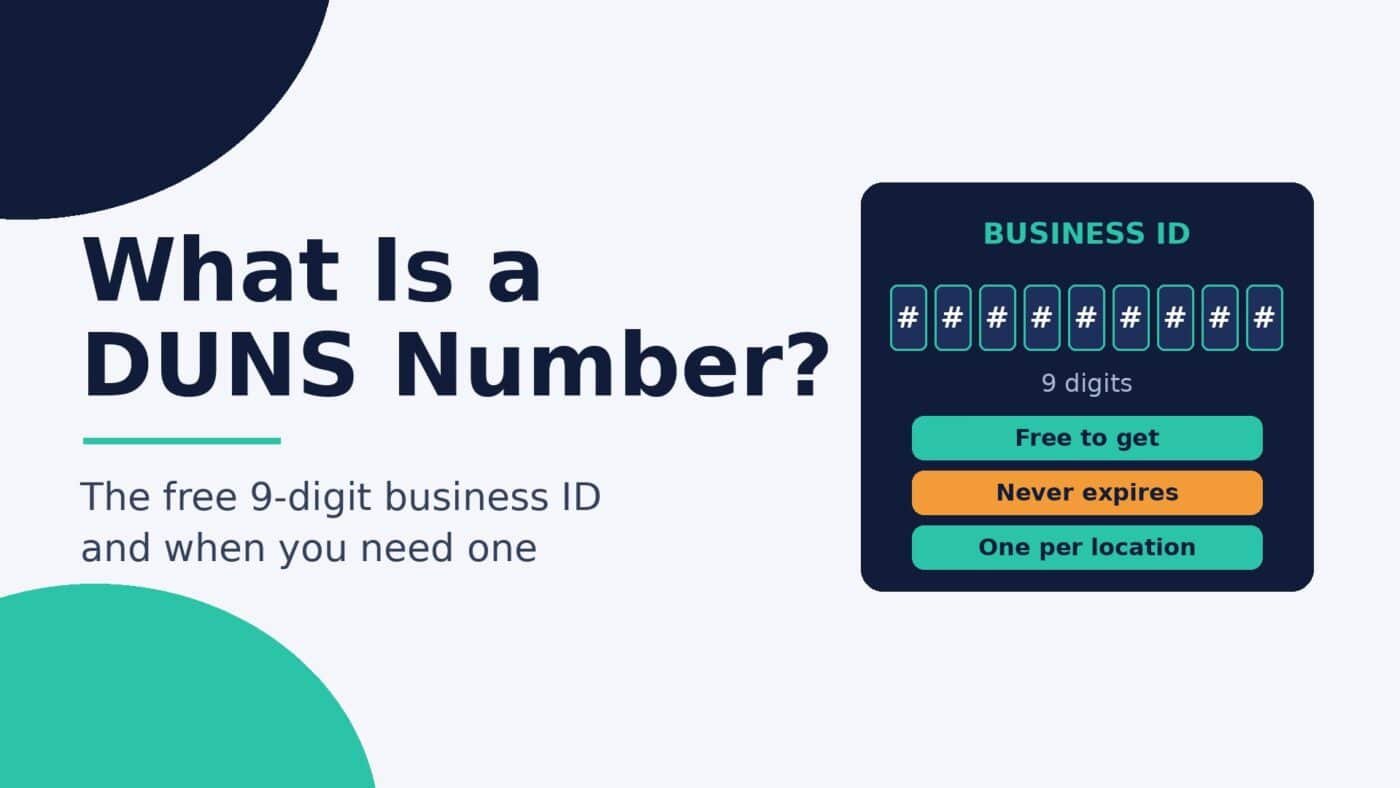
A DUNS number (D-U-N-S, short for Data Universal Numbering System) is a free nine-digit ID that Dun & Bradstreet assigns to a business location. Companies, lenders, app stores and some agencies use it to look up your business and its Dun & Bradstreet credit file. You don’t need one to run a business, but you will if you want to enroll a company in the Apple Developer Program, open an organization account on Google Play, or sign up with suppliers that ask for it. You can get one free from Dun & Bradstreet in up to 30 business days, or pay to speed it up.
Most people search for a DUNS number because a form asked for one: a supplier portal, an app store sign-up, or a credit application. This guide explains what the number is, who actually needs it, how it differs from an EIN and the federal government’s Unique Entity ID, and how to get one without paying anyone. Every rule and figure links to the official page it comes from.
DUNS number at a glance
| What you need to know | |
|---|---|
| What it is | A unique nine-digit business identifier |
| Who issues it | Dun & Bradstreet (D&B), a private business data and credit company |
| Cost | Free; optional paid expedited service |
| Standard wait | Up to 30 business days |
| Expedited wait | Within 8 business days (paid) |
| One per | Business location (multi-location businesses get one per location) |
| Expires? | No, and there’s no renewal fee |
| Legally required? | No; some companies and programs require it |
| Used for federal contracts? | Not since April 4, 2022; SAM.gov uses the Unique Entity ID instead |
Sources for the table: Dun & Bradstreet’s How to Get a D-U-N-S Number page and the GSA Vendor Support Center’s Unique Entity ID notice.
What is a DUNS number used for?
Dun & Bradstreet describes the D-U-N-S Number as a unique nine-digit identifier used exclusively for businesses. Think of it as a lookup key. When another company types your number into D&B’s database, it pulls up a profile of your business: legal name, address, industry, size and, once payment history builds up, business credit scores.
That profile gets used in a few common ways:
- Supplier and vendor onboarding. D&B says many of the world’s largest companies will ask for a D-U-N-S Number on applications to become a supplier or to get credit. Big retailers, manufacturers and corporate procurement portals often have a DUNS field on their vendor forms.
- Trade credit and loans. A supplier deciding whether to give you “net 30” terms, or a lender reviewing a business loan, may check your D&B file. D&B says a number connected to your credit file may help expedite the loan approval process with some financial institutions.
- App store developer accounts. Apple and Google both use DUNS numbers to verify organizations (details below).
- Some government and international programs. The U.S. federal government dropped DUNS in 2022, but D&B notes that many other agencies, governments, and companies around the world still use it.
Do you need a DUNS number?
Not by law. D&B itself says you are not required to have a D-U-N-S Number to own and operate your business. Whether you need one depends on who you want to work with.
You probably need one if you:
- Want to publish apps under a company name on the Apple App Store or Google Play
- Are filling out a supplier or vendor application with a large company that asks for it
- Want suppliers to offer you trade credit based on a business credit file rather than your personal credit
- Are bidding on contracts with a non-federal agency, foreign government or large corporation that lists DUNS as a requirement
You can usually skip it if you:
- Freelance or run a side hustle for individual clients who pay your invoices directly
- Sell on marketplaces or your own site and nobody has asked for one
- Only need to work with the U.S. federal government (you need a SAM.gov Unique Entity ID instead)
- Publish apps as an individual: Apple says if you’re enrolling as an individual, you don’t need a D-U-N-S Number
Getting one costs nothing, so there’s little downside to applying if you think you’ll need it in the next year. The main cost is your time and a few weeks of waiting, which is why it’s worth applying before a deadline rather than after.
DUNS number vs EIN vs UEI
These three IDs get mixed up constantly because they’re all business numbers and two of them are nine digits. They come from different organizations and do different jobs.
| DUNS number | EIN | UEI (SAM) | |
|---|---|---|---|
| Issued by | Dun & Bradstreet (private company) | IRS | SAM.gov (U.S. General Services Administration) |
| Main purpose | Business identity and credit file | Federal tax ID | Federal contracts and grants |
| Cost | Free (paid expedite optional) | Free | Free |
| Required by law? | No | Yes, for many businesses (employees, corporations, partnerships) | Only to get federal awards |
| Who asks for it | Suppliers, lenders, Apple, Google, some agencies | IRS, banks, payroll, clients filing 1099s | Federal agencies and prime contractors |
- EIN: The IRS calls it a federal tax ID number for businesses, tax-exempt organizations and other entities, and you can get it free from the IRS in minutes. The same IRS page lists who needs an EIN, including businesses with employees, corporations and partnerships. It’s what goes on tax returns, bank account applications and the Form W-9 you give clients. Our guide to applying for an EIN online walks through it.
- UEI: As of April 4, 2022, the federal government is no longer using the Data Universal Numbering System (DUNS) number as its entity identifier and switched to the Unique Entity ID (SAM) generated at SAM.gov. GSA’s announcement said the DUNS Number is no longer valid for federal award identification. If you only need an ID for subaward reporting, SAM.gov lets you request a Unique Entity ID only without having to complete a registration.
A typical small business might end up with all three: an EIN for taxes, a DUNS number for a supplier portal or app store, and a UEI if it ever bids on federal work.
How to get a DUNS number for free
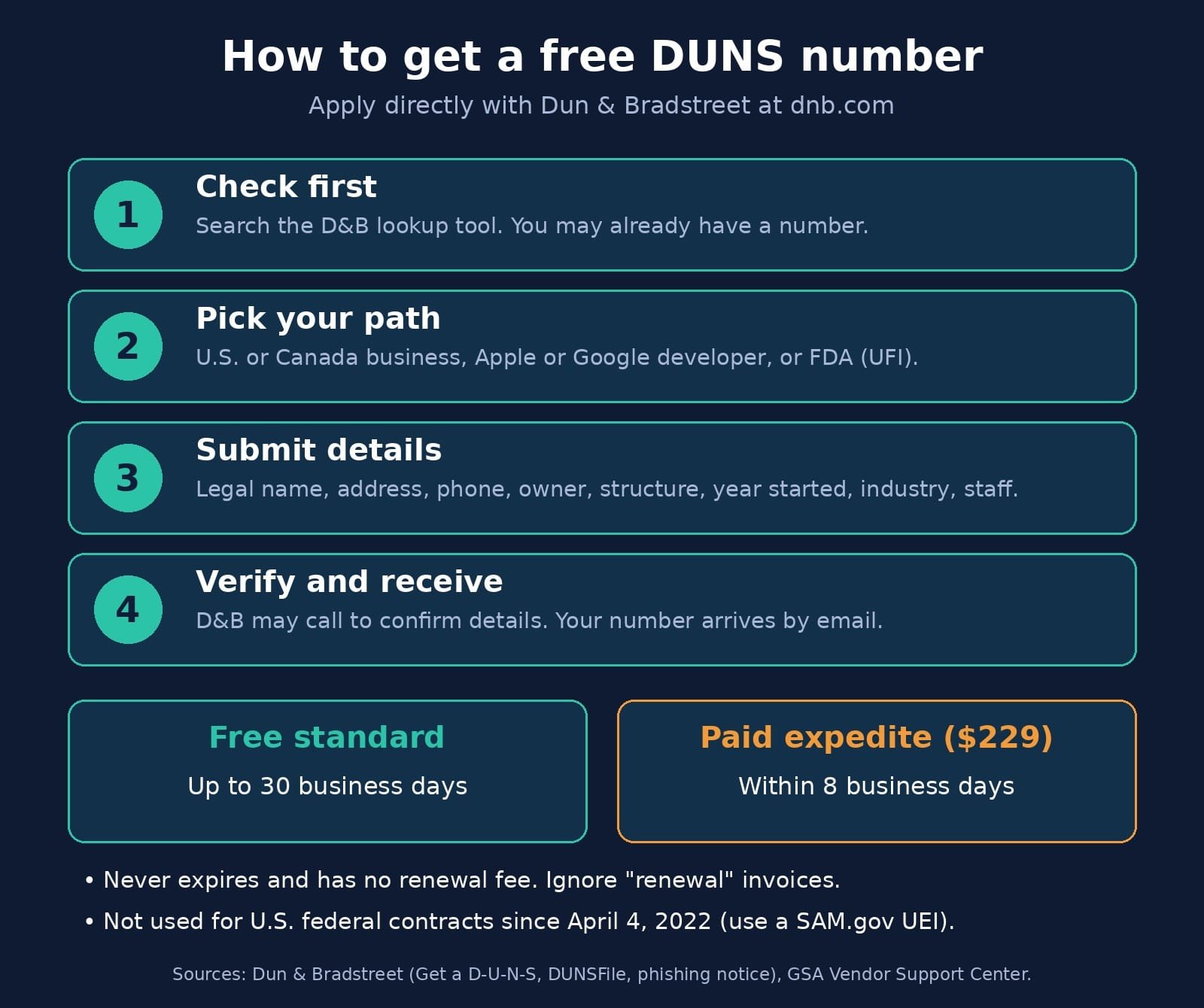
Apply directly with Dun & Bradstreet. The process on D&B’s application page has four steps:
- Check whether you already have one. D&B sometimes creates a file when a bank, supplier or customer asks about your company. Search the D-U-N-S Number Lookup tool first. Applying again when you already have a number just creates confusion.
- Pick the option that fits you. D&B offers separate paths for U.S.-based businesses, Canada-based businesses, Apple developers, Google developers, and businesses that need a UFI for FDA registration.
- Fill in your business details. D&B may ask for your legal business name, business address, phone number, the name of the owner, president or CEO, legal structure, the year the business started, primary industry, and total number of full- and part-time employees. Use your legal name exactly as it appears on your state formation documents, not a trade name.
- Verify and wait for the email. A D&B representative may contact you to confirm details. Once your information is authenticated, the number arrives by email.
During checkout you’ll be offered paid expedited processing. D&B says this is not required. There is no charge to receive a D-U-N-S Number.
Before you apply: make sure your business details are settled. If you’re still deciding on a structure, read sole proprietorship vs LLC or our guide on how to start an LLC. If you operate under a trade name, our DBA vs LLC guide explains why some programs won’t accept one.
How long does it take to get a DUNS number?
Through the free route, D&B says normal processing can take up to 30 business days, which is roughly six calendar weeks. Plan for the full window.
If you can’t wait, D&B sells expedited processing through its DUNSFile product, listed at $229, with delivery in up to 8 business days after you submit the registration form. DUNSFile also creates a basic D&B business credit file and a company profile in D&B’s Business Directory.
Is it worth paying? Only if a deadline depends on it, such as a supplier contract with a start date or a product launch that needs an organization developer account. If you’re applying “just in case,” the free route gives you the same number.
Apple and Google developers: different timelines
App developers go through dedicated D&B paths with their own rules:
- Apple Developer Program: Companies and educational institutions must provide a D-U-N-S Number registered to their legal entity. Apple accepts corporations, limited partnerships and LLCs, but says DBAs, fictitious businesses, trade names and branches are not accepted. Apple tells applicants to allow up to 5 business days to get the number from D&B, notes that expediting won’t shorten that wait, and says to allow up to 2 more business days before Apple receives it. If D&B lists you as a sole proprietorship, Apple says to enroll as an individual.
- Google Play: Google says you can’t create an organization developer account without a valid D-U-N-S number, that getting one can take up to 30 days, and that Google displays your legal name and D-U-N-S number on Google Play. The legal name and address in your Google payments profile must exactly match your D&B profile, or your account can be restricted.
The practical takeaway for developers: form your LLC or corporation first, get the DUNS number under that exact legal name and address, then enroll. A registered agent address and your business address are different things, so double-check which one you give D&B.
How to look up a DUNS number
Use D&B’s free D-U-N-S Number Lookup tool. You can search for your own business or for a company you plan to work with. A few things to know:
- Numbers are per location. D&B says D-U-N-S Numbers are assigned at an individual branch level, so a company with several offices can have several numbers. Pick the one that matches the legal entity and address the form is asking about.
- Check your details while you’re there. If your address, phone number or legal structure is wrong, fix it before a supplier or app store compares records. D&B says U.S.-based non-public companies can view and request updates to their business information for free through D-U-N-S Manager.
- Your number won’t change. D&B says your number will never expire or change even if your business closes or is purchased by another company.
DUNS numbers and business credit: the PAYDEX score
A DUNS number is what connects your business to a D&B credit file. The best-known score in that file is PAYDEX, which tracks how promptly your business pays suppliers. According to D&B, the PAYDEX score runs from 1 to 100, with 0 to 49 indicating a high risk of late payment, 50 to 79 a moderate risk, and 80 to 100 a low risk.
Two points that surprise new business owners:
- Having a DUNS number doesn’t give you a score. PAYDEX is built from payment experiences that suppliers and vendors report to D&B. A brand-new number with no reported payments has little or nothing to score.
- Not every bill gets reported. D&B’s advice for improving PAYDEX is to pay your bills on or ahead of time and make sure your suppliers and lenders are reporting your payments. If your vendors don’t report to D&B, on-time payments to them won’t show up.
Business credit builds slowly. Paying suppliers on time, keeping business and personal money separate, and using the same legal name and address everywhere matter more than anything you can buy. Our cash vs accrual accounting guide covers the bookkeeping side of keeping your business finances clean.
DUNS number scams and upsells to avoid
Because the number is free and people often need it urgently, there’s a small industry built around charging for it. Watch for these:
- Fake renewal invoices. D&B warns that some companies receive emailed “estimates” that look like invoices for D-U-N-S renewal. D&B says these are not issued by Dun & Bradstreet and should NOT be paid, because D-U-N-S Numbers do not expire and do not need to be renewed. It asks you to forward such emails to security@dnb.com.
- Third-party “registration services.” Google’s help page warns developers to be aware of third-party services that may attempt to charge high administrative fees for this free registration. Apply only on dnb.com.
- Bundled products. D&B sells credit monitoring and credit-building products alongside the free number. D&B states there is never a requirement that you purchase any product or services to obtain, use or maintain a D-U-N-S Number. Buy them only if you have a specific use for them.
DUNS number: frequently asked questions
What is a DUNS number in simple terms?
A DUNS number is a free nine-digit ID that Dun & Bradstreet gives a business location. Suppliers, lenders, app stores and some agencies use it to look up your company’s profile and business credit file in D&B’s database. It identifies your business; it is not a tax number.
Is a DUNS number free?
Yes. Dun & Bradstreet doesn’t charge to request or receive a DUNS number, and there’s no renewal or maintenance fee. The only legitimate paid option is D&B’s own expedited service, listed at $229, which gets the number to you within 8 business days instead of up to 30.
Is a DUNS number the same as an EIN?
No. An EIN is a federal tax ID issued free by the IRS and used on tax returns, bank applications and W-9s. A DUNS number is a business identifier issued by Dun & Bradstreet, a private company, and used mainly for supplier onboarding, business credit and verification by companies like Apple and Google.
Do I need a DUNS number for an LLC?
Not to form or run one. An LLC needs a DUNS number only if someone you work with asks for it, such as Apple or Google for an organization developer account, or a large company’s supplier portal. Many single-owner LLCs never need one.
Do I need a DUNS number for government contracts?
Not for U.S. federal contracts. Since April 4, 2022, federal agencies use the Unique Entity ID (SAM) issued through SAM.gov instead. Some state, local and foreign agencies and many companies still ask for a DUNS number, so check each program’s requirements.
Does a DUNS number expire?
No. Dun & Bradstreet says a DUNS number never expires or changes, even if the business closes or is bought by another company. Any email asking you to pay to renew your DUNS number is not from D&B.
The bottom line
A DUNS number is a free business ID from Dun & Bradstreet that companies use to check who you are and how you pay your bills. You don’t need one to run a business, but you’ll need it to publish apps as a company on Apple or Google and for many supplier applications. Check the lookup tool first, apply free on dnb.com using your exact legal name and address, allow up to 30 business days, and ignore anyone who wants to charge you for registration or renewal. If you’re working with the federal government, get a SAM.gov Unique Entity ID instead.

The Teck Hustlers Editorial Team covers technology, business, finance and gaming news for readers who want the story behind the headline. Every article is researched, written and edited by our in-house team, checked against company announcements, filings and reputable reporting, and updated when new facts emerge. We focus on what each development means for founders, professionals, investors and everyday users. Have a tip or a correction? Reach us through our contact page.