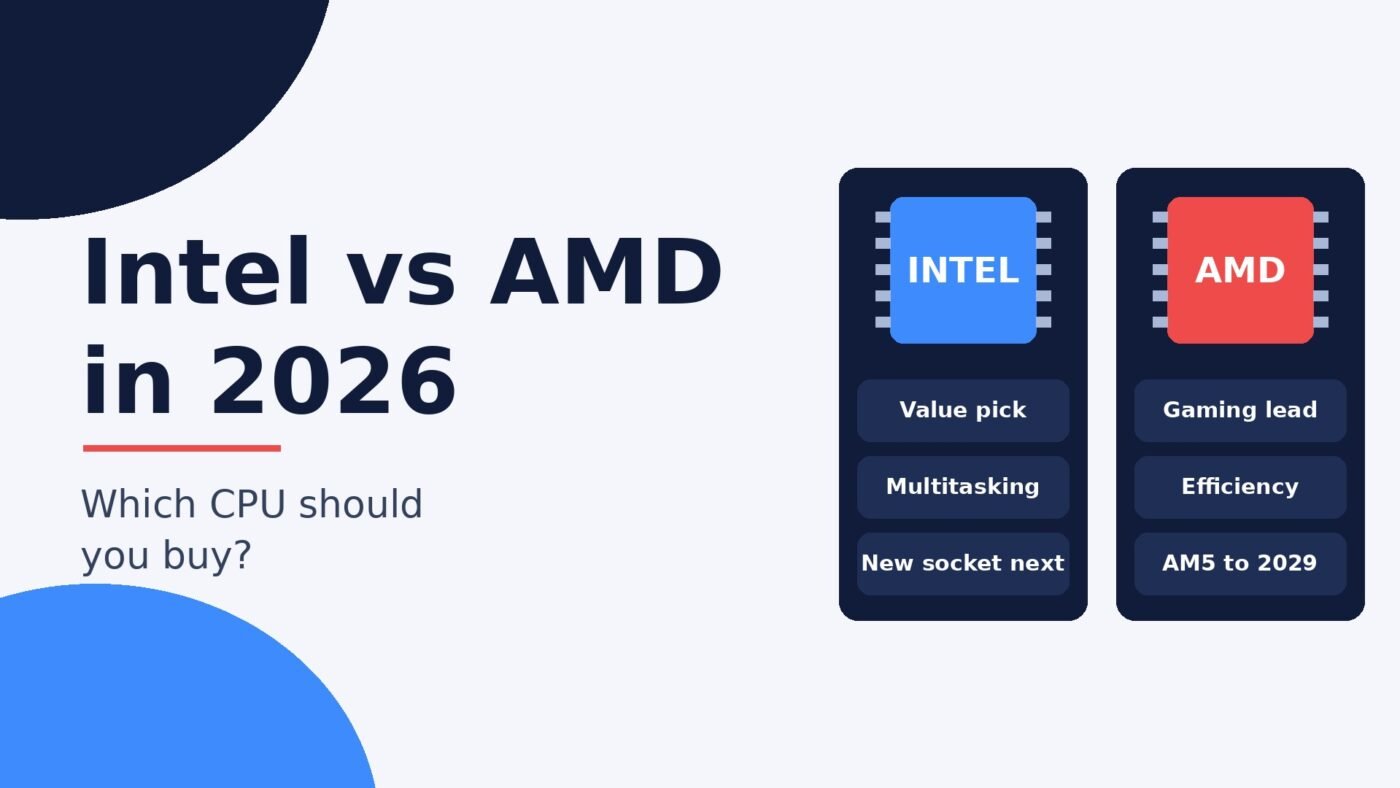
In late 2026, AMD is the better pick if gaming is your main reason for buying a CPU, because its Ryzen X3D chips with extra stacked cache top every major gaming benchmark. Intel is the better pick for value and mixed work: its new Core Ultra 200S Plus chips, like the Core Ultra 5 250K Plus and Core Ultra 7 270K Plus, deliver flagship-level multitasking speed for roughly $200 to $300. AMD also offers the longer upgrade path, since its AM5 socket is supported through 2029, while Intel’s current socket gets no new chips.
The Intel vs AMD argument has been running for decades, and it’s mostly noise now. Both brands make fast, reliable desktop processors, and the “right” choice depends on what you do with your PC, how much you want to spend, and whether you plan to upgrade the CPU later. This guide covers desktop CPUs (not laptops or servers), uses published benchmark data instead of brand loyalty, and ends with a simple checklist so you can decide in a few minutes.
All prices below are the street prices Tom’s Hardware listed in its CPU benchmark hierarchy, last updated in October 2026. CPU prices move often, especially around Black Friday, so check current listings before you buy.
Intel vs AMD at a glance
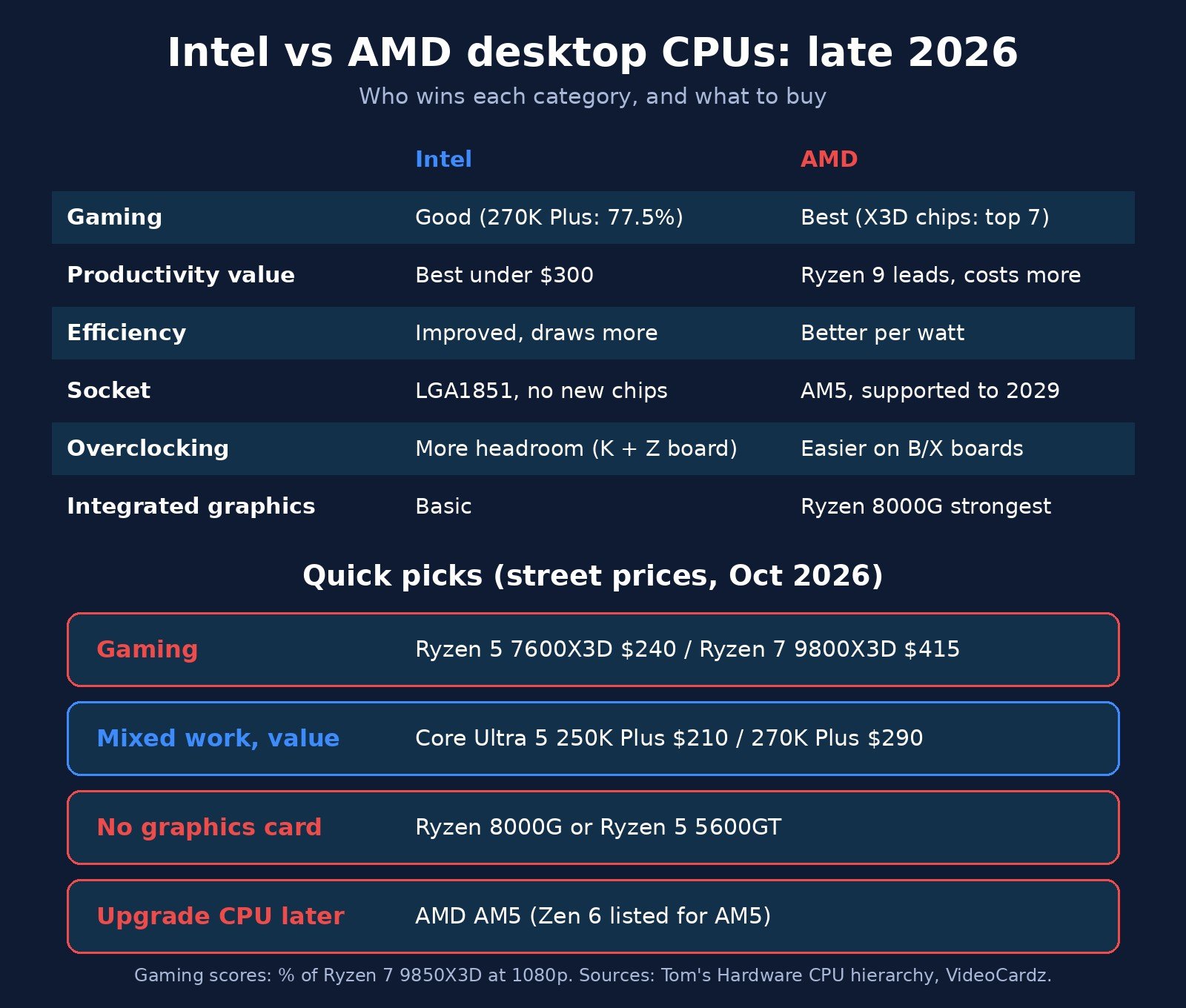
Here’s how the two brands compare on the things that matter most to buyers right now. Each row is explained, with sources, in the sections that follow.
| Category | Intel (Core Ultra 200S / 200S Plus) | AMD (Ryzen 9000 / X3D) | Edge |
|---|---|---|---|
| Gaming performance | Good; best current chip is the Core Ultra 7 270K Plus | X3D chips are the fastest gaming CPUs available | AMD |
| Single-threaded speed | Core Ultra 7 270K Plus tops the charts | Close behind | Intel |
| Multi-threaded work for the money | Mid-range chips match far pricier Ryzen 9s | Ryzen 9 flagships lead outright, at higher prices | Intel (value) |
| Power efficiency | Much improved, still draws a bit more | Better performance per watt | AMD |
| Socket and upgrade path | LGA1851 is a dead end; next chips need a new socket | AM5 supported through 2029 | AMD |
| Overclocking | More headroom, but needs a K chip plus a Z-series board | Simpler one-click tuning on cheaper B- and X-series boards | Intel (enthusiasts) |
| Integrated graphics on desktop | Basic | Ryzen 8000G APUs are the strongest | AMD |
| Hyper-Threading / SMT | Removed in Core Ultra 200S | Yes (two threads per core) | Depends on workload |
That scorecard lines up with Tom’s Hardware’s own nine-category Intel vs AMD comparison, which splits the wins fairly evenly but still names AMD as its go-to recommendation for most people, mainly because of gaming.
Gaming performance: AMD’s X3D chips lead
If you’re building a gaming PC, this is the section that matters most. AMD’s X3D processors use a technology called 3D V-Cache, which stacks a large block of extra cache memory onto the chip. Games constantly reuse the same data, so having more of it close to the cores keeps frame rates high and steady.
The results are lopsided. In Tom’s Hardware’s 1080p gaming rankings, the top seven spots all belong to AMD X3D chips, led by the Ryzen 7 9850X3D. Intel’s best showing is the older Core i9-14900K at 78.2% of the leader’s speed, with the newer Core Ultra 7 270K Plus right behind at 77.5%.
| CPU | 1080p gaming score (Tom’s Hardware) | Cores / threads | Street price (Oct 2026) |
|---|---|---|---|
| AMD Ryzen 7 9850X3D | 100% | 8 / 16 | $484 |
| AMD Ryzen 7 9800X3D | 97% | 8 / 16 | $415 |
| AMD Ryzen 7 7800X3D | 85.6% | 8 / 16 | $330 |
| AMD Ryzen 5 7600X3D | 80.6% | 6 / 12 | $240 |
| Intel Core i9-14900K | 78.2% | 24 / 32 | $396 |
| Intel Core Ultra 7 270K Plus | 77.5% | 24 / 24 | $290 |
| Intel Core Ultra 5 250K Plus | 73.3% | 18 / 18 | $210 |
| AMD Ryzen 5 9600X | 72.6% | 6 / 12 | $173 |
| Intel Core Ultra 9 285K | 71.8% | 24 / 24 | $499 |
Source: Tom’s Hardware CPU benchmark hierarchy. Scores are relative to the Ryzen 7 9850X3D.
Two things stand out. First, core count doesn’t predict gaming speed: the six-core Ryzen 5 7600X3D beats every Intel chip on that list, including 24-core models. Second, Intel’s flagship Core Ultra 9 285K is slower in games than its cheaper Core Ultra 7 270K Plus. Tom’s Hardware says Intel’s tile-based design in this generation holds back gaming performance, and it measured AMD’s latest X3D chips beating Intel’s current-generation chips by 30% or more in games.
When the CPU stops mattering in games
Those gaps are measured at 1080p, where the processor is the bottleneck. At 1440p and 4K, the graphics card does most of the work, so the difference between a fast and a very fast CPU shrinks. If you game at high resolution on a mid-range graphics card, a cheaper CPU and a better GPU is usually the smarter split. Not sure what card you have now? Our guide on how to check what GPU you have takes a minute.
Productivity and everyday speed: Intel punches above its price
For video editing, code compiling, 3D rendering and heavy multitasking, the picture flips. Intel’s recent “Arrow Lake Refresh” chips, sold as the Core Ultra 200S Plus series, are the standouts. According to Tom’s Hardware, the Core Ultra 7 270K Plus takes the lead in single-threaded performance across its full benchmark suite and matches AMD’s Ryzen 9 9950X in multi-threaded work at roughly half the price.
AMD still holds the absolute top of the multi-threaded charts with its 16-core Ryzen 9 9950X and 9950X3D, and the newer Ryzen 9 9950X3D2 claims the top overall slot, but Tom’s Hardware notes it costs about $900, which is out of reach for most buyers.
Why core counts are confusing
The two brands build chips differently, so spec sheets mislead:
- Intel mixes big performance cores (P-cores) with smaller efficiency cores (E-cores), and it dropped Hyper-Threading in the Core Ultra 200S generation. So a 24-core Intel chip runs 24 threads.
- AMD uses one type of core, and each core runs two threads. A 16-core Ryzen runs 32 threads.
Despite those numbers, Intel’s 24-thread Core Ultra 9 285K and AMD’s 32-thread Ryzen 9 9950X deliver competitive multi-threaded performance. Judge chips by benchmarks for the apps you use, not by thread counts.
One niche detail: AMD’s Zen 5 chips support AVX-512 instructions, which speed up some scientific, AI and media software. Tom’s Hardware notes that Intel’s current desktop chips don’t support AVX-512. If you run local AI tools, the graphics card and its memory matter far more, as we explain in RAM vs VRAM.
Price and value: the best pick at each budget
Intel and AMD now price their matching chips within about $20 to $30 of each other, according to Tom’s Hardware’s pricing analysis, which gives Intel a slight edge on value at the lower end. Here are sensible picks by budget, drawn from Tom’s Hardware’s testing:
| Budget | Best for gaming | Best for mixed work and value |
|---|---|---|
| Under $150 | AMD Ryzen 5 5600 (older AM4 platform) | Intel Core i3-14100F (entry level) |
| About $200 to $250 | AMD Ryzen 5 7600X3D ($240) | Intel Core Ultra 5 250K Plus ($210) |
| About $300 | AMD Ryzen 7 7800X3D ($330) | Intel Core Ultra 7 270K Plus ($290) |
| $400 and up | AMD Ryzen 7 9800X3D ($415) or 9850X3D ($484) | AMD Ryzen 9 9950X ($550) for heavy workstation loads |
Budget picks come from Tom’s Hardware’s best budget CPUs list, and prices from its October 2026 hierarchy. Tom’s Hardware calls the Core Ultra 5 250K Plus its top budget CPU because it matches AMD’s six-core chips in games and offers nearly twice the multi-threaded performance, while it names the Ryzen 5 7600X3D the better choice for pure gamers.
Remember that the CPU is only part of the cost. Both current platforms use DDR5 memory, and RAM prices have climbed this year (see our report on the latest RAM price hikes), so budget for memory and a motherboard before you pick a chip.
Power, heat and cooling
AMD wins on efficiency. Its Ryzen chips are built on TSMC’s 4nm process, and Tom’s Hardware found they consume less power for the work they do. Intel’s Core Ultra 200S chips have cut power draw a lot compared with the 13th and 14th generation, but they still use slightly more overall.
You can see it in the rated limits. The Ryzen 7 9800X3D is rated at 120W with a 162W maximum, and the Ryzen 5 9600X at 65W with an 88W maximum. Intel’s Core Ultra 7 270K Plus is rated at 125W with a maximum of 250W, per the Tom’s Hardware spec tables. In practice, a high-end Intel chip deserves a stronger cooler, while a Ryzen 5 runs happily on a modest one.
Platform, sockets and upgrade path
This is the factor buyers most often overlook. The socket on your motherboard decides which future CPUs you can drop in without replacing the board.
AMD AM5: supported through 2029
AMD’s current AM5 socket launched in 2022 with the Ryzen 7000 series. At Computex 2026, AMD extended its support commitment to AM5 “through 2029”, and AMD’s technical documentation now lists its next desktop family, the Zen 6 “Olympic Ridge” chips, as AM5-compatible. AMD hasn’t announced those chips or their launch date yet, and whether a given older board supports them will depend on a BIOS update from the motherboard maker.
Intel LGA1851: no more new chips
Intel’s current LGA1851 socket covers the Core Ultra 200S and 200S Plus chips, and Tom’s Hardware calls it a dead end: no further processors are expected. Intel’s next desktop generation, code-named Nova Lake, moves to a new LGA1954 socket and will need a new motherboard. Intel CEO Lip-Bu Tan said Nova Lake is coming at the end of 2026, while reports point to a launch in the first quarter of 2027.
What this means for you: an Intel Core Ultra 200S Plus build is still a great machine, but treat it as a complete system you’ll keep as-is. If you want to swap in a faster CPU in three years without changing the motherboard, AM5 is the safer bet today.
Integrated graphics, overclocking and reliability
Integrated graphics
If you’re building a PC without a graphics card, AMD’s Ryzen 8000G “APU” chips, like the 8700G and 8600G, have the best built-in graphics on desktop, according to Tom’s Hardware. For a cheap all-in-one build, its budget list highlights the Ryzen 5 5600GT.
Overclocking
Intel gives enthusiasts more fine control and headroom, but you need an unlocked “K” chip and a pricier Z-series motherboard to overclock the CPU. AMD lets you overclock on its cheaper B-series and X-series boards and leans on one-click Precision Boost Overdrive. For most people, neither matters much; both brands boost themselves close to their limits out of the box.
Reliability
Both brands have had recent problems. Intel’s 13th- and 14th-generation Core i9 chips suffered instability that Intel addressed with microcode updates, and some Ryzen 7 9800X3D chips burned in their sockets, mostly on ASRock boards, which Tom’s Hardware reports ASRock addressed with BIOS updates. Neither became a formal recall. Whichever you buy, update your motherboard BIOS and drivers when you set it up; our guide to updating graphics drivers covers the GPU side.
Ryzen 5 vs Ryzen 7 (and Core Ultra 5 vs 7)
Within each brand, the number roughly tells you the tier. In AMD’s current Ryzen 9000 lineup, the Ryzen 5 9600X has 6 cores and 12 threads, while the Ryzen 7 9700X has 8 cores and 16 threads, per Tom’s Hardware’s spec table. Intel’s Core Ultra 5 250K Plus has 18 cores (6 performance plus 12 efficiency), and the Core Ultra 7 270K Plus has 24 (8 plus 16).
For gaming, the “X3D” label matters more than the 5 or 7: a Ryzen 5 7600X3D outruns a regular Ryzen 9 9950X in Tom’s Hardware’s gaming chart (80.6% vs 76.9%). Step up to a Ryzen 7 or Core Ultra 7 when you edit video, stream while gaming, or run lots of apps at once.
Should you buy now or wait?
Both companies have new desktop generations on the horizon. Intel’s Nova Lake on LGA1954 is expected in early 2027, and AMD’s Zen 6 Ryzen chips are confirmed for AM5 but unannounced. Neither has a confirmed launch date or price.
- Buy now if your current PC is holding you back. Today’s chips are mature, and prices on the current lineup have already dropped well below launch.
- Buy AMD AM5 now if you want the option to upgrade later, since Zen 6 is listed for the same socket.
- Wait only if your PC still works fine and you specifically want Intel’s next platform, which will need a new motherboard anyway.
Which should you pick?
- Mainly gaming, any budget: AMD Ryzen X3D (7600X3D, 7800X3D, 9800X3D or 9850X3D).
- Gaming plus streaming or editing on a budget: Intel Core Ultra 5 250K Plus or Core Ultra 7 270K Plus.
- Heavy workstation tasks with no budget limit: AMD Ryzen 9 9950X or 9950X3D.
- No graphics card: AMD Ryzen 8000G or Ryzen 5 5600GT.
- Want to upgrade the CPU later without a new board: AMD AM5.
- Office work, browsing, school: either brand’s cheapest current chip is plenty; spend the savings on an SSD and enough RAM.
Building a new PC also means picking a Windows license. If you’re unsure which edition you need, see Windows 11 Home vs Pro. And if you’re weighing a Mac instead, our explainer on unified memory vs RAM covers how Apple Silicon handles memory differently.
Intel vs AMD: frequently asked questions
Is AMD or Intel better for gaming?
AMD is better for gaming right now. Its Ryzen X3D chips hold the top seven spots in Tom’s Hardware’s 1080p gaming rankings, led by the Ryzen 7 9850X3D. Intel’s fastest gaming chips, the Core i9-14900K and Core Ultra 7 270K Plus, score about 78% of that leader.
Is Intel or AMD better for productivity?
Intel gives you the most productivity speed for the money. The Core Ultra 7 270K Plus leads in single-threaded performance and matches the Ryzen 9 9950X in multi-threaded work at about half the price. AMD’s Ryzen 9 flagships still post the highest multi-threaded scores overall.
Is AMD better than Intel overall?
For most buyers in 2026, AMD is the slightly safer all-round choice because it leads in gaming and efficiency and its AM5 socket is supported through 2029. Intel is the better value for mixed work under $300. Neither is a bad choice.
Do Intel and AMD CPUs use the same motherboard?
No. AMD’s current desktop chips use the AM5 socket, and Intel’s current chips use LGA1851. Each needs a motherboard built for its socket, and Intel’s next generation will move to a new LGA1954 socket.
Does it matter if I game at 1440p or 4K?
Less than at 1080p. At higher resolutions the graphics card becomes the bottleneck, so the gap between CPUs shrinks. Spending more on the GPU usually pays off more than buying the fastest processor.
Should I wait for Zen 6 or Nova Lake?
Only if your current PC still meets your needs. Intel’s Nova Lake is expected in early 2027 on a new socket, and AMD’s Zen 6 chips are confirmed for AM5 but not yet announced. If you need a PC now, today’s chips are a solid buy.
The bottom line
Pick AMD if you mostly game or want a socket you can upgrade for years; an X3D chip is the clearest win in the whole Intel vs AMD debate. Pick Intel if you want the most multitasking power for around $200 to $300 and plan to keep the system as-is. Either way, check current prices before you buy, match the CPU to your graphics card and screen resolution, and put the money you save toward the parts you’ll actually notice.

The Teck Hustlers Editorial Team covers technology, business, finance and gaming news for readers who want the story behind the headline. Every article is researched, written and edited by our in-house team, checked against company announcements, filings and reputable reporting, and updated when new facts emerge. We focus on what each development means for founders, professionals, investors and everyday users. Have a tip or a correction? Reach us through our contact page.