To invoice a client, send a numbered document that lists your details and theirs, the work you did, the amount due, an exact due date, and how to pay, then follow up on a set schedule until it is paid. That is the whole job. The parts that trip people up are the ones around it: agreeing terms before you start, getting the invoice to the person who actually pays bills, and chasing politely when the money is late. This guide walks through all of it, with a worked example and copy-ready messages.
It is written for side hustlers and new freelancers, whether you design logos, write copy, manage social accounts or work as a virtual assistant. The tax notes at the end are US-focused; if you work elsewhere, check your own tax agency’s rules.
Before you send your first invoice
Most late payments start before the invoice exists. A few minutes of setup with each new client saves weeks of chasing later.
- Agree on the price and scope in writing. An email that says “logo design, two revision rounds, flat fee, half up front” is enough for small jobs. The invoice should match what was agreed, line for line.
- Agree on payment terms. Settle when payment is due (for example, 14 days after the invoice date), which payment methods you accept, and whether you charge a late fee. Clients rarely argue with terms they already said yes to.
- Ask who pays the bills. Your day-to-day contact is often not the person who releases payment. Larger companies route invoices to an accounts payable inbox, and Xero’s freelance guide recommends sending invoices to accounts payable, not your project contact.
- Ask if they need a PO number. Some companies will not pay an invoice unless it quotes their purchase order (PO) number. Ask once, up front.
- Expect a W-9 request (US). US business clients usually ask freelancers for Form W-9, which gives them your taxpayer identification number so they can file an information return about what they paid you. If you would rather not hand out your Social Security number, you can apply for an EIN online for free and use that instead.
- Decide on a deposit for bigger jobs. Asking for part of the fee before you start protects you if the client disappears halfway through.
What to include on an invoice
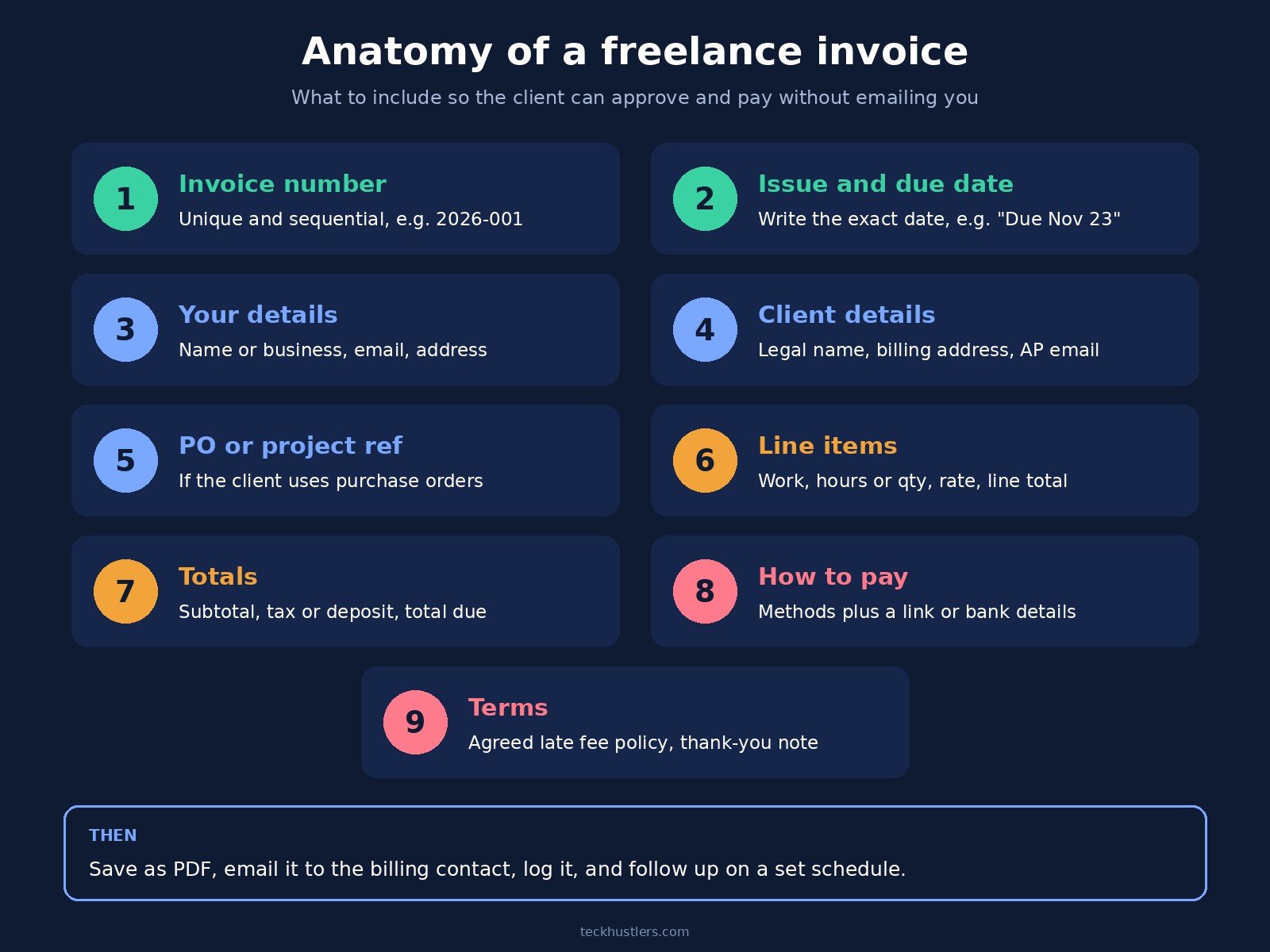
There is no single legal format for a freelance invoice in the US, but the same fields show up in every good one. Here is the checklist.
| Field | What to put | Why it matters |
|---|---|---|
| The word “Invoice” | At the top, in large text | So nobody mistakes it for a quote or a receipt |
| Invoice number | A unique, sequential number, like 2026-001 | Both sides can refer to it; you can spot gaps and duplicates |
| Issue date | The date you send it | Payment terms count from this date |
| Due date | An exact calendar date | “Due March 3” leaves no room for interpretation |
| Your details | Name or business name, address, email, phone | Tells the client who to pay and who to ask |
| Client details | Legal business name, billing address, contact or AP email | Gets the invoice routed and approved |
| PO or project reference | Their PO number or project name, if they use one | Some finance teams cannot pay without it |
| Line items | Each service or deliverable, with hours or quantity, rate and line total | Clear itemizing cuts down on questions |
| Totals | Subtotal, any tax or discount, then total due in bold | The number they need to pay, impossible to miss |
| Payment instructions | Accepted methods plus a payment link or bank details | Removes the “how do I pay you?” email |
| Terms and notes | Late fee policy (if any) and a short thank-you | Puts agreed rules in writing |
Sales tax on services depends on the state and the type of work. Many freelance services are not taxed, but some are. If you are unsure, check your state’s department of revenue before you add a tax line.
How to invoice a client in 7 steps
1. Pick a template or an invoicing tool
For your first few clients, a template in Google Docs, Google Sheets, Word or Excel works fine. Once you have several clients or recurring work, invoicing or accounting software saves time because it numbers invoices for you, calculates totals, sends reminders and shows what is still unpaid. We compare options in our guide to AI accounting software.
2. Add your business details
Put your name or business name, email, phone and mailing address at the top. A logo is optional. If you run your freelance work through an LLC, use the LLC’s exact legal name; our guide on how to start an LLC explains when that structure is worth it.
3. Add the client’s billing details
Use the client’s legal business name and billing address, not just the brand name you know them by, and add the billing contact or accounts payable email. If they gave you a PO number, put it here.
4. Number and date the invoice
Give every invoice a unique number and never reuse one. A simple sequence such as 2026-001, 2026-002 is easy to track. Add the issue date and an exact due date. Stripe’s guide makes the same point: write “Payment due by [exact date]” rather than “due in 30 days”.
5. Itemize the work
List each deliverable or block of work on its own line. For hourly work, show hours and rate. For project work, show the milestone and the agreed fee. Describe the work in the client’s language (“Homepage copy, 3 sections”), not internal shorthand. A single lump-sum line invites questions; a clear breakdown gets approved faster.
6. Total it and state how to pay
Show a subtotal, then any tax, discount or deposit already paid, then the total due in bold. Below that, list the payment methods you accept, such as bank transfer (ACH), card or PayPal, with a payment link or the details the client needs. If you agreed a late fee, state it here in plain words.
7. Save as a PDF, send it, and log it
Export the invoice as a PDF so the layout cannot shift, attach it to a short email, and record it in a simple tracker: invoice number, client, amount, sent date, due date, paid date. That tracker is how you will know who to chase, and it doubles as an income record at tax time.
A worked example
Here is what a finished invoice might look like. All names and amounts below are made-up example data, not recommended rates.
| Item | Qty | Rate | Amount |
|---|---|---|---|
| Blog post writing, 1,500 words (October batch) | 4 posts | $200 per post | $800 |
| Keyword research and outlines | 3 hours | $50 per hour | $150 |
| Rush edit on launch post | 1 | $75 flat | $75 |
| Subtotal | $1,025 | ||
| Less deposit received (Invoice 2026-006) | −$300 | ||
| Total due | $725 | ||
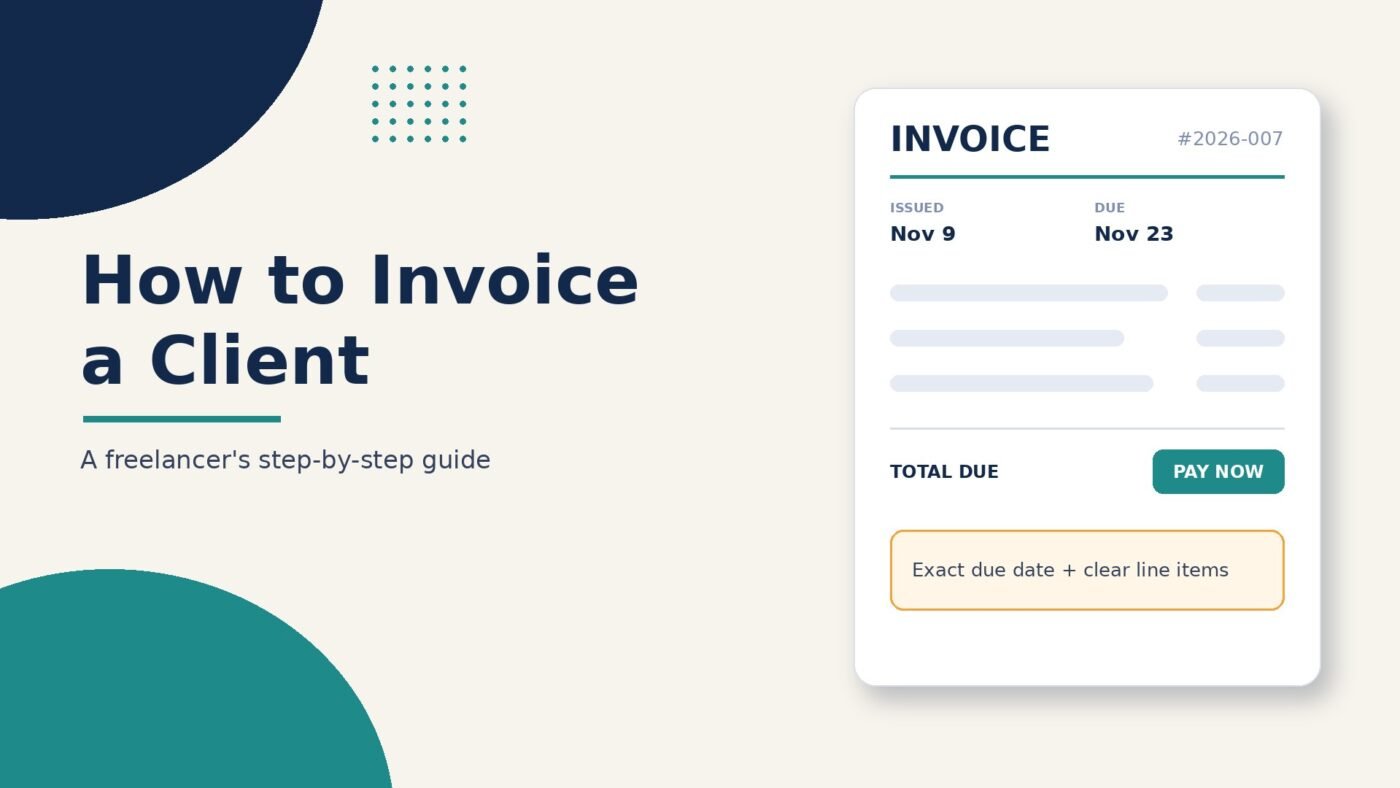
The header above that table would read: Invoice 2026-007, issued November 9, due November 23 (Net 14), PO 4471, billed to Example Media LLC, Accounts Payable, ap@example.com. The footer would list “Pay by ACH or card via the link below” and the agreed late fee policy.
Payment terms explained
Payment terms tell the client how long they have to pay. The common ones:
- Due on receipt: pay as soon as the invoice arrives. Common for one-off jobs from individuals.
- Net 7, Net 14, Net 15: pay within that many days of the invoice date. Shorter terms usually mean faster cash for you.
- Net 30: pay within 30 days. Xero calls this the industry standard, and many larger companies default to it or longer.
- Deposit plus balance: part up front, the rest on delivery. Useful for new clients and bigger projects.
- Milestone billing: invoice at agreed checkpoints (outline approved, draft delivered, final files) instead of waiting until the end.
- Retainer: a fixed monthly fee, invoiced at the start of each month, for ongoing work.
Whatever you choose, write both the term and the actual date (“Net 14, due November 23”), and use the same policy across clients so your cash flow is predictable.
How to send the invoice
Email is the default for most freelancers. Keep it short, put the invoice number and due date in the subject line, and attach the PDF. Here is a template you can copy:
Subject: Invoice 2026-007 for October blog content, due Nov 23
Hi [Name],
Attached is invoice 2026-007 for the October blog content ([brief description]). The total due is [amount], payable by [due date]. You can pay by [methods] using [link or details].
Let me know if you need anything else to process it, such as a PO number or a W-9.
Thanks, and I’m looking forward to the next batch.
[Your name]
Send it as soon as the work or milestone is done. An invoice sent weeks later signals that you are not in a hurry to be paid. For retainers, send it on the same date every month.
What to do when a client pays late
Late payment is usually disorganization, not bad faith: the invoice went to the wrong inbox, it is waiting for an approval, or someone forgot. A calm, scheduled follow-up fixes most of it. A simple ladder:
- A few days before the due date: a friendly heads-up. “Quick reminder that invoice 2026-007 for [amount] is due on [date]. Just checking it reached the right person.”
- The day after it is due: “Invoice 2026-007 for [amount] was due yesterday. Could you let me know when payment is scheduled? I’ve attached it again for convenience.”
- About a week overdue: ask a direct question and offer help. “Is anything holding this up on your side, like a missing PO number or approval? Happy to resend anything you need.”
- Two weeks or more overdue: pause new work, reference your agreed terms and any late fee, and ask for a firm payment date in writing.
- Still nothing: a formal final notice, then options like a collection agency or small claims court. Rules and limits differ by state, so check your local court’s website before you file.
Keep every message polite and written, so you have a clear record if it ever escalates. A late fee only holds up well if it was agreed before the work started, which is one more reason to settle terms early.
Invoicing tools: template or software?
| Template (Docs, Sheets, Word, Excel) | Invoicing or accounting software | |
|---|---|---|
| Best for | Your first few clients and occasional jobs | Several clients, recurring invoices, or retainers |
| Invoice numbering | Manual, so easy to slip | Automatic |
| Online payments | You paste a payment link or bank details | Usually built in as a “Pay now” button |
| Reminders | You send them yourself | Can be scheduled automatically |
| Records for taxes | You keep a separate tracker | Unpaid, paid and totals tracked for you |
Online payment options are convenient for clients, but card and payment-platform transactions usually carry processing fees. Check the current fee page of whichever processor you use before you decide whether to pass fees on, and mention any surcharge in your terms up front.
Keep records and handle the tax side (US)
Your invoices are not just requests for money; they are part of your tax records.
- Invoices count as records. The IRS lists invoices among the supporting documents that show your gross receipts. Keep copies of what you send and proof of what you were paid.
- Keep them for years, not months. The IRS says to generally keep records for 3 years after you file, and longer in some cases, such as 6 years if you under-report income by more than 25% of the gross income on your return.
- The 1099 threshold changed for 2026. A client generally files Form 1099-NEC for a freelancer it pays at or above a reporting threshold. That threshold is $600 for payments made before 2026 and $2,000 for payments made in 2026.
- Report all income anyway. Not getting a 1099 does not make income tax-free. The IRS says you must report all income on your tax return, even if you don’t receive Forms 1099, and that you must file if you have net self-employment earnings of $400 or more. Your invoice tracker is how you catch the payments no form covers.
- Plan for estimated taxes. No one withholds tax from freelance payments, so you may need to pay quarterly estimated taxes. The same IRS page lists the deadlines.
This is general information, not tax advice. If your situation is more complicated, a tax professional is worth the fee.
Common invoicing mistakes
- Vague due dates. “Due in 30 days” or “payable soon” gives the client room to drift. Use a calendar date.
- Sending to the wrong person. Your creative contact may forward it late or not at all. Copy the accounts payable inbox.
- Missing the PO number. At some companies, no PO means no payment, and nobody tells you.
- Lump-sum billing. One line that says “Services: $1,025” invites questions and delays approval.
- Reusing or skipping invoice numbers. It makes your own records confusing and can confuse the client’s system.
- Invoicing late. The longer you wait after delivery, the longer the payment takes.
- No follow-up plan. Without a reminder schedule, overdue invoices quietly age.
Fixing these takes no extra tools, just a template and a habit. If you are still finding clients, our lists of remote side hustles and online side business ideas are a good place to start, and our guide to cold email outreach covers landing the work you will be invoicing for.
FAQ
What is the simplest way to invoice a client?
The simplest way to invoice a client is to fill in a free invoice template with your details, the client’s details, a unique invoice number, the work and amount, an exact due date and payment instructions, then save it as a PDF and email it. Software is optional until you have several clients.
What should a freelance invoice include?
A freelance invoice should include the word “Invoice,” a unique invoice number, the issue date and due date, your contact details, the client’s legal name and billing address, itemized work with rates, the total due, accepted payment methods, and any agreed late fee or terms.
When should I send an invoice?
Send an invoice as soon as the work or milestone is delivered, or at the start of the month for retainers. Invoicing promptly starts the payment clock sooner and shows the client you expect to be paid on time.
What does Net 30 mean on an invoice?
Net 30 means the client has 30 days from the invoice date to pay the full amount. Net 7, Net 14 and Net 15 work the same way with shorter windows. Write the exact due date next to the term to avoid confusion.
Can I invoice without a registered business?
Yes. In the US, you can invoice under your own name as a sole proprietor; you do not need an LLC to send an invoice. Many freelancers get a free EIN so they can give clients that number instead of their Social Security number.
How do I number my invoices?
Use a simple sequence that never repeats, such as 2026-001, 2026-002, or a client prefix plus a number. The key rule is that every invoice gets its own number and you never reuse one.
What do I do if a client doesn’t pay?
Follow a written reminder schedule: a heads-up before the due date, a polite note right after it, a direct check-in about a week late, then a pause on new work and a firm request citing your agreed terms. Formal steps like collections or small claims court come last.
The bottom line
Good invoicing is mostly preparation and habit. Agree on price, terms and the billing contact before you start, send a clear, itemized, numbered invoice with an exact due date as soon as the work is done, and follow up on a fixed schedule. Keep a copy of everything, because those invoices are also your income records at tax time.

The Teck Hustlers Editorial Team covers technology, business, finance and gaming news for readers who want the story behind the headline. Every article is researched, written and edited by our in-house team, checked against company announcements, filings and reputable reporting, and updated when new facts emerge. We focus on what each development means for founders, professionals, investors and everyday users. Have a tip or a correction? Reach us through our contact page.