TL;DR: A transformer model in AI is a type of neural network that reads a whole sequence of text (or images, or audio) at once and uses a mechanism called attention to work out which parts relate to which. It was introduced by Google researchers in the 2017 paper “Attention Is All You Need,” and it is the architecture behind almost every major chatbot today. The “T” in ChatGPT literally stands for transformer.
If you have read anything about AI in the last few years, you have bumped into the word “transformer.” It sounds like a robot toy, but it is actually the design that made modern AI possible. So what is a transformer model in AI, and why did it take over so quickly? This guide explains it in plain English, without the math.
What is a transformer model in AI?
A transformer is a blueprint for building a neural network that handles sequences, meaning data where order matters, like words in a sentence. The idea comes from the paper “Attention Is All You Need” by Ashish Vaswani and colleagues at Google, published in 2017. The authors proposed a model that relies “solely on attention mechanisms,” dropping the older step-by-step designs that most language models used at the time.
The original transformer was built for machine translation, turning English into German or French. Researchers soon found the same design worked for almost any language task, and later for images, audio and code. Today it is the foundation of every popular large language model.
The problem transformers solved
Before transformers, most language models were recurrent neural networks (RNNs). An RNN reads text one word at a time, carrying a running memory forward. That causes two problems:
- It is slow to train. Each word depends on the one before it, so the work can’t easily be split across many chips at once.
- It forgets. By the end of a long paragraph, the details from the start have faded from that running memory.
Transformers fix both. They look at every word in the input at the same time, which suits modern GPUs that do thousands of calculations in parallel. And because every word can “look at” every other word directly, distance matters far less.
How a transformer works, step by step
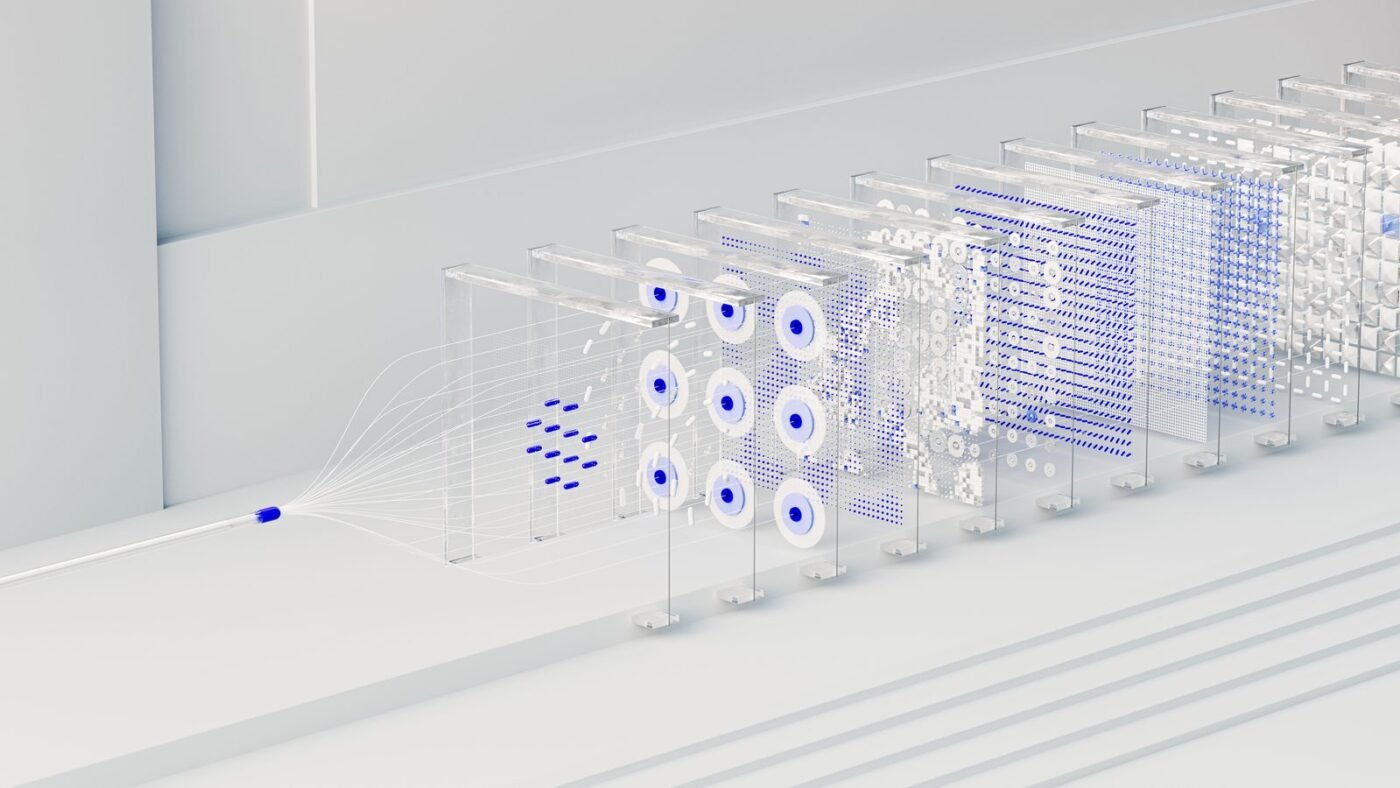
You don’t need the equations to get the idea. Here is the journey a sentence takes through a transformer:
- Split into tokens. The text is chopped into small pieces called tokens, which are often whole words or parts of words.
- Turn tokens into numbers. Each token becomes a list of numbers called an embedding, which captures something about its meaning.
- Add position. Since the model sees all tokens at once, it needs extra information about word order. This is called positional encoding.
- Apply attention. Each token checks every other token and decides how much to “pay attention” to it. This is the core trick, explained below.
- Repeat in layers. The attention step and a small feed-forward network are stacked dozens of times. Each layer refines the model’s understanding.
- Produce an output. In a chatbot, the final layer predicts the most likely next token, adds it, and repeats until the answer is done.
Attention, explained with one sentence
Take the sentence: “The trophy didn’t fit in the suitcase because it was too big.” What does “it” refer to? You know it’s the trophy. A transformer works this out with self-attention: when processing “it,” the model gives a high score to “trophy” and a lower score to “suitcase,” then blends their information accordingly.
Transformers also use multi-head attention, which runs several attention patterns side by side. One head might track grammar, another might track which nouns go with which pronouns. Google’s research blog post on the original model shows this kind of pronoun example with diagrams, and Jay Alammar’s The Illustrated Transformer is a great visual walkthrough if you want to go deeper.

Encoders, decoders and the models you know
The original transformer had two halves: an encoder that reads the input and a decoder that writes the output. Later models often use only one half.
| Type | What it is good at | Well-known examples |
|---|---|---|
| Encoder-only | Understanding text: search, classification, sentiment | BERT |
| Decoder-only | Generating text one token at a time: chatbots, writing, code | GPT models, Claude, Llama |
| Encoder-decoder | Turning one sequence into another: translation, summarizing | The original 2017 transformer, T5 |
The name GPT stands for “Generative Pre-trained Transformer,” which tells you exactly which family it belongs to.
Why transformers took over AI
Three things made transformers the default choice:
- They scale. Because training runs in parallel, labs could train far bigger models on far more data. Bigger transformers kept getting better, which kicked off the race to scale.
- They are general. The same basic design works for text, images (vision transformers), audio and video. Many multimodal AI models are transformers underneath.
- They handle context well. Attention lets a model connect ideas across long passages, which is why chatbots can follow a long conversation.
The limits of transformers
Transformers are not perfect, and their weaknesses shape how AI products work:
- Attention gets expensive. In the standard design, every token compares itself with every other token, so the cost grows roughly with the square of the input length. This is a big reason models have a context window limit.
- They predict, they don’t “know.” A transformer generates likely text. It can sound confident while being wrong, which is why retrieval tricks like RAG exist.
- They are hungry. Training large transformers takes huge amounts of data, chips and electricity.
Researchers are testing alternatives and add-ons, such as state space models, mixture-of-experts designs and diffusion-based language models. But in 2026 the transformer is still the backbone of the field, and newer ideas like reasoning models are mostly built on top of it rather than replacing it.
Transformer model FAQ
Is ChatGPT a transformer?
Yes. ChatGPT runs on OpenAI’s GPT models, and GPT stands for Generative Pre-trained Transformer.
Who invented the transformer?
A team of eight researchers, mostly at Google, led by first author Ashish Vaswani, published the design in 2017.
Is a transformer the same as a large language model?
Not quite. A transformer is the architecture, or the blueprint. A large language model is a specific, very large model, usually built with that blueprint and trained on huge amounts of text.

The Teck Hustlers Editorial Team covers technology, business, finance and gaming news for readers who want the story behind the headline. Every article is researched, written and edited by our in-house team, checked against company announcements, filings and reputable reporting, and updated when new facts emerge. We focus on what each development means for founders, professionals, investors and everyday users. Have a tip or a correction? Reach us through our contact page.