TL;DR: What is a neural network? It’s a type of machine learning model made of layers of simple connected units, loosely inspired by neurons in the brain. Each connection has a weight, and during training the network adjusts those weights, using a method called backpropagation, until its outputs match the examples it’s shown. Neural networks power image recognition, speech assistants, translation and chatbots like ChatGPT. The main types are feedforward networks, convolutional neural networks (CNNs), recurrent neural networks (RNNs) and transformers.
Almost every AI headline today, from chatbots to self-driving features, traces back to one idea. If you’ve ever wondered what is a neural network and why it matters so much, this guide explains it in plain English: the parts, how it learns, the main types and where its limits are. No math degree needed.

What is a neural network, in simple terms?
A neural network is a program that learns patterns from examples instead of following hand-written rules. Show it thousands of labeled photos of cats and dogs, and it gradually figures out which visual features separate the two, without anyone telling it to look for whiskers or ear shapes.
The name comes from a loose analogy with the brain. Biological neurons pass signals to each other, and the strength of those connections changes as we learn. An artificial neural network does something similar with numbers: units called neurons or nodes pass values along weighted connections, and learning means adjusting those weights. As IBM’s overview puts it, neural networks are at the heart of deep learning.
The parts of a neural network
| Part | What it does | Everyday analogy |
|---|---|---|
| Input layer | Receives the raw data, such as pixel values or words turned into numbers | Your eyes taking in a scene |
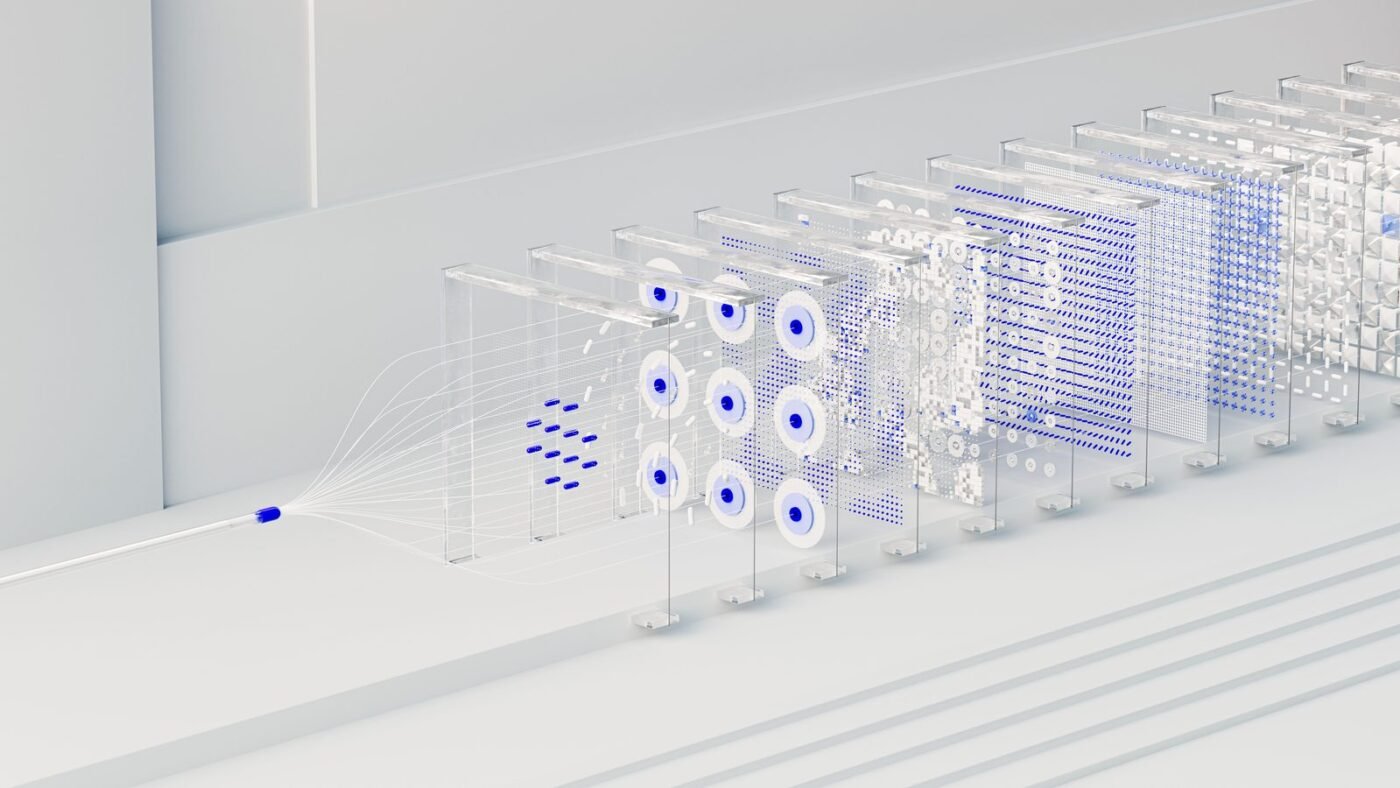
| Hidden layers | Transform the data step by step, finding increasingly complex patterns | Your brain noticing edges, then shapes, then “that’s a cat” |
| Output layer | Produces the answer, such as a label, a number or the next word | Saying the answer out loud |
| Weights | Numbers on each connection that set how much one neuron influences the next | How much you trust each clue |
| Bias | An extra adjustable number that shifts a neuron’s output | Your starting assumption |
| Activation function | Decides how strongly a neuron “fires,” letting the network model non-linear patterns | A threshold for paying attention |
A network with many hidden layers is called a deep neural network, which is where the term deep learning comes from.
How a neural network learns
1. The forward pass
Data flows from the input layer through the hidden layers to the output. Each neuron multiplies its inputs by their weights, adds them up with its bias, and passes the result through its activation function.
2. Measuring the error
The network’s output is compared with the correct answer using a loss function, a single number that says how wrong it was.
3. Backpropagation and gradient descent
The error is sent backward through the network to work out how much each weight contributed to the mistake. An optimizer, usually a form of gradient descent, then nudges every weight slightly in the direction that reduces the error. Google’s Machine Learning Crash Course walks through this process with interactive examples.
4. Repeat, many times
This loop runs over the training data again and again. Each full pass is called an epoch. Once trained, the network can make predictions on new data, a stage known as AI inference.
The main types of neural networks
- Feedforward networks (multilayer perceptrons): the simplest kind, where data moves in one direction. Good for tabular data and basic classification.
- Convolutional neural networks (CNNs): designed for images. They scan small patches to detect edges, textures and shapes, and they drove the computer vision boom of the 2010s.
- Recurrent neural networks (RNNs) and LSTMs: built for sequences like text, audio and time series, keeping a kind of memory of earlier inputs.
- Transformers: use an “attention” mechanism to weigh every part of the input at once. They power today’s large language models. Our guide to transformer models explains attention in detail.
- Generative networks: models such as GANs and diffusion models learn to create new images, audio or video.
A very short history
| Year | Milestone |
|---|---|
| 1958 | Frank Rosenblatt introduces the perceptron, an early single-layer neural network. |
| 1986 | David Rumelhart, Geoffrey Hinton and Ronald Williams popularize backpropagation for training multilayer networks. |
| 2012 | AlexNet, a deep CNN, wins the ImageNet image recognition challenge by a wide margin, kicking off the deep learning era. |
| 2017 | Google researchers publish “Attention Is All You Need,” introducing the transformer. |
| 2024 | John Hopfield and Geoffrey Hinton win the Nobel Prize in Physics for foundational work enabling machine learning with artificial neural networks. |
Where you use neural networks every day
- Face unlock and photo search on your phone
- Voice assistants turning speech into text
- Translation apps and live captions
- Streaming and shopping recommendations
- Spam filters and fraud detection
- Chatbots built on large language models
Limitations to know about
- They need a lot of data and computing power. Large models are trained on huge datasets using thousands of specialized chips.
- They’re hard to interpret. A network can be accurate without anyone being able to explain exactly why it made a given decision, which is why they’re often called “black boxes.”
- They can overfit. A network may memorize its training data and perform poorly on new examples.
- They inherit bias and make confident mistakes. If the training data is skewed, the outputs will be too, and language models can produce hallucinations.
Neural network vs machine learning vs deep learning
These terms nest inside each other. Machine learning is the broad field of systems that learn from data, including methods like decision trees that aren’t neural networks at all. Neural networks are one family of machine learning models. Deep learning refers specifically to neural networks with many layers. So every deep learning model is a neural network, but not every machine learning model is.
Bottom line
A neural network is a stack of simple, connected number-crunching units that learns by adjusting its weights to reduce its mistakes. That simple recipe, scaled up with more layers, more data and better architectures like the transformer, is what powers nearly every modern AI tool. Understanding it makes concepts such as fine-tuning and RLHF much easier to follow.

The Teck Hustlers Editorial Team covers technology, business, finance and gaming news for readers who want the story behind the headline. Every article is researched, written and edited by our in-house team, checked against company announcements, filings and reputable reporting, and updated when new facts emerge. We focus on what each development means for founders, professionals, investors and everyday users. Have a tip or a correction? Reach us through our contact page.