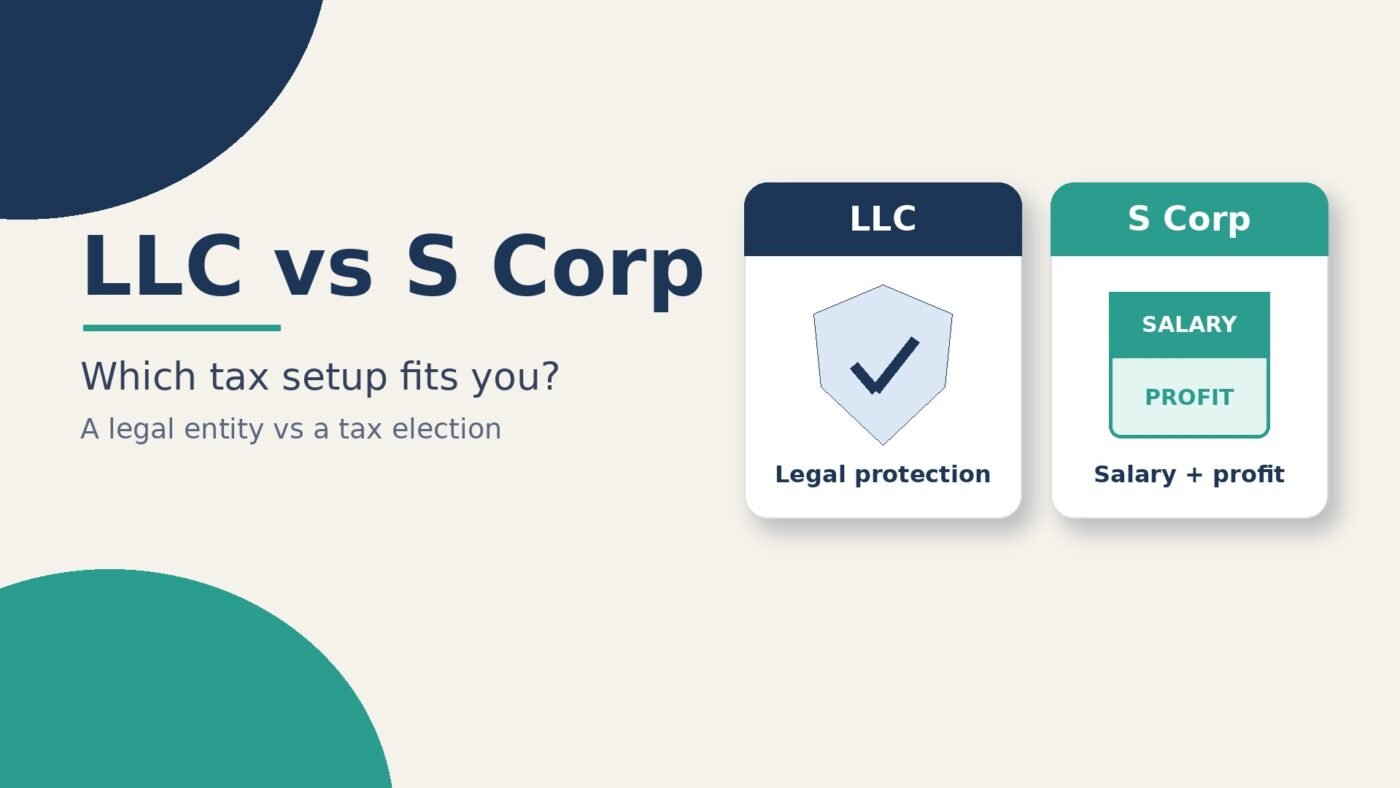
An LLC is a type of business you form with your state. An S corp is a federal tax status that a business, including an LLC, can choose by filing IRS Form 2553. So the real question isn’t “LLC or S corp?” but “should my LLC stay taxed the default way, or be taxed as an S corp?” The S corp option can lower self-employment tax once profits are steady, because you pay payroll taxes only on a reasonable salary instead of on all your profit. In exchange, you take on payroll, extra tax returns and stricter rules.
This guide explains how each option is taxed, walks through a simple example using IRS rates, lists the extra work an S corp brings, and gives you a checklist for deciding when the election is worth it.
Not tax or legal advice: this is general information based on IRS, SSA and SBA guidance for US businesses. State rules differ, and the right choice depends on your numbers, so talk to a tax professional before you file an election.
LLC vs S corp at a glance
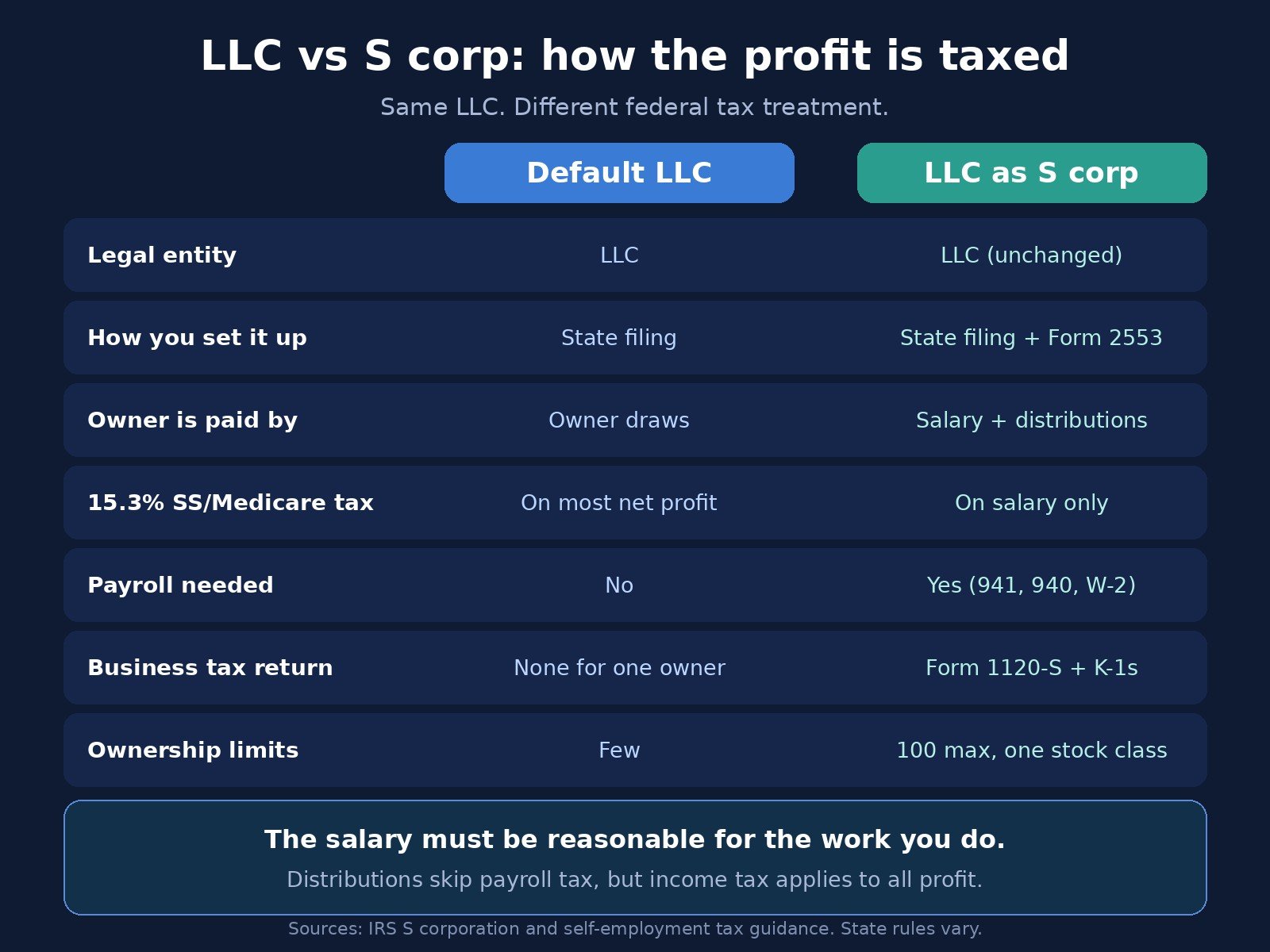
| LLC (default tax treatment) | LLC taxed as an S corp | |
|---|---|---|
| What it is | A legal entity formed under state law | The same LLC, with an S corporation tax election |
| How you set it up | File articles of organization with your state | Form the LLC, then file IRS Form 2553 |
| Liability protection | Yes, in most instances | Same as the LLC: the election doesn’t change it |
| Federal income tax | One owner: Schedule C on your return. Two or more: partnership return | Form 1120-S for the business, K-1s to owners, income on your personal return |
| Self-employment / payroll tax | 15.3% self-employment tax on most of your net profit | Payroll taxes on your salary only; remaining profit isn’t subject to them |
| How you get paid | Owner draws whenever you like | A reasonable salary through payroll, plus distributions |
| Ownership rules | Few limits: any number of members | Max 100 shareholders, one class of stock, no corporate, partnership or nonresident alien owners |
| Paperwork | Lightest | Payroll filings, W-2s and an extra business tax return |
What is an LLC?
A limited liability company is a business structure created under state law. The SBA says an LLC protects you from personal liability in most instances, so your house, car and savings generally aren’t on the line if the business is sued or can’t pay its debts.
For federal taxes, an LLC has no tax category of its own. The IRS says a single-member LLC is treated as disregarded as separate from its owner by default, and an LLC with two or more members is classified as a partnership, unless it elects otherwise. In practice, a one-person LLC is taxed just like a sole proprietorship. (If you haven’t formed one yet, see our guide on how to start an LLC.)
What is an S corp?
An S corporation is a tax classification, named after Subchapter S of the Internal Revenue Code. The IRS describes S corporations as corporations that elect to pass corporate income, losses, deductions, and credits through to their shareholders, who then pay tax at their individual rates. That avoids the “double taxation” a regular C corporation faces.
The key point for LLC owners: you don’t need to form a corporation to get S corp taxation. The IRS says an LLC may elect to be classified as an S corporation by filing Form 2553, as long as it meets the S corporation requirements. Your LLC stays an LLC under state law; only its federal tax treatment changes.
How LLC and S corp taxes differ
Default LLC: self-employment tax on most of your profit
As the owner of a default-taxed LLC, you pay self-employment tax, which is Social Security and Medicare for people who work for themselves. The IRS puts the rate at 15.3%: 12.4% for Social Security and 2.9% for Medicare. For 2026, the Social Security part applies to the first $184,500 of earnings; the Medicare part has no cap. The amount subject to the tax is generally 92.35% of your net earnings from self-employment.
The important detail is that this applies to your profit, whether you leave the money in the business or take it out. Every dollar of net profit is treated as your earnings.
S corp: salary plus distributions
With an S corp election, you become an employee of your own company. The profit is split into two parts:
- Salary (wages): paid through payroll, with Social Security and Medicare tax withheld and matched, just like any job.
- Distributions: the profit left over after salary and expenses. It still flows to your personal return for income tax, but it isn’t wages, so it doesn’t pay Social Security and Medicare tax.
That split is the entire source of the savings. Income tax still applies to all of the profit either way.
A simplified example
Here’s a rough illustration using the IRS rates above. It is not a projection for your business, and it ignores income tax effects, deductions, state taxes and the cost of running payroll.
| Assumption: $100,000 net profit, one owner | Default LLC | LLC taxed as S corp, $60,000 salary |
|---|---|---|
| Amount subject to Social Security and Medicare tax | $92,350 (92.35% of profit) | $60,000 (the salary) |
| Tax at 15.3% | About $14,130 | About $9,180 (half paid by the company, half withheld) |
| Difference | About $4,950 less in payroll-type taxes with the S corp, before its extra costs | |
Two things shrink that gap in real life. First, the salary has to be reasonable for the work you do (more on that below), so you can’t set it at $20,000 to save more. Second, an S corp costs money to run: a payroll service, an extra business tax return and possibly state fees or taxes. Those costs are roughly fixed, which is why the election tends to make sense only once profits are high enough to outweigh them.
The reasonable salary rule
This is the rule that trips up the most S corp owners. The IRS says S corporations must pay reasonable compensation to a shareholder-employee for their services before making non-wage distributions. It also has the authority to reclassify distributions as wages, which brings back the employment taxes, and courts have backed that up.
There’s no fixed percentage. The IRS lists factors such as your training and experience, your duties, the time you put in, what comparable businesses pay for similar services, and what you pay non-owner employees. A useful way to think about it: if your profit comes mostly from your own personal work, like consulting, design or coding, most of it is probably payment for services. The IRS notes that receipts generated by other employees or by capital and equipment are more fairly treated as distributions.
A practical approach is to document how you picked your salary, for example with salary data for your role and region, and keep that note with your tax records.
The extra costs and paperwork of an S corp
Here’s what you take on with the election, based on the IRS’s S corporation filing requirements:
- Payroll: withholding on your salary, payroll tax deposits, quarterly Form 941 and annual Form 940 for federal unemployment tax, plus W-2s each year. Most owners pay a payroll service or an accountant to handle this.
- A business tax return: Form 1120-S, with a Schedule K-1 for each owner. You then report your share on Schedule E of your personal return.
- Estimated taxes: payroll withholding covers your salary, but you may still owe quarterly estimated taxes on your distributions.
- Health insurance handling: premiums for an owner holding more than 2% of the company are reported as wages on your W-2, under the IRS rules for 2-percent shareholder-employees, to keep the deduction.
- State rules: some states and cities tax S corporations at the entity level or treat the election differently. Check your state’s tax department before you elect.
Who can be an S corp?
Not every LLC qualifies. According to the IRS, to be an S corporation a business must:
- Be a domestic corporation (or an eligible entity, like an LLC, taxed as one).
- Have only allowable shareholders: individuals, certain trusts and estates. Partnerships, corporations and nonresident aliens can’t be shareholders.
- Have no more than 100 shareholders.
- Have only one class of stock.
- Not be an ineligible type of company, such as certain banks and insurance companies.
The one-class-of-stock rule matters for multi-member LLCs. In plain terms, owners generally need identical rights to distributions, so distributions follow ownership percentages. If your operating agreement gives one partner a special share of profits, talk to a professional before electing.
When does an S corp election make sense?
Use this as a starting checklist, not a final answer.
Staying a default LLC usually makes sense if:
- Your profit is modest, or you’re still testing a side hustle. The fixed costs of payroll and an extra return can eat any savings.
- Your income swings a lot from month to month, so a regular salary would be hard to keep up.
- You want the simplest setup: one Schedule C, no payroll.
- You have an owner who couldn’t be an S corp shareholder, such as a nonresident alien or another company.
Electing S corp status is worth a look if:
- Your business makes steady profit well above what a reasonable salary for your role would be.
- You’re comfortable running payroll, or already pay an accountant.
- Your state doesn’t take back most of the savings with its own taxes.
- All owners meet the eligibility rules and agree to sign the election.
Many side hustlers start with a default LLC, or even a sole proprietorship (see DBA vs LLC), and revisit the S corp question once their profit is consistent. Ask a tax professional to run your real numbers, including the income tax side, before you decide.
How to elect S corp status for your LLC
- Form the LLC and get an EIN. The EIN is free from the IRS; see how to apply for an EIN online.
- Confirm you qualify using the eligibility list above, and check your state’s treatment of S corporations.
- File Form 2553. The IRS says all shareholders must sign it. An LLC that files Form 2553 is treated as electing corporate status too, so per the Form 2553 instructions it doesn’t need to file Form 8832 separately.
- Watch the deadline. The instructions say to file no more than 2 months and 15 days after the beginning of the tax year the election is to take effect, or any time during the preceding tax year.
- Set up payroll and start paying yourself a reasonable salary.
- File Form 1120-S each year and issue K-1s.
Missed the deadline? The IRS may grant relief for a late election if you had reasonable cause and file within 3 years and 75 days of the intended effective date, among other conditions.
LLC vs S corp vs C corp
A C corporation is the default tax treatment for a regular corporation, and an LLC can also choose it by filing Form 8832, according to the IRS. A C corp pays tax on its own profit, and shareholders pay tax again on dividends, which is the double taxation an S corp avoids. C corps have no 100-shareholder limit and can issue more than one class of stock, which is why startups planning to raise outside investment often choose them. For most solo owners and small teams, the real choice is between a default LLC and an LLC taxed as an S corp.
Common mistakes to avoid
- Thinking an S corp is a different kind of company. It’s a tax election. Your LLC’s liability protection, name and bank account stay the same.
- Paying yourself a tiny salary. The IRS can reclassify distributions as wages and assess the payroll taxes you skipped.
- Taking money without running payroll. Once you elect, money for your work should go through payroll as salary first.
- Electing too early. If profit is low, the extra costs can be more than the tax savings.
- Uneven distributions in a multi-owner LLC. This can clash with the one-class-of-stock rule.
- Mixing personal and business money. Keep one business account and send invoices in the company’s name.
LLC vs S corp: frequently asked questions
Is an S corp better than an LLC?
Neither is better in general, because they aren’t the same kind of thing. An LLC is a legal entity, and an S corp is a tax election an LLC can make. Electing S corp status can reduce Social Security and Medicare tax once profits are steady and well above a reasonable salary, but it adds payroll and an extra tax return.
Can an LLC be taxed as an S corp?
Yes. An eligible LLC can elect S corporation tax treatment by filing IRS Form 2553, signed by all owners. It stays an LLC under state law, keeps its liability protection, and is taxed as an S corporation for federal purposes.
How does an S corp save on taxes?
The owner is paid a reasonable salary through payroll, which pays Social Security and Medicare tax, and the remaining profit is paid as distributions, which don’t. In a default LLC, the owner pays the 15.3% self-employment tax on most of the net profit instead.
What is a reasonable salary for an S corp owner?
There’s no fixed number. The IRS says it should reflect what you’d pay someone for the same services, based on factors such as your duties, experience, time spent and what comparable businesses pay. Document how you set it.
When is the deadline to elect S corp status?
File Form 2553 no more than 2 months and 15 days after the start of the tax year the election should take effect, or at any time during the year before. Late-election relief may be available within 3 years and 75 days if you had reasonable cause.
Does an S corp election change my liability protection?
No. Liability protection comes from the LLC under state law. The S corp election only changes federal tax treatment.
Can a single-member LLC be an S corp?
Yes. A one-owner LLC can elect S corporation status as long as the owner is an allowable shareholder, such as a US citizen or resident individual. The owner then becomes an employee of the company and takes a salary through payroll.
The bottom line
The LLC vs S corp decision isn’t a choice between two business types. Form an LLC for liability protection, then decide how it should be taxed. Default LLC taxes are simple but put self-employment tax on most of your profit. An S corp election limits payroll taxes to a reasonable salary, at the cost of payroll, extra filings and stricter ownership rules. If your profit is steady and well above a fair salary for your work, ask a tax professional to run the numbers. This article is general information, not tax or legal advice.

The Teck Hustlers Editorial Team covers technology, business, finance and gaming news for readers who want the story behind the headline. Every article is researched, written and edited by our in-house team, checked against company announcements, filings and reputable reporting, and updated when new facts emerge. We focus on what each development means for founders, professionals, investors and everyday users. Have a tip or a correction? Reach us through our contact page.