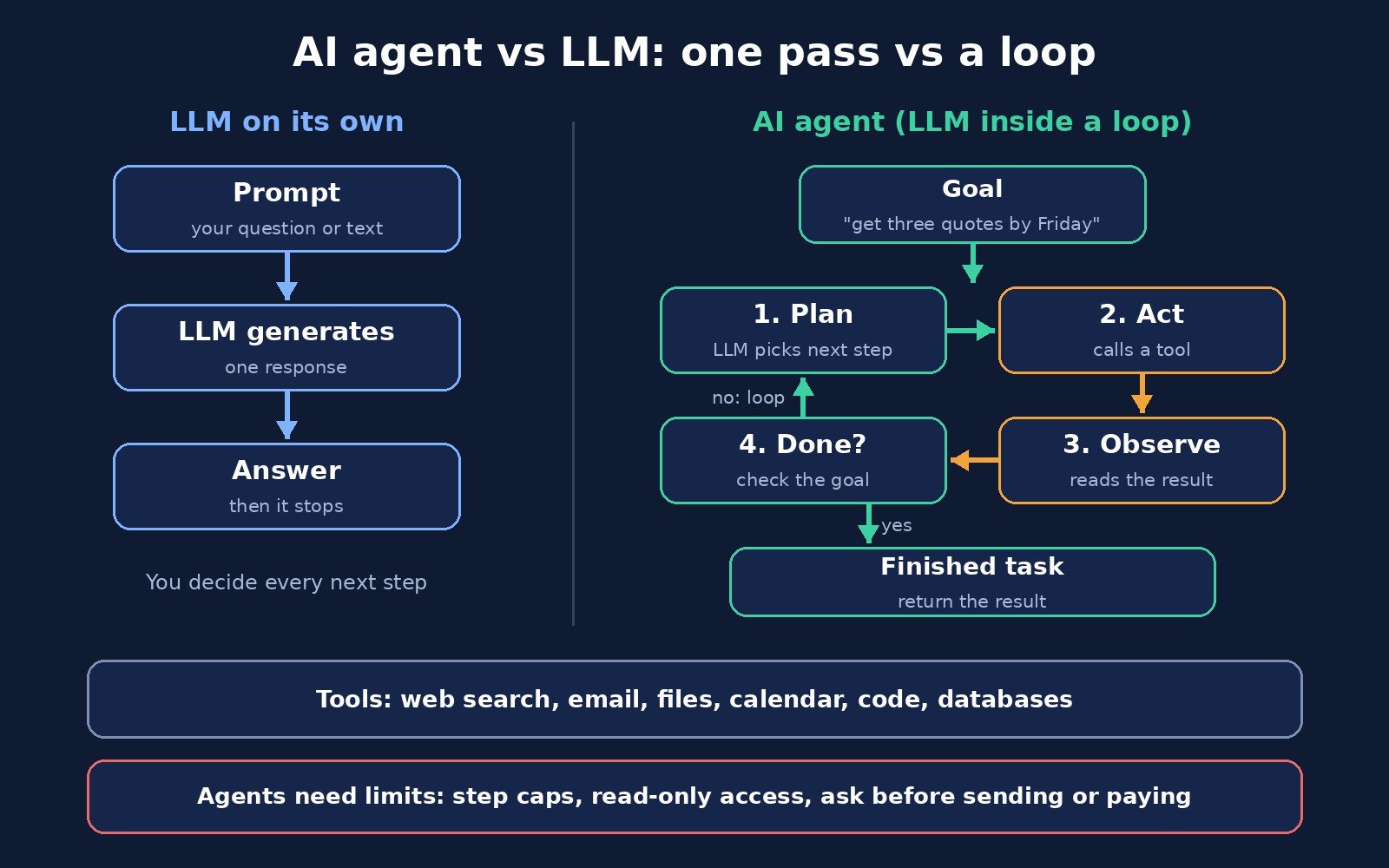
An LLM (large language model) is the AI model itself: you give it text, it writes a response, and it stops. An AI agent is a system built around an LLM that can plan steps, use tools such as web search, email or a database, look at what happened, and keep going until a goal is done. Put simply, an LLM answers and an agent acts. Almost every AI agent you’ll hear about has an LLM inside it doing the thinking, but the LLM on its own can’t click, send, book or check anything.
This guide explains the difference in plain English, walks through the same task handled both ways, shows where chatbots like ChatGPT fit, and helps you decide which one a job actually needs.
AI agent vs LLM at a glance
| LLM | AI agent | |
|---|---|---|
| What it is | A trained model that predicts and writes text | Software that wraps an LLM with tools, memory and a control loop |
| Input | A prompt plus any context you paste in | A goal, such as “find three suppliers and email me a summary” |
| Output | One response (text, code, a summary) | A finished task, plus a record of the steps it took |
| How it works | One pass: read, generate, stop | A loop: plan, act, check the result, decide the next step |
| Tools | None on its own | Can call search, APIs, files, calendars, code and more |
| Memory | Only what fits in the current context window | Can store notes and state between steps or sessions |
| Who decides the next step | You, every time | The agent, within the limits you set |
| Typical cost and speed | One model call, fast and cheap | Many model calls, slower and more expensive |
| Main risk | A wrong or made-up answer | A wrong action, and mistakes that build on each other |
What is an LLM?
A large language model is a neural network trained on huge amounts of text to predict the next word (more precisely, the next token). That simple skill, done at scale, lets it summarize, translate, draft emails, explain code and answer questions. If you want the full picture of how that works, read our explainer on what a large language model is.
The important thing for this comparison is what an LLM does not do on its own. As JetBrains puts it, the model itself is stateless: each request is independent. It doesn’t remember your last conversation unless the app sends that history back in, it can’t open a website, and it can’t run code or send a message. Everything it knows in the moment has to fit inside its context window.
That makes an LLM a very capable writer and reasoner that is stuck in a room with no doors. You slide a note under the door, it slides an answer back.
What is an AI agent?
An AI agent is a program that gives the LLM doors. It adds tools the model can call, a place to keep notes, instructions about the goal and its limits, and a loop that keeps running until the job is finished or the agent hits a stopping point.
Anthropic, the company behind Claude, gives one of the clearest definitions in its guide Building effective agents. It describes agents as systems where LLMs “dynamically direct their own processes and tool usage, maintaining control over how they accomplish tasks.” It also says that in practice agents “are typically just LLMs using tools based on environmental feedback in a loop.”
That last phrase is the whole idea. The LLM is still the brain. The agent is the brain plus a body that can act and a habit of checking its own work before moving on. For a broader non-technical overview, see what agentic AI is.
The loop is the real difference
The easiest way to see the gap is to give both the same request: “Find me three local print shops that can do 500 flyers by Friday, and draft an email asking each for a quote.”
What a plain LLM does
A standalone model reads the request and writes one response. It can draft a good quote-request email. It might suggest what to look for in a print shop. But it can’t search for shops near you, so any names it gives come from its training data, may be out of date, and could be made up entirely (that’s an AI hallucination). You’d still do the searching, checking and sending yourself.
What an AI agent does
An agent with search and email tools treats the request as a goal and works through it:
- Plan. Break the goal into steps: search for print shops, check which offer flyers and fast turnaround, pick three, find contact emails, write drafts.
- Act. Call a web search tool with a query it writes itself.
- Observe. Read the results. Maybe one shop’s site says it’s closed for renovations.
- Adjust. Drop that shop, search again, and check the next one’s services page.
- Finish. Write three tailored drafts and hand them to you, ideally for approval before anything is sent.
Anthropic stresses that at each step an agent needs to get “ground truth” from its environment, such as tool results, to judge its progress, and that agents usually include stopping conditions like a maximum number of steps so they don’t run forever. That check-and-continue cycle is what a plain LLM call simply doesn’t have.
Chatbot, workflow or agent? Where tools like ChatGPT fit
People often say “LLM” when they mean the chatbot app they use, and that’s where much of the confusion comes from. It helps to think of four levels:
- The raw LLM. The model behind the app. Text in, text out.
- A chatbot. An app around the LLM that keeps your conversation history and sends it back each turn, so it feels like it remembers. Many chatbots now also have built-in tools like web search, file reading or image generation. That’s what Anthropic calls an “augmented LLM”: a model enhanced with retrieval, tools and memory.
- A workflow. A fixed sequence of LLM calls and tools that a developer wired up in advance, such as “summarize this support ticket, classify it, then route it to the right team.” Anthropic defines workflows as systems where LLMs and tools are “orchestrated through predefined code paths.” Prompt chaining is a common example.
- An agent. The model decides the steps itself, picks which tools to use, and loops until the goal is met.
So a chatbot like ChatGPT, Claude or Gemini is not just an LLM, but in a normal back-and-forth chat it isn’t fully an agent either. You still decide each next step. When those same products offer modes where you hand over a task and the assistant browses, runs code or works through steps on its own, they’re acting as agents. The line is less about the brand name and more about who is steering: you, a fixed script, or the model.
If you’ve seen the term “agentic AI” next to “generative AI,” it’s the same distinction at a bigger scale. Our guide to agentic AI vs generative AI covers that side.
What an agent adds on top of the LLM
Different agent products are built differently, but most combine the same parts around the model:
Tools
Functions the model can ask the system to run: search the web, read a spreadsheet, query a database, send a message, create a calendar event, run code. The LLM doesn’t execute these itself. It writes a structured request, the agent software runs the tool, and the result is fed back to the model. Standards like the Model Context Protocol make it easier to plug tools in; see what MCP is in AI.
Memory and state
A record of what has happened so far in the task, plus, in some agents, longer-term notes saved between sessions. This is often stored outside the model, for example in a vector database, and pulled back in when relevant, the same idea behind RAG.
Instructions and planning
A system prompt that defines the goal, the tone, the tools allowed and the rules, plus the model’s own step-by-step plan for the task.
Guardrails and human checkpoints
Limits on what the agent may do, such as read-only access, spending caps, a maximum number of steps, or a rule that it must ask before sending, paying or deleting anything. Anthropic notes that agents can pause for human feedback at checkpoints or when they hit blockers.
The downsides of agents
Agents sound strictly better, but they come with real trade-offs, and the companies building them say so plainly.
- Cost and speed. One task can mean many model calls and tool calls. Anthropic writes that agentic systems “often trade latency and cost for better task performance.”
- Compounding errors. A wrong turn early on can lead the agent down a path of further wrong steps. Anthropic lists “the potential for compounding errors” as a direct result of agents’ autonomy and recommends testing them in sandboxed environments with guardrails.
- Real-world consequences. A bad LLM answer is just text you can ignore. A bad agent action might send an email, change a file or place an order.
- Harder to predict. Because the model picks its own steps, two runs of the same task can go differently.
That’s why Anthropic’s own advice is to find the simplest solution that works and only add complexity when needed, noting that for many applications a single well-built LLM call with retrieval and examples “is usually enough.”
Which one do you need?
For most people, small businesses and side hustlers, the honest answer is: start with the LLM, and reach for an agent only when the task clearly needs one.
A plain LLM or chatbot is enough when:
- You want a draft, summary, rewrite, explanation or list of ideas.
- You can paste in all the information the model needs.
- You’ll review the output and do any follow-up actions yourself.
- The task is one step, or a few steps you’re happy to guide.
A workflow fits when:
- You do the same multi-step job the same way every time, like turning a form submission into a tagged CRM entry and a reply draft.
- You want predictable results you can test.
An agent is worth it when:
- The task needs information the model doesn’t have and has to go find.
- You can’t know the steps in advance, because they depend on what it finds.
- Success is easy to check, such as code that passes tests or a ticket that gets resolved.
- You can give it limited permissions and review anything risky before it goes out.
Anthropic points to customer support and coding as areas where agents have worked well, since both mix conversation with action and have clear ways to measure success. For more real-world examples of where agents and workflows earn their keep, see agentic AI workflow examples.
Frequently asked questions
Is an AI agent the same as an LLM?
No. An LLM is the language model that reads and writes text. An AI agent is a larger system that uses an LLM to decide what to do, then calls tools, checks the results and repeats until a goal is reached. The LLM is one part of the agent.
Can an AI agent work without an LLM?
Yes, in the older sense of the word. “Agent” has long meant any software that senses and acts toward a goal, including rule-based bots. Today, though, when people say “AI agent” they almost always mean an agent that uses an LLM to plan and decide.
Is ChatGPT an LLM or an AI agent?
ChatGPT is a chatbot app built on top of OpenAI’s LLMs. In a normal chat it behaves like an LLM with memory of the conversation and some tools. When it is given a task it carries out on its own, such as browsing and completing several steps, it is acting as an agent.
What is the difference between an AI agent and a chatbot?
A chatbot replies to each message you send, and you decide what happens next. An AI agent takes a goal and decides the next steps itself, using tools to take actions and checking the results before continuing. Many chatbots now include agent modes.
Are AI agents more accurate than LLMs?
Not automatically. Agents can check facts with tools and retry after errors, which helps. But they can also chain mistakes together across many steps. Accuracy depends on good tools, clear limits and human review of important actions.
Do I need to code to use an AI agent?
Not always. Many AI assistants and business apps now include built-in agent features you switch on in settings. Building a custom agent that connects to your own systems usually still needs some setup or developer help.
The bottom line
An LLM is the engine: it understands your words and writes a reply, then stops. An AI agent is the car built around that engine: tools to act, memory to keep track, rules to stay safe, and a loop that keeps going until the job is done. Use a plain LLM or chatbot for writing, summarizing and thinking through problems. Use an agent when a task needs the AI to go and do things, and when you can set clear limits and check its work.

The Teck Hustlers Editorial Team covers technology, business, finance and gaming news for readers who want the story behind the headline. Every article is researched, written and edited by our in-house team, checked against company announcements, filings and reputable reporting, and updated when new facts emerge. We focus on what each development means for founders, professionals, investors and everyday users. Have a tip or a correction? Reach us through our contact page.