
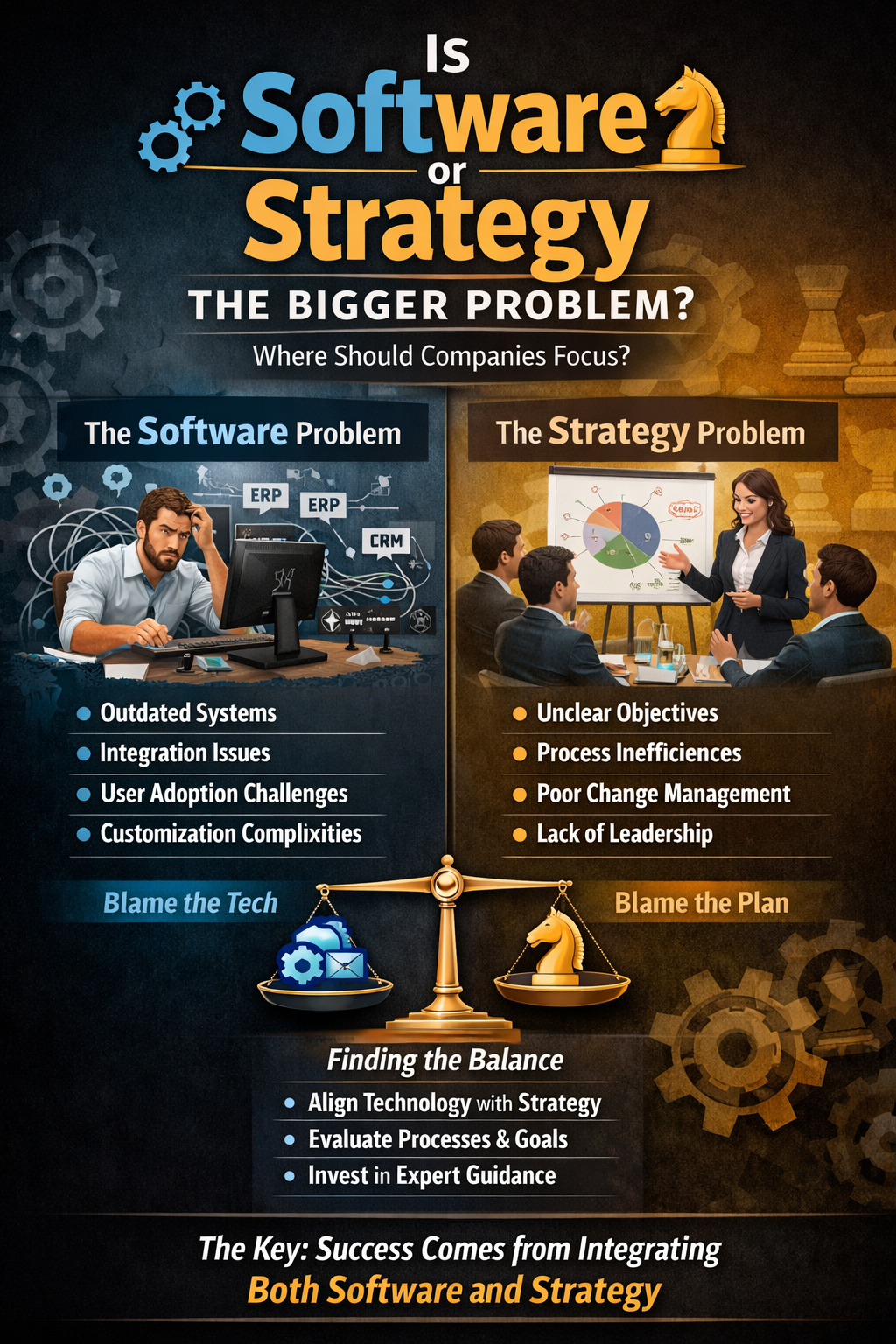
Companies often face a critical challenge: understanding why their operations are not running as smoothly as they should. When inefficiencies arise, fingers often point to technology, perhaps because the software is outdated, glitchy, or poorly integrated. Yet more often than not, the real issue lies elsewhere. Is software truly the problem, or is it strategy? This question has sparked debates in boardrooms, consulting sessions, and IT departments as leaders seek clarity on where to invest time, money, and energy. The answer is not always straightforward, but exploring both sides of the debate provides insight into why many businesses struggle and how they can move forward effectively.
The Software Argument
When a business experiences slow processes, errors, or communication breakdowns, software is usually the first suspect. Enterprise Resource Planning (ERP) systems, customer relationship management tools, and other digital solutions are supposed to streamline operations, reduce manual effort, and provide real-time insights. When they fail to deliver, the consequences are noticeable: wasted resources, frustrated employees, and missed opportunities.
Some common software-related challenges include:
- Complexity: Modern business software can be powerful but complicated. Without proper training, employees may use only a fraction of the available functionality, leading to inefficiencies that are often mistaken for broader strategic failures.
- Integration Issues: Companies rarely rely on a single platform. Multiple systems need to communicate seamlessly, yet integration is often incomplete or poorly executed. When data is siloed, reporting becomes inaccurate, and decision-making suffers.
- Customization and Scalability: Off-the-shelf software rarely fits every company perfectly. Customization may be required, but it comes at a cost and increases the likelihood of errors. Moreover, as companies grow, software may not scale effectively, forcing additional investment or complete system overhauls.
- User Adoption: Technology is only as good as its users. Resistance to change, lack of understanding, or poor onboarding can turn even the most sophisticated software into a roadblock.
At first glance, software appears to be the obvious culprit. Technology problems are immediate and visible, making them easy to blame when things go wrong.
The Strategy Argument
While software challenges are real, they are often symptoms rather than root causes. Many businesses invest heavily in technology but neglect the strategic groundwork necessary for it to succeed. A well-designed ERP system will not fix problems that stem from poor planning, unclear goals, or misaligned processes.
Several strategic factors contribute to business inefficiencies:
- Unclear Objectives: If an organization lacks clear goals or key performance indicators, software can only do so much. Without a roadmap, even the most sophisticated tools cannot prioritize the right tasks or provide meaningful insights.
- Process Misalignment: Technology is meant to support processes, not define them. If workflows are inefficient, overly complex, or outdated, software implementation often magnifies these issues rather than resolving them.
- Change Management: Strategy involves people and processes as much as technology. Without a structured approach to change management, employees may not understand how to use new tools effectively or why they are necessary, leading to underutilization and frustration.
- Leadership and Governance: Strategic direction and oversight are crucial. Organizations lacking strong leadership or governance structures may deploy software haphazardly, creating duplication, confusion, or inconsistent standards across teams.
The strategic perspective suggests that technology problems are rarely isolated. Instead, they often reflect deeper issues in planning, communication, and execution. Companies that jump straight to software solutions without addressing strategy risk repeating the same mistakes in new systems.
Why the Debate Matters
Understanding whether software or strategy is the bigger problem has real implications for budget allocation, project planning, and organizational change. Misdiagnosing the problem can lead to costly mistakes: purchasing expensive software that goes underutilized, investing in consulting services that fail to address root causes, or implementing quick fixes that provide temporary relief but no long-term improvement.
Companies must evaluate their challenges holistically, considering both technology and strategic alignment. Asking the right questions helps uncover the real barriers to efficiency:
- Are our goals clearly defined and measurable?
- Do our processes support these goals effectively?
- Is our software aligned with our strategic needs, or are we forcing workflows to fit the technology?
- Do employees understand and embrace the tools provided to them?
Answering these questions can reveal whether inefficiencies stem from software limitations, strategic misalignment, or a combination of both.
The Role of Technology Consultants
Even with a clear strategy, implementing and optimizing software is rarely straightforward. This is where technology consultants play a pivotal role. Experienced consultants not only help select the right software but also ensure it aligns with organizational goals and processes. They bridge the gap between technology and strategy, guiding companies through complex integrations, user adoption challenges, and long-term planning.
For businesses considering ERP implementation or optimization, experts like Nine Feet Tall provide tailored consulting that goes beyond the software itself. Their approach emphasizes understanding the unique strategic needs of each organization, ensuring that technology serves as a true enabler rather than a temporary fix.
The Interdependence of Software and Strategy
It is tempting to frame software and strategy as opposing forces, but in reality, they are deeply interdependent. Effective strategy amplifies the benefits of technology, while well-designed software supports and informs strategic decision-making. Companies that excel focus on both elements simultaneously.
For example, a retail chain may implement advanced inventory management software. Without a clear strategy around supply chain optimization, store replenishment policies, and sales forecasting, the software cannot deliver maximum value. Conversely, even the most comprehensive strategy will falter if the software infrastructure is inadequate or poorly executed. The key is integration, aligning technological capabilities with strategic objectives, and ensuring that people, processes, and tools work in harmony.
Lessons from Real-World Examples
Many high-profile technology failures illustrate the software-versus-strategy debate. Some companies have invested millions in ERP systems only to abandon them due to lack of strategic clarity or employee adoption. Others have struggled with software limitations despite having strong strategic plans, underscoring the need for the right tools to execute effectively.
The most successful organizations treat software and strategy as two sides of the same coin. They involve cross-functional teams in decision-making, set clear goals, map processes before implementing technology, and continually monitor performance to adjust both strategy and software as needed. This iterative approach minimizes risk and maximizes return on investment.
Moving Forward: Finding the Balance
So, is software or strategy the bigger problem? The answer is rarely one or the other. It is the interplay between the two that determines outcomes. Businesses must resist the temptation to place blame solely on technology or strategic planning. Instead, they should adopt a holistic approach that evaluates processes, people, and systems together.
Practical steps for achieving this balance include:
- Conducting Comprehensive Assessments: Evaluate both technological capabilities and strategic objectives before implementing changes.
- Prioritizing Change Management: Ensure employees understand new tools and processes and feel supported throughout transitions.
- Investing in Expertise: Engage consultants who can navigate both strategic planning and software implementation, ensuring alignment and minimizing disruption.
- Monitoring and Iterating: Continuously measure performance against strategic goals and adjust software or processes as needed.
By treating software and strategy as mutually reinforcing rather than opposing, businesses can avoid costly missteps and position themselves for sustained success.