TL;DR
Pinterest is a visual search engine, not a social feed. It ranks pins on four signals — domain quality, pin quality, pinner quality, and relevance plus engagement (mainly saves and long clicks). Put your keywords in the seven places Pinterest reads them, publish fresh vertical pins (1000×1500, 2:3) consistently, and give it 60–90 days. A ranked pin can drive traffic for months or years.
Why Pinterest Still Matters in 2026
Pinterest reported an all-time high of 661 million monthly active users in Q3 2026, up 10% year over year. Around 96% of Pinterest searches are unbranded, which means people search for ideas, not brand names: a small account can outrank a big one with the right keywords. More than 85% of weekly users say they use Pinterest to plan a new project, 85% of weekly pinners have made a purchase based on a pin they saw, and 80% of weekly users have discovered a new brand or product through Pinterest search — so the traffic it sends arrives with buying and doing intent, not idle scrolling.
Unlike a Reel that dies in 48 hours, a well-ranked pin keeps working. Pinterest itself says content can keep driving impressions for more than three months after posting, and top pins keep generating clicks for years.
How the Pinterest Algorithm Decides What Ranks
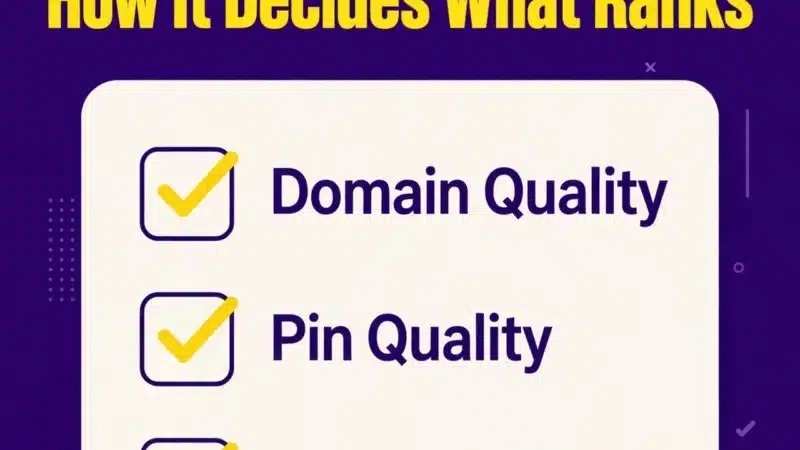
Pinterest ranks pins on four signals:
- Domain quality — how trusted your linked website is. Pins that link to a fast, relevant site people save and click raise the score of every pin you publish after them.
- Pin quality — the image itself plus a complete title, description, and working link.
- Pinner quality — how active and consistent your account is. An account posting 10 fresh pins a week signals reliability far more than one dumping 50 pins once a month and going silent.
- Relevance + engagement — how well your pin’s text matches the search, and how people react: saves are the strongest signal, and “long clicks” (someone spending 35+ seconds on your page after clicking) tell Pinterest the destination was worth it.
No single fix flips your account overnight. The four signals work together.
Pinterest Keyword Research (Do This First)
Before you design anything, find the words people actually type.
- Pinterest Trends (free, in the business dashboard): shows how a term has trended over the past year, plus related terms and seasonal timing. Check your seed keyword there first.
- Search-bar autocomplete: type your seed keyword and write down every suggested completion. Those are real queries, and the colored topic bubbles under the results are more keywords.
- Google cross-check: pinners often type the same long-tail queries into Google first, so a Google search volume above 1,000/month is a reliable sign the keyword has weight on Pinterest too.
Build your list as one primary keyword per pin or article, with 3–5 long-tail variations around it. Long-tail wins on Pinterest: a short keyword like “Pinterest SEO” has everyone competing for it, while a longer phrase like “Pinterest SEO for bloggers” has fewer searches but far less competition — and a much higher chance to rank. For this guide the primary is “how to rank on Pinterest”; the secondaries are “Pinterest SEO”, “Pinterest algorithm 2026”, “Pinterest keyword research”, “Pinterest board SEO”, and “how to get more saves on Pinterest”.
Where to Put Keywords: The Seven Places
Pinterest reads text from seven surfaces. Miss one and you cap your ranking ceiling.
- Profile display name — add your primary keyword after your brand name.
- Profile bio — two sentences, three to five keywords, one call to action with a link.
- Board names — use the exact phrase people search (“Pinterest SEO Tips”, not “My Stuff”).
- Board descriptions — 300–500 characters with natural keyword variants.
- Pin titles — up to 100 characters; the first 40 are the most-read, so lead with the keyword.
- Pin descriptions — up to 500 characters. Aim for 200–400 characters: open with the search query restated naturally, add 2–3 sentences with related keywords, close with the outcome the pin delivers. Put the primary keyword in the first 50 characters — that’s what Pinterest weighs most.
- Image file names + alt text — name the file with the keyword (how-to-rank-on-pinterest-2026.png) and write alt text up to 500 characters describing the image.
Hashtags no longer help discovery on Pinterest, and stuffing several into a description can dilute the keyword signal. Skip them.
Pin Design That Ranks
- Size: 1000×1500 pixels, 2:3 vertical. Square and horizontal pins take less space in the grid and show up less in search. Oversized pins beyond 2:3 have been progressively capped since 2023.
- Text overlay that reads at grid size. Keep it to 4–7 words, big and high-contrast. If the title is unreadable at 236 pixels wide, it won’t get clicked. Put your primary keyword in the on-image headline: Pinterest’s OCR reads the text on your image and treats it as a ranking signal.
- One idea per pin. A pin that tries to say everything says nothing in the feed.
- Fresh images, not repins. The 2026 algorithm prioritizes new, original images over re-saves of the same image — even when the destination URL is the same. Make 3–5 fresh pin designs per article and spread them over 2–3 months, not 10 copies of one.
- Real images over low-effort AI stock. Pinterest now detects AI-generated images and gives users the option to limit GenAI content in their feeds. Original photos and genuinely designed graphics rank better.
Short vertical video (6–15 seconds) also earns higher engagement than static pins — use it for tutorials and before/after content.
Boards: One Board Per Keyword Cluster
Treat your account like a library, not a junk drawer. One board per core keyword cluster, named exactly how people search, with a keyword-rich description. Topical concentration is itself a ranking signal: a board full of Pinterest SEO pins tells Pinterest your account is an authority on that topic.
Start with 5–8 boards around your main topics, and pin every new pin to its most relevant board first. Saving your own pin to a second board later is fine; the first board is the one that counts most.
How Often to Post
5–15 fresh pins per week. Consistency beats volume: 2 pins a day, every day, outperforms 30 pins in one sitting. Fresh pins get a temporary visibility boost, so a steady cadence keeps new pins in circulation while older ones compound.
Expect 60–90 days before you see a real shift. Pinterest traffic is evergreen and slow to start — the pins you publish in month one are the ones paying off in month three.
Claim Your Site and Turn On Rich Pins
Connect your domain and claim your website in Pinterest settings, then enable Rich Pins. Rich Pins pull your article title and meta description directly into the pin, which improves click-through and keeps the information consistent when other people save your content. A claimed, fast-loading site also feeds the domain-quality signal.
Measure What Matters
In Pinterest Analytics, watch saves and outbound clicks per pin — not impressions. Impressions tell you Pinterest showed the pin; saves and clicks tell you it earned its ranking. Check the first 48 hours: save rate in that window is the single highest-weighted early signal. Double down on whatever format and topic earns saves, and remake your best pins as fresh designs every few months. Tag every pin link with UTM parameters (?utm_source=pinterest&utm_medium=social&utm_campaign=pin-name) so Google Analytics 4 shows exactly which pins send sessions — Pinterest’s own numbers undercount clicks.
Mistakes That Kill Rankings
- Keyword-stuffed descriptions that read like tag dumps.
- Square or horizontal pins.
- Repinning the same image over and over instead of fresh designs.
- Linking to slow or irrelevant pages (Pinterest tracks long clicks — a bounce hurts).
- Treating Pinterest like Instagram: pretty pictures with no keywords rank nowhere.
FAQ
How long does it take to rank on Pinterest?
60–90 days for a real shift on a new account. Pins keep ranking for months or years after that.
Do hashtags help on Pinterest?
No. Pinterest has said hashtags no longer boost reach or ranking.
How many pins should I post per day?
1–2 fresh pins a day (5–15 a week) is the sweet spot for most accounts.
Do I need a business account?
Yes — it unlocks Pinterest Trends, Analytics, and Rich Pins, all free.
Can small accounts rank?
Yes. Around 96% of searches are unbranded, so relevance and saves beat follower counts.
Bottom Line
Rank on Pinterest by treating it like a search engine: research the keyword, put it in all seven places, publish fresh vertical pins consistently, and link to pages worth a 35-second visit. Do that for a month and the pins start compounding — that is the whole game.
Sources: Pinterest Q3 2026 results (661M MAU, +10% YoY, all-time high); Pinterest Business data via Sprout Social (96% unbranded searches); Pinterest distribution and pin-performance guidance; Pinterest Trends and Pinterest Predicts 2026.

The Teck Hustlers Editorial Team covers technology, business, finance and gaming news for readers who want the story behind the headline. Every article is researched, written and edited by our in-house team, checked against company announcements, filings and reputable reporting, and updated when new facts emerge. We focus on what each development means for founders, professionals, investors and everyday users. Have a tip or a correction? Reach us through our contact page.