TL;DR: Agility Robotics started trading on the Nasdaq Thursday under the ticker AGLT, becoming the first humanoid robot maker to go public in the United States. The SPAC merger with Michael Klein’s Churchill Capital Corp XI raised $465 million and values the combined company at roughly $2.5 billion, but Agility’s own numbers show a business still years from profitable: $174,000 in revenue against a $362 million loss in the first half of 2026.

Shareholders approved the merger on November 2 with more than 84% of votes cast in favor. The deal closed Wednesday, and shares began trading Thursday morning, with warrants listed separately as AGLTW. Churchill is the same SPAC vehicle run by Michael Klein that took Lucid and Oklo public, and it brought roughly $164 million held in trust plus a $201 million PIPE round priced at $10 a share and led by Foxconn. Agility says it has raised more than $390 million from private investors since it was founded in 2015.
CEO Peggy Johnson, who took over the company in March 2024 after nearly 24 years at Microsoft and a short stint running Magic Leap, used her first public comments to draw a line between Agility and the flashier end of the humanoid robot market. “You don’t see a lot of dancing robots or backflipping robots from Agility,” she said. It’s a pointed line, given that rivals like Boston Dynamics and Figure have built their public image on exactly that kind of demo reel. Johnson’s pitch is closer to a logistics vendor than a robotics showman: a bipedal machine, about 5 feet 9 inches tall, built to walk, bend, and carry totes the way a warehouse associate would.
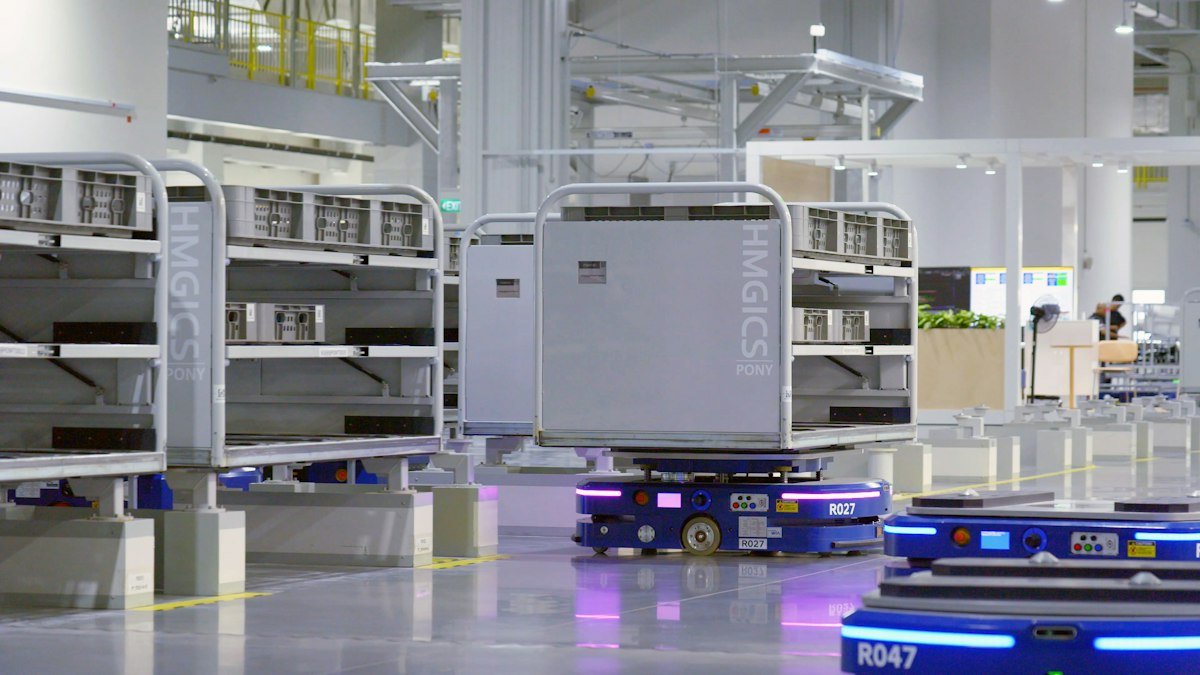
That machine, called Digit, has sold roughly 100 units so far and is running at nine customer sites. GXO has it doing real warehouse work today and plans to expand the deployment to new facilities in Statesville, North Carolina, and Lebanon, Tennessee, starting early next year. Schaeffler is piloting Digit on a manufacturing floor, and Amazon has run its own trials. The newer Digit 5 is designed to operate near people without a safety cage, which is the detail that actually matters for scaling past pilot programs: a robot that needs to be fenced off is a robot that stays in a demo video. Agility is targeting first deliveries of Digit 5 in the first half of 2027, with broader availability by the end of that year.
The company says it already has around $300 million in contracted business lined up for the Digit 5 across roughly 30 customers, including one deal for 1,000 units with payments tied to actual usage over three years. That’s a meaningfully different sales model than a straight equipment purchase, and it’s a bet that customers will pay for robots the way they pay for cloud compute: by the hour of work actually done, not by the unit sitting on the floor.
The financials explain why Agility needed a SPAC instead of a traditional IPO roadshow. Full-year 2025 revenue came in at $1.8 million against a $138.1 million net loss, with roughly $99.8 million burned on operations. More than half that year’s revenue reportedly came from just five robots sold to a single investor, which is not the kind of customer diversification public market investors usually like to see. The first half of 2026 looks worse on paper: $174,000 in revenue against a $362 million loss, a sign that spending on manufacturing and software scaled up well ahead of any matching revenue. Agility is, in effect, asking retail investors to fund the gap between a hardware company’s prototype phase and whatever comes next.
Context matters here too. Privately held rivals are valued far higher than Agility’s $2.5 billion: Figure AI around $39 billion, Neura Robotics around $7 billion, and Apptronik around $5.5 billion. Agility is the smallest name in that group by a wide margin, but it’s now the only one ordinary investors can actually buy shares in, which is a different kind of advantage than the one the valuation numbers suggest. Even Meta, which has no commercial humanoid product to sell, built a humanoid robot prototype with China’s Fourier Intelligence in just three months earlier this month, which says something about how fast the hardware side of this race is moving regardless of who’s actually shipping units. There’s also a geopolitical layer: Omdia estimates Chinese manufacturers accounted for roughly 90% of humanoid robot shipments last year, and the FCC barred new foreign-made advanced robotic devices back in July. A US-listed, US-built humanoid company lands differently in that environment than the balance sheet alone would suggest.
George Chowdhury, an analyst at ABI Research, put the scale question bluntly: “In the grand scheme of things, the deployments are very small, but it’s big for commercial humanoids.” That’s a fair summary of where the category actually sits. Agility’s listing arrives in the same stretch of weeks where Anthropic’s own amended S-1 revealed a $17 billion quarterly run rate and $895 billion in compute commitments ahead of its planned IPO, a reminder of just how far apart “AI company going public” can mean in practice. Agility isn’t playing in that league, and it isn’t trying to.
The bottom line
Going public first is a real milestone, but it isn’t the same thing as winning. Agility’s revenue is tiny, its losses are growing faster than its sales, and its biggest near-term customers can be counted on two hands. What it does have is a ticker symbol, a usage-based pricing model that could scale better than a one-time hardware sale, and a position as the only pure-play humanoid stock a retail investor can buy today. That’s enough to make AGLT worth watching, but not enough, yet, to call it a bet on the winner. The real test comes in 2027, when Digit 5 actually has to ship in volume and GXO, Schaeffler, and whoever signed that 1,000-unit order have to decide whether the robots are worth the money once the SPAC excitement fades.

The Teck Hustlers Editorial Team covers technology, business, finance and gaming news for readers who want the story behind the headline. Every article is researched, written and edited by our in-house team, checked against company announcements, filings and reputable reporting, and updated when new facts emerge. We focus on what each development means for founders, professionals, investors and everyday users. Have a tip or a correction? Reach us through our contact page.