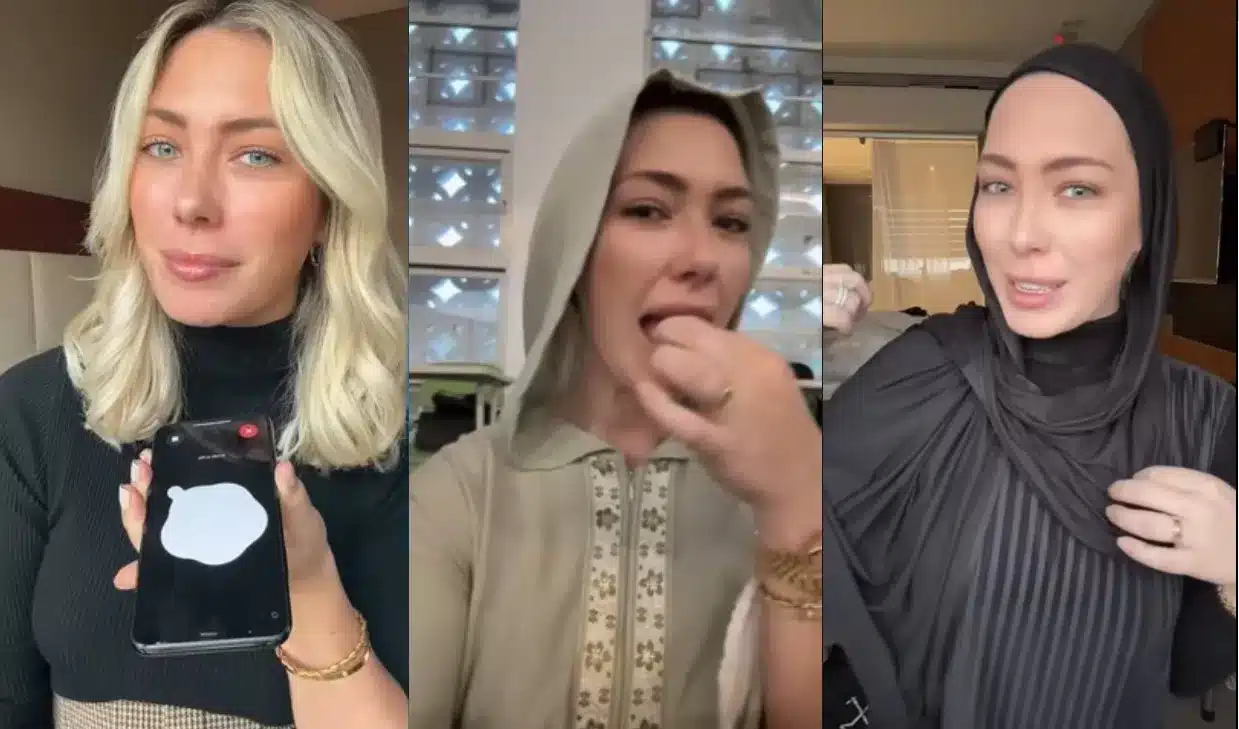
From Queensland theatre stages to one of the most-watched Muslim voices on the internet — the full story of Lily Jay’s journey from atheism to Islam, the role ChatGPT played in her conversion, and the foundation she built to give her platform purpose.
Lily Jay at a glance — the headlines of a remarkable two-year transformation.
Some stories slip through the algorithm and become movements. Lily Jay’s is one of them. In April 2025, an Australian actress and performer who had spent nineteen years as a self-described atheist sat down in front of a camera, pressed record, and recited the Shahadah — the Islamic declaration of faith — at the end of Ramadan. Within months, the video had been viewed by tens of millions of people, her follower count crossed five million, and conversations she started about purpose, doubt, and meaning were happening in mosques, on podcasts, and in WhatsApp groups across Pakistan, Indonesia, Malaysia, the UK, and Australia.
This is a guide to who Lily Jay actually is. It covers her career before Islam, the questions that led her to start exploring religion, the unusual role ChatGPT played in her research, the moment of her conversion, the family reaction she’s documented openly, and the humanitarian foundation she launched in late 2025. Most of what you’ll find online about her is fragmentary — TikTok clips, Threads posts, Instagram reels. This article puts the full picture together using her own statements, interviews, and the platforms where her story has actually been told.
If you’re a new Muslim, a curious non-Muslim, a Pakistani reader who’s seen her name trending, or someone trying to understand why so many Western converts are speaking up about Islam in 2025–2026, her story is worth knowing in detail. Here it is.
Who Is Lily Jay? Background and Early Life
@real.lilyjay See you in the afterlife! 😎 #islam #christianity #religion #afterlife #religiousdebate #faith
Lily Jay is an Australian actress, performer, and content creator from Queensland, on Australia’s east coast. Before her conversion, she was best known in Australian entertainment circles for her work in musical theatre, television, and film. She was raised in a non-religious household, identified as atheist for most of her young adult life, and spent close to two decades — nineteen years, by her own count — outside any religious tradition before she began the process of converting.
Her early career was performance-focused. She trained in dance, acting, and singing, and moved through Australia’s musical theatre circuit before transitioning into screen work. Productions she’s appeared in include:
- Chicago — the Kander and Ebb musical, in which she had a stage role
- Hairspray — the John Waters–derived musical comedy, another stage credit
- Dance Academy — the popular Australian teen drama series, where she had a supporting role
- The Great Gatsby — Baz Luhrmann’s 2013 adaptation, where she appeared in supporting work during the Sydney filming
- Pirates of the Caribbean: Dead Men Tell No Tales — the 2017 Disney franchise installment
She was, by any reasonable measure, a working performer with a respectable resume. The trajectory looked straightforward: more theatre, more screen credits, the slow building of a career on the periphery of Australia’s film and television industry. But Lily has spoken in multiple videos about how that career, while real, never felt like enough on its own. Behind the public persona of an actress and performer, she has said, was someone wrestling with bigger questions — about meaning, purpose, and what life is actually for.
From Stage to Shahadah: A Timeline
@real.lilyjay I’m trying to recite Al-Fatiha. It was a nice attempt! ✨📖 #lilyjay #alfatihah #pray
Lily Jay officially embraced Islam in April 2025, at the end of the holy month of Ramadan. She posted a video of her Shahadah (declaration of faith) titled.Lily’s journey from atheist Australian performer to viral Muslim creator didn’t happen in a straight line. It unfolded across years of private questioning, months of research, weeks of practice, and a single public moment that changed everything.
The arc of her path — from a non-religious Queensland childhood to leading a humanitarian foundation by late 2025.
The childhood phase is straightforward: a non-religious upbringing, a period as an atheist that ran from her teens through her twenties, and a creative life rooted in performance rather than belief. Her own framing is honest about this period — she didn’t reject religion bitterly, she just didn’t engage with it. Religion, for her, was something other people did.
The career years deepened this disconnect. Theatre and film cultures, particularly the strands she worked in, tend toward secular humanism and progressive politics rather than active religious practice. Lily has said that nothing in her professional life pushed her toward faith — if anything, it pushed her further from it. The shift, when it came, was internal.
That shift began with what she’s described in TikTok videos as a deepening sense that something was missing. The standard atheist answers to the standard existential questions — why we’re here, what happens at death, whether there’s any meaning beyond what we manufacture for ourselves — stopped feeling sufficient. She started reading. She started asking questions. And in late 2024, she started doing something nobody had really done at this scale before: she started using ChatGPT to compare what different religions actually taught.
The Five Questions That Led Her to Islam
Lily has spoken in detail across her TikTok and YouTube content about the specific questions she was wrestling with during the year before her conversion. Five of them came up repeatedly.
The existential questions Lily Jay says Islam answered for her in ways no other framework had.
These weren’t novel questions — they’re the same ones that have driven religious inquiry for millennia. What was different was the framing. As a former atheist who’d been satisfied with secular answers for nineteen years, Lily was approaching them not from inherited faith but from genuine intellectual curiosity. She wanted answers that could survive examination, not answers that required her to switch off her skepticism.
The Tawheed concept — the radical oneness of God in Islamic theology — was, by her own account, the single biggest factor. In her words: there’s no Trinity to make sense of, no incarnation, no mediator, no saints to appeal to. One God, accessible directly, with the Quran as the preserved word and the Prophet Muhammad (PBUH) as the messenger and human exemplar. Lily described this in a series of videos as the moment something clicked. Other religious frameworks, she said, felt cluttered by comparison.
The eschatology — the Islamic teaching about death, judgment, and the afterlife — was the second major piece. The framework provides a coherent answer to what happens after death: there’s a real accounting, real consequences, real paradise and real hell, real responsibility for the choices made in this life. For someone who’d spent nearly two decades operating under the assumption that death is simply the end, the structural completeness of Islamic teaching on this question was, in her words, “clarity I’d never gotten from anywhere else.”
The framework for ethics and daily life — the Five Pillars, the Quran as moral guidance, the example of the Prophet Muhammad (PBUH) — provided what she calls “a structured way of living.” Most religious converts emphasize how their new faith liberated them. Lily emphasizes the opposite: she found freedom in the structure, not in the absence of it. The discipline of five daily prayers, the community built into Friday prayers, the annual reset of Ramadan — these weren’t burdens. They were what she’d been missing.
How ChatGPT Played a Role in Her Conversion
This is the part of Lily’s story that went viral first, before her conversion did. The narrative of “woman becomes Muslim because of ChatGPT” — exaggerated and incomplete as it is — captured attention from secular and religious audiences alike. The actual story is more interesting than the headline suggests.
Where AI helped her religious research, where it didn’t, and what she now tells other seekers.
Lily was clear in multiple videos: ChatGPT didn’t convert her. What it did was function as an always-available, judgment-free study companion during a period when she had questions but didn’t yet have a teacher, didn’t know which sheikh to ask, and didn’t want to commit to a religious community before she’d done her own work. She used the tool to compare doctrines side-by-side, to define unfamiliar Arabic terminology, to translate Quranic verses with context, and to ask the kind of “what would a Muslim say to this hypothetical” questions that would have felt awkward in a real human conversation while she was still skeptical.
Her video that named ChatGPT in the title — “Lily Jay becomes Muslim after ChatGPT confirms Islam is the truth!” — was, on closer inspection, less about the AI and more about her process of intellectual inquiry. She didn’t take ChatGPT’s word as authoritative; she used it as a research tool, then verified what she learned against the Quran itself, against scholarly Islamic sources, and eventually against conversations with actual Muslim teachers.
The advice she now gives to other seekers reflects this nuance. Use AI to learn — start there if it’s useful — but verify everything against scholars and primary sources. ChatGPT, in her telling, is a starting point, not a destination. “Don’t be afraid to use modern tools,” she’s said in multiple videos, “but always cross-reference what you learn with real scholars and the Quran itself.”
The respected Indonesian-American Imam Shamsi Ali — one of the prominent Islamic scholars who publicly recognized Lily’s conversion — has commented on this aspect of her story specifically. AI tools, he’s noted, can supplement religious learning when used thoughtfully, but they can’t replace the relationship between teacher and student that Islamic scholarship has been built on for fourteen centuries. Lily’s own framing aligns with this. She used ChatGPT. Then she found teachers.
Her Shahadah: The Moment of Conversion
Lily officially embraced Islam in April 2025, at the end of the holy month of Ramadan. She posted a video on her TikTok account titled “A Shahadah Experience That Changed My Life” that documented the moment. The video shows her, visibly emotional, reciting the testimony of faith that formally enters a person into Islam:
“I bear witness that there is no god but Allah, and I bear witness that Muhammad is the messenger of Allah.”
— The Shahadah, which Lily Jay recited in April 2025
The Shahadah is the first of the Five Pillars of Islam. It’s the simplest and shortest of them — just two declarations, recited with sincere belief and intention — but it’s also the doctrinal foundation everything else rests on. In Islamic teaching, anyone who recites the Shahadah with genuine belief and understanding becomes a Muslim from that moment. Lily’s video captured the recital live.
The video resonated enormously. Within hours of posting, it was being shared across TikTok, Instagram, and YouTube; within days, it had crossed millions of views; within weeks, thousands of people in the comments and shares were posting their own conversion stories — Westerners, secular-raised young people, former Christians and atheists who said Lily’s openness had pushed them to take their own questions about Islam more seriously. Whatever the algorithm thought it was promoting that day, what it actually surfaced was a moment of genuine religious feeling that other people recognized in themselves.
Lily later spoke about what the moment itself felt like. She described an emotional release — months of research, reading, doubt, and prayer compressed into a few seconds of declaration. She also described the awareness that everything in her life would now be organized differently: how she dressed, what she ate, how she structured her days, how she introduced herself to people. The Shahadah was a single point. The change it triggered was much larger.
How Her Family Reacted
Telling her family was one of the most difficult steps.
In multiple videos posted in mid-2025, Lily shared how anxious she felt before having that conversation. Her family didn’t come from a religious background, which made the uncertainty even greater.
But their reaction surprised her.
Her parents respected her decision, even though they didn’t share her beliefs. Some of her siblings became curious, asking thoughtful questions about Islam and what it meant to her. No one tried to stop her or pressure her to change her mind. She later described their response as “the kind of love I wasn’t sure I’d get.”
This support became a key part of her early journey.
Over time, her personal transformation began to influence those closest to her. Her husband, who initially observed quietly, started noticing positive changes in her character—more patience, discipline, and purpose. Instead of being pressured, he explored Islam on his own terms. His curiosity eventually led to conviction, and he accepted Islam, turning their relationship into a shared spiritual journey.
Her daughter, Aminah—an international model—also underwent a powerful transformation. After accepting Islam, she took a significant step in early 2026 by performing Umrah in Makkah and Madinah. The experience deeply impacted her, marking a shift from a fast-paced modeling life to a more faith-centered path. Her journey became widely discussed online, with many inspired by her change.

At the same time, Lily’s story includes profound loss.
Her brother, known as Aussie, also accepted Islam after becoming curious about her journey. He began learning deeply and even took part in da’wah, encouraging others to understand the faith. During this period, he traveled to Vietnam, but his health deteriorated. He was brought back and hospitalized, where he continued battling cancer.
Before his passing, he left Lily with a powerful final message: to continue spreading Islam and helping people in need.
His death was a deeply emotional moment, but it also strengthened the family’s connection to faith. His words became a lasting source of purpose in Lily’s life.
A Story That Resonates Beyond One Family
Lily’s experience challenges the common stereotype that families always react negatively to conversion. While that does happen, her story shows another reality—one where respect, curiosity, and love can exist even without shared beliefs.
At the same time, she remains honest. Not every convert receives this kind of support. Some face isolation or pressure. Her advice is consistent: take your time, build a supportive community, and remember that faith is ultimately a personal journey between a person and Allah.
What makes her story powerful is not just the moment of conversion—but what followed. A ripple effect across her family: her husband’s acceptance, her daughter Aminah’s Umrah journey, and her brother’s lasting message.
Together, these moments form a story not just about faith—but about influence, connection, loss, and purpose.
What Practicing Islam Looks Like in Her Daily Life
Conversion is the beginning of a Muslim’s practice, not the end. Once Lily had taken the Shahadah, she entered the much longer phase of actually living as a Muslim — learning the Five Pillars in detail, practicing each one, and integrating them into a daily life that had previously had no religious structure at all. She’s documented this learning curve unusually openly.
The Five Pillars of Islam — the framework Lily Jay now organizes her daily life around.
The first Pillar — the Shahadah itself — was the moment of her conversion. The other four are ongoing practices.
Salah: Five Daily Prayers
Salah, performed five times a day at fixed times (Fajr at dawn, Dhuhr at midday, Asr in the afternoon, Maghrib at sunset, and Isha at night), is the daily backbone of Islamic practice. For a new convert, it’s also one of the steepest learning curves: there are specific recitations to memorize, physical movements to learn, conditions of cleanliness to observe, and prayer times that shift slightly with the seasons. Lily has posted videos of her early attempts at reciting Surah Al-Fatiha — the opening chapter of the Quran, recited in every Salah — and has spoken openly about how strange the discipline felt at first, then how natural it became after a few weeks.
Zakat: Charitable Giving
Zakat is the annual obligation to give a portion of one’s qualifying wealth (typically 2.5%) to those in need. Beyond the obligation, voluntary charity (sadaqah) is strongly encouraged. Lily has extended this principle far beyond the personal obligation: in late 2025 she launched the Lily Jay Foundation, a humanitarian arm that channels her platform’s reach toward famine relief, Palestinian advocacy, and scholar-led aid projects. More on the foundation below.
Sawm: Ramadan Fasting
Ramadan, the lunar month of fasting from dawn to sunset, is the period during which Lily completed her conversion. Her video series documenting Ramadan 2025 — including the practical realities of fasting in Australia’s autumn climate, the discipline of breaking fast at iftar, and the spiritual intensity of the final ten nights — became some of her most-watched content. For many of her viewers, it was their first close-up look at what Ramadan actually involves.
Hajj: Pilgrimage to Makkah
The fifth Pillar, Hajj, is required at least once in a Muslim’s life if they are physically and financially able to undertake it. The pilgrimage takes place during the Islamic month of Dhul-Hijjah and brings together millions of Muslims from across the world to perform a sequence of rites at Makkah and the surrounding sites. Lily has spoken about Hajj as a goal rather than a completed event — she has not yet performed her first Hajj as of the writing of this article — but it sits as a marker on her spiritual horizon, alongside the practical questions of when she’ll go and how she’ll prepare.
The Lily Jay Foundation: Turning a Platform Into Action
Most viral creators stop at content. They build a platform, monetize it, and let the platform itself become the product. Lily Jay didn’t. In late 2025, she launched the Lily Jay Foundation, a humanitarian organization built specifically to direct the reach of her platform toward concrete charitable work.
The Foundation’s stated focus areas include three things. First, famine relief — channeling donations toward food security work in regions experiencing acute hunger crises. Second, Palestinian advocacy — producing raw, unfiltered documentary content that amplifies Palestinian voices, particularly during the ongoing humanitarian crises in Gaza and the West Bank. Third, scholar collaborations — partnering with respected Islamic scholars on humanitarian projects that pair religious teaching with concrete aid delivery.
The model is unusual in the creator economy. Most celebrity-led foundations are vehicles for tax-efficient charitable giving, with celebrities serving as figureheads rather than active operators. Lily has positioned the Foundation differently — as the operational extension of her platform, with content production and humanitarian aid feeding into each other. The documentaries the Foundation produces serve both as journalism and as fundraising tools. The fundraising, in turn, supports more documentaries and more direct aid.
Critics could reasonably ask whether this model is sustainable, whether the Foundation’s revenue is meaningful relative to the size of the problems it’s tackling, and whether a creator-led humanitarian organization can do work that would be better done by established NGOs. These are fair questions. What’s harder to dispute is the impact on the conversation itself: by routing humanitarian content through a platform that reaches millions of younger viewers who don’t usually engage with traditional aid organizations, the Foundation has surfaced issues — particularly the Palestinian humanitarian situation — to audiences that NGOs have struggled to reach for decades.
Why Her Platform Reshaped Digital Dawah
Dawah — the Islamic concept of inviting others to consider the faith — has been practiced for as long as Islam has existed. What’s changed in the last decade is the medium. Where dawah was once primarily face-to-face, mosque-based, and conducted by religious scholars, it now happens substantially on TikTok, YouTube, and Instagram, by creators who are often not formally trained scholars but who have access to audiences that traditional dawah never reached. Lily Jay sits at the leading edge of this shift.
Four reasons Lily Jay’s platform has reached audiences traditional dawah never has.
Four things distinguish her platform from most religious content.
First, she speaks the language of secular audiences. Most dawah content is made by Muslims for Muslims, with assumed-knowledge gaps that lock out non-Muslim viewers. Lily, having been an atheist for nineteen years, instinctively explains terms her former-self wouldn’t have known — Tawheed, Salah, Quran, Hadith — in ways that work for first-time encounters. Her videos are accessible to people who walk in knowing nothing.
Second, she’s authentic about doubt and difficulty. There’s no curated “perfect convert” performance. She talks about her own anxiety, her family worries, the awkwardness of learning Salah, the criticism she receives online from both Muslim and non-Muslim viewers. Audiences trust this honesty in a way they don’t trust polished religious content. “Conversion isn’t about perfection,” she’s said, “it’s about intention.”
Third, she takes on hard topics directly. Christianity-vs-Islam debates, atheism, women’s roles in Islam, modesty practices, geopolitical questions — particularly about Palestine. These are topics most religious creators avoid for fear of backlash. Lily addresses them, with arguments and sources, in a way that’s earned her recognition from established scholars including Imam Shamsi Ali.
Fourth, she’s moved from talk to action. The Lily Jay Foundation gives the platform purpose beyond engagement. The combination of digital reach and humanitarian work is what scholars have started calling a new form of dawah — one that integrates the spiritual and the practical, the message and the material help.
Her Advice to New Muslims and Seekers
A significant portion of Lily’s audience consists of people in the same position she was in two years ago — questioning their existing beliefs, considering Islam, or recently converted and trying to figure out what comes next. Her advice to them is consistent across her content.
- Don’t rush. Conversion is a process, not an event. The Shahadah is a moment, but the practice of Islam is a lifetime. Take the time you need to actually understand what you’re committing to.
- Ask the difficult questions. Don’t assume you’re supposed to accept things on faith without examining them. Islam, in Lily’s framing, welcomes hard questions and answers them. If a teacher won’t engage with your questions, find a different teacher.
- Connect with community. Islam is fundamentally communal. Find your local mosque, find converts who are a few years ahead of you, find online groups that match your demographic. Going through conversion alone is harder than it needs to be.
- Be kind to yourself. You will mess up. You will forget prayers, mispronounce Arabic words, struggle with practices you thought would be easy. None of this means you’re a bad Muslim. Intention is what matters.
- Use modern tools, but verify. ChatGPT, YouTube lectures, Islamic apps — all useful starting points. None replace teachers or primary sources. Cross-reference everything you learn against the Quran and against scholars whose credentials you can verify.
- Read the Quran for yourself. Don’t rely solely on what others say it contains. Read it. With a translation if you don’t speak Arabic. With a tafsir (commentary) for context. Lily has said this was the single most important step in her own journey.
Frequently Asked Questions
Who is Lily Jay?
Lily Jay is an Australian actress, performer, and content creator from Queensland. She is known for theatre work in Chicago and Hairspray, screen roles in Dance Academy, The Great Gatsby, and Pirates of the Caribbean: Dead Men Tell No Tales, and most recently for her conversion to Islam in April 2025 and the subsequent rapid growth of her social media platform.
When did Lily Jay convert to Islam?
She officially converted in April 2025, at the end of the holy month of Ramadan. She recited the Shahadah on her TikTok account in a video titled “A Shahadah Experience That Changed My Life,” which went viral within days of posting.
How long was Lily Jay an atheist?
Approximately nineteen years, by her own count. She grew up in a non-religious household in Queensland and identified as atheist throughout her teen and young adult years before beginning her religious exploration in late 2024.
Did ChatGPT really convert Lily Jay to Islam?
Not exactly. ChatGPT was a research tool she used during her religious exploration to compare doctrines, define terms, and ask questions she wasn’t yet ready to ask a teacher. The actual conversion came after extensive reading of the Quran and conversations with Islamic scholars. The viral framing of “ChatGPT converted her” overstates the AI’s role — she’s been clear about this in subsequent videos.
How big is Lily Jay’s audience?
Her combined following across TikTok, YouTube, and Instagram is over 5 million. Her videos have crossed 200 million combined views and over 100 million likes. She is one of the most-watched Muslim creators on the internet as of late 2025.
What is the Lily Jay Foundation?
A humanitarian organization Lily launched in late 2025 to direct her platform’s reach toward charitable work. Its focus areas include famine relief, Palestinian advocacy through documentary content, and scholar-led aid projects. The Foundation operates as the practical extension of her digital platform.
How did Lily Jay’s family react to her conversion?
Supportively, by her own account. Her family is not religious, but they respected her decision. Some of her siblings became curious about Islam and asked her questions about it. She has described their reaction as a major source of comfort during the early months of her practice.
What films and TV shows has Lily Jay appeared in?
Her acting credits include the Australian teen drama Dance Academy, supporting work in Baz Luhrmann’s The Great Gatsby (2013), and Pirates of the Caribbean: Dead Men Tell No Tales (2017). On stage, she has performed in productions of Chicago and Hairspray.
Does Lily Jay wear hijab?
Yes. She has shared videos discussing her first experiences wearing hijab and her thoughts on modest dress as part of her Islamic practice. Like many new Muslim women, she has spoken about the hijab as a personal choice that reflects her commitment to her faith rather than something imposed externally.
Where can I follow Lily Jay?
Her TikTok handle is @real.lilyjay. She also maintains active YouTube and Instagram accounts where she posts longer-form content about her conversion, her Foundation’s work, and her ongoing journey as a Muslim. Her foundation’s website (lilyjayfoundation.com) hosts longer-form profiles and humanitarian content.
Why Her Story Matters
Stories like Lily Jay’s are part of a larger pattern that scholars, journalists, and demographers have been tracking for several years. Islam is the fastest-growing religion in the world. Within Western countries — particularly Australia, the United Kingdom, the United States, and Western Europe — the rate of conversion among young women has been particularly notable. Lily is not the only Western convert with a large platform, but she’s currently among the most visible.
What makes her story significant isn’t novelty — converts have existed for as long as Islam has — but the way she’s chosen to tell it. Most religious converts retreat into their new community, learn their practice quietly, and emerge into religious life on their own terms. Lily did the opposite. She made the entire process public, including the doubts, the awkwardness, the family conversations, and the practical realities of learning to pray, fast, and dress as a Muslim. The result is a kind of digital primary source — a real-time documentary of what conversion actually looks like in 2025 — that didn’t exist before.
For Pakistani readers, Indonesian readers, and the broader Muslim world watching Western converts with curiosity and sometimes pride, Lily’s story is also a reminder that Islam’s appeal in the West isn’t primarily political or cultural. It’s theological and existential. People are converting because the questions they’re asking are old questions — about purpose, accountability, meaning, and what it means to live well — and Islam answers them in ways that other frameworks haven’t.
“Don’t be scared of Islam because of what others have told you. Read the Quran. Reflect. You might be surprised by the peace you find.”
— Lily Jay, in a video addressed to non-Muslim viewers
Whether her platform’s current reach is sustained over time, whether the Lily Jay Foundation grows into a major humanitarian player, whether her example inspires further conversions in the years ahead — these are open questions. What’s clear right now is that her story has surfaced a conversation that was already happening quietly into the open. Western converts to Islam, particularly women, have been a significant demographic shift for years. Lily Jay didn’t create that shift. She just gave it a face, a platform, and a foundation.
From a Queensland stage to the most-watched Muslim voice on TikTok in eighteen months — that’s the headline of her story so far. The next chapters are still being written.