
Reviewed October 2026 — historical facts re-checked; the title’s history is unchanged.
A working guide to one of Europe’s oldest noble titles — its rank, history, modern usage, and the women who held it in their own right.
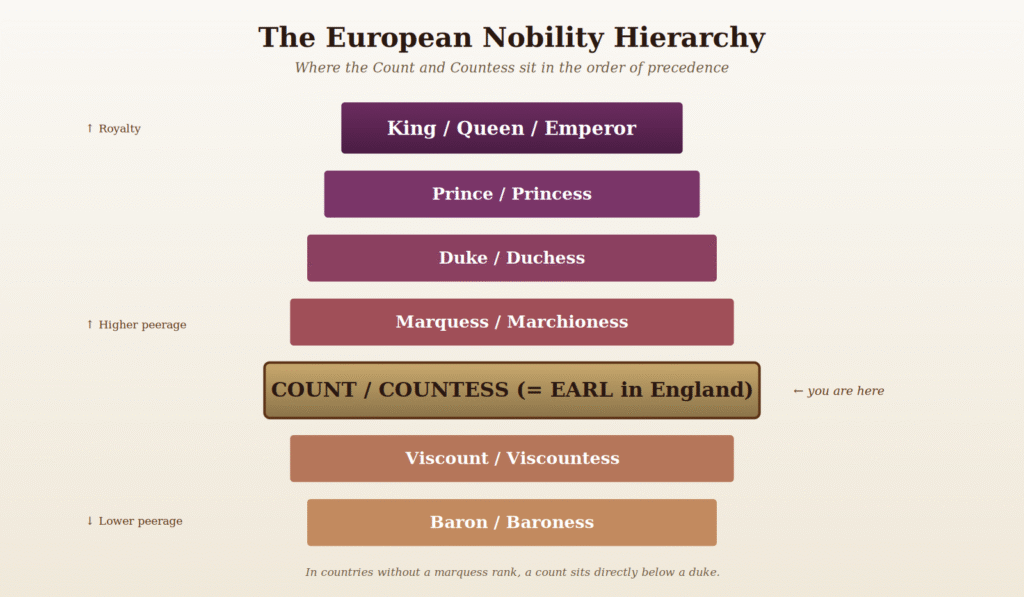
Where the count and countess sit in the European order of precedence — middle of the pack, but with a long history.
Most articles that try to explain what a count is fall into one of two traps. They either reduce the answer to a single line — “a count is a noble below a marquess and above a viscount” — and call it done, or they sprawl into 5,000 words of medieval administrative history that nobody reads to the end. The truth sits somewhere in the middle. The title carries 1,500 years of meaning behind a deceptively simple word, and getting it right matters if you write fiction set in a noble court, study European history, watch period dramas, or just want to understand why your favourite character is called “the Earl of Grantham” instead of “the Count of Grantham.”
This guide walks through what a count actually is, what the title used to mean, what it means now, why English uses “earl” instead, and how the female form (countess) works as both a courtesy title and an inherited rank. There are real examples, named historical figures, current royal families that still use the title, and an honest look at where the meaningful power went after the medieval period ended.
The Quick Answer: What Is a Count?

A count is a European noble title that ranks below a marquess and above a viscount in the traditional aristocratic hierarchy. The female form is countess. In English-speaking Britain, the equivalent rank is called an earl — but the female form remained “countess” because the feminine of “earl” never developed in the language. So a British earl’s wife is correctly addressed as a countess, never as an “earless” (a word that thankfully doesn’t exist).
That’s the headline. The detail underneath is more interesting.
The word “count” comes from the Latin comes, which literally meant “companion” — specifically a companion or attendant of the Roman emperor. Two thousand years ago, being called comes wasn’t a hereditary title; it was a job description. The man designated comes might be running the imperial finances, commanding a frontier garrison, or supervising the emperor’s private estates. Over the next millennium, the word travelled with Roman administrative ideas as they spread across Europe, picked up local flavour in each kingdom it landed in, and ended up as the noble title we recognise today.
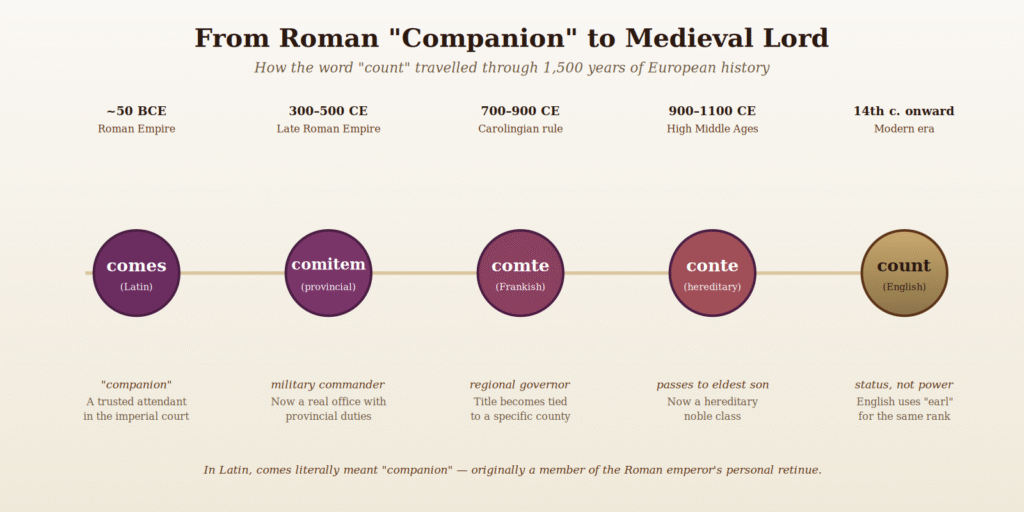
The fifteen-hundred-year journey from Roman attendant to medieval lord.
Where the Count Sits in the Order of Precedence
In the standard European peerage, the order from highest to lowest looks like this:
- King or Queen (or Emperor / Empress)
- Prince or Princess
- Duke or Duchess
- Marquess or Marchioness — sometimes Marquis / Marquise in French-influenced contexts
- Count or Countess — or Earl / Countess in England
- Viscount or Viscountess
- Baron or Baroness
That puts a count right in the middle. Above most of the landed gentry but well below royalty — and crucially, several rungs below a duke, which is the rank people often confuse with count.
There’s a wrinkle worth knowing. In countries that never developed the rank of marquess (Sweden, parts of Eastern Europe, and most of the medieval Italian peninsula at different points), a count sat directly below a duke. In countries that developed marquess later as a separate rank — England, France after 1385 — the count slipped down one position. So when you read a 12th-century chronicle and a 17th-century chronicle from the same kingdom, the count’s place in the hierarchy may have moved without the title itself changing.
In post-1809 Sweden, only the head of a comital family kept the title “count.” The rest of the family used what was effectively the equivalent of “Mr.” or “Ms.” — a striking departure from how most other European nobilities worked, where the comital style passed to all children.
Count vs Earl: Why English Has a Different Word
This is the question that confuses readers more than any other, and the answer is shorter than people expect: count and earl are functionally the same rank. They aren’t two different titles. They are two different words for the same thing, used in different countries because of accidents of language.
England already had its own word — “earl” — when the Normans arrived in 1066. The word comes from the Old English eorl, meaning “warrior” or “man of high rank,” and it predates the Norman Conquest by several hundred years. Under the Anglo-Saxon kings, an earl (or ealdorman in even older usage) was a regional governor — a man who administered a shire on the king’s behalf. The role was a near-perfect functional match for what the Continental word comes had come to describe.
When William the Conqueror reorganised English government, he could have replaced “earl” with the French comte. He didn’t. The word “earl” was deeply embedded in the Anglo-Saxon legal and political vocabulary, and replacing it would have caused unnecessary confusion in a country that was already adjusting to French-speaking rulers. So earl stayed.
The female form is the giveaway that the two ranks are equivalent. English never developed a feminine of “earl” — there’s no “earless” or “earlette,” and the awkward sound of those constructions probably explains why. Instead, when an earl’s wife needed a title, English borrowed the French “countess” wholesale. So a British peer can be called both “the Earl of Devon” and his wife “the Countess of Devon” without anyone batting an eye, even though linguistically the two words come from completely different roots.
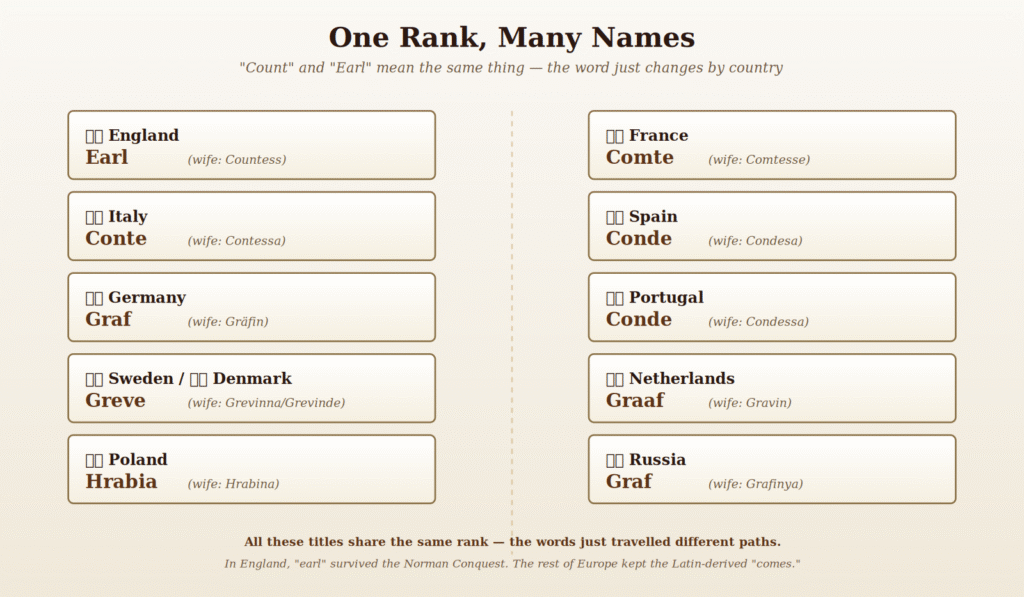
The same noble rank, expressed in nine different European languages.
As of September 2025, England has 191 male earls and four countesses (women holding the title in their own right) — figures the Peerage of England’s records confirm. That four-vs-191 imbalance reflects English peerage law’s strong male-line preference, not any intrinsic feature of the rank.
How Someone Became a Count (and How They Mostly Don’t Anymore)
Historically, there were three paths to the title.
Inheritance
This was the dominant route. In most of Europe, the title passed from a count to his eldest son under the principle of primogeniture. Younger sons sometimes received a courtesy title (“X dei conti di Y” in Italian usage, meaning “X of the counts of Y”), but they didn’t inherit the rank itself. In Italy, certain comital titles allowed all sons to be called contini — “little counts” — though they didn’t inherit the senior title. Daughters generally couldn’t inherit unless the title was specifically created with female-line succession allowed, which was uncommon.
Royal grant
Monarchs created new counts as rewards. A successful general, a financier who bailed out the crown, a politically valuable supporter — all were potential recipients of a comital grant. The practice was at its peak in the medieval and early modern periods. Most European royal courts maintained workshops that produced the elaborate letters patent that conferred a comital title, sometimes with a small estate attached, sometimes purely as an honorific. New comital creations effectively stopped in most European monarchies during the late 19th and 20th centuries — Britain has not granted a new hereditary earldom outside the royal family in decades, and the last marquessate was created in 1936.
Marriage
A woman who married a count automatically became a countess in most jurisdictions. This was a courtesy attachment to her husband’s title, not a rank she held independently — if the marriage ended (through death or, later, divorce), she might keep the title as “the Dowager Countess of Place” or lose it, depending on local custom. Marriage couldn’t make a man a count by reverse — a man who married a countess regnant remained whatever rank he’d held before, though their children would inherit the title.
The fourth path, in a sense, was buying it. In several Italian states until the formal abolition of feudalism in the early 19th century, the purchaser of land designated as a feudal estate was automatically ennobled by the seat — buying the right kind of estate made you a count. Wikipedia’s article on the count title notes that in Italy this practice continued until 1812 in some regions. It’s a useful reminder that the medieval and early modern nobility was less of a closed caste than later mythologised, particularly at the lower comital end.
What a Count Actually Did (Back When the Job Came With Work)
In the early Middle Ages, a count was a regional governor. Charlemagne’s empire — and the Frankish kingdoms that followed it — was divided into administrative units called counties (comitatus), each one run by a count answerable to the king. The job was demanding.
A count’s responsibilities included collecting taxes for the crown, raising soldiers when the king issued a summons (the host), judging legal disputes among the count’s subjects, maintaining roads and bridges within the county, supervising local fortifications, and keeping order generally. In return the count drew income from the county’s lands, taxes, and tolls — a kind of medieval revenue-share arrangement. He was meant to be a working official, not a decorative title-holder.
As feudalism developed and centralised royal power weakened, the role drifted in two directions. It became more autonomous — counts started passing the title to their sons rather than waiting for the king’s reappointment, and over generations the county effectively became a private possession of the count’s family rather than a delegation from the crown. And it became more powerful in some cases, less in others. By the 12th century in France, the Counts of Flanders, Toulouse, and Champagne were effectively independent rulers who treated with kings as something close to equals. The Count of Flanders was sometimes informally called the “archcount” because the wealth and effective sovereignty of his territory put him in a class of his own.
The reassertion of central royal authority — under the French Capetian kings, during the Spanish Reconquista, and especially during the absolutist monarchies of the 17th and 18th centuries — gradually stripped counts of their administrative powers. By the time Louis XIV consolidated French royal authority at Versailles, being a count meant having a lineage and a coat of arms, not running anything. The job was over. The status remained.
Famous Counts and Countesses Through History
Some specific cases help anchor what the title actually looked like in practice.
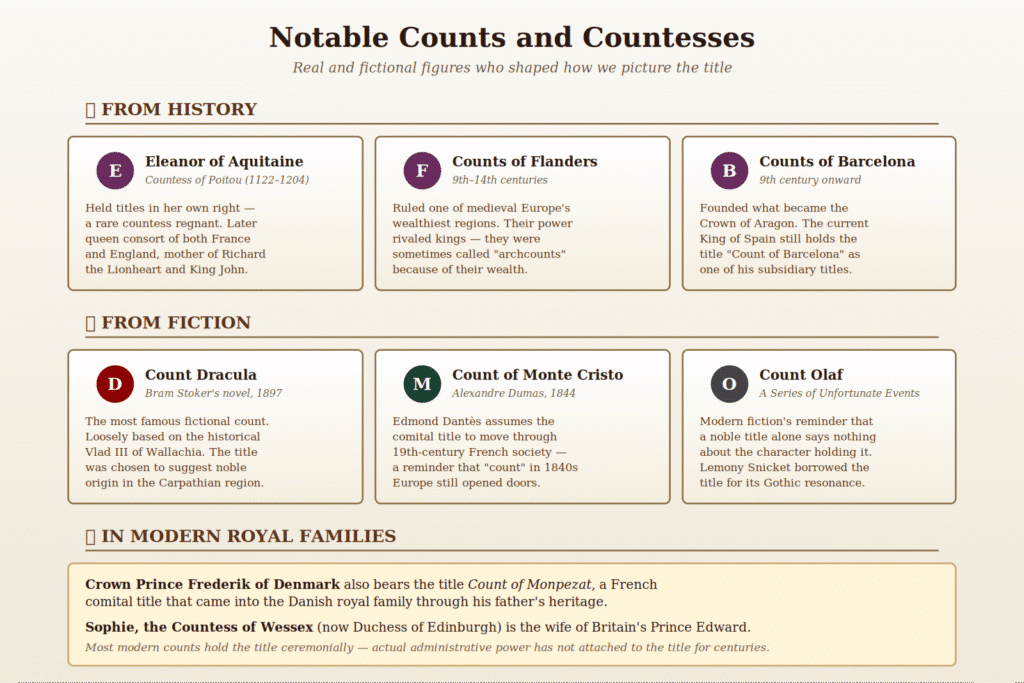
Real and fictional comital figures who shaped how we picture the title today.
Eleanor of Aquitaine (c. 1122–1204)
Eleanor was a countess regnant — a woman who held comital titles in her own right rather than through marriage — and she’s the textbook case for what that meant in practice. Before she became queen consort of first France and then England, she inherited the Duchy of Aquitaine and the County of Poitou from her father in 1137. As ruling countess of Poitou, she had the same legal authority a male count would have had: revenue collection, justice administration, military summons. Her case is usually cited as evidence that medieval women could exercise real political power when their family’s succession arrangements allowed it. Her marriages to Louis VII of France and Henry II of England came after she’d already inherited the comital lands, not the other way around.
The Counts of Flanders
The Counts of Flanders ruled what became one of the wealthiest economic regions of medieval Europe — the cloth-trade heartland of what is now Belgium and northern France. Their wealth was so substantial, and their political position so independent, that the title sometimes carried unofficial honorifics like “archcount.” Flanders was originally a French peerage (a comté-pairie under the French crown), but in 1299 it was confiscated by France, returned in 1303, and then absorbed in stages into the wider European political map. The historic county dissolved as a political entity by the late 15th century, but the title “Count of Flanders” survived in Belgian royal usage as a subsidiary title — Prince Philippe of Belgium held it before becoming king in 2013.
Count Dracula
The most famous fictional count, courtesy of Bram Stoker’s 1897 novel, deserves attention because the choice of title was deliberate. Stoker could have made his vampire a duke, a baron, or simply a lord. He chose count specifically because the title evoked Eastern European nobility, carried gothic resonance from earlier vampire literature, and signalled enough status to put the character in elite social circles without making him obviously royal. The historical figure Stoker drew loose inspiration from — Vlad III of Wallachia — was a voivode (a Slavic military rank), not a count. The transformation is pure fiction.
The Count of Monte Cristo
Alexandre Dumas’s 1844 novel built its plot machinery on the social mobility implied by the comital title. Edmond Dantès, the unjustly imprisoned sailor at the heart of the book, can transform himself into the Count of Monte Cristo because the title still opened social doors in 1840s European society — fictionally so, but realistically reflective of the actual era. The novel works as a revenge fantasy precisely because the title gives Dantès access he otherwise wouldn’t have. By the time the novel was written, comital titles in France had been subject to multiple revolutionary upheavals, but the social cachet hadn’t completely faded.
Crown Prince Frederik of Denmark
Now reigning as King Frederik X (since January 2024), the Danish king also bears the title Count of Monpezat — a French comital style that came into the Danish royal family through his father, Prince Henrik, born Henri de Laborde de Monpezat. The Monpezat title is a lovely example of how comital titles still travel through royal families even when the substantive power attached to them disappeared centuries ago. Frederik holds it as a subsidiary title; his primary title is King of Denmark.
How to Address a Count or Countess
Formal address depends on the country, the context, and how much the holder cares about it. Most modern title-holders prefer first names or professional roles in everyday life. Formal styling is reserved for ceremonies, official correspondence, and certain conservative social settings.
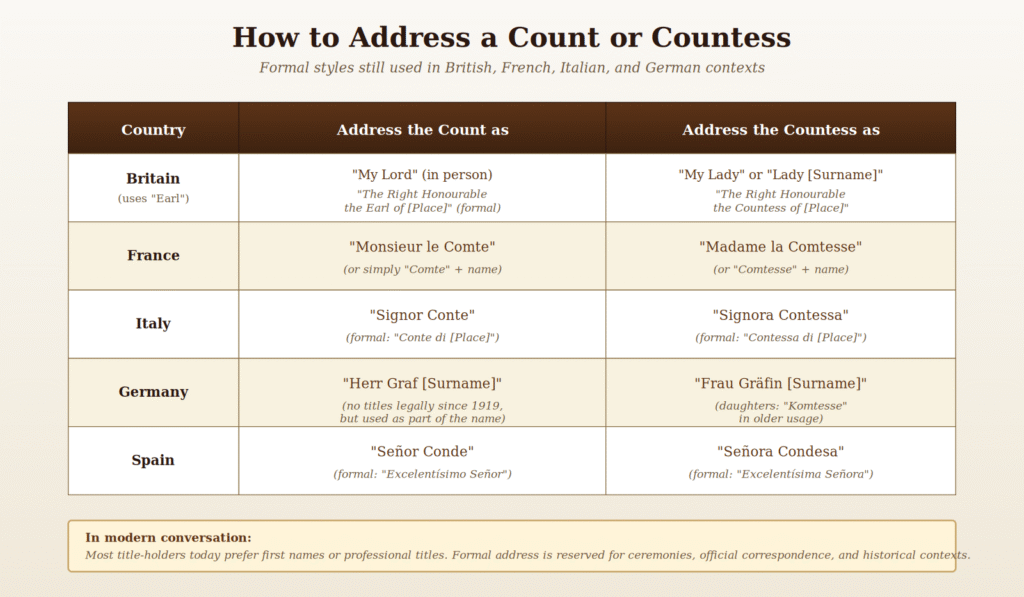
Formal address styles still recognised in the principal European traditions.
A few notes the chart can’t fully capture:
In Britain, the address “My Lord” is used in person to address an earl. The full formal style, used in writing or in ceremonies, is “The Right Honourable the Earl of [Place].” The same earl might also be called “Lord [Surname]” — Debrett’s, the British etiquette authority, allows the less formal style in non-ceremonial contexts. An earl’s wife is “My Lady,” “Lady [Surname],” or formally “The Right Honourable the Countess of [Place].”
In Germany, this gets legally complicated. The Weimar Constitution of 1919 abolished the legal recognition of noble titles, converting them into part of the family surname. So the modern Graf von Bismarck isn’t legally a count — he’s a person whose surname happens to include the words “Graf von.” He can be addressed as “Herr Graf von Bismarck” socially, but his passport and tax documents treat “Graf von Bismarck” as a name, not a rank.
In Austria, the situation is even stricter — the 1919 Adelsaufhebungsgesetz (Law on the Abolition of Nobility) banned the use of noble titles entirely in legal and official contexts. Austrian counts can use their family names but cannot legally style themselves as Graf or Gräfin in any official capacity. Social use persists informally, but it has no legal standing.
In France, formal address survives mainly in social and ceremonial contexts. The French nobility lost its legal privileges in the Revolution and was abolished outright on 19 June 1790. Titles were briefly restored under Napoleon’s empire and again under the Bourbon Restoration before being reduced to a purely social custom. Modern French comtes use their titles informally and in social registers, but the French state doesn’t recognise nobility as having any legal effect.
The Countess: How the Female Form Actually Works
There’s a tendency in casual reference materials to treat the countess as a passive title — the wife of a count and not much more. The reality is more interesting and worth a section of its own.
A woman could become a countess in two distinct ways. The first, and by far the most common, was marriage: a woman who married a count automatically held the rank of countess as a courtesy title. This is the model most familiar to readers of period drama. Lady Mary Crawley in Downton Abbey would have become a countess if she’d married a count, in the same way Cora Crawley became Countess of Grantham by marrying the Earl of Grantham. The title is real but contingent — it depends on the marriage.
The second way was much rarer and far more powerful: inheritance in her own right. A countess regnant or suo jure countess (the Latin phrase means “in her own right”) held the title independently, with the same legal powers as a male count. She could administer the county, collect its revenues, command its soldiers when the king summoned them, and pass the title to her own heirs. Whether this was possible depended on the specific letters patent that created the title. Some titles were created “to heirs male of the body,” meaning only male-line descendants could inherit. Others were created “to heirs general,” allowing female-line inheritance when no male heir existed. A few were specifically created to allow female inheritance from the start.
Eleanor of Aquitaine, mentioned earlier, is one of the most famous examples — but the practice wasn’t unique to her. Across medieval Europe, several dozen comital titles passed through women at one point or another. The Countess of Boulogne, the Countess of Champagne (when no male heir survived), and various Italian comital titles all admitted female inheritance under specific circumstances.
In modern Britain, the picture has been complicated and slowly improved. Most English earldoms still descend only through the male line — which is why there are 191 earls and just four countesses in their own right as of late 2025. There has been ongoing debate about whether the rule of male-only succession should be reformed, but no general legislative change has gone through. Some specific peerages (the Cornwallis barony, for example) have had their letters patent altered to allow female succession through Acts of Parliament, but this is done on a case-by-case basis.
Count vs Duke vs Baron: At a Glance
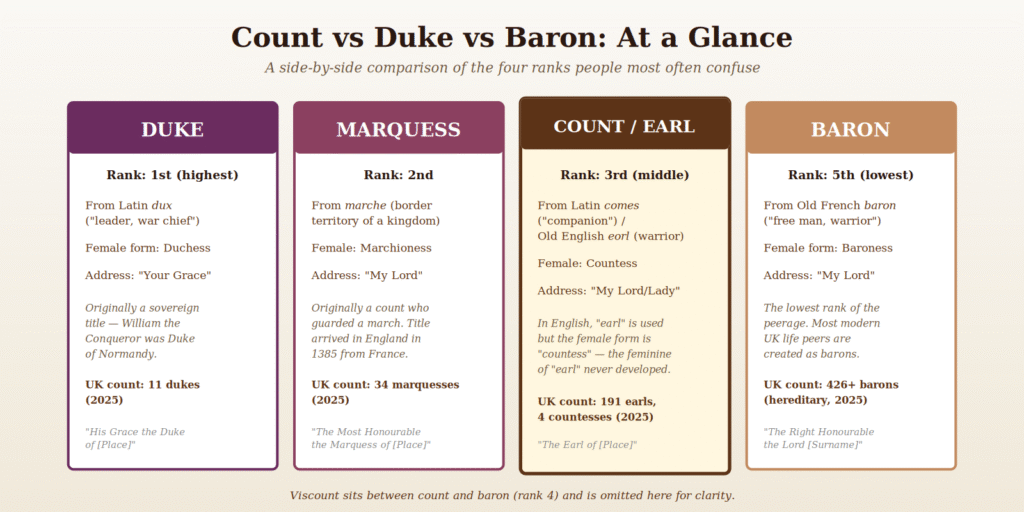
The four ranks people most often confuse, side by side.
The most common confusion isn’t between count and earl — it’s between count, duke, and baron. People know they’re all noble titles. They’re less sure which is highest and what the differences mean in practice. Three quick principles cover most of the confusion.
First: a duke significantly outranks a count. Two full ranks separate them in the standard European hierarchy. Originally, a duke was a sovereign or near-sovereign ruler — the Duke of Normandy was a near-equal of the King of France in the 11th century. A count was always a delegated authority, never a sovereign in his own right except in unusual circumstances. The status gap was real and meaningful.
Second: a baron is the lowest rank of the peerage. Two ranks below a count. Originally, a baron was simply a man who held land directly from the king — “baron” comes from an Old French word meaning “free man.” The title was the entry-level form of nobility, granted to the lowest tier of vassals who owed military service directly to the crown.
Third: in modern UK practice, almost all new peerages are baronies, not earldoms or anything higher. The Life Peerages Act of 1958 specifically created the framework for life peerages — peerages that don’t pass to descendants — and these are essentially always baronies. So when a contemporary British prime minister appoints someone to the House of Lords, they become a baron or baroness, not a count or duke. The higher titles have effectively become inactive in terms of new creations.
Where the Title Stands Today
Most functioning European monarchies still recognise existing comital titles as a class, even though almost none of them create new ones.
Britain, as discussed, has 191 earls and 34 marquesses still using their hereditary titles. The House of Lords reform of 1999 stripped most hereditary peers of their automatic right to sit in the upper chamber of Parliament — only 92 elected hereditaries remained — but the titles themselves continue. Belgium, Spain, the Netherlands, Sweden, Denmark, and Luxembourg all maintain their existing comital nobility on a similar basis. Belgium has even continued making rare new comital creations as honors, though the practice is unusual.
Italy abolished its nobility legally with the Constitution of 1948. Article XIV of the transitional provisions explicitly stripped noble titles of legal recognition, though families can still use the words informally. The Vatican continues to grant papal counts and marchionesses, though the practice has been discouraged since Pope John XXIII (papacy 1958–1963) and is now largely vestigial.
The big question that comes up in modern coverage of nobility — “can someone buy the title of count?” — has a short answer: not in any way that’s legally meaningful. There are companies that sell “lordship of the manor” titles in Britain (which are real but don’t make you a peer), Sealand-style micronation titles (which aren’t recognised by any sovereign government), and various scammy arrangements that promise comital styles for a few thousand pounds. None of these confer actual nobility, and several of them have been used in fraud cases. A real count is created by an existing sovereign, and existing sovereigns don’t sell the title.
Frequently Asked Questions
Is a count higher than a baron?
Yes. The order from highest to lowest is duke, marquess, count (or earl), viscount, baron. A count outranks a baron by two positions in the standard European peerage.
Is a count the same as a duke?
No. A duke ranks two positions higher than a count in most European systems. A duke originally signified sovereign or near-sovereign status; a count was always a delegated authority. The two ranks have never been equivalent except in very specific local contexts.
Can someone buy the title of count today?
Not legitimately. No functioning monarchy sells hereditary noble titles. Companies that offer “lordship” or “count” titles are selling either ceremonial souvenirs (which are legal but not actual nobility) or outright scams (which sometimes get prosecuted). If you want to be addressed as Lord or Lady at a Renaissance fair, that’s available. Real noble titles aren’t for sale.
What is the difference between a count and a count palatine?
A count palatine was a count whose authority derived directly from a royal household — usually exercising delegated royal powers within a palatinate. The Counts Palatine of the Rhine, in the Holy Roman Empire, were among the most powerful nobles in medieval Germany and held the right to participate in elections of the emperor. Most counts palatine had wider powers than ordinary counts.
Is countess the same as duchess?
No. A countess is the wife of a count or earl (or a woman holding the rank in her own right). A duchess is the wife of a duke (or a woman holding the rank in her own right). A duchess outranks a countess by two positions, mirroring the duke-count gap.
Why does English use earl when the rest of Europe uses count?
Because the word “earl” already existed in Old English — meaning “warrior” or “man of high rank” — and was deeply embedded in pre-Norman English administration. After the Norman Conquest, the new French-speaking ruling class saw no reason to replace the perfectly functional native word. The female form “countess” was borrowed from French because English never developed a feminine of “earl.”
How many counts and countesses exist today in the UK?
As of September 2025, the Peerage of England’s records show 191 male earls and 4 countesses (women holding the title in their own right). Including all five UK peerages combined (England, Scotland, Great Britain, Ireland, and the United Kingdom), the total earl count is somewhat higher — around 200 in active use — though precise numbers fluctuate as titles go extinct or get revived.
What’s the female version of an earl?
Countess. English never developed a true feminine form of “earl,” so the word countess was borrowed wholesale from French. The wife of an earl is therefore correctly addressed as a countess, not as an “earless.”
The Short Version
A count is a middle-rank European noble title — below a marquess, above a viscount — with roots in the Latin word for “companion.” It started as a real administrative job, a regional governor with tax-collecting and military responsibilities. Over the medieval period, the title became hereditary, then became increasingly ceremonial as central monarchies absorbed the count’s actual powers, and eventually settled into its modern form as a marker of social rank with no governmental function attached.
In England, the same rank is called an earl — but the wife of an earl is still a countess, because English never developed a feminine of “earl.” That linguistic accident is the single most common source of confusion when people first encounter European nobility, and now you’ve got it sorted.
If you’ve made it this far, you understand the title better than most people who think they understand it. The next time someone in a period drama is introduced as “the Count of” or “the Earl of” something, you’ll know exactly where they sit in the room.

The Teck Hustlers editor oversees publishing, fact-checking and corrections across Teck Hustlers, making sure every story on technology, business, finance and gaming meets our editorial standards before it goes live.