We review and update this article regularly as new information becomes available.
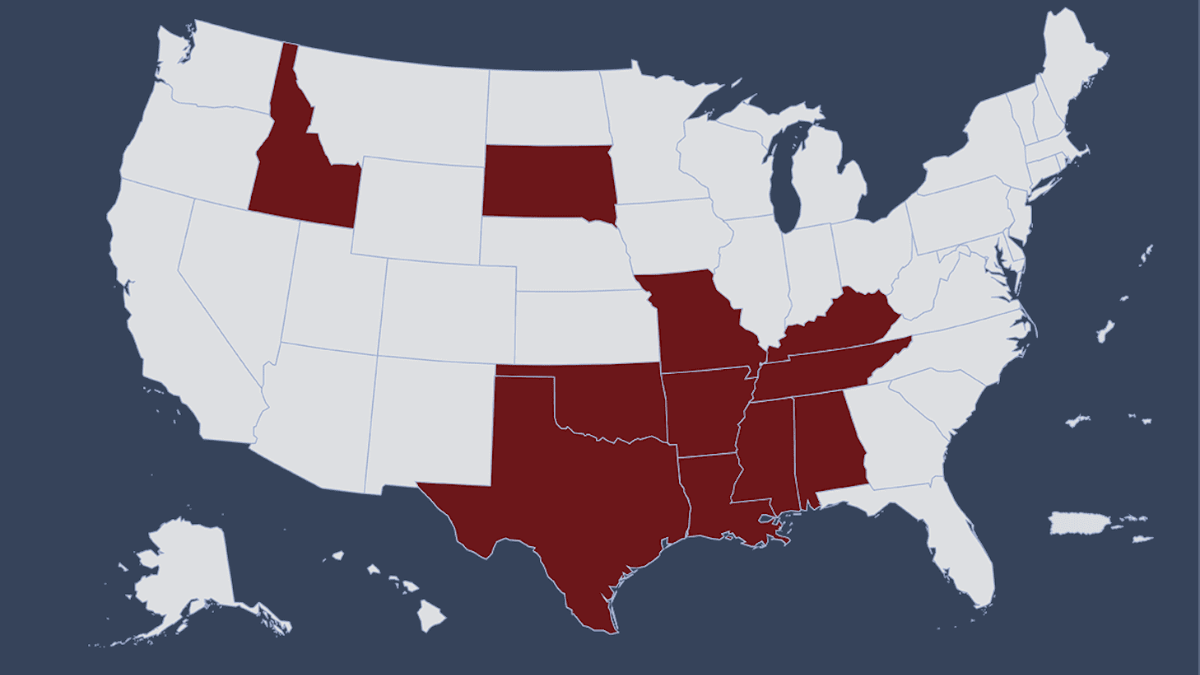
Abortion is banned at all stages of pregnancy in 13 US states. It is not illegal nationwide, and it is not restricted in most states. This guide lists the 13 states with total bans, the states that allow abortion only in early pregnancy, a full reference table for all 50 states and the District of Columbia, and the practical questions that the raw legal status does not answer on its own.
TL;DR: Thirteen states ban abortion throughout pregnancy: Alabama, Arkansas, Idaho, Indiana, Kentucky, Louisiana, Mississippi, North Dakota, Oklahoma, South Dakota, Tennessee, Texas and West Virginia. Four more limit it to roughly six weeks, which functions as a near ban. The rest allow it up to viability or set no gestational limit at all. Three states have abortion measures on their November 2026 ballots, so the map could move again within weeks. Confirm any specific state against a live tracker before relying on it.
The Short Answer: 13 States Ban Abortion Entirely
Two organisations track this state by state and update continuously: the Guttmacher Institute and KFF. As of October 2026 both list the same 13 states as banning abortion throughout pregnancy.
| State | Status |
|---|---|
| Alabama | Banned throughout pregnancy |
| Arkansas | Banned throughout pregnancy |
| Idaho | Banned throughout pregnancy |
| Indiana | Banned throughout pregnancy |
| Kentucky | Banned throughout pregnancy |
| Louisiana | Banned throughout pregnancy |
| Mississippi | Banned throughout pregnancy |
| North Dakota | Banned throughout pregnancy |
| Oklahoma | Banned throughout pregnancy |
| South Dakota | Banned throughout pregnancy |
| Tennessee | Banned throughout pregnancy |
| Texas | Banned throughout pregnancy |
| West Virginia | Banned throughout pregnancy |
Each of these has some form of exception, and none of them is as broad as the word “exception” suggests. More on that below.
What a Six Week Limit Actually Means
Four states allow abortion only up to about six weeks: Florida, Georgia, Iowa and South Carolina. On paper that sounds like a limit rather than a ban. In practice it rarely works out that way.
Gestational age is counted from the first day of the last menstrual period, not from conception. Six weeks from that date is roughly two weeks after a missed period. Someone with an irregular cycle may not suspect a pregnancy by then at all. Even when a test comes back positive early, the remaining window has to cover a confirmed test, finding a clinic that is still operating in the state, any state-mandated counselling visit, any waiting period, and an available appointment.
That is why clinicians and researchers usually describe six week limits as functionally close to a ban rather than a mid-range restriction. It is also why the practical difference between Florida and Alabama is smaller than the legal difference suggests.
Full Reference Table: All 50 States and DC
The table below reflects the Guttmacher Institute’s categorisation as of its September 2026 update. Weeks are counted from the last menstrual period.
| Jurisdiction | Limit |
|---|---|
| Alabama | Banned throughout pregnancy |
| Alaska | No gestational limit |
| Arizona | Viability |
| Arkansas | Banned throughout pregnancy |
| California | Viability |
| Colorado | No gestational limit |
| Connecticut | Viability |
| Delaware | Viability |
| District of Columbia | No gestational limit |
| Florida | 6 weeks |
| Georgia | 6 weeks |
| Hawaii | Viability |
| Idaho | Banned throughout pregnancy |
| Illinois | Viability |
| Indiana | Banned throughout pregnancy |
| Iowa | 6 weeks |
| Kansas | 22 weeks |
| Kentucky | Banned throughout pregnancy |
| Louisiana | Banned throughout pregnancy |
| Maine | Viability |
| Maryland | No gestational limit |
| Massachusetts | 24 weeks |
| Michigan | No gestational limit |
| Minnesota | No gestational limit |
| Mississippi | Banned throughout pregnancy |
| Missouri | Viability (vote on November 3, 2026 could change this) |
| Montana | Viability |
| Nebraska | 12 weeks |
| Nevada | 24 weeks |
| New Hampshire | 24 weeks |
| New Jersey | No gestational limit |
| New Mexico | No gestational limit |
| New York | 24 weeks |
| North Carolina | 12 weeks |
| North Dakota | Banned throughout pregnancy |
| Ohio | 20 weeks |
| Oklahoma | Banned throughout pregnancy |
| Oregon | No gestational limit |
| Pennsylvania | 24 weeks |
| Rhode Island | Viability |
| South Carolina | 6 weeks |
| South Dakota | Banned throughout pregnancy |
| Tennessee | Banned throughout pregnancy |
| Texas | Banned throughout pregnancy |
| Utah | 18 weeks |
| Vermont | No gestational limit |
| Virginia | Third trimester |
| Washington | Viability |
| West Virginia | Banned throughout pregnancy |
| Wisconsin | 20 weeks |
| Wyoming | Viability, currently in litigation |
Two points about reading this table. First, “viability” is not a fixed number of weeks. Courts have never defined it precisely, and it is usually described as somewhere around 24 weeks depending on the individual pregnancy. Second, a legal limit tells you what the state permits, not what is actually available. Several states with permissive laws have very few clinics, and a state can be legally open while being practically hard to reach.
How the Exceptions Are Actually Written
Almost every total ban includes an exception for the life of the pregnant person. Some add exceptions for serious risk to physical health, for rape or incest, or for fatal fetal conditions. The category names are similar across states. The statutory language is not.
The differences matter more than they look. Some states require the risk to be imminent. Some require a second physician to sign off. Some require a police report for a rape exception, within a set time limit. Some attach criminal penalties to a physician who misjudges whether an exception applied, which shifts the decision from a medical question to a legal one.
This is the part clinicians in banned states have objected to most publicly. Several have said the wording is unclear enough that they delay intervening in a deteriorating pregnancy until the situation is unambiguous, because the personal legal exposure for getting it wrong is severe. KFF maintains a state by state breakdown of the exact exception text, which is the right place to look rather than any summary.
The exception landscape shifted slightly in August 2026, when a federal court in Idaho expanded that state’s exceptions to include threats to the physical and general health of the pregnant person. A later court order narrowed that ruling to the physician who brought the case, so it does not apply statewide, according to Guttmacher.
Medication Abortion, Telehealth and Shield Laws
Most abortions in the United States are now medication abortions, using a two-drug regimen of mifepristone and misoprostol. That has moved the legal fight away from clinic buildings and toward pills and prescriptions.
A number of states have passed what are known as shield laws. These are written to protect clinicians in the state who provide care to patients elsewhere, including by telehealth, from out-of-state investigations, subpoenas and licence actions. Maryland, Massachusetts, New York and California are among the states with such laws.
The most closely watched fight over pills is Louisiana’s federal challenge to the FDA’s 2023 decision allowing telehealth prescribing and mail dispensing of mifepristone. Louisiana’s attorney general and an individual plaintiff sued in October 2025. On May 1, 2026 a three-judge Fifth Circuit panel sided with Louisiana and reinstated the in-person dispensing requirement nationwide. The drug’s manufacturers, Danco Laboratories and GenBioPro, sought emergency relief, and the Supreme Court issued a 7-2 stay on May 14, 2026, keeping telehealth and mail access in place while the case proceeds through the lower courts. The Fifth Circuit heard arguments on September 9, 2026, where the panel questioned whether Louisiana has legal standing to bring the case; no ruling had been issued as of early October.
Separately, the FDA is conducting its own safety review of mifepristone and told the court it expects to complete it by March 2027. And in early October 2026, Louisiana, Alabama and Arkansas filed two new lawsuits arguing that out-of-state providers are creating a “public nuisance” by mailing abortion drugs into their states, and directly challenging the shield laws of New York, California and Massachusetts. Legal experts described it as the first direct challenge to shield laws by states with bans. Guttmacher estimates that about 91,000 abortions in 2025 were provided by telehealth to patients in states with total bans, up from 74,000 in 2024. As with everything else in this area, the rules that apply depend on the state and on litigation that has not concluded.
Travel Between States
Travelling to a state where abortion is legal is the route many people in banned states now take, and the volume of interstate travel for care rose sharply after 2022. No state currently bans a resident from leaving to obtain legal care elsewhere, though proposals to restrict travel or to target people who help arrange it have been introduced in several legislatures.
The practical barriers are money and time rather than a legal prohibition: the cost of travel, time off work, childcare, and the compressed timeline created by gestational limits at both ends. Abortion funds exist in most states to help with those costs, and clinics in destination states can usually point to the relevant one.
Who These Laws Target
This is widely misunderstood. Most state bans are written to penalise the person providing the abortion, not the pregnant person. Penalties for providers range up to serious felony charges and loss of medical licence. Many statutes explicitly exclude the pregnant person from prosecution.
That is not the same as saying no individual has ever faced charges. People have been prosecuted in connection with self-managed abortion under other statutes, such as those covering the handling of human remains or child neglect, in states with and without bans. The point is that the ban itself usually is not the mechanism, which is why legal advice on an individual situation has to come from an attorney in that state rather than from a general summary.
Why the Map Keeps Changing
Roe v. Wade, decided in 1973, established a federal right to abortion. The Supreme Court overturned it in June 2022 in Dobbs v. Jackson Women’s Health Organization. That ruling did not ban abortion. It returned the question to the states, which is why there is no single national answer now.
Since then the picture has moved in both directions, repeatedly. Ballot measures have expanded or protected access in several states, including Arizona, where a 2024 measure replaced an earlier 15-week limit, and Missouri, where voters approved a constitutional amendment.
Wyoming is the clearest illustration of how unstable this can be. The Wyoming Supreme Court struck down the state’s abortion bans in January 2026, ruling 4-1 that they violated the state constitution’s protections for individual health care decisions. The legislature passed a narrower heartbeat measure in March 2026, and a district judge blocked its enforcement in April 2026 while the challenge continues. In June 2026 a different judge struck down three other 2025 Wyoming laws, including a mandatory ultrasound and 48-hour waiting period, on the same constitutional ground. Guttmacher currently categorises Wyoming as allowing abortion to viability while the litigation runs. This is exactly why any article on this topic has a shelf life measured in months.
Three more votes on November 3, 2026 could move the map again. Missouri voters face a second measure also called Amendment 3: a “yes” vote would repeal the 2024 amendment that protects abortion through viability and replace it with a ban allowing exceptions for medical emergencies, fetal anomalies, and rape or incest within the first 12 weeks, while also barring certain gender-transition procedures for minors. A “no” vote keeps the 2024 amendment in place. Virginia voters will decide whether to add abortion rights to the state constitution, and Nevada voters will vote a second time on a constitutional amendment protecting abortion through viability, which citizen-initiated amendments in Nevada must win twice to take effect.
How to Check a Specific State
For any decision that matters, use a source that updates continuously rather than an article. Three are reliable:
- Guttmacher Institute state policy tracker, which timestamps its last update on the page.
- KFF abortion dashboard, which also tracks how exceptions are worded per state.
- Center for Reproductive Rights state map, which covers pending litigation.
Frequently Asked Questions
Is abortion illegal in the United States?
No. There is no national ban. It is banned throughout pregnancy in 13 states and restricted to early pregnancy in several more. The rest allow it up to viability or set no gestational limit.
How many states ban abortion completely?
Thirteen, as of October 2026: Alabama, Arkansas, Idaho, Indiana, Kentucky, Louisiana, Mississippi, North Dakota, Oklahoma, South Dakota, Tennessee, Texas and West Virginia.
Is abortion illegal in California, New York or Illinois?
No. All three allow abortion up to or beyond viability. They are often miscategorised in older lists written before or shortly after the Dobbs decision.
Does the 1973 Roe v. Wade ruling still apply?
No. It was overturned in June 2022 by Dobbs v. Jackson Women’s Health Organization. Any article describing Roe as current law is out of date.
Do banned states still allow exceptions?
Most do, typically for the life of the pregnant person, and in some states for rape, incest or fatal fetal conditions. The wording varies significantly and several conditions attach, such as second-physician sign-off or reporting requirements. KFF publishes the exact text per state.
Can I be prosecuted for travelling to another state?
No state currently bans travel for legal care elsewhere, though bills targeting travel or those who help arrange it have been introduced in several legislatures. The real obstacles are cost and timing.
Is it legal to receive abortion pills by mail?
At the federal level, yes for now: the Supreme Court’s May 14, 2026 stay keeps telehealth prescribing and mail dispensing of mifepristone in place nationwide while Louisiana’s challenge to the FDA’s 2023 rule proceeds. But state law still matters, and in October 2026 Louisiana, Alabama and Arkansas filed new lawsuits aimed at pill shipments from out-of-state providers, while the Fifth Circuit has yet to rule on whether Louisiana has standing. Check the current position rather than relying on a general answer.
Bottom Line
The accurate answer to this question is 13 states, not 50 and not zero. Four more restrict abortion to roughly six weeks, which works as a near ban given how gestational age is counted. Everywhere else it remains legal, in most cases up to viability, and in ten jurisdictions with no gestational limit at all.
Two things are worth carrying away beyond the list. The legal status of a state is not the same as whether care is reachable there, and the exception written into a ban is not the same as the exception a clinician can safely act on. Because rulings and ballot measures keep moving individual states, treat this as a snapshot and confirm anything that matters against one of the trackers above. Missouri, Nevada and Virginia all have abortion measures on their November 2026 ballots, so the count itself may not hold through the year.
This article is general information, not legal or medical advice. Laws in this area change frequently and exceptions are state specific. For a decision affecting you, consult a licensed clinician or an attorney in the relevant state.

The Teck Hustlers editor oversees publishing, fact-checking and corrections across Teck Hustlers, making sure every story on technology, business, finance and gaming meets our editorial standards before it goes live.